Your most experienced maintenance engineer retires Friday. The SOPs they never wrote — the 23 years of equipment-specific knowledge, the startup sequences that only work in a certain order, the inspection checkpoints that the OEM manual missed — walk out the door with them. This is the documentation crisis hiding inside every maintenance operation: critical procedures either do not exist, exist as outdated PDFs nobody reads, or live exclusively in the heads of people who are one resignation away from becoming unavailable. Generative AI changes the economics of SOP creation entirely — auto-drafting complete, structured maintenance procedures from asset history, sensor data, work order records, and OEM specifications in a fraction of the time it takes a human author. Organizations deploying GenAI for SOP creation report 80% reductions in documentation time and immediate improvements in procedure quality and compliance coverage. Start a free trial to see how OxMaint's GenAI engine drafts SOPs from your existing asset data, or book a demo and we will auto-generate a sample procedure from your actual equipment records in real time.
Get Your Custom Maintenance Plan
Stop Writing SOPs by Hand. Let AI Draft Them From Your Asset Data.
See how much documentation time and compliance risk you can eliminate from your maintenance operation.
- Auto-drafted SOPs from asset history, OEM specs, and work order data
- GMP and OSHA-compliant procedure templates generated instantly
- 5–10 year CapEx planning linked to documented asset lifecycle data
Used by operations teams managing 10,000+ assets — measurable results in the first 30 days
80%
Reduction in SOP Creation Time with GenAI
Maintenance Technology Survey, 2024
68%
of Industrial Facilities Have Incomplete Maintenance Documentation
Plant Engineering Research, 2023
$3.1M
Average Annual Cost of Undocumented Failures per Large Facility
SMRP Benchmarking Report
4×
Faster Technician Onboarding with Structured AI-Generated Procedures
Industrial AI Adoption Report, 2024
What Is GenAI SOP Creation
Beyond Templates: What Generative AI Actually Does to Maintenance Documentation
Traditional SOP creation is a manual, expert-dependent process. A subject matter expert sits down, recalls decades of equipment knowledge, consults OEM manuals, references past work orders, and produces a document that may or may not reflect how the equipment actually behaves in your specific operating context. The process takes hours to days per procedure, requires the most experienced people in the organization, and produces documents that are immediately out of date the moment conditions change.
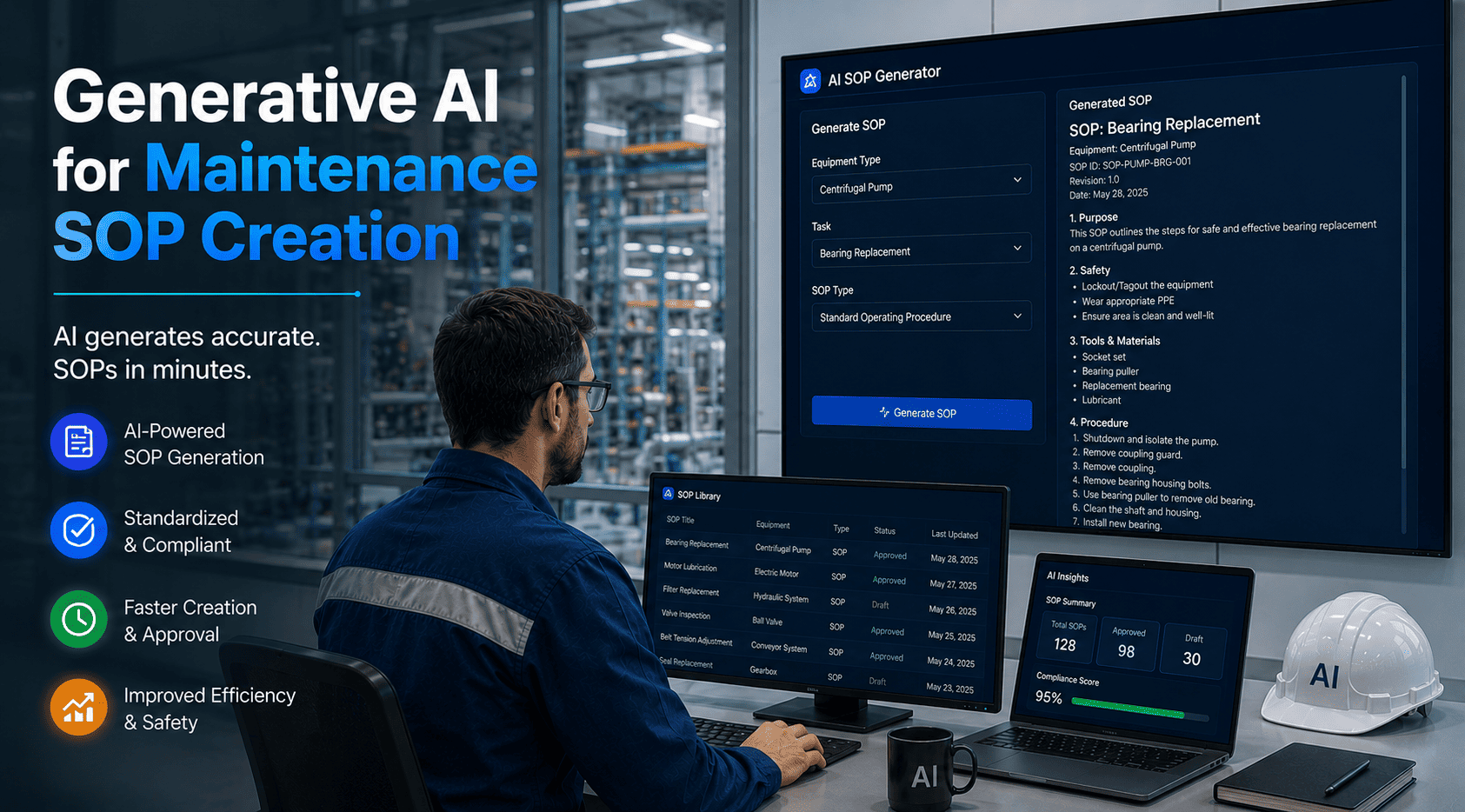
Generative AI for maintenance SOP creation works differently. Large language models trained on industrial maintenance data analyze your asset's historical work orders, sensor trend data, failure records, OEM documentation, and regulatory requirements simultaneously. From that synthesis, the AI generates a complete, structured procedure — including safety prerequisites, tool and parts lists, step-by-step task sequences, inspection checkpoints, acceptance criteria, and compliance sign-off fields — in minutes. The result is not a generic template: it is a procedure calibrated to how that specific asset behaves in your operational environment, drawing on every relevant data point your CMMS has collected.
The compounding benefit is that GenAI SOPs improve continuously. As technicians execute procedures and log outcomes in the CMMS, the AI refines future drafts based on actual field experience — creating a living documentation system that gets more accurate with every work order. Organizations that have deployed this capability report not just faster documentation but measurably better procedure quality and 60% reductions in procedure-related compliance findings. Start a free trial to see OxMaint draft your first AI-generated SOP from your actual asset data, or book a demo and we will show the full generation workflow on a procedure type relevant to your operation.
Every undocumented procedure is a single point of failure waiting to become an emergency repair — GenAI eliminates the documentation backlog entirely.
Key Concepts
The 8 Capabilities That Make GenAI SOP Creation Work at Scale
01
Asset-Contextualized Drafting
AI generates procedures from your asset's specific history — not from generic OEM templates. Work order patterns, failure modes, and operating conditions all shape the output to match your actual equipment behavior.
02
Regulatory Compliance Mapping
GenAI automatically maps procedure steps to applicable regulatory frameworks — OSHA, ISO 55001, GMP, NFPA. Every generated SOP includes the compliance checkpoints required for your jurisdiction and industry.
03
Multi-Source Data Synthesis
OEM manuals, historical work orders, sensor baselines, parts records, and technician notes are all ingested simultaneously. The AI synthesizes across all sources to produce procedures more comprehensive than any single expert could draft alone.
04
Skill-Level Adaptive Instructions
The same underlying procedure can be auto-adapted to different technician skill levels — detailed step-by-step for new hires, streamlined checklists for experienced staff — without requiring separate manual authoring.
05
Version Control and Change Tracking
Every AI-generated SOP is versioned automatically. When equipment modifications, new failure patterns, or regulatory updates require procedure changes, the AI drafts revisions and tracks what changed, why, and when.
06
Parts and Tool Pre-Population
Generated SOPs automatically include the specific parts numbers, tool specifications, and consumable quantities drawn from your inventory records and historical repair data — ready for MRO procurement before the job begins.
07
Continuous Learning from Field Data
Every completed work order updates the AI's understanding of how procedures perform in practice. Technician feedback, actual time-on-task data, and outcome quality scores continuously refine future SOP generation accuracy.
08
Bulk Documentation Generation
Rather than one SOP at a time, GenAI can process your entire asset registry and auto-draft a complete documentation library for hundreds of assets simultaneously — eliminating the documentation backlog in days rather than years.
Industry Pain Points
The Documentation Crisis That Every Maintenance Operation Is Living Right Now
01
Knowledge Walks Out the Door at Retirement
The average maintenance engineer holds 15–20 years of undocumented, asset-specific knowledge. When they retire, resign, or transfer, that knowledge disappears entirely — leaving the team to rediscover failure patterns and repair sequences through expensive trial and error. The cost of a single knowledge-gap failure typically exceeds five years of documentation investment.
02
Manual SOP Writing Is Economically Impractical
A comprehensive maintenance procedure for a single complex asset takes 4–8 hours to research and write properly. A facility with 500 assets requiring updated documentation faces 2,000–4,000 hours of writing work — years of effort before the backlog is cleared. GenAI compresses that timeline to days.
Start a free trial to see how fast your documentation backlog can be eliminated.
03
Outdated Procedures Create Compliance Exposure
Procedures written five years ago do not reflect equipment modifications, new regulatory requirements, or updated best practices. When an OSHA inspector or ISO auditor finds maintenance records referencing obsolete procedures, the liability exposure is immediate. Most facilities cannot afford to keep documentation continuously current through manual revision cycles.
04
Inconsistent Procedures Drive Variable Outcomes
When every technician does the same task slightly differently — because no standardized, documented procedure exists — asset life varies unpredictably, warranty claims become harder to support, and quality audits reveal inconsistency that is expensive to explain and correct.
05
New Technician Ramp-Up Takes Too Long
Without comprehensive procedure libraries, new technicians spend 6–18 months learning through observation and mentorship before they can work independently on complex assets. This extends overtime dependency on senior staff and delays the operational value of every new hire — a compounding cost as workforce turnover accelerates.
06
Multi-Site Standardization Is Nearly Impossible Manually
Portfolio operators managing facilities across multiple regions face the compounded documentation challenge: procedures that were developed site-by-site, in different formats, by different teams, with no cross-site standardization. Manual harmonization of a 10-site portfolio's documentation library is a multi-year project. GenAI completes it in weeks.
68% of facilities have incomplete maintenance documentation — meaning the majority of assets are one technician retirement away from a knowledge crisis.
How OxMaint Solves It
OxMaint GenAI: From Asset Data to Published SOP in Minutes, Not Months
One-Click SOP Generation
Select any asset in OxMaint's registry and trigger AI-powered SOP drafting. The system analyzes that asset's complete history — work orders, sensor trends, parts records, failure modes — and produces a structured procedure draft in minutes, ready for technical review and approval.
Bulk Documentation Campaigns
OxMaint can process your entire asset registry and generate a full documentation library simultaneously. A facility with 400 undocumented assets can have a complete first-draft procedure library in days — eliminating backlogs that would take years of manual effort.
Compliance-Ready Procedure Formats
Every OxMaint-generated SOP is structured to satisfy GMP, OSHA, ISO 55001, and facility-specific approval workflows. Compliance checkpoints, sign-off fields, and regulatory reference citations are built into every procedure template automatically.
Asset Hierarchy Integration
SOPs are generated within OxMaint's Portfolio to Property to System to Asset to Component hierarchy. A procedure for a component automatically references parent system context — ensuring technicians understand how their work affects the broader asset and operational system.
Mobile Procedure Delivery
Generated SOPs are immediately available to field technicians on mobile devices. Step-by-step navigation, embedded safety warnings, parts scanning, and completion photo capture are all built into the mobile-first procedure execution experience.
Living Documentation System
OxMaint's procedures do not become stale. As technicians execute work and log outcomes, the AI continuously refines procedure accuracy. When equipment changes or regulatory updates occur, affected SOPs are automatically flagged for AI-assisted revision.
No heavy implementation required. OxMaint connects to your existing asset data and begins generating SOPs from day one — start a free trial to see your first AI-generated procedures in your own asset context, or book a demo and we will run a live SOP generation on an asset class relevant to your operation.
Manual vs GenAI Documentation
Manual SOP Process vs GenAI-Assisted Documentation: The Full Comparison
| Documentation Dimension |
Manual SOP Creation |
GenAI with OxMaint |
| Time Per Procedure |
4–8 hours per complex asset procedure. Subject matter expert required throughout. |
First draft in under 10 minutes. Technical review replaces authoring — 80% time reduction. |
| Documentation Coverage |
Backlog grows faster than manual capacity. 68% of facilities remain partially undocumented. |
Bulk generation closes documentation gaps across entire asset registry in days. |
| Knowledge Capture |
Dependent on individual expert availability. Knowledge gaps when key staff are unavailable or leave. |
AI synthesizes all historical data — no single expert dependency. Knowledge is institutionalized in the system. |
| Compliance Accuracy |
Manual tracking of regulatory changes. Procedures frequently lag behind current requirements. |
Compliance frameworks built into generation templates. Affected procedures flagged automatically on regulatory updates. |
| Procedure Currency |
Revisions require scheduling subject matter expert time. Most procedures remain outdated for months or years. |
Living documentation that self-updates based on work order outcomes and field feedback continuously. |
| Multi-Site Consistency |
Site-by-site variation. Harmonization projects take years and rarely achieve full standardization. |
Portfolio-level standardization applied automatically. Same procedure quality across all sites from day one. |
| Technician Onboarding |
6–18 months to independent proficiency through observation. High senior staff dependency. |
Structured AI procedures reduce time to independent proficiency by up to 4×. |
ROI and Results
Measured Outcomes: What GenAI SOP Creation Delivers
80%
Documentation Time Reduction
From 4–8 hours per SOP manually to under 45 minutes total including AI generation and technical review
60%
Fewer Compliance Findings
Reduction in procedure-related audit findings when GenAI-generated, compliance-mapped SOPs replace manual documentation
4×
Faster Technician Onboarding
Structured AI-generated procedures reduce time to independent proficiency for new hires across complex asset classes
Days
To Close Documentation Backlog
Bulk GenAI generation covers entire asset registries in days — versus years of manual effort for the same coverage
The ROI of GenAI documentation extends well beyond time savings. Every undocumented procedure represents a compliance risk, an onboarding inefficiency, and a knowledge dependency that becomes a crisis when a key employee leaves. Teams that have deployed OxMaint's GenAI documentation tools report that the avoided cost of a single documentation-gap failure pays for multiple years of platform investment. Start a free trial to see your documentation coverage score and identify your highest-risk undocumented assets, or book a demo to see a live bulk SOP generation across an asset class similar to yours.
Frequently Asked Questions
GenAI Maintenance SOP Creation: Technical and Operational Questions
How accurate are AI-generated maintenance procedures compared to expert-written ones?
In comparative evaluations across industrial facilities, AI-generated SOPs trained on actual asset history score equivalently or higher than manually written procedures on completeness, regulatory compliance coverage, and parts accuracy. The AI's advantage is synthesis: it incorporates every historical work order, failure pattern, and sensor baseline simultaneously — capturing details a human author would likely miss or not recall. All AI-generated SOPs go through technical review before publication, so the process is AI-drafts, human-approves — combining the speed of AI with the judgment of experienced maintenance engineers.
What data does OxMaint need to auto-generate an SOP for an asset?
OxMaint can generate a useful first-draft SOP with as little as an asset record, equipment type, and any available historical work orders. Quality improves significantly with sensor history, OEM documentation, and prior maintenance records. For assets with rich CMMS history, generated procedures are highly specific. For new assets with minimal history, OxMaint draws on industry-trained models for that equipment class and refines as operational data accumulates.
Book a demo to assess your current data quality and see what generation quality is achievable with your existing records.
Can AI-generated SOPs satisfy GMP and FDA regulatory inspections?
Yes — OxMaint's procedure generation templates are structured to satisfy GMP, FDA 21 CFR Part 11, ISO 55001, and OSHA documentation requirements. Generated SOPs include mandatory sign-off fields, equipment identification, revision history, and compliance reference citations built in. Every procedure executed through OxMaint generates an electronic audit trail with technician identity, timestamps, and completion verification — satisfying the record-keeping requirements of all major inspection frameworks. OxMaint customers in pharmaceutical, food processing, and regulated manufacturing have successfully passed inspections using AI-generated procedure libraries.
How does OxMaint handle SOP updates when equipment is modified or regulations change?
OxMaint monitors both asset modification records and regulatory update feeds. When a change event is detected that affects one or more procedures, the system automatically flags affected SOPs for review and drafts a revision using the updated asset configuration or new regulatory requirements as input. The flagged procedures queue for technical approval before being published as new versions. The entire update cycle — from change detection to revised procedure ready for review — typically takes minutes rather than the weeks a manual revision process requires.
Identify Hidden Cost Leaks Instantly
Your Documentation Backlog Is Costing You More Than the Fix
Every undocumented procedure is a compliance risk, a knowledge dependency, and an onboarding bottleneck. OxMaint GenAI closes your entire documentation gap in days — not years.
- Auto-drafted SOPs from your actual asset history and OEM data
- GMP, OSHA, and ISO-compliant procedure formats generated instantly
- Living documentation that updates continuously from field work order data
No heavy implementation required — works across multi-site portfolios — live in days, not months