Early Drift Detection on Cooking Lines: How SPC Prevents Defects and Downtime in Food Manufacturing

Connect with Industry Experts, Share Solutions, and Grow Together!

Join Discussion Forum
early-drift-detection-cooking-line

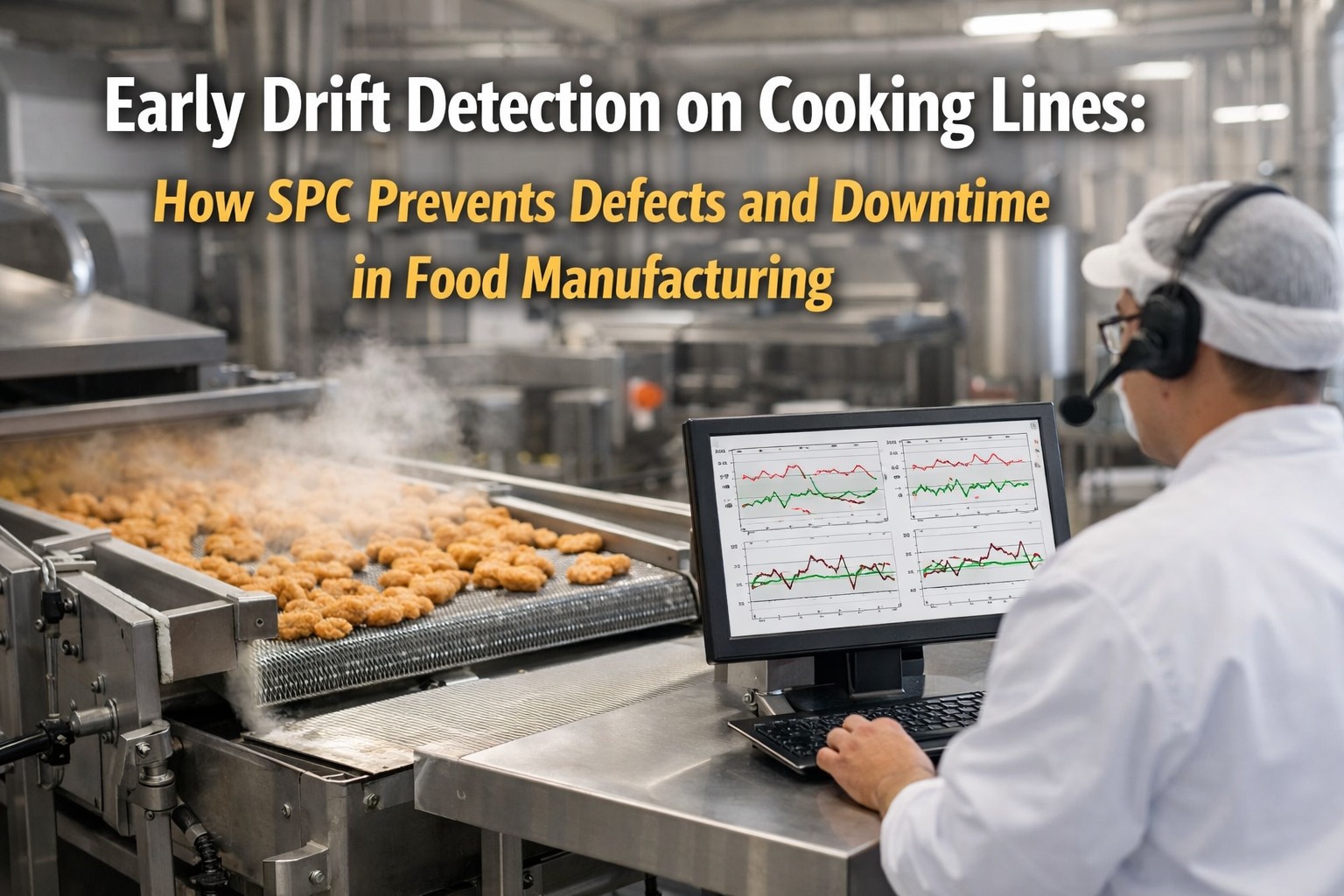
Your cooking line has been running for six hours. The temperature readout shows 165°F—exactly where it should be. But underneath that number, something is shifting. The actual temperature has been climbing by 0.3°F every 20 minutes, so gradually that no one notices. By hour eight, you're cooking at 173°F. Products are overcooked. Texture is wrong. And the batch fails quality inspection. This is process drift—and it costs food manufacturers millions every year in waste, rework and recalls. Statistical Process Control (SPC) exists to catch these invisible shifts before they become visible failures.

The Invisible Threat on Your Cooking Line
Process drift happens gradually—too slowly for operators to notice, but fast enough to ruin entire batches


UCL Target LCL
Drift Detected: +2.4°F from baseline
75%
of food manufacturers still use paper-based quality systems
$30K
average hourly cost of unplanned downtime in food processing
47
days of advance warning with continuous SPC monitoring

What Is Process Drift and Why Does It Matter?

Process drift occurs when a manufacturing parameter gradually moves away from its target value over time. On cooking lines, this typically involves temperature, pressure, conveyor speed, or cooking duration. Unlike sudden equipment failures that trigger immediate alarms, drift is insidious—each individual reading appears acceptable, but the cumulative movement pushes your process outside acceptable limits. A 2024 industry analysis found that 82% of food manufacturers experienced unplanned downtime in the past three years, with process-related issues accounting for a significant portion of these incidents. Food manufacturers who start their free SPC monitoring trial today catch drift patterns weeks before they cause product failures, transforming reactive firefighting into proactive quality management.

How SPC Control Charts Reveal Hidden Drift
Real-time visualization catches what human observation misses
UCL Target LCL OUT OF CONTROL
Normal Variation
Drift Warning (Rule Violation)
Out of Control
SPC run rules detect drift patterns 6-8 data points before crossing control limits—giving operators time to intervene before product is affected.

The Warning Signs SPC Catches Before Failure

Statistical Process Control doesn't wait for a parameter to breach its limits. Instead, it uses run rules—patterns in consecutive data points that indicate a process is drifting even while individual readings remain acceptable. When seven consecutive points trend in the same direction, or when data clusters unusually close to the centerline, SPC flags these as early warnings. Food processing facilities using modern SPC systems report catching potential issues an average of 47 days before they would have caused failures under traditional monitoring approaches.

SPC Alert Stages: From Normal to Critical
01
Normal Operation
Random variation within control limits. No action needed.
Monitoring
02
Early Warning
Run rule triggered: 7+ points trending in one direction.
Investigate
03
Intervention Required
Multiple rule violations or approaching control limits.
Correct Now
04
Out of Control
Data point outside control limits. Process stopped.
Hold Product

The difference between catching drift at the warning stage versus the critical stage can mean the difference between a minor adjustment and a full production stoppage. When a cooking line's temperature begins trending upward, early SPC detection allows operators to recalibrate sensors, adjust heating elements, or modify process parameters—all during normal operation. Waiting until the process goes out of control often means stopping production, quarantining product, and conducting root cause investigations. Facilities looking to understand how this early detection integrates with maintenance workflows can book a live demo to see drift detection in action.

The Financial Case for Early Drift Detection

The economics of drift detection are compelling. According to Siemens' 2024 True Cost of Downtime report, unplanned downtime costs the world's 500 largest companies $1.4 trillion annually—representing 11% of total revenues. For food manufacturers specifically, the per-hour cost of a cooking line stoppage ranges from $500 to $30,000 depending on facility size and product value. But downtime is only part of the equation. Product that drifts out of specification often passes through production before the issue is detected, creating batches that must be reworked, reprocessed or scrapped entirely.

Cost Impact: Drift Detection Timing
The earlier you catch drift, the less it costs
Early Detection (SPC)
$200 - $500
Minor calibration adjustment
No production stoppage
Zero product waste
Documented for compliance
Response Time: Minutes
VS
Late Detection (Traditional)
$15K - $50K+
Emergency maintenance call
2-8 hours production stoppage
Batch quarantine/disposal
Root cause investigation
Response Time: Hours to Days
$10M Average direct cost of a single food recall
23% of food recalls exceed $30 million in total costs
See How SPC Integrates With Your Cooking Line
Watch live drift detection in action. Our demo shows the complete workflow from sensor data to automated work orders—customized for food manufacturing operations.

Critical Parameters to Monitor on Cooking Lines

Effective drift detection requires monitoring the parameters that most directly impact food safety and quality. On cooking lines, these typically fall into four categories: thermal parameters (cooking temperature, holding temperature, cooling rate), temporal parameters (cooking duration, dwell time, cycle time), mechanical parameters (conveyor speed, agitation rate, pressure), and environmental parameters (humidity, ambient temperature). Each parameter has its own natural variation, and SPC helps distinguish between normal fluctuation and genuine process drift.

Key Cooking Line Parameters for SPC Monitoring
Core Temperature
Food Safety Critical
Must reach minimum internal temperature for pathogen kill step. Drift can result in undercooked product.
Cook Time
Quality Critical
Insufficient time affects safety; excess time degrades texture and nutritional value.
Belt Speed
Process Critical
Drift affects cook time and throughput. Often the root cause of temperature-related issues.
Oven Humidity
Quality Critical
Affects moisture retention and product weight. Steam injection systems prone to drift.

Most food manufacturers target a Process Performance Index (Ppk) of 1.33, meaning 99.99% of all product falls within specification limits. Achieving this level of consistency requires continuous monitoring and rapid response to drift conditions. Operations teams ready to evaluate their current monitoring capabilities against industry benchmarks can sign up free to access SPC process tracking tools to identify gaps in their quality control systems.

Expert Perspective: Making SPC Actionable

Industry Insight

The food industry is highly regulated, with strict standards for product quality and safety. SPC is essential for food manufacturers to comply with these regulations and maintain consumer trust. The facilities succeeding with drift detection share one common trait: they've integrated SPC alerts directly into their maintenance management systems, turning data into automated action.

From Reactive to Predictive
Traditional quality checks catch problems after they happen. SPC run rules identify drift patterns while product is still within spec, enabling intervention before defects occur.
CMMS Integration Is Essential
When SPC detects drift, automatic work order generation ensures the right technician gets notified immediately. No manual interpretation, no forgotten alerts, no emergency scrambles.
Documentation for Compliance
FDA, USDA, and FSMA requirements demand proof that preventive controls are consistently implemented. SPC provides the continuous documentation that auditors expect.

The resistance to adopting SPC among food manufacturers often stems from insufficient statistical knowledge and lack of management commitment. However, modern SPC platforms have eliminated the need for specialized analysts—AI-driven systems automatically classify anomalies and translate sensor data into plain-language alerts that any operator can understand. Teams exploring how to implement SPC without specialized training can schedule a free consultation with our food manufacturing specialists.

Implementation: Your First 30 Days

Implementing drift detection on cooking lines doesn't require overhauling your entire operation. The most successful implementations start with identifying critical control points—the specific parameters where drift creates the greatest risk to food safety or product quality. For most cooking lines, this means temperature and time at the cook step, temperature during holding, and cooling rate during product transition. Modern wireless sensors install quickly, connect to cloud platforms automatically, and begin establishing baseline patterns immediately.

The SPC software market for food manufacturing reached $1.26 billion in 2024 and is projected to grow at 8.2% annually through 2033, driven by increasing regulatory scrutiny and the rising need for quality assurance. This growth reflects a fundamental shift in how food manufacturers approach quality: from inspection-based methods that catch problems after they happen to monitoring-based methods that prevent problems from occurring. Facilities ready to begin this transition can get started with a free 14-day trial to see how SPC integrates with their existing processes.

Stop Drift Before It Stops Your Line
Join food manufacturers using OXmaint to catch process drift weeks before it affects product quality. See how SPC alerts integrate with automated maintenance workflows.

Frequently Asked Questions

What exactly is process drift on a cooking line?
Process drift occurs when a manufacturing parameter gradually moves away from its target value over time. On cooking lines, this typically involves temperature, cooking time, conveyor speed, or humidity. Unlike sudden equipment failures, drift is gradual—each individual reading may appear acceptable, but the cumulative movement pushes your process toward or beyond specification limits. For example, a heating element slowly degrading might cause oven temperature to climb by 0.5°F per hour—imperceptible in any single reading but significant over an 8-hour shift.
How does SPC detect drift before it causes problems?
SPC uses run rules—statistical patterns that indicate a process is drifting even while individual data points remain within control limits. Common run rules include seven consecutive points trending in the same direction, two of three consecutive points in the outer third of the control zone, or unusual clustering near the centerline. These patterns typically appear 6-8 data points before a process would actually breach its control limits, giving operators time to investigate and correct the issue before product is affected.
What cooking line parameters should be monitored with SPC?
The most critical parameters for SPC monitoring on cooking lines include core product temperature (the food safety kill step), cooking duration, oven or cooking zone temperature, conveyor belt speed, and humidity levels in steam-injection systems. Secondary parameters might include cooling rates, holding temperatures, and equipment-specific measurements like pressure in retort systems or oil temperature in fryers. The specific parameters depend on your products and cooking methods, but temperature and time at the critical control point should always be priorities.
Do I need statistical expertise to use SPC software?
No. While traditional SPC required trained analysts to interpret control charts and frequency spectra, modern platforms use AI algorithms to automatically detect anomalies and translate them into plain-language alerts. Operators receive notifications specifying what parameter is drifting, how severe the drift is, and what action is recommended—without needing to understand the underlying statistics. The system handles the math; your team handles the response.
How quickly can we implement SPC on existing cooking lines?
Most facilities can implement basic SPC monitoring within 30 days. Modern wireless sensors install in minutes without requiring production downtime. The system begins collecting data immediately and establishes baseline patterns within the first week of operation. Full integration with CMMS platforms for automated work order generation typically adds another 1-2 weeks. The key is starting with your most critical control points rather than attempting to monitor everything at once—this approach delivers rapid ROI while building organizational familiarity with SPC concepts.
By Sam Parker

Experience
Oxmaint's
Power

Take a personalized tour with our product expert to see how OXmaint can help you streamline your maintenance operations and minimize downtime.

Book a Tour

Share This Story, Choose Your Platform!

Connect all your field staff and maintenance teams in real time.

Report, track and coordinate repairs. Awesome for asset, equipment & asset repair management.

Schedule a demo or start your free trial right away.

iphone

Get Oxmaint App
Most Affordable Maintenance Management Software

Download Our App