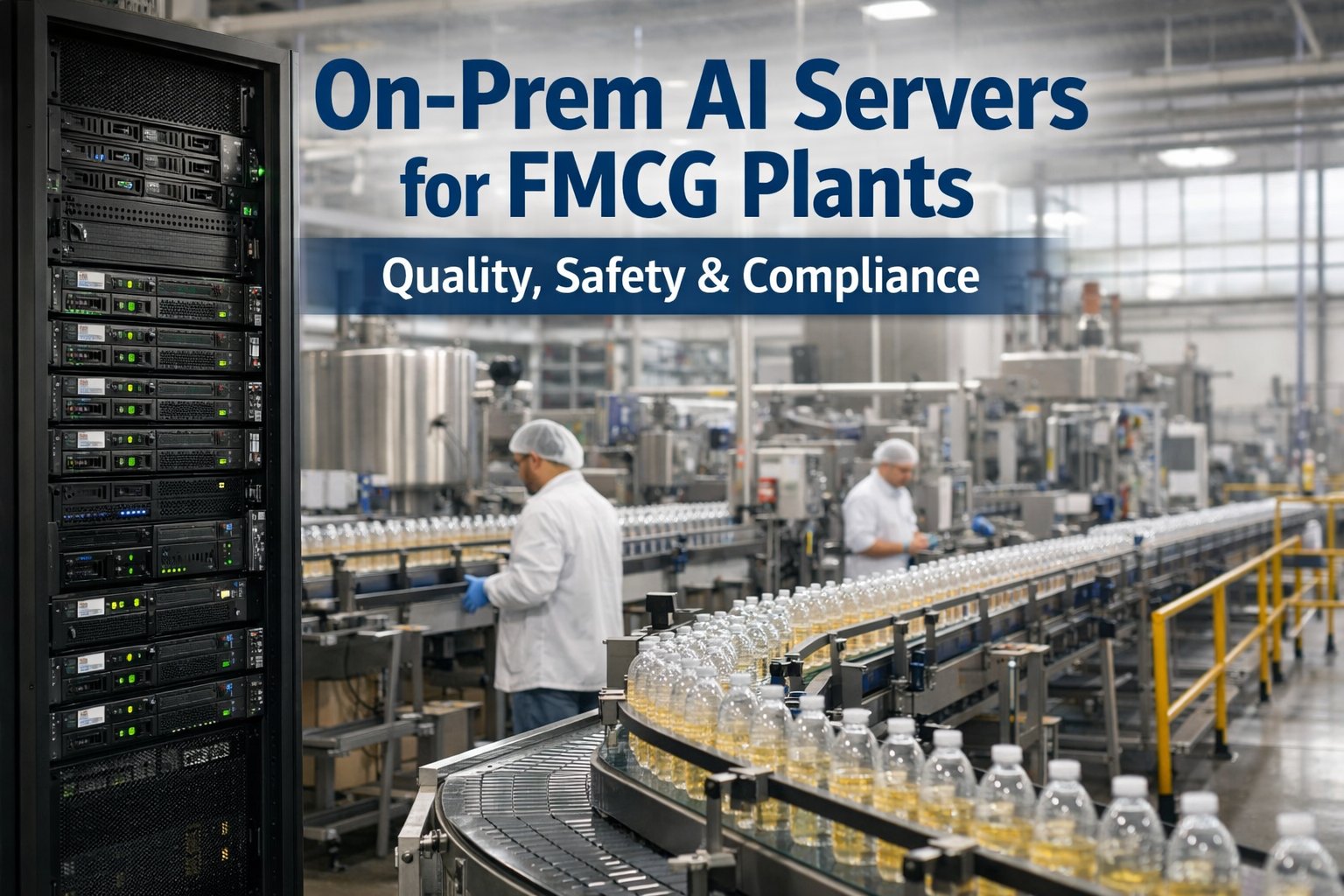
Your production data leaves your plant every 50 milliseconds. Temperature logs, quality images, equipment readings—all streaming to a cloud server hundreds of miles away. When that server experiences latency, your real-time inspection becomes a 3-second delay. When that connection drops, your AI goes blind. And when that data crosses into third-party infrastructure, your proprietary formulations and process parameters become someone else's dataset. On-premise AI servers solve all three problems simultaneously—keeping your intelligence where it belongs: inside your plant, under your control, operating at the speed your production line demands.
$128B
AI server market value in 2024
28.2%
Annual market growth rate (CAGR)
32%
Low-latency AI demand growth
20ms
On-prem response time
The Three Forces Driving On-Prem AI Adoption
Cloud AI revolutionized experimentation. But FMCG production isn't an experiment—it's a continuous operation where milliseconds matter, proprietary data is competitive advantage, and regulatory compliance isn't optional. The shift toward on-premise AI infrastructure reflects a maturing understanding that some workloads simply cannot tolerate the uncertainties of remote processing. Plants that implement integrated AI monitoring systems gain complete control over their quality and safety intelligence without sacrificing speed or security.
Real-Time Processing
Production lines running at 1,000+ units per minute can't wait for cloud round-trips. On-prem AI delivers sub-20ms inference—fast enough to reject defects before they reach packaging.
Data Sovereignty
Proprietary recipes, process parameters, and quality data stay within plant walls. No third-party exposure. No cross-border transfers. Complete control over competitive intelligence.
Regulatory Compliance
FSMA traceability, FDA 21 CFR Part 11, GDPR data residency—on-prem AI simplifies compliance by keeping audit trails and quality records within controlled infrastructure.
Cloud vs. On-Prem: The Real Performance Gap
The cloud vs. edge debate isn't theoretical for FMCG operations—it's measured in rejected batches, missed detections, and compliance gaps. When your vision AI needs to inspect every product on a high-speed line, even a 200-millisecond delay means products have moved past the rejection point. The comparison isn't about which technology is "better"—it's about which architecture fits production-critical workloads.
Swipe to view full comparison
For FMCG plants running continuous operations, network independence isn't a luxury—it's a requirement. When your ISP has an outage, cloud-dependent AI stops working. When latency spikes during peak internet usage, your quality inspection slows down. On-prem AI operates on plant infrastructure, delivering consistent performance regardless of external network conditions. Facilities ready to evaluate how this architecture integrates with maintenance workflows can schedule a consultation to explore implementation options.
Critical Applications: Where On-Prem AI Delivers
On-premise AI isn't just about speed—it's about enabling applications that cloud architecture simply cannot support reliably. Real-time quality inspection, safety monitoring, and predictive maintenance all require the kind of deterministic performance that only local processing can guarantee. When a vision system needs to inspect and reject defective products in milliseconds, the processing must happen at the point of action.
Vision Quality Inspection
AI cameras inspect every product for defects, contamination, and labeling errors at production speed
1,000+
units/min
99.8%
accuracy
Safety Monitoring
Real-time PPE compliance detection, zone intrusion alerts and hazard identification with instant response
50ms
detection
24/7
coverage
Predictive Maintenance
Vibration analysis and equipment health scoring to predict failures before they cause downtime
47
days warning
85%
less downtime
Process Control
Real-time SPC monitoring, drift detection, and automated parameter adjustments for consistency
20-50%
error reduction
Real-time
optimization
Ready to Bring AI Inside Your Plant?
See how on-prem AI integrates with CMMS for real-time quality monitoring, predictive maintenance, and automated compliance tracking.
Expert Perspective: Why Data Sovereignty Matters
Industrial AI is becoming machine-level intelligence, anchored in physical infrastructure where uptime, safety, and proprietary process logic demand local execution. When a misprediction can stop a conveyor, damage equipment, or trigger a safety shutdown, AI must run beside the machines it governs—not in a distant datacenter. OT telemetry, vibration signatures, and process logic represent some of the most sensitive industrial IP.
01
Data Never Leaves
Quality images, process parameters, and production data stay within plant infrastructure with no external network exposure
02
Audit-Ready Records
Complete traceability logs maintained on-site, accessible within the 24-hour FDA response window requirement
03
Operational Continuity
AI continues functioning during internet outages, ensuring production never stops due to connectivity issues
The decision to deploy on-premise AI isn't about rejecting cloud technology—it's about placing compute where security, compliance, and operational criticality demand it. For FMCG plants handling proprietary formulations, FDA-regulated processes, and high-speed production lines, that place is inside the facility. Plants exploring this transition can start with a connected CMMS platform that bridges on-prem AI systems with maintenance workflows, creating unified visibility across quality, safety, and equipment health.
Implementation: Getting Started with On-Prem AI
Deploying on-premise AI doesn't require replacing your entire infrastructure overnight. Modern edge AI systems are designed to integrate with existing plant networks, cameras, and sensors. The key is starting with high-impact applications—typically quality inspection or predictive maintenance—where the latency and data sovereignty benefits deliver immediate, measurable returns. Teams ready to explore implementation can book a technical consultation to discuss infrastructure requirements.
1
Identify high-impact use cases
Audit existing infrastructure
Define data sovereignty requirements
2
Deploy edge AI servers
Configure network isolation
Integrate with plant systems
3
Train models on plant data
Validate detection accuracy
Optimize inference speed
4
Expand to additional lines
Add new AI applications
Integrate CMMS workflows
Take Control of Your Plant Intelligence
Join FMCG leaders using OXmaint to connect on-prem AI systems with maintenance workflows. Real-time quality monitoring, predictive maintenance, and compliance tracking—all under your control.
Frequently Asked Questions
What's the difference between on-prem AI and edge AI?
Edge AI refers to processing that happens close to data sources—on cameras, sensors, or local gateways. On-prem AI is broader, encompassing dedicated servers within your facility that can handle more complex workloads like model training, multi-camera coordination, and historical analysis. Most FMCG implementations use both: edge devices for real-time inference at the production line, connected to on-prem servers for aggregation, analytics, and model management. The common factor is that all processing stays within plant infrastructure rather than traversing external networks.
How much does on-prem AI infrastructure cost compared to cloud?
Initial hardware investment for on-prem AI typically ranges from $50,000-$200,000 depending on scale and complexity, compared to cloud AI which starts lower but accumulates ongoing fees. However, high-volume FMCG operations often find on-prem more economical over 3-5 years—especially when processing thousands of images daily or running 24/7 inference workloads. The break-even point depends on data volume, required latency, and compliance requirements. Plants with strict data sovereignty needs often find on-prem delivers better total cost of ownership regardless of volume.
Can on-prem AI systems still receive model updates?
Yes. On-prem doesn't mean isolated. Modern architectures use secure, scheduled connections to receive model updates, security patches, and algorithm improvements without exposing operational data. Updates can be staged in a test environment, validated against plant-specific conditions, and deployed during maintenance windows. The key difference from cloud AI is that production inference runs locally—the training data and operational telemetry never leave your infrastructure.
What compliance requirements does on-prem AI help address?
On-prem AI simplifies compliance with FDA 21 CFR Part 11 (electronic records), FSMA traceability requirements, GDPR data residency rules, and industry-specific standards like GFSI certification. By keeping quality records, inspection images, and audit trails within controlled infrastructure, you maintain clear chain of custody for all data. When FDA requests traceability records within 24 hours, having that data on-site rather than scattered across cloud services dramatically simplifies response.
How does on-prem AI integrate with existing CMMS and quality systems?
Modern on-prem AI systems are designed with standard integration protocols—REST APIs, OPC-UA, MQTT—that connect to CMMS platforms, quality management systems, and ERP solutions. When the AI detects a quality defect or predicts equipment failure, it automatically generates work orders, logs quality events, and updates relevant systems. This integration is often easier with on-prem than cloud because all systems reside on the same network, eliminating internet dependencies and reducing integration complexity.