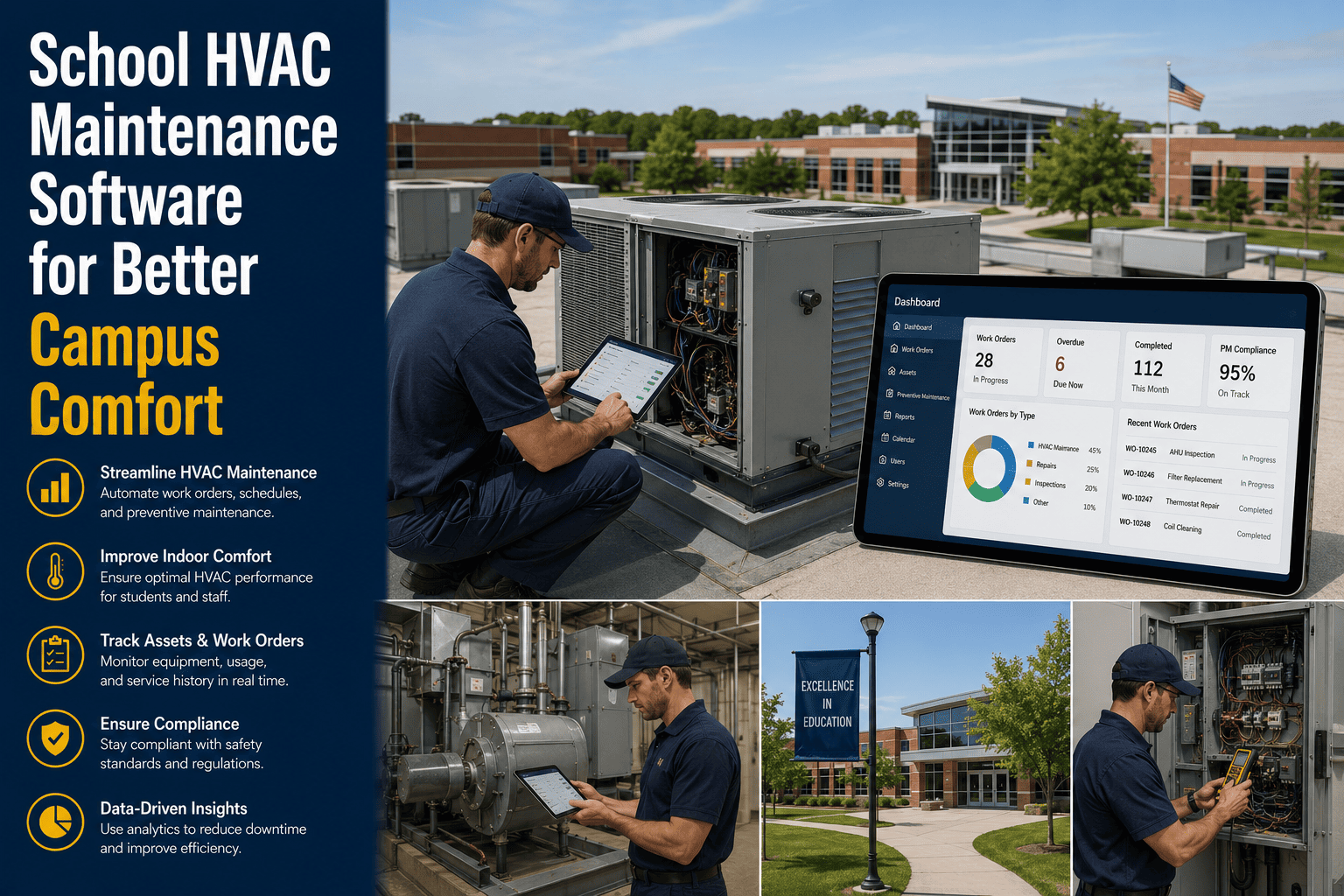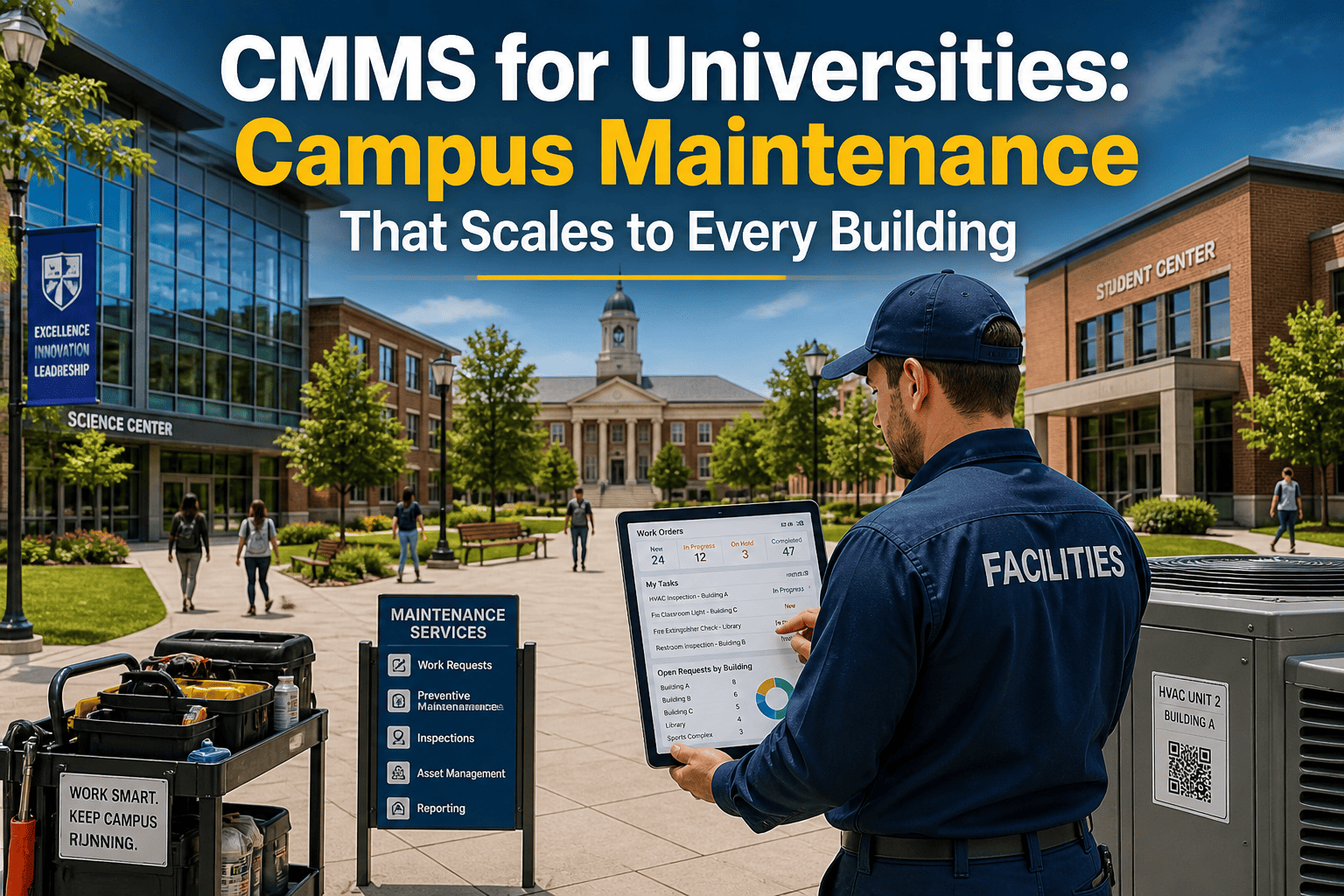
Campus facilities are unlike any private property in the country — a single university maintenance team is simultaneously responsible for a fleet of 300+ shuttle buses, utility trucks, mowers, and golf carts, miles of parking lot pavement, hundreds of outdoor LED poles, walkway lighting, garage levels, EV chargers, and the buildings these systems serve. Most campuses still run three or four disconnected systems to manage this — a fleet log, a parking work request spreadsheet, an electrician's notebook for lighting, and a paper PM binder for everything else. The typical institution manages an average of 368 vehicles, yet many administrators cannot answer basic questions about which units are underutilised, where fuel is wasted, or when assets should be retired. Start a free trial to consolidate fleet, parking, and lighting maintenance in one workflow — or book a demo to walk through your specific asset structure.
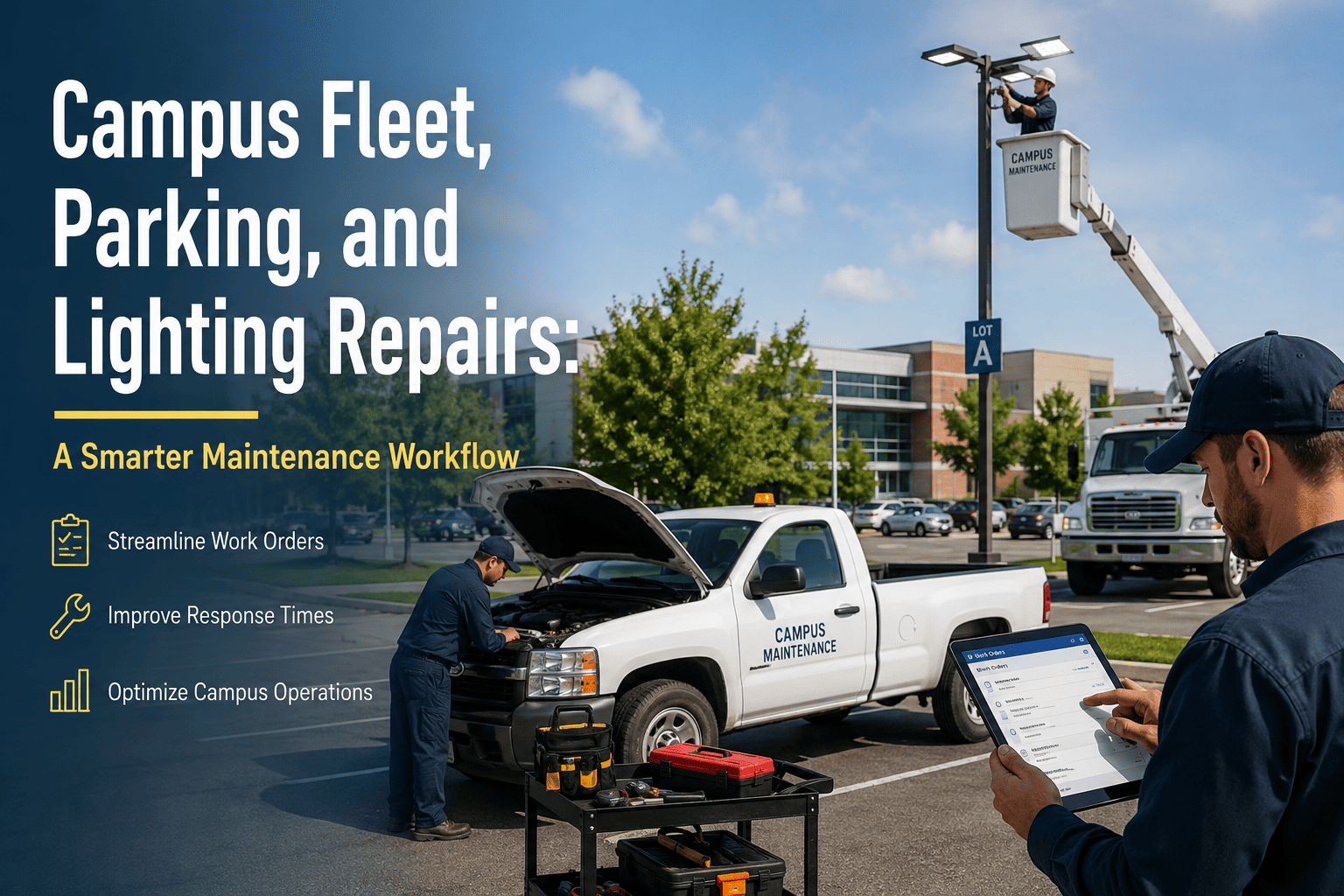
Campus Fleet, Parking, and Lighting Repairs: A Smarter Maintenance Workflow
Unify shuttle fleets, parking surfaces, garage levels, and outdoor lighting under one preventive maintenance system. See how mixed-campus teams cut response time, prove safety compliance, and stop chasing assets across hundreds of acres.
What is a Unified Campus Maintenance Workflow
A unified campus maintenance workflow consolidates every moving and standing asset on a college, school, or municipal campus — shuttle buses, utility carts, parking-lot surfaces, garage levels, outdoor lighting circuits, EV chargers, and adjacent building systems — into a single CMMS. Instead of dispatching three different teams from three different systems, work orders, PM schedules, and inspection records live on one platform that every technician opens from their phone.
The model matters because campus operations create natural visibility gaps that drain productivity in ways that compound: equipment disappears across hundreds of acres, parking decks deteriorate quietly until a slab repair becomes a structural problem, and a single burnt-out pole light becomes a Clery Act incident report after dark. Campus maintenance teams that shift from siloed tracking to unified workflows recover hours of audit time per cycle and catch failures before they become safety incidents — start a free trial to see how one asset registry replaces three spreadsheets.
Key Concepts in Mixed-Campus Maintenance
Six concepts separate campuses running structured maintenance from those running on reactive habit. Each one represents a decision point that determines whether the team is in control of the asset base or reacting to whatever fails next.
Industry Pain Points Across Campus Operations
Every campus maintenance director recognises the same set of recurring failures — and every one of them traces back to the same root cause: information that lives in one person's head, one notebook, or one spreadsheet that nobody else can reach when something breaks at 2am. Start a free trial to see how shared digital records eliminate every pattern below.
How Oxmaint Solves Campus Maintenance Complexity
Oxmaint replaces every disconnected tracking system on campus with one platform — fleet PM, parking surface inspections, lighting circuit registries, and adjacent building work orders all flow through a single mobile app, with a single asset hierarchy, and a single set of reports for facilities leadership. Implementation takes days, not months — book a demo to walk through configuration on your own asset list.
Reactive vs Planned Campus Maintenance — Side by Side
The clearest argument for unified campus maintenance is the cost difference between catching a fault before it fails and responding after it does. The table below maps the same five asset categories against both operating models — start a free trial to model the savings on your own asset base.
| Asset Category | Reactive Campus Maintenance | Planned Workflow with Oxmaint |
|---|---|---|
| Shuttle Fleet | Engine fails mid-route, replacement bus dispatched, students stranded, $4,800 emergency tow + repair | Mileage-triggered PM at 5,000 mi, planned shop time, $980 service, zero route disruption |
| Pole Lighting | Reported by student via incident report after dark, electrician dispatched next morning, 12+ hour safety gap | Quarterly circuit inspection logs degraded ballasts, replacement scheduled before failure |
| Parking Deck Slabs | Spalling progresses untracked for 3 years, engineer inspects, level closed, $1.2M emergency repair | Annual condition scoring catches degradation early, sealant work scheduled, $40K maintenance event |
| EV Chargers | User complaint logged, ticket sits in shared inbox, charger offline 8–14 days, complaints escalate | Citizen request creates work order, routed to electrician, fix logged within 24–48 hours |
| Utility Vehicles | Mower breakdown during peak grounds season, full day of labour lost, rental at $480/day | Engine-hour PM, blade sharpening on schedule, mowing crew never loses a shift |
| Asset Audit | 9–12 staff hours per cycle driving campus to physically count equipment | QR-coded asset registry — full audit complete in under 90 minutes |
ROI and Results from Unified Campus Maintenance
The financial case for a campus CMMS is not theoretical — institutions running structured workflows publish measurable outcomes within the first 12 months. The numbers below come from public-sector campus fleet and facilities operations that moved from spreadsheets to a unified platform — and they represent the recurring annual return that pays the platform several times over. Most campus teams switching to structured CMMS see up to 40% lower breakdown costs in the first year alone, which is why a free trial costs nothing to validate this on your own asset data.
Frequently Asked Questions
Does Oxmaint handle fleet, parking surfaces, and lighting in one system
How long does implementation take for a typical campus
Can students and staff report issues directly into the system
Does it integrate with telematics for fleet PM
Stop Losing Hours to Disconnected Maintenance Tools
One platform for fleet, parking, lighting, and adjacent buildings. Used by operations teams managing 10,000+ assets. Live in days, not months.