Here is the uncomfortable truth about most FDA 483 observations for maintenance records: the CMMS existed, the signatures were captured, and the audit trails were generated. The failure was not that the work went undone — it was that the electronic record could not prove it in the way Part 11 requires. In 2023, roughly two-thirds of FDA inspections at pharmaceutical manufacturing facilities cited incomplete electronic-record documentation under 21 CFR Part 11, and industry assessments still find that 40 to 60 percent of pharma and food manufacturers carry significant Part 11 gaps. A single deficient maintenance record — missing its audit trail, signed by an unauthenticated user, stored without integrity controls — can escalate from a 483 to a Warning Letter with millions in exposure and a hold on product shipments. This guide breaks down exactly what makes an electronic maintenance record trustworthy to the FDA, and how a validated CMMS closes the gap. Start a free Oxmaint trial to generate Part 11-compliant maintenance records with immutable audit trails, or book a demo to see e-signatures, audit trails, and validation documentation built for FDA inspection.
Pharmaceutical · GMP Quality · FDA Compliance
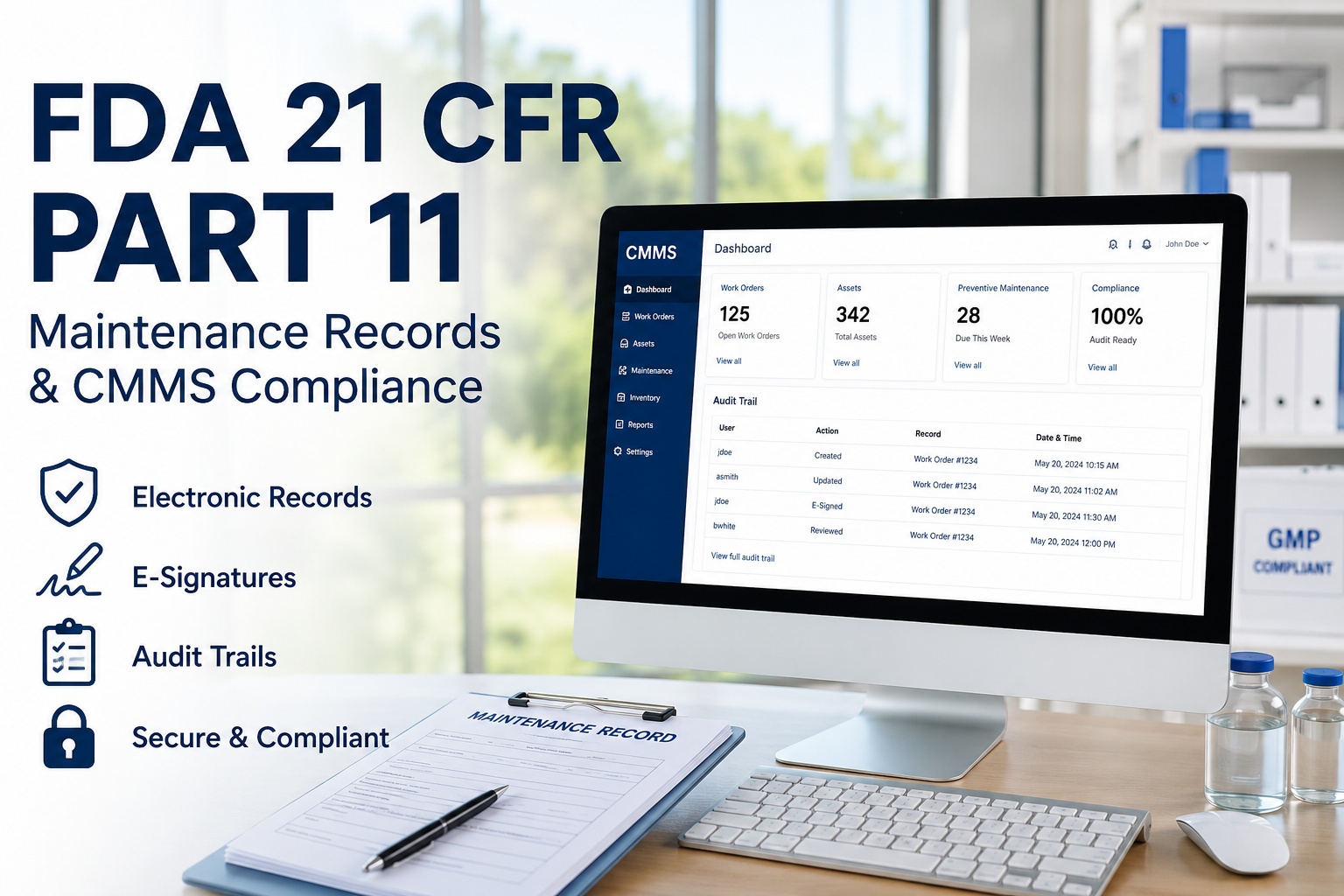
FDA 21 CFR Part 11 Maintenance Records & CMMS Compliance
Immutable audit trails, authenticated e-signatures, and IQ/OQ/PQ validation — what makes an electronic maintenance record trustworthy to the FDA, and how a validated CMMS produces inspection-ready GMP documentation from day one.
-
67%
of 2023 pharma FDA inspections cited incomplete electronic-record documentation
-
40–60%
of pharma and food manufacturers carry significant Part 11 compliance gaps
-
$2.4M
average Warning Letter exposure from an escalated record deficiency
-
10–50x
cost of non-compliance versus implementing a compliant CMMS
Anatomy of a Compliant Record
What Turns a Work Order Into an FDA-Trustworthy Record
A maintenance work order and a Part 11 record look identical on screen. The difference is four invisible layers underneath. Remove any one and the record fails inspection — even if the maintenance was done perfectly. This is what an inspector is actually looking at.
-
01
The Record Itself
§11.10(b) The work order, calibration log, or CAPA — generatable as an accurate, complete copy in both human-readable and electronic form for agency review and copying. -
02
The Audit Trail
§11.10(e) A secure, computer-generated, time-stamped log recording who did what and when for every create, modify, or delete. Changes must not obscure prior values. No user, not even an admin, can alter it. -
03
The Electronic Signature
§11.50 Permanently bound to the record and carrying three mandatory elements: the signer's printed name, the date and time, and the meaning of the signature. A scanned image of a signature is not one of these. -
04
The Validation
§11.10(a) Documented proof the system performs reliably and can discern invalid or altered records — the IQ/OQ/PQ package that makes every record the system produces defensible.
The Signature Test
Three Elements, or It Is Not a Signature
This is the most-missed detail in maintenance records. Under §11.50, an electronic signature is only valid if it carries all three of these — and is inseparably, tamper-evidently linked to the record it signs. A picture of a signature fails every one of these tests.
-
Who
Printed Name
The full printed name of the signer, tied to unique login credentials — never a shared account, which invalidates signature uniqueness under §11.100(a).
-
When
Date & Time
The exact timestamp of signing, captured by the system — not entered by the user — and recorded in the immutable audit trail alongside the signature.
-
Why
Meaning
The purpose of the signature: authored, reviewed, approved, or verified. Reauthentication before signing proves the signer is who they claim to be.
Where Inspections Fail
The Five Findings That Show Up Again and Again
FDA 483 observations and Warning Letters cluster around the same five Part 11 deficiencies. Every one is preventable with the right system and SOPs — and every one is a place an inspector will look first.
-
1
Audit Trails Never Reviewed
The single most common finding. The trail exists but QA never reviews it on a documented schedule — so deviations sit undetected. -
2
Shared User Accounts
Multiple people on one login destroys signature uniqueness under §11.100(a). Every action becomes unattributable. -
3
Signatures Missing Elements
E-signatures without the name, timestamp, or meaning — or not permanently bound to the record, allowing repudiation. -
4
System Never Validated
A GxP system used to create regulated records with no IQ/OQ/PQ documentation demonstrating it performs as intended. -
5
Change Control Gaps
Software updates pushed without a Part 11 impact assessment or revalidation — quietly eroding the validated state.
Proving the System Works
The IQ / OQ / PQ Validation Sequence
Any system that creates, modifies, or stores FDA-regulated records must be validated before GxP use. FDA's 2025 Computer Software Assurance guidance allows risk-based, proportionate evidence — but the three-stage sequence remains the backbone.
- IQ Installation Qualification Confirms the hardware and software installation matches approved specifications — the system is built as designed.
- OQ Operational Qualification Demonstrates the Part 11 controls — access restrictions, audit trails, e-signatures — operate correctly under all expected conditions.
- PQ Performance Qualification Verifies the complete system performs reliably in the real production environment with real users and workflows — then it goes live.
Validation is not a one-time checkbox. FDA expects a continuous lifecycle — periodic review and revalidation tied to change control after any update that could affect record integrity. Sign up for Oxmaint to start with a pre-built IQ/OQ/PQ template package aligned to FDA CSA guidance.
Know Your System Type
Closed vs Open Systems
Part 11 treats two system types differently, and misclassifying yours is a compliance risk. The distinction is about who controls access to the records.
-
Closed System
Access is controlled by the people responsible for the records — a typical internal, authenticated CMMS. Requires the full §11.10 controls: validation, audit trails, access limits, and e-signatures.
-
Open System
Access extends to external parties not responsible for the records. Requires everything a closed system needs plus additional controls — including encryption — to protect record authenticity in transit.
Cloud hosting does not transfer compliance responsibility to the vendor. Vendor-hosted means vendor-supported, not vendor-responsible — your organization retains every Part 11 obligation and must validate the system and confirm the controls. Book a demo to see how a validated cloud CMMS keeps Part 11 responsibility properly documented.
The Inspection Clock Is Always Running
Two Hours to Produce Every Record, or a Finding
When an inspector asks for a maintenance record, its audit trail, and its signature log, the question is whether you can produce them in minutes or spend weeks assembling paper and PDFs. A validated CMMS turns inspection readiness into a one-click export — and the cost of that readiness is a fraction, often 10 to 50 times less, than the cost of the Warning Letter it prevents.
Oxmaint for Pharma
How Oxmaint Delivers Part 11 Compliance
-
Immutable Audit Trails
Every Action Logged, No Override
Every create, modify, and delete is captured in a computer-generated, time-stamped, tamper-evident trail that no user — including administrators — can alter, satisfying §11.10(e) by design.
-
Authenticated E-Signatures
Name, Time, and Meaning, Bound to the Record
Signatures carry all three §11.50 elements, tied to unique credentials with reauthentication before signing — permanently bound so they cannot be repudiated or reused.
-
Role-Based Access
Unique IDs That Prevent Shared Logins
Unique user IDs, role-based permissions, and account lifecycle management structurally prevent the shared accounts that invalidate signature uniqueness — the second most common finding.
-
Validation Package
Pre-Built IQ/OQ/PQ Aligned to CSA
A complete qualification package with risk-based test scripts and IQ/OQ/PQ templates aligned to FDA's Computer Software Assurance guidance — reducing validation scope versus a blank-slate system.
-
Inspection Export
Records Retrievable in Under Two Hours
Audit-trail reports, signature logs, and system-change documentation exported as structured records for an inspector — instead of weeks of manual paper and PDF assembly.
-
Compliance Built In
Not a Separate Paid Tier
Part 11 controls live in the core platform — every audit trail, e-signature tool, and access control included in the standard license, not gated behind a compliance upsell.
Frequently Asked
Part 11 CMMS Compliance Questions
Does a maintenance CMMS actually fall under 21 CFR Part 11?
Yes, whenever it creates, modifies, maintains, archives, retrieves, or transmits records that predicate rules require you to keep. If your CMMS generates the maintenance records that demonstrate GMP compliance — work orders, calibration logs, CAPA documents — those records must meet Part 11 or face enforcement. Sign up for Oxmaint to generate maintenance records that meet Part 11 from day one.
What are the three required elements of an electronic signature?
Under §11.50, every compliant electronic signature must carry the signer's printed name, the date and time of signing, and the meaning of the signature (authored, reviewed, approved, or verified). It must also be permanently and tamper-evidently bound to the record and tied to unique login credentials. A scanned image of a handwritten signature satisfies none of these.
Does using a cloud or vendor-hosted CMMS transfer Part 11 responsibility?
No. Cloud hosting does not move compliance responsibility to the vendor. Your organization retains every Part 11 obligation, must validate the system, and must confirm all controls are in place. Vendor-hosted means vendor-supported, not vendor-responsible. FDA cares about data integrity and access control, not where the data center sits. Book a demo to see how validation responsibility is documented for a cloud CMMS.
What is the most common Part 11 inspection finding?
Audit trails that exist but are never reviewed on a documented schedule. The system captures every entry correctly, but QA has no evidence of periodic review — so deviations go undetected. The other frequent findings are shared user accounts, e-signatures missing required elements, unvalidated GxP systems, and change control that skips Part 11 impact assessment. Sign up for Oxmaint to build documented audit-trail review into your compliance workflow.
Record · Validate · Prove
The Maintenance Happened. Part 11 Is About Whether You Can Prove It.
Every missing audit trail, shared login, and unsigned record is a 483 observation waiting for the next inspection. Oxmaint gives pharmaceutical quality and maintenance teams one validated platform to generate compliant electronic records, capture authenticated e-signatures, maintain immutable audit trails, and produce an inspection-ready export on demand — with IQ/OQ/PQ documentation built in.