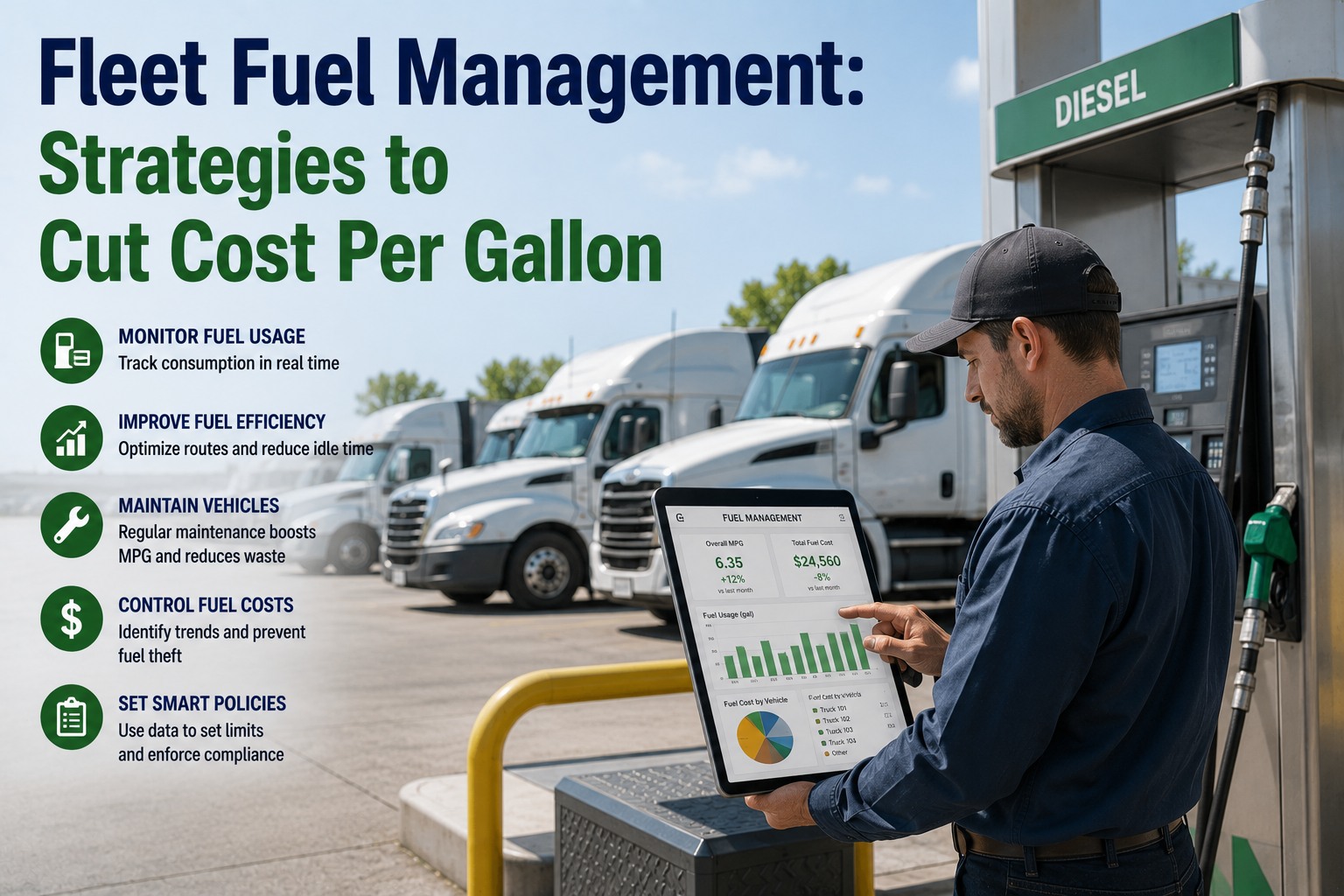
Fleet fuel management is the single largest controllable expense for most fleet operators, typically consuming 20–30% of total operating costs. By combining telematics fuel monitoring, driver behavior coaching, idle reduction programs, and proactive vehicle maintenance, fleet managers can consistently cut fuel consumption by 8–15% and meaningfully lower their cost per gallon. The most successful fleet fuel programs treat fuel efficiency not as a one-off initiative but as a daily operational rhythm baked into work orders, preventive maintenance schedules, and maintenance analytics. OxMaint brings all of these levers—telematics integration, asset tracking, and CMMS-driven maintenance—into one AI-powered platform so your reliability teams can stop guessing and start saving. Ready to turn fuel data into measurable cost reduction? You can Start Free Trial today.
Fleet Fuel Cost Reduction
Turn Fuel Data Into Measurable Cost-per-Gallon Savings
Telematics-driven fleet fuel programs consistently deliver 8–15% fuel savings. OxMaint connects fuel monitoring, driver behavior, and maintenance triggers so reliability teams can stop waste before it hits the pump.
30%
Of Operating Cost
15%
Fuel Savings Target
$0.14
Cost Per Idle Mile
ROI & Savings Breakdown
How Much Does Poor Fleet Fuel Management Actually Cost?
For a 150-vehicle fleet averaging 40,000 miles per vehicle annually at 6 MPG, even a 5% fuel efficiency deficit translates to over $95,000 in wasted diesel every year. Fleet fuel cost is not just a line item—it is a controllable variable that maintenance and reliability teams can directly influence through asset condition, preventive maintenance adherence, and fault-code resolution.
Annual Fleet Fuel Cost Formula
(Total Miles ÷ Fleet MPG) × Cost Per Gallon = Annual Fuel Spend
Worked example: (6,000,000 miles ÷ 6.2 MPG) × $4.10/gal = $3,967,742 annual spend. A 10% MPG improvement saves $396,774.
| Fuel Efficiency Lever | Mechanism | Estimated Savings | OxMaint Capability |
|---|---|---|---|
| Idle Reduction | Telematics alerts + driver coaching | 5–8% of total consumption | Automated idle-time work orders |
| Tire Pressure PM | Scheduled PSI checks & retorques | 2–3% MPG improvement | Preventive maintenance triggers |
| Aerodynamic Repair | Fixing fairings & gap reducers | 1–2% MPG improvement | Inspection defect tracking |
| Driver Behavior | Speeding & harsh acceleration limits | 3–5% MPG improvement | Telematics data integration |
| Engine Fault Resolution | DERATE / DPF / EGR rapid repair | Up to 10% MPG recovery | Predictive maintenance analytics |
Strategy Guide
Fuel Efficiency Strategies for Fleets: A Month-by-Month Roadmap
Implementing a fleet fuel program requires sequencing technology, process, and people. Rushing telematics without maintenance alignment creates data noise. Follow this 4-month rollout to embed fuel efficiency strategies into your operation.
Month 1
Baseline & Telematics Integration
Integrate telematics fuel data into OxMaint to establish a 30-day baseline of fleet fuel consumption, idle time, and MPG per asset. Identify the bottom 10% of performers for immediate intervention.
Month 2
PM Optimization & Idle Policy
Launch a formal idle reduction fleet policy with driver scorecards. Align preventive maintenance schedules to tire pressure, oil viscosity, and air filter replacements—each extending fleet fuel economy by 1–3%.
Month 3
Fault Code & DPF Rapid Response
Configure automated work orders in OxMaint triggered by telematics fault codes (DERATE, DPF, EGR). Resolving these within 48 hours prevents up to 10% MPG degradation and avoids costly roadside failures.
Month 4
Driver Behavior Analytics & Coaching
Use driver behavior fuel data—speeding, harsh braking, over-revving—to coach the bottom quartile. Fleets that pair coaching with telematics see a sustained 3–5% fleet fuel savings within 60 days.
KPI Tiles
Fleet Fuel Monitoring KPIs You Should Track Daily
You cannot manage what you do not measure. Effective fuel management software tracks these core metrics in real time, allowing maintenance teams to spot anomalies before they drain the budget.
6.2+
Target Fleet MPG
Benchmark average across Class 8 trucks; flag any asset falling below 5.8 MPG for immediate diagnostic review.
<5%
Idle Time Ratio
Excessive idle time burns fuel without moving freight. Target under 5% of total engine hours.
48h
Fault-to-Repair Window
Resolving engine and emissions fault codes within 48 hours prevents fuel-wasting derates and DPM clogs.
95%
PM Compliance Rate
Fleets achieving 95%+ on-time preventive maintenance see measurably better fuel economy and fewer breakdowns.
Platform Integration
How OxMaint Helps Cut Fleet Fuel Cost Per Gallon
OxMaint is an AI-powered CMMS and EAM platform that transforms fuel data into maintenance action. Instead of logging telematics alerts in a spreadsheet, OxMaint automatically generates work orders, tracks parts, and validates fuel economy improvements—closing the loop between fuel monitoring and cost reduction.
Telematics-Driven Work Orders
Automatically convert fuel-wasting fault codes (DERATE, DPF) into prioritized work orders, cutting fault-to-repair time by 40–60% and recovering lost MPG.
Predictive Maintenance Triggers
AI models analyze asset history and telematics to predict component failures before they impact fuel efficiency, reducing unplanned downtime by 30–50%.
Fuel Economy Analytics
Track MPG, idle time, and cost per gallon by asset, route, or driver. Identify the bottom 10% of performers and deploy targeted interventions with real ROI tracking.
PM Compliance & Inspection
Digitize DVIRs and PM schedules so tire pressure, aerodynamics, and oil changes happen on time—protecting the 2–4% MPG that poor maintenance quietly erodes.
Real-World Impact
The Cost of Inaction: A 180-Vehicle Fleet Scenario
Consider a 180-asset regional fleet spending $3.2M annually on diesel. Without a structured fleet fuel program, they accept a 4% efficiency loss from poor PM compliance, unaddressed fault codes, and excessive idling. That is $128,000 evaporating every year.
Status Quo (Reactive)
$3,200,000
Annual fuel spend with unmanaged idle time, delayed DPF cleanings, and paper-based PM tracking.
With OxMaint (Optimized)
$2,752,000
14% fuel cost reduction via telematics-triggered PM, idle alerts, and predictive fault resolution.
$448,000
Estimated Annual Savings
★★★★★
"Within 90 days of connecting our telematics to OxMaint, we cut idle time by 22% and recovered nearly half a MPG across the fleet. The automated fault-code work orders alone paid for the platform."
Director of Maintenance, 220-Truck Regional Carrier
See How OxMaint Lowers Your Cost Per Gallon
Book a 30-minute demo and we will map your fleet's fuel-saving opportunities live on the OxMaint platform.
Frequently Asked Questions
Fleet Fuel Management FAQs
What is fleet fuel management and why does it matter?
Fleet fuel management is the systematic process of monitoring, controlling, and reducing fuel consumption across a fleet using telematics, driver behavior data, and preventive maintenance. It matters because fuel is typically 20–30% of total operating cost, and even a 10% improvement in fleet fuel economy can save hundreds of thousands of dollars annually for mid-sized fleets.
How much can a fleet save by reducing idle time?
Idle reduction fleet programs typically cut total fuel consumption by 5–8%. Since an idling Class 8 truck burns about 0.8 gallons per hour, a 150-truck fleet reducing idle by just one hour per vehicle per day can save over $100,000 per year. You can Start Free Trial to see how OxMaint automates idle-time tracking and alerts.
How does preventive maintenance affect fuel efficiency?
Preventive maintenance directly impacts fleet fuel economy. Proper tire inflation improves MPG by 2–3%, clean air filters restore up to 2% lost efficiency, and timely oil changes reduce engine friction. When PM is delayed, small issues escalate into fault codes and derates that can cut MPG by up to 10%.
What is the best fuel management software for fleets?
The best fuel management software integrates telematics data with maintenance workflows so fuel insights trigger immediate action. OxMaint stands out by automatically converting telematics fault codes into prioritized work orders, tracking PM compliance, and providing analytics that tie maintenance decisions directly to cost-per-gallon savings.
How quickly can a fleet fuel program deliver ROI?
Most fleets see measurable fuel savings within 60–90 days of implementing a structured fuel program with telematics and CMMS integration. The fastest returns come from resolving active engine fault codes and launching idle-reduction policies, which can recover 5–10% of fuel spend in the first month alone.
Stop Wasting Fuel. Start Saving with OxMaint.
Join the fleets using OxMaint to cut fuel cost per gallon, eliminate unplanned downtime, and predict failures before they happen.
Free 14-day trial · No credit card