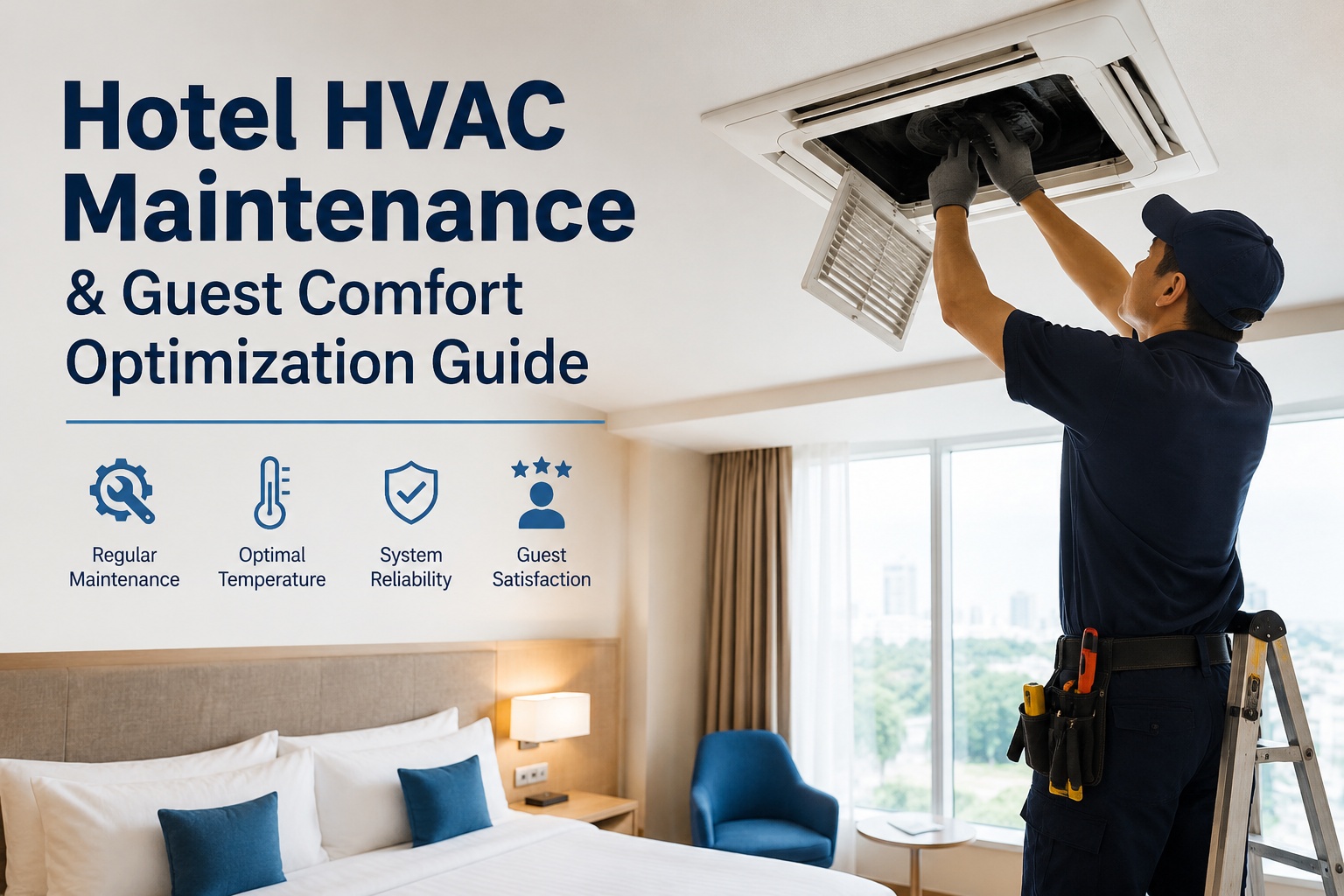
Every hotelier eventually confronts the same operational truth: the difference between a five-star review and a one-star complaint often comes down to whether a single fan coil unit was cleaned last quarter. Guest satisfaction is built on many things — arrival experience, service quality, room design, F&B — but comfort is the invisible foundation. Room temperature that drifts two degrees off setpoint, humidity that climbs into the sticky range, a compressor that clicks on at 3 AM, or a musty smell from a neglected drain pan will undo every other positive touchpoint in a stay. The properties that consistently earn top comfort scores treat HVAC maintenance as a revenue-protecting discipline, not a facilities overhead. OxMaint provides the maintenance management platform that lets hotel operations teams execute that discipline systematically across every guest room, public space, and central plant asset in the portfolio. Book a free demo to see hotel HVAC PM running inside OxMaint.
Trigger
FCU coil fouled, room temperature drifts
Guest experience
Sleep disturbed, comfort complaint filed at check-out
Review platform
1-star review mentioning "AC noise" or "hot room"
Booking impact
ADR compression, occupancy softening, direct booking loss
A single unresolved comfort issue in one room is estimated to reduce lifetime property revenue by 30-80× the actual repair cost when the review is public
20-30%
operational cost reduction achievable when smart HVAC controls are paired with disciplined PM
NC-35
maximum noise criterion for guest room sleeping areas — NC-30 for luxury and boutique properties
30-45%
annual HVAC energy savings from VRF systems versus legacy PTAC — with 4-7 year payback
Four HVAC Architectures Every Hotel Operator Must Understand
Hotel HVAC decisions ultimately reduce to one of four system architectures — each with distinct PM requirements, cost profiles, and comfort characteristics. Understanding which system your property runs (or which you should consider on your next capital cycle) determines the entire maintenance program that follows. OxMaint stores each system as a distinct asset class with its own PM template library, so the same platform handles a 45-room boutique on PTAC and a 400-room full-service property on chilled water fan coils.
Tier 1 · Budget
PTAC
Packaged Terminal Air Conditioner
Best forUnder 100 rooms · Budget properties
Cost per room$4,500-6,500
PM disciplineFilter, coil, drain per unit
Comfort riskNoise · uneven cooling
Tier 2 · Mid-Scale
VRF
Variable Refrigerant Flow
Best for50-200 rooms · Mid-luxury
Cost per room$8,000-12,000
PM disciplineRefrigerant, indoor units, controls
Comfort riskRefrigerant leak · sensor drift
Tier 3 · Full-Service
Chilled Water FCU
Central chiller + fan coil units
Best for200+ rooms · Full-service
Cost per room$6,000-9,000
PM disciplineChiller plant + 500-2000 FCUs
Comfort riskWater quality · valve drift
Tier 4 · Public Spaces
DOAS + AHU
Dedicated Outdoor Air System
Best forLobbies, ballrooms, F&B
Cost per unitProperty-specific
PM disciplineFilter banks, humidity, ventilation
Comfort riskIAQ · humidity swings
Guest Comfort Has Four Measurable Dimensions
Hotel operators sometimes talk about "comfort" as a single subjective metric, but guests actually experience it across four distinct physical dimensions — and any one of them out of specification will trigger the complaint that ends up on TripAdvisor. The targets below reflect industry standards for upscale and luxury hospitality environments, and each is directly influenced by an HVAC maintenance decision.
01
Temperature
68-72°F setpoint · ±1°F tolerance
Driven by: FCU coil condition, valve accuracy, sensor calibration
02
Humidity
40-55% RH · never above 60%
Driven by: Chilled water flow, coil bypass, drain pan condition
03
Air Quality
CO₂ < 800 ppm · no odor · MERV 13+
Driven by: Filter program, ventilation rate, coil biological control
04
Acoustics
NC-35 max · NC-30 for luxury
Driven by: Blower balance, bearing condition, mount integrity
The Four PM Zones of a Hotel Property
Effective hotel HVAC PM requires treating the property as four distinct maintenance zones — each with its own operating cadence, guest-visibility level, and failure consequence. What works in the central plant would be intrusive if scheduled during peak guest hours in a lobby. What is acceptable in a back-of-house area would be catastrophic if executed near a guest room at 8 AM. OxMaint routes and schedules by zone so PM discipline stays aligned with the guest experience.
Zone A
Guest Rooms
100-1000+ units
Filter change · Coil clean · Drain flush · Sensor cal · Thermostat check
Only during vacancy or between check-out and check-in
Zone B
Public Spaces
Lobby · Ballrooms · F&B
AHU filters · Humidity ctrl · DOAS damper · CO₂ sensor
Overnight / low-traffic hours only
Zone C
Back-of-House
Kitchen · Laundry · Housekeeping
Exhaust hood · Makeup air · Grease filter · Laundry vent
During scheduled operational lulls
Zone D
Central Plant
Chillers · Boilers · Pumps
Refrigerant · Tube brush · Pump seal · Controls calibration
Shoulder seasons · planned windows
Chilled Water Plant — The Central Nervous System
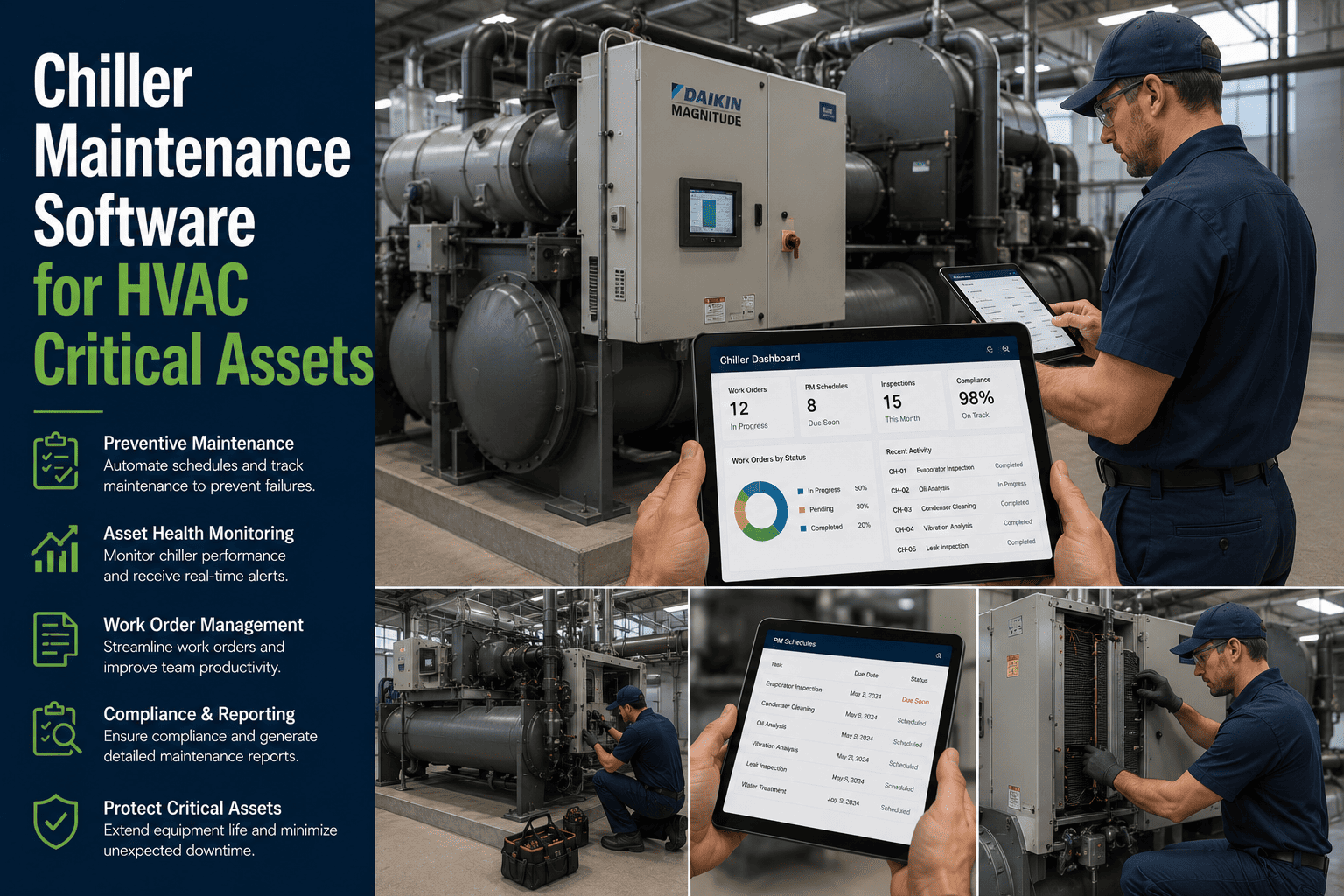
For hotels of 200 rooms and above, the chilled water plant is the single most consequential asset in the entire property. A chiller failure on a July Saturday with a 92% occupancy is not a maintenance event — it is a business continuity crisis. Rooms uncool. Guests demand refunds. Room blocks get relocated at $300/night to competitive properties. The reputation damage lasts a quarter. The PM discipline for a central chiller plant reflects the stakes: multiple redundant systems, quarterly detailed inspections, annual comprehensive service, and continuous condition monitoring.
Chiller (centrifugal / screw)
Refrigerant charge quarterly, tube brushing annually, oil analysis quarterly, vibration trending, log approach temperatures
Q + A
Cooling towers
Water treatment daily, fill inspection quarterly, drift eliminator condition, biocide dosing, Legionella management
D + Q
Primary & secondary pumps
Seal condition, bearing lubrication, flow verification, VFD parameter check, differential pressure trending
M + Q
Chilled water distribution
Water chemistry, air separator function, expansion tank pressure, isolation valve exercise, insulation integrity
Q + A
BAS / plant controls
Setpoint verification, sensor calibration, staging logic test, alarm review, trend log analysis
M
Fan Coil Units — The Point of Contact With Every Guest
Central plants matter operationally, but fan coil units matter experientially. Every guest interacts with a FCU during their stay. A 300-room hotel typically operates 400-800 fan coil units when public spaces are included — each requiring the same PM cadence to keep the guest experience consistent. The PM checklist below is compact but non-negotiable: skip any one item and guest-room performance drifts within one quarter.
Guest Room FCU Quarterly PM · Per Unit
Filter Replacement
Correct MERV rating, no bypass gaps, log replacement date to unit asset
Coil Cleaning
Coil brush + no-rinse cleaner, verify fin straightness, check for biological growth
Drain Pan Flush
Flush with biocide, verify free drainage, inspect for cracks or corrosion
Blower Balance
Verify blower wheel cleanliness, listen for bearing noise, check motor amp draw
Valve & Control
Verify chilled water valve operates full stroke, sensor reading matches actual room temp
Guest-Facing Check
Thermostat response, no vibration, no noise complaints in prior stay reviews
Manage Every FCU as an Individual Asset
OxMaint registers every fan coil unit in the property with its own PM cadence, service history, and guest-facing performance record. See how portfolio-scale FCU management works in a 30-minute walkthrough.
VRF System Inspection — Zone Control With Precision Requirements
Variable refrigerant flow systems have become the preferred architecture for mid-scale and boutique hotels because they deliver whisper-quiet operation (below 35 decibels), individual zone control, and 30-45% energy savings versus PTAC. That capability comes with different PM requirements. VRF systems are refrigerant-heavy, controls-dependent, and sensitive to installation and maintenance discipline. The three-column reference below distinguishes what changes when a property runs VRF versus other architectures.
VRF PM Focus Areas
Outdoor Unit
Condenser coil chemical clean annually
Compressor amp draw trending
Refrigerant leak detection per EPA 608
Inverter board temperature check
Fan motor bearing lubrication
Indoor Units
Filter change per room quarterly
Evaporator coil inspection
Drain pump verification
Sensor calibration to thermostat
Blower wheel balance
Controls & Piping
Refrigerant piping insulation inspection
BACnet / Modbus integration test
Zone setpoint verification
PMS integration data flow check
Alarm log review and clearance
PMS Integration — The Room-Ready Advantage
The highest-performing hotel HVAC operations are the ones that never leave a room in guest-ready temperature when no guest is present. Property Management System integration turns the reservation database into an HVAC control input: when a room is vacant, the setpoint drifts to an economy band; when a check-in is confirmed for a specific room, the setpoint restores 45-60 minutes before arrival so the guest walks into a perfectly conditioned space. OxMaint captures the maintenance side of this integration — every sensor, actuator, and control point that must remain calibrated for PMS-driven room-ready to work reliably.
Room-Ready Timeline · What Happens Behind the Scenes
T-6h
Reservation locked · room assigned
T-60m
Setpoint restored from economy to guest-ready
T-0
Guest checks in · room at 70°F, 48% RH
Stay
Occupancy sensor maintains comfort automatically
Check-out
Room reverts to economy band, energy saved
Result: guest walks into perfect comfort, property saves 15-30% on HVAC energy during vacancy windows
Executive Perspective · Why Maintenance Discipline Protects Property Value
The properties in our portfolio that consistently outperform on RevPAR and guest satisfaction share one operational characteristic — their engineering teams treat HVAC as a revenue-protecting asset rather than a cost center. A well-maintained fan coil unit costs the same as a neglected one. A quarterly PM program executed with discipline costs the same as one that gets skipped when the schedule gets tight. The difference between the two isn't budget — it's the operational system underneath. When we standardized our multi-property engineering teams on a single CMMS, the reduction in comfort-related complaints was measurable within two quarters, and the improvement in reviews mentioning "comfortable room" or "quiet AC" showed up on the platforms shortly after. That is not a maintenance story. That is a revenue story.
Every FCU Is an Asset
Managing 400-800 fan coil units with individual PM histories in OxMaint replaces spreadsheets that no VP can actually audit.
Comfort Drives Reviews
Comfort-related complaints correlate directly with review scores. Preventing them is the highest-leverage operational discipline available.
Portfolio-Wide Standards
Consistency across properties is what protects brand promise. OxMaint enforces the standard from a single platform for the entire portfolio.
Turn HVAC Maintenance Into a Guest Experience Advantage
If your hotel is still managing HVAC PM on spreadsheets and engineer memory, comfort complaints are already showing up in reviews you have not yet seen. See what OxMaint — a maintenance management platform built for hospitality operations — looks like against your property or full portfolio.
Frequently Asked Questions
Which HVAC system is best for a hotel?
The correct architecture depends on room count, service tier, and climate. Budget properties under 100 rooms typically use PTAC. Mid-scale and boutique properties from 50-200 rooms favor VRF for quiet operation and zone efficiency. Full-service properties above 200 rooms usually run chilled water fan coil systems for scale efficiency. Public spaces across all tiers use DOAS + AHU architectures. OxMaint supports each architecture with its own PM template library.
How often should hotel fan coil units be maintained?
Guest room fan coil units should be inspected quarterly and receive full PM including filter change, coil cleaning, drain flush, blower balance, and valve verification. Any room with a comfort complaint receives immediate attention outside the standard cycle. OxMaint tracks each FCU as an individual asset with its own service history, so PM cadence stays consistent whether the property has 100 or 1,000 units.
What are the guest comfort target ranges for hotels?
The four dimensions of comfort each carry standard targets. Temperature: 68-72°F setpoint with ±1°F tolerance. Humidity: 40-55% RH, never above 60%. Air quality: CO₂ under 800 ppm with MERV 13+ filtration. Acoustics: NC-35 maximum in sleeping areas, NC-30 for luxury properties. Missing any one of these ranges consistently produces the comfort complaints that show up in reviews.
How does chilled water plant PM differ from FCU PM?
Chilled water plant PM operates on quarterly and annual intervals focused on chiller refrigerant, tube cleaning, cooling tower water treatment, pump condition, and BAS calibration. FCU PM operates on quarterly per-unit intervals focused on filter, coil, drain, blower, and controls. The plant PM protects operational continuity; the FCU PM protects guest experience directly. Both are managed inside OxMaint against their respective assets.
Can OxMaint integrate with our Property Management System?
OxMaint supports the maintenance layer that PMS-driven HVAC control depends on — every sensor, actuator, and control point calibrated and documented. PMS integration for setpoint control typically flows through the Building Automation System, and OxMaint stores the BAS calibration events, sensor drift records, and control point service history that keeps room-ready automation reliable across every room in the portfolio.
What are the biggest ROI wins for hotel HVAC maintenance?
Three consistently deliver measurable returns: annual chiller condenser cleaning (recovers 15-20% cooling capacity), quarterly FCU coil cleaning (prevents comfort complaints and extends equipment life), and PMS-driven setpoint scheduling (cuts vacancy-hour energy use by 15-30%). Combined, these three disciplines typically improve operating margin by 20-30% while raising comfort-related review scores measurably within two quarters.