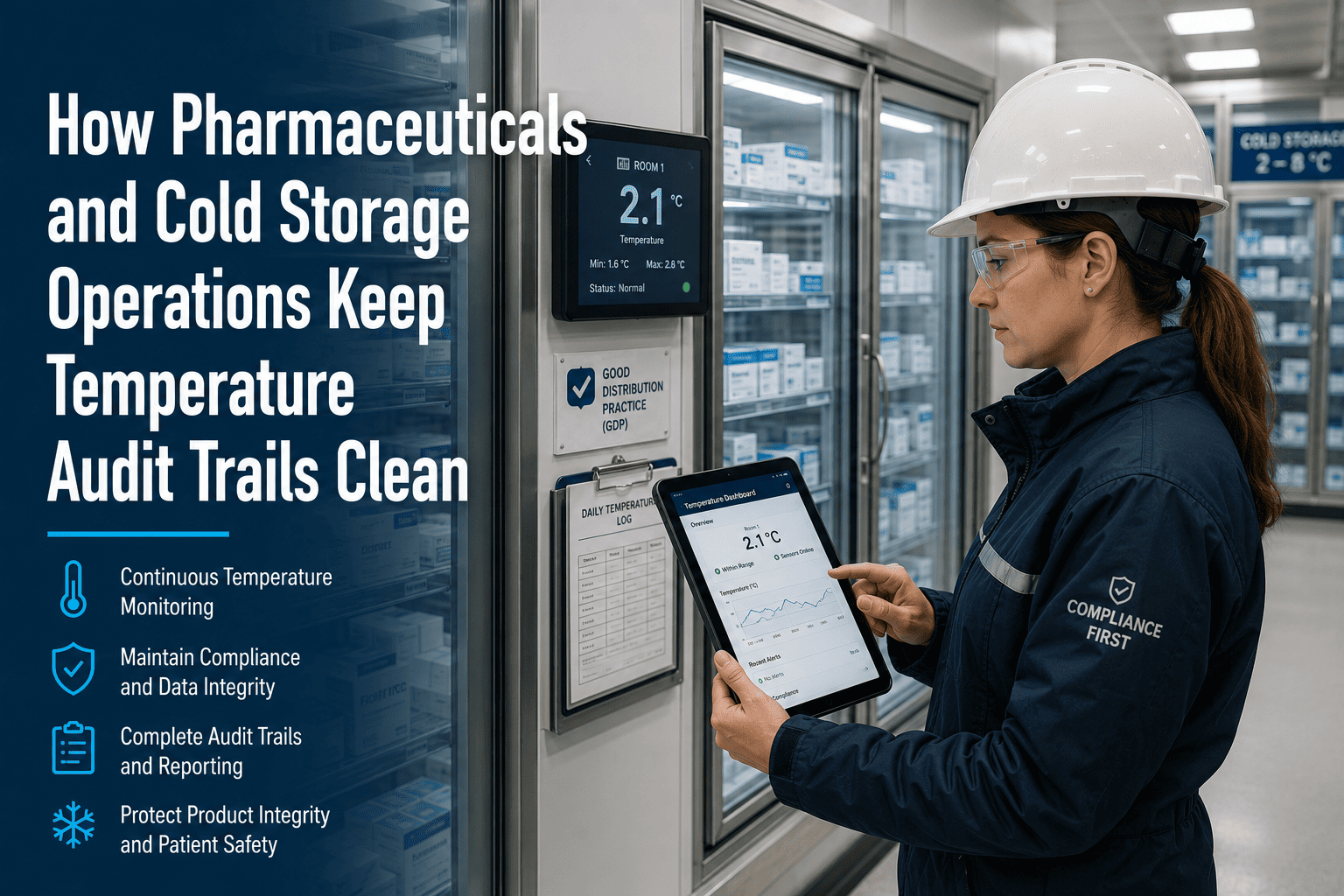
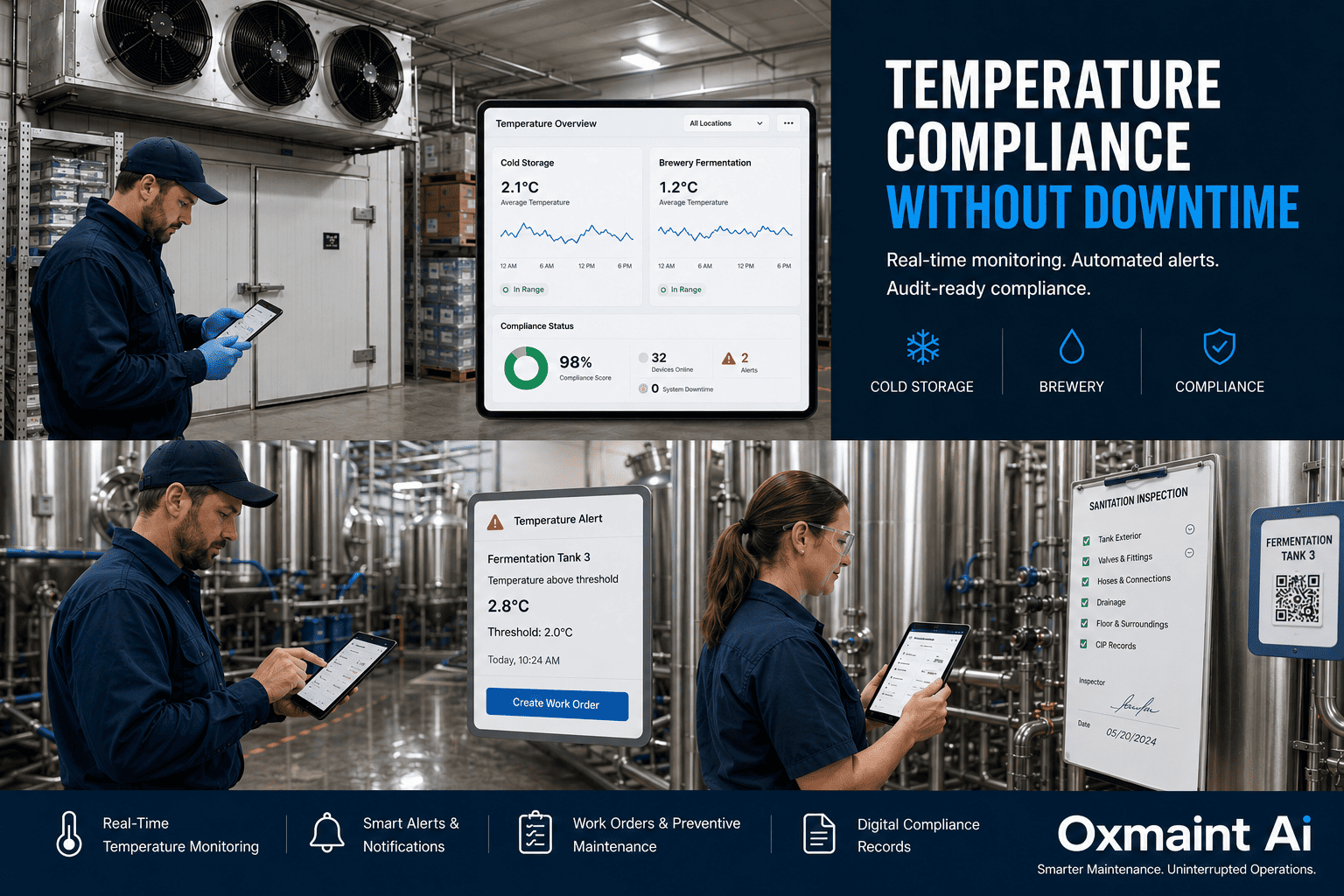
A pharmaceutical cold room holding two million dollars in vaccines can lose everything in four hours. Not from a dramatic failure — from a compressor that had been drawing slightly high amperage for weeks, a condenser coil nobody cleaned, and a backup generator that was never load-tested. When the temperature drifts past 8°C at 3 AM on a Sunday, the only things standing between the product and the incinerator are the alarm that wakes someone up and the redundancy that buys them time. Temperature excursions cost the pharmaceutical industry an estimated $35 billion a year, and nearly every one traces back to a maintenance gap that was invisible until the moment it mattered. This guide covers how to keep product inside the band — the refrigeration PM, the continuous monitoring, the alarm response, and the GDP documentation that proves it. Start a free Oxmaint trial to schedule cold-chain PM and log every temperature record for GDP audits, or book a demo to see refrigeration maintenance, alarms, and calibration in one platform.
Pharmaceutical · Cold Chain · GDP Compliance
Pharmaceutical Cold Chain Storage Maintenance & Monitoring
Refrigeration equipment PM, continuous temperature monitoring, alarm response, and redundancy — how quality and facilities teams keep product inside the 2–8°C band and prove GDP compliance every day of the year.
-
$35B
annual cost of temperature excursions to the pharmaceutical industry
-
4 hrs
enough to destroy a $2M vaccine store once temperature control is lost
-
±0.5°C
sensor accuracy required, calibrated quarterly to NIST-traceable standards
-
10 sec
maximum transfer-switch activation time to backup power on outage
The Band Is Everything
Where Product Lives, and Where It Dies
Every cold-chain decision comes down to one question: is the product inside its temperature band? For most refrigerated pharmaceuticals that band is 2–8°C, and the margins are unforgiving. Read the scale from top to bottom — the gold zone is where product is safe, and everything outside it is an excursion that starts a deviation investigation.
- Above 8°C — heat excursion. Biologics and vaccines degrade. Product is quarantined, a deviation investigation opens, and release is delayed while stability data is reviewed.
- 2–8°C — the safe band. The target for most refrigerated pharmaceuticals. Continuous monitoring must prove the product stayed here for its entire storage life.
- Below 2°C — freeze risk. Just as damaging as heat. Many biologics are destroyed by a single freeze event, and the damage is often invisible on inspection.
Three Lines of Defense
What Actually Keeps Product in the Band
Cold-chain integrity is not one system — it is three, layered so that when one weakens, the next holds. A mature program maintains all three, and a CMMS schedules and documents every one.
-
1
Refrigeration Equipment PM
The compressor, condenser, evaporator, and seals that make the cold. Kept healthy through scheduled inspection, they hold the band. Neglected, they drift — slowly, then all at once.
-
2
Continuous Monitoring
Calibrated sensors logging every 15 minutes, mapped across the storage area, with alarms that fire the moment temperature approaches a limit — day or night, staffed or not.
-
3
Redundancy & Backup
N+1 refrigeration, backup generators, and 72 hours of fuel — so a single failure or a scheduled repair never becomes a product loss. The insurance layer that buys response time.
Pillar One in Detail
The Refrigeration PM Schedule
Refrigeration failures announce themselves weeks early — in amperage trends, pressure readings, and coil condition — if someone is looking. This is the interval schedule that catches degradation before it reaches the product.
| Task | Component | Interval |
|---|---|---|
| Compressor oil level & amperage | Compressor | Weekly |
| Suction & discharge pressure trending | Refrigeration circuit | Weekly |
| Condenser & evaporator coil cleaning | Heat exchange | Monthly / as fouled |
| Refrigerant leak check & log | Seals, joints, valves | Monthly |
| Door seal & mount inspection | Cold room envelope | Monthly |
| Backup generator load test (30 min) | Emergency power | Monthly |
| Sensor calibration (NIST-traceable) | Monitoring | Quarterly |
| Transfer switch load test | Emergency power | Quarterly |
| Temperature mapping (72-hour) | Storage area | Annual / after change |
The 3 AM Sunday Test
What Has to Happen When the Alarm Fires
GDP requires that an excursion at 3 AM on a Sunday is detected and answered as fast as one at 10 AM on a Tuesday. The minutes after an alarm decide whether product is saved or scrapped. This is the response chain a program has to guarantee.
- 0 min Alarm Fires Sensor detects temperature approaching a limit and triggers an automated alert — not just on-site, but to an out-of-hours responder.
- Minutes Responder Acknowledges A named on-call responder acknowledges the alarm. The clock and the acknowledgment are logged automatically into the audit trail.
- Act Diagnose & Contain Switch to backup refrigeration, move product to a qualified unit, or restore power. Redundancy is what makes containment possible in time.
- Record Deviation & CAPA The excursion triggers a deviation report; the corrective action links to the root-cause maintenance finding. Every step becomes part of the GDP record.
The Math Is Never Close
A $100K Generator Against a $2M Loss Is Not a Decision
A cold room holding two million dollars in product loses power for four hours and, without backup, everything is discarded. A generator that would have prevented it costs a fraction of that. The same lopsided math runs through the whole program: the cost of maintenance, monitoring, and redundancy is always a small fraction of the excursion it prevents. The only question is whether the discipline is in place before the failure, not after.
What Inspectors Check
The GDP Documentation an Audit Demands
Inspectors consistently flag the same weaknesses: poor alarm response, missing calibration records, and mishandled excursions. Each is a documentation problem before it is a maintenance one. These are the records a cold-chain program must be able to produce on demand.
-
Temperature Mapping
72-hour mapping studies proving every point in the storage area holds 2–8°C — repeated annually, after any modification, and following significant refrigeration maintenance.
-
Calibration Records
NIST-traceable quarterly calibration for every sensor and data logger, with certificates on file. Missing calibration records are one of the most common inspection findings.
-
Continuous Data Logs
Unbroken temperature records at 15-minute intervals or better. A logger offline for more than 15 minutes is itself an incident that must be recorded.
-
Excursion & CAPA Files
Every alarm with a documented, acknowledged corrective action. Unresolved or unacknowledged alerts are a direct GDP documentation gap.
-
Refrigerant & Leak Logs
Refrigerant logs and leak certificates kept for audit, proving the circuit is maintained and charged within specification.
-
Backup System Tests
Monthly generator load tests and quarterly transfer-switch tests, documented — proving the redundancy layer will actually hold when primary power fails.
Oxmaint for Cold Chain
How Oxmaint Runs a Cold-Chain Program
-
Refrigeration PM
Every Interval Auto-Scheduled
Weekly compressor and pressure checks, monthly coil cleaning and leak logs, quarterly calibration and transfer-switch tests — each fires as a recurring work order assigned to the right technician, so no interval slips.
-
Sensor Integration
Excursion Alerts Become Work Orders
Temperature and refrigeration sensor data feed straight in. An excursion alert or a compressor drawing high amperage auto-generates an inspection work order before the drift reaches product.
-
Predictive Trending
Failures Caught Weeks Ahead
Trending compressor amperage, suction and discharge pressure, and coil condition identifies mechanical degradation weeks before failure — turning an emergency into a scheduled repair.
-
Calibration Management
NIST-Traceable Records on File
Every sensor and logger carries its calibration date and certificate, with alerts before the quarterly interval lapses — closing one of the most common inspection gaps.
-
Alarm-to-CAPA
Every Excursion Linked to Its Fix
An alarm creates a deviation record; the corrective action links back to the root-cause maintenance finding — so the excursion, the response, and the repair live in one traceable chain.
-
GDP Audit Export
Records Ready in Minutes
Mapping studies, calibration certificates, data logs, excursion files, and backup-test records assembled into an audit-ready package on demand — not compiled from paper over weeks.
Frequently Asked
Cold Chain Maintenance Questions
How often does a pharmaceutical cold room need temperature mapping?
Temperature mapping should be repeated at least annually, and also after any modification to the storage area or any significant maintenance on the refrigeration equipment. Each study uses calibrated sensors at multiple points recording over at least 72 hours to verify every location holds 2–8°C. Sign up for Oxmaint to schedule mapping studies and trigger them automatically after refrigeration work.
How often must temperature sensors be calibrated?
Quarterly, against NIST-traceable standards, to maintain accuracy within ±0.5°C. Every sensor and data logger needs a calibration certificate on file — missing calibration records are among the most common findings in a GDP inspection, so the schedule and the certificates both have to be tracked.
What does GDP require for out-of-hours alarm response?
A temperature excursion at 3 AM on a Sunday must be detected and responded to as quickly as one during business hours. That means automated alerts to a named out-of-hours responder, acknowledged and logged, with the ability to contain the excursion — via backup refrigeration or product transfer — before product is lost. Book a demo to see alarm-to-response workflows logged into the audit trail.
How much redundancy does a pharmaceutical cold room need?
Best practice is N+1 refrigeration — the facility holds temperature even with one unit offline — plus a backup generator with a transfer switch that activates within 10 seconds and fuel for at least 72 hours of continuous operation. This lets scheduled maintenance happen without risking product, and covers the outage that would otherwise cause a total loss. Sign up for Oxmaint to schedule and document redundancy testing on every backup system.
Maintain · Monitor · Prove
The Excursion That Scraps the Batch Was a Maintenance Gap First
The high-amperage compressor, the fouled coil, the untested generator, the lapsed calibration — every temperature excursion has a maintenance root cause that was visible weeks earlier. Oxmaint gives pharmaceutical quality and facilities teams one platform to schedule refrigeration PM, integrate temperature alarms, manage calibration, and produce the GDP documentation that proves the cold chain never broke.