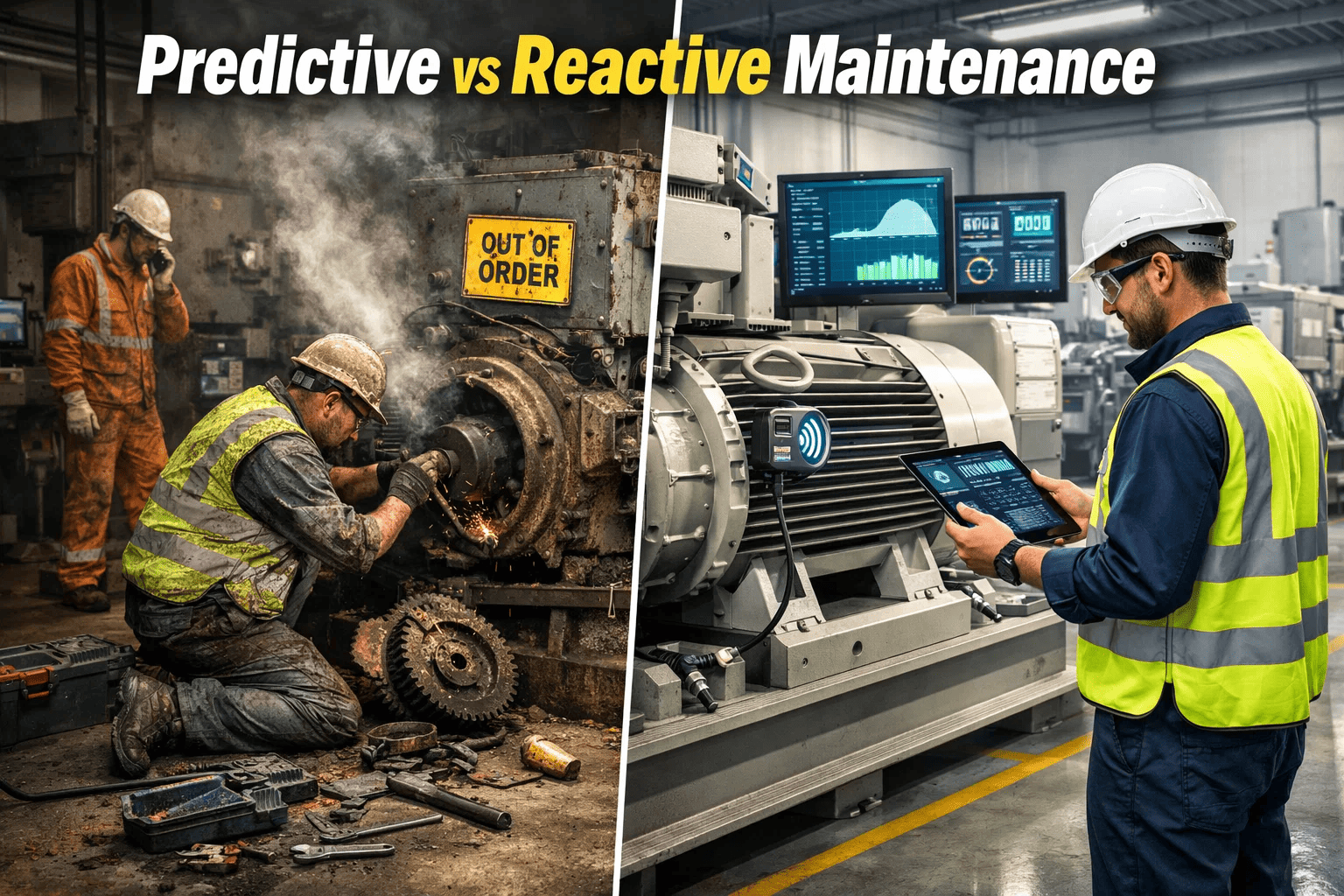
What if every dollar you spent on predictive maintenance returned $10–$30? That's not a pitch — it's the documented ROI range from hundreds of manufacturing facilities that shifted from reactive "firefighting" to AI-driven prediction. Organizations implementing AI predictive maintenance consistently achieve 25–40% lower maintenance costs, 35–45% less unplanned downtime, and 20–40% longer equipment life. With the average manufacturing facility losing $260,000 per hour of unplanned downtime — and each hour costing 50% more than it did in 2019 — the financial case for AI predictive maintenance isn't just positive, it's overwhelming. Schedule a demo to calculate your plant's predictive maintenance ROI with real data.
UPCOMING OXMAINT EVENT
AI Predictive Maintenance: Eliminate Downtime Before It Starts
Join OxMaint's expert-led session covering how AI-native predictive maintenance — including real-time anomaly detection, sensor-to-work-order automation, and CMMS-driven reliability — transforms your maintenance strategy from reactive to predictive.
✓ Live AI anomaly detection walkthrough
✓ Q&A with OxMaint's maintenance AI specialists
✓ Real-world breakdown prevention case studies
✓ Actionable predictive maintenance roadmap you can use immediately
10–30×
Documented ROI
Return on investment within 12–18 months of deployment
25–40%
Cost Reduction
Lower total maintenance spend vs. reactive or preventive
6–14 mo
Full Payback
Most manufacturers recover investment within the first year
95%
Report Positive ROI
Of adopters confirm measurable returns from AI maintenance
The ROI Formula: How to Calculate Your Return
Predictive maintenance ROI isn't abstract — it's a straightforward financial calculation. The formula captures both direct cost savings and the often-overlooked "hidden multipliers" that traditional ROI models miss.
Where the Money Comes From: 5 Revenue Streams of Savings
AI predictive maintenance doesn't generate revenue in one place — it creates five distinct savings streams that compound over time. Most manufacturers undercount their ROI because they only measure the first stream. The real financial impact is 3–5× larger when all streams are captured.
1. Eliminated Unplanned Downtime
$860K+ / year
35–45% reduction in unplanned stops. At $260K/hour, even 3.3 fewer hours/year = $860K saved.
2. Planned vs. Emergency Repair Savings
$500K–$600K / year
Emergency repairs cost 3–5× more than planned. Shifting to planned windows cuts repair spend by 25–30%.
3. Equipment Life Extension
$200K–$400K / year
20–40% longer asset life defers capital expenditure. A $500K motor lasting 12 years instead of 8 = $125K/year saved.
4. Inventory Optimization
$100K–$250K / year
15–30% reduction in spare parts inventory through just-in-time ordering based on predicted demand.
5. Labor Efficiency
$80K–$150K / year
18–25% less maintenance labor through optimized scheduling. Eliminate overtime, reduce contractor dependency.
Total Annual Savings (Typical Mid-Size Plant)
$1.7M – $2.3M / year
Against an annual program cost of $50K–$150K = 10–30× ROI
What's Your Plant's Number? OxMaint calculates your specific ROI based on your asset count, downtime cost, and current maintenance spend — before you commit a dollar.
Start Free Trial
Get Your ROI Calculation
The Payback Timeline: When You Break Even
Most manufacturers worry about the "when" of payback more than the "how much" of ROI. The answer: faster than almost any other capital investment in your plant. A single prevented major breakdown typically covers the entire first year of platform cost.
Month 1–3
Deploy & Baseline
Install sensors on 5–10 critical assets. AI learns equipment baselines. First anomaly alerts begin. Cost: $5K–$25K for pilot.
Month 3–6
First Prevented Failure = Breakeven
One avoided unplanned outage ($50K–$500K saved) typically covers 1–3 years of platform cost. 60–70% of projected savings realized by end of quarter 1.
Most plants hit breakeven here — from a single save.
Month 6–12
Compounding Returns
AI accuracy exceeds 90%. Predictive work orders become routine. Downtime drops 35–45%. Maintenance costs drop 25–30%. Full payback confirmed.
Year 2+
10–30× ROI Zone
Scale to full plant. AI models improve continuously. Equipment life extends 20–40%. Inventory drops 15–30%. Returns compound annually with zero additional capital.
Real-World ROI by Industry
ROI varies by sector because downtime costs, equipment complexity, and failure consequences differ dramatically. But across every manufacturing segment, the pattern is the same: predictive maintenance pays for itself faster than any competing investment.
Automotive
Downtime: $2.3M/hr
30% lower maintenance costs, 40% more uptime. One prevented line stop = full annual ROI.
Payback: <3 months
Heavy Industry
Downtime: $200K+/line
Cement plant achieved 57× ROI in 6 months through software-only monitoring. No new hardware needed.
Payback: <6 months
General Mfg.
Downtime: $260K/hr avg.
25–30% cost reduction. $2M annual spend → $500–600K saved/year. 10–30× return within 12–18 months.
Payback: 6–14 months
Fleet / Equipment
$43K savings/unit/yr
25+ unit fleets achieve payback in 3–4 months. Smaller fleets with high-value assets: 12–18 months.
Payback: 3–18 months
The Hidden ROI Most CFOs Miss
Direct cost savings are only half the story. The "operational multipliers" — the second-order effects of preventing failures — create substantial value that standard ROI calculations often miss entirely. Smart CFOs account for all six.
01
Product Quality Preservation — Equipment running in optimal condition produces consistent quality. Degraded equipment causes dimensional drift, surface defects, and batch failures before anyone notices.
02
Supply Chain Continuity — A single unplanned stop cascades through your delivery schedule. Prevented outages keep commitments intact and avoid penalty clauses.
03
Worker Safety Improvement — Equipment operating within predicted parameters is safer equipment. Fewer emergency repairs = fewer high-risk situations for maintenance crews.
04
Insurance Premium Reduction — Documented predictive maintenance programs demonstrate lower risk profiles, qualifying for reduced premiums on equipment and business interruption coverage.
05
Energy Optimization — Degraded equipment consumes 5–15% more energy. AI-maintained equipment runs at peak efficiency, saving 12% on average in energy costs.
06
Sustainability & ESG Reporting — Extended asset life reduces material consumption. Optimal operation cuts carbon emissions. Documented maintenance supports ESG compliance and reporting.
The ROI Isn't a Question. The Only Question Is When You Start.
95% of adopters report positive ROI. Average return: 10–30×. Typical payback: 6–14 months. OxMaint gives your maintenance team the AI platform to prove it — with your numbers, your assets, your savings.
Frequently Asked Questions
What's the realistic ROI range for AI predictive maintenance?
Documented ROI ranges from 10:1 to 30:1 within 12–18 months. The US Department of Energy reports a 70–75% decrease in breakdowns and potential 10× ROI. For facilities with $2M+ annual maintenance spend, savings of $500K–$600K per year are typical. A cement plant achieved 57× ROI in just six months through software-only monitoring. The key variable is your downtime cost — if each hour costs $50K+, ROI is almost guaranteed at any scale.
Start free and calculate your specific ROI with OxMaint.
How quickly does predictive maintenance pay for itself?
Most manufacturers hit breakeven within 3–6 months from a single prevented major failure. Full payback of the entire program typically occurs within 6–14 months. 60–70% of projected savings are realized within the first quarter post-implementation. For large fleets of 25+ assets, payback can be as fast as 3–4 months.
What does a predictive maintenance program cost to implement?
For a mid-sized plant with 50–100 critical assets, expect $50,000–$150,000 per year including software, hardware integration, and support. Pilot programs covering 5–10 assets cost $5,000–$25,000. IoT sensors run $0.10–$0.80 per unit, and edge gateways cost $2,000–$10,000 per node. OxMaint offers a free trial so you can evaluate before committing budget.
Book a demo for a customized cost estimate.
How do I build the business case for my CFO?
Use the Total Business Value (TBV) framework: combine direct savings (downtime reduction + repair cost savings + inventory optimization) with indirect multipliers (quality preservation + supply chain continuity + energy savings + insurance reductions). The formula is: ROI = (Total Savings − Program Cost) ÷ Program Cost × 100. OxMaint generates CFO-ready ROI reports automatically from your actual maintenance data.
Start free to generate your first ROI projection.
Does ROI improve over time or plateau?
ROI compounds annually. AI models improve with more data — prediction accuracy exceeds 92% by month 12 and keeps climbing. Equipment life extension (20–40% longer) defers capital expenditure year after year. Inventory optimization tightens as demand prediction improves. Most mature programs document 40%+ maintenance cost reductions by year 3, with zero additional capital investment required beyond the initial deployment.