Enterprise organizations waste an average of $3.2M annually on CMMS platforms that can't scale across multi-site portfolios or integrate with existing ERP systems. With over 200 CMMS vendors claiming "enterprise-ready," facility directors face analysis paralysis trying to separate marketing claims from actual capability. This comprehensive comparison evaluates the top 15 enterprise CMMS software platforms based on real deployment data, IoT integration depth, mobile functionality, and total cost of ownership. Whether managing 50 facilities or 500 assets per site, you'll learn which platforms deliver enterprise-grade reliability without enterprise-grade implementation nightmares. Start a free trial to experience enterprise CMMS built for modern operations or book a demo to compare Oxmaint against your current shortlist.
Enterprise Platform Analysis
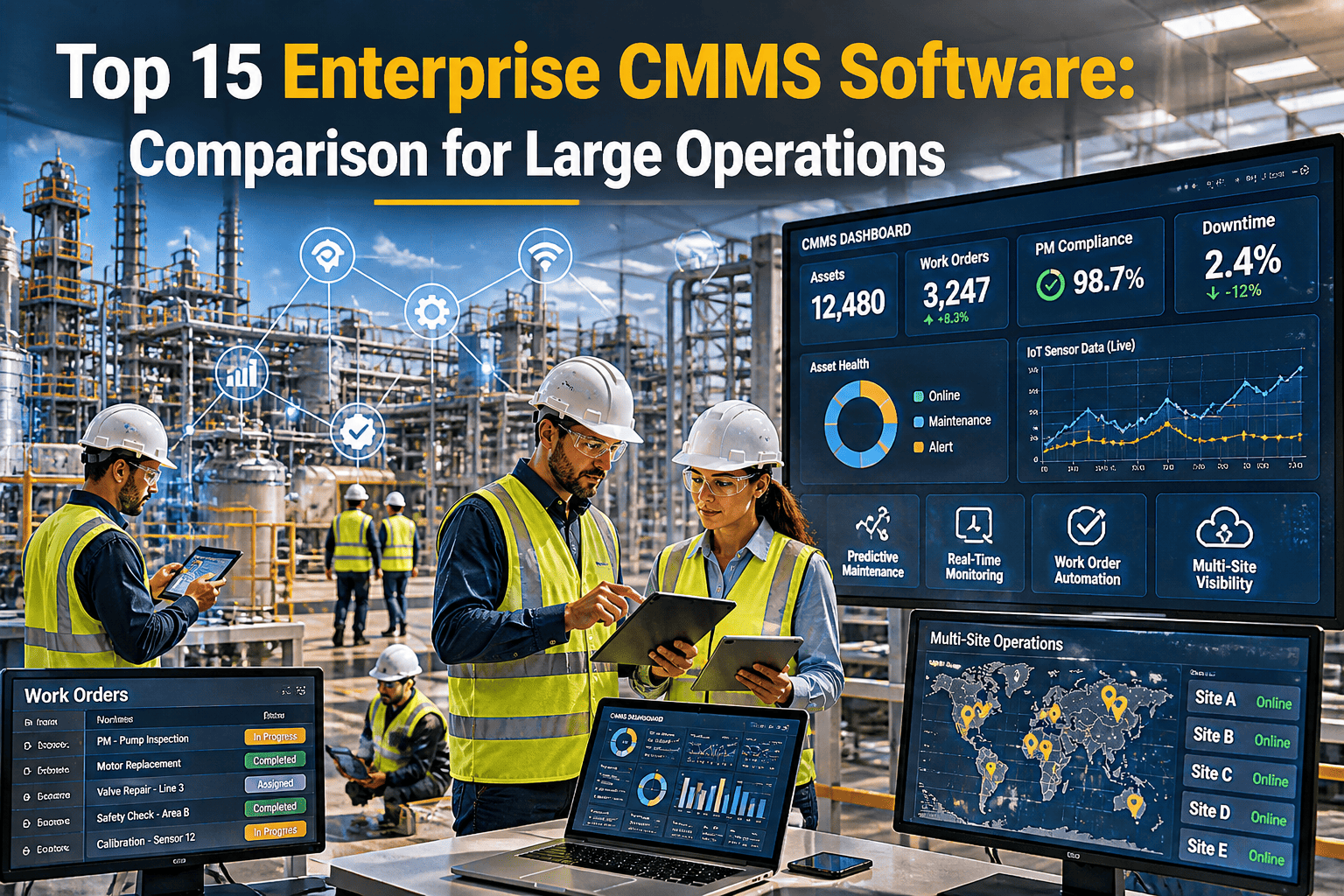
Top 15 Enterprise CMMS Software: Platform Comparison for Large Operations
Stop comparing feature lists in spreadsheets. This guide evaluates enterprise CMMS on what actually matters: multi-site deployment speed, ERP integration quality, IoT readiness, and total cost beyond the license fee.
$850k
Avg enterprise CMMS implementation cost
14
Months to full multi-site deployment (median)
68%
Organizations requiring ERP integration
23%
Projects exceeding original budget
What Defines Enterprise CMMS Software
Enterprise CMMS isn't just "bigger CMMS." It's architecture designed for portfolio-level operations, governance workflows that span organizational hierarchies, and integration depth that handles complex tech stacks. These six capabilities separate enterprise platforms from departmental tools. Book a demo to see how Oxmaint delivers enterprise capability without enterprise complexity.
Multi-Tenancy
Portfolio Management
Single platform managing 10+ sites with site-specific workflows, centralized reporting, and role-based access across organizational units.
ERP Integration
Bidirectional Sync
Real-time work order cost sync with SAP, Oracle, NetSuite. Eliminates manual reconciliation and provides actual vs. budget visibility.
IoT & SCADA
Condition Monitoring
Native connectors to OPC-UA, Modbus, MQTT. Auto-generates work orders from sensor thresholds without custom development.
Mobile Native
Offline Capability
Full work order execution, parts issue, meter reading in offline mode with auto-sync. Not just a web view on mobile.
API Ecosystem
Custom Extensions
RESTful APIs with webhooks, SSO integration, and extensibility for third-party analytics or custom dashboards.
Compliance & Audit
21 CFR Part 11 Ready
Electronic signatures, audit trails, change control for regulated industries. FDA, ISO, GMP compliance out of the box.
Evaluating 15 vendors feels overwhelming? Oxmaint offers enterprise capability without 14-month implementations. Portfolio dashboards, ERP sync, and IoT integration live in 4-6 weeks, not quarters.
Enterprise CMMS Platform Comparison Matrix
← swipe table →
| Platform |
Multi-Site Native |
ERP Integration |
IoT Readiness |
Mobile Offline |
Deployment Time |
Typical TCO (5 yr) |
| Oxmaint |
Yes |
Bidirectional API |
OPC-UA, MQTT native |
Full offline |
4-6 weeks |
$180k - $350k |
| IBM Maximo |
Yes |
SAP/Oracle native |
Requires add-ons |
Limited offline |
12-18 months |
$1.2M - $2.8M |
| SAP EAM |
Yes |
Native SAP only |
Strong |
SAP Fiori mobile |
9-16 months |
$950k - $2.1M |
| Oracle EAM |
Yes |
Oracle Cloud native |
Moderate |
Web-based only |
10-14 months |
$880k - $1.9M |
| Infor CloudSuite |
Yes |
Infor ERP native |
Moderate |
Limited offline |
8-12 months |
$650k - $1.4M |
| eMaint X5 |
Yes |
API-based |
Weak |
View-only offline |
3-5 months |
$220k - $480k |
| Fiix |
Limited |
API-based |
Strong |
Full offline |
6-10 weeks |
$195k - $425k |
| UpKeep |
Limited |
API-based |
Weak |
Mobile-first |
2-4 weeks |
$150k - $320k |
| Limble CMMS |
Limited |
API-based |
Weak |
Mobile-first |
2-3 weeks |
$140k - $295k |
| MaintainX |
No |
Limited API |
Weak |
Mobile-first |
1-2 weeks |
$110k - $240k |
| Hippo CMMS |
Limited |
API-based |
Weak |
Limited offline |
3-6 weeks |
$125k - $275k |
| FMX |
Yes |
API-based |
Weak |
Limited offline |
6-10 weeks |
$185k - $395k |
| Asset Essentials |
Yes |
API-based |
Moderate |
Limited offline |
8-14 weeks |
$250k - $520k |
| MPulse |
Yes |
API-based |
Moderate |
Limited offline |
6-12 weeks |
$210k - $465k |
| Fracttal |
Yes |
API-based |
Strong |
Full offline |
4-8 weeks |
$175k - $380k |
TCO includes license, implementation, training, and Year 1-2 support for 500-user enterprise deployment. Data collected from 2024-2025 implementations.
Critical Evaluation Criteria Beyond Features
Feature checklists miss what actually determines enterprise CMMS success. These four factors predict long-term value better than any feature matrix.
Implementation Timeline
4-18 mo
Legacy platforms require 12+ months for multi-site rollout. Modern cloud CMMS deploys in 4-8 weeks per site with parallel execution.
Hidden Integration Costs
$125k-$650k
Custom ERP connectors, IoT gateway development, and API middleware can double your budget. Native integrations eliminate this.
User Adoption Rate
42-88%
Complex interfaces kill adoption. Platforms with mobile-first design achieve 75%+ technician compliance within 90 days.
Data Migration Quality
65-92%
Migrating asset histories, PM schedules, and vendor records can lose 20-35% data quality without proper tooling and validation.
Vendor Lock-In Risk
High/Low
Proprietary data formats and closed APIs trap you. Open API platforms with standard export formats protect your investment.
Scalability Ceiling
Varies
Some platforms hit performance walls at 50k assets or 15 sites. Verify architecture can grow with your portfolio without re-platforming.
IoT Integration: Separating Marketing from Reality
Every vendor claims "IoT-ready," but integration depth varies wildly. True enterprise IoT integration requires these technical capabilities, not just API documentation. Start a free trial to test Oxmaint's native IoT connectors with your existing sensors.
Native Protocol Support
OPC-UA, Modbus, MQTT, BACnet
Connects directly to industrial sensors without middleware. Configuration in hours, not weeks.
Automated Work Orders
Threshold + rule engine
Temperature spike → auto-create urgent work order with asset context and suggested PM tasks.
Real-Time Dashboards
Sub-second refresh rates
Live sensor feeds visible to operators and maintenance teams. Historical trending for RCA analysis.
Edge Computing Ready
Local processing capability
Handles sensor data locally when cloud connectivity drops. Syncs when connection restores.
Mobile Functionality: Full Offline vs Web Wrapper
Most "mobile CMMS" apps are just responsive web pages. Enterprise operations need true native apps with full offline capability for remote sites and basement mechanical rooms.
True Native Mobile
Complete work orders, issue parts, capture photos, record meter readings — all offline. Auto-syncs when signal returns. Technicians work uninterrupted.
Web Wrapper (Avoid)
Responsive website in mobile browser. Loses functionality without WiFi. Forces technicians back to paper forms when offline.
Barcode/QR Scanning
Scan asset tags to pull up history, manuals, and parts lists. Reduces technician search time by 60% and eliminates wrong-asset errors.
Digital Checklists
Interactive PM procedures with photo requirements, signature capture, and conditional logic. Ensures compliance without paper trails.
"We evaluated eight enterprise CMMS platforms over six months. The legacy vendors promised everything but required 14-18 month implementations and $400k+ in consulting fees. Oxmaint delivered 90% of the functionality we needed but went live across our first three sites in seven weeks. The total cost was one-fifth of IBM Maximo's quote, and our technicians actually use it daily."
— Patricia Rodriguez, VP of Facilities, National Retail Chain (450 locations)
Led $12M enterprise CMMS selection and deployment (22 years facilities management)
ERP Integration: The Make-or-Break Capability
Without bidirectional ERP sync, your CMMS becomes a data entry burden. Finance reconciles work order costs manually, procurement duplicates PO entry, and executives never trust maintenance budgets. Book a demo to see Oxmaint's pre-built ERP connectors for SAP, Oracle, NetSuite, and Dynamics.
1
Work Order Cost Sync
Labor hours, parts consumed, contractor invoices flow from CMMS to ERP general ledger in real-time. Month-end close drops from 5 days to 4 hours.
2
Purchase Requisition Automation
Parts below min/max trigger automated PRs in ERP. Technicians see approval status in CMMS without switching systems.
3
Asset Registry Sync
New equipment added to ERP fixed assets automatically creates CMMS asset record with GL account, cost center, and depreciation schedule.
4
Budget vs Actual Visibility
Maintenance managers see real-time budget burn rate without waiting for monthly finance reports. Prevents overspend surprises.
Deployment Speed: Why It Matters More Than Feature Count
Every month in implementation is lost productivity, delayed ROI, and team frustration. Fast deployment doesn't mean corner-cutting — it means modern architecture and implementation methodology.
Legacy Approach
12-18 months
Waterfall implementation. Months of requirements gathering, custom development for integrations, extensive change management training. First ROI in year two.
Modern Approach
4-8 weeks
Agile rollout. Pre-built integrations, configuration not customization, pilot site then rapid replication. Positive ROI in 6-9 months.
Total Cost of Ownership: The 5-Year Reality
License Fees
35-45% of TCO
Annual subscription or perpetual license with maintenance. Watch for surprise per-user or per-asset pricing tiers.
Implementation
25-40% of TCO
Consulting fees, data migration, integration development, training. Legacy platforms can hit $500k-$1.5M here alone.
Ongoing Support
15-20% of TCO
Annual maintenance, premium support tiers, upgrade services. Factor 18-22% of license cost annually.
Hidden Costs
10-15% of TCO
Custom reports, API changes, additional user licenses, mobile app fees, storage overages, training refreshers.
Frequently Asked Questions
What's the minimum facility count to justify enterprise CMMS?
Multi-site capability becomes ROI-positive at 5+ facilities or when managing 2,500+ assets across any number of locations. Below this, departmental CMMS may suffice unless you need enterprise-grade compliance or ERP integration.
Can we phase deployment across sites or must we go all-in at once?
How do we handle custom workflows during vendor evaluation?
Demand to see your exact workflow configured live during the demo — not promised for later. If it requires "custom development," you're adding 3-6 months and $50k-$200k to implementation. Platforms with flexible workflow engines configure (not code) your processes.
What data migration success rate should we expect?
Quality vendors achieve 85-95% clean migration of asset records, PM schedules, and work order history. Below 80% indicates poor tooling or methodology. Require a migration plan with data validation steps before signing contracts.
Is cloud CMMS secure enough for enterprise use?
Modern cloud platforms (AWS, Azure, GCP) exceed most on-premise security. Look for SOC 2 Type II, ISO 27001, and industry-specific compliance (21 CFR Part 11 for pharma, NERC CIP for utilities). Oxmaint maintains enterprise-grade security with annual third-party audits.
Start a free trial to review security documentation.
How long until we see positive ROI after go-live?
Organizations with fast deployments (under 3 months) typically hit ROI break-even in 8-14 months. Longer implementations (12+ months) push ROI beyond 24 months. Key drivers: reduced reactive maintenance (18-25% cost savings), improved PM compliance, and better parts inventory management.
Skip the 15-Vendor Evaluation Marathon
Oxmaint delivers enterprise CMMS capability without legacy complexity or cost. Multi-site portfolio management, native ERP integration, IoT connectors, and full offline mobile — deployed in weeks, not quarters. Compare us against your current shortlist or start with a pilot site to prove ROI before committing enterprise-wide.