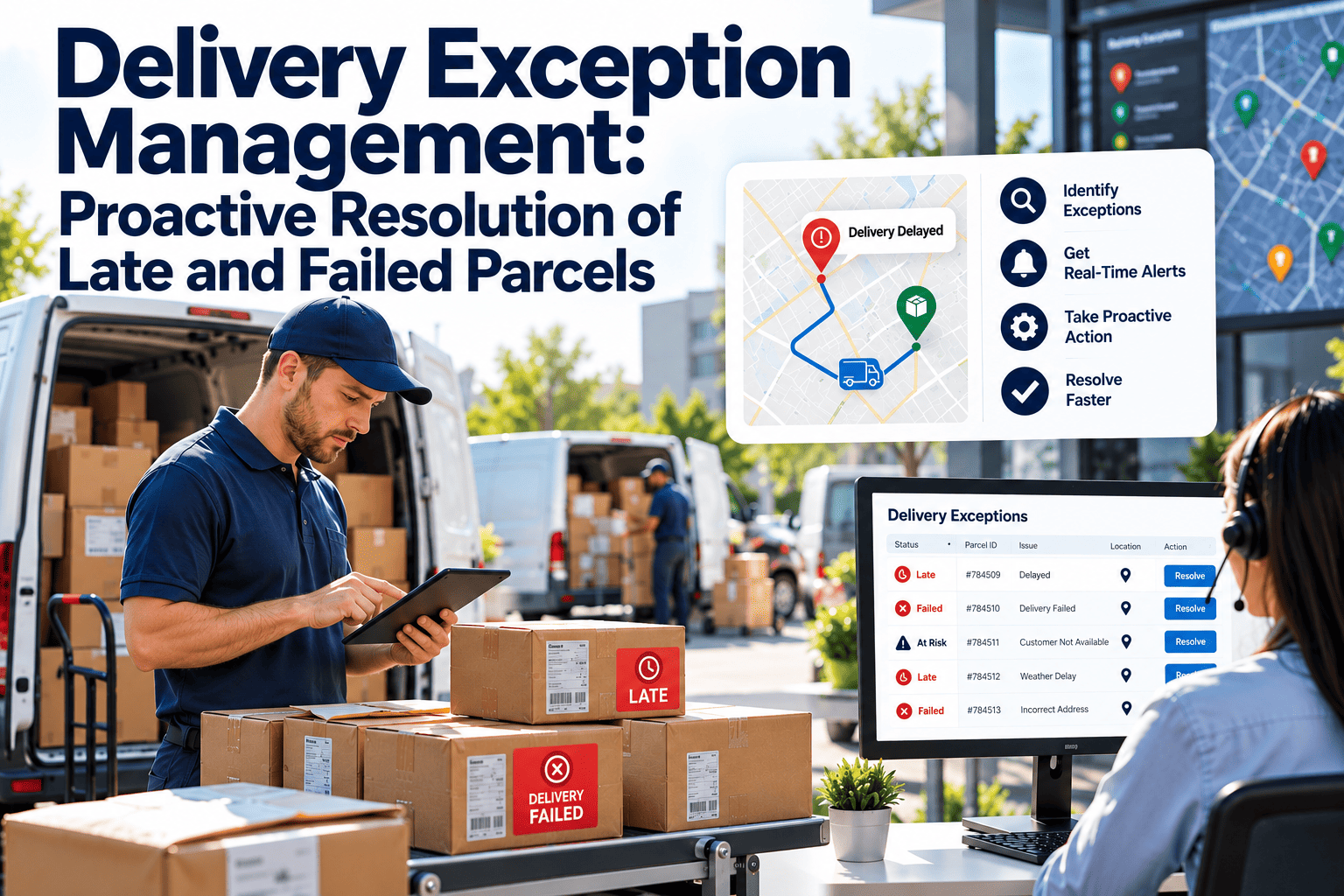
Every delivery network produces exceptions: a wrong gate code, a refused carton, a van that will not start, a handheld scanner that stops syncing. What separates strong operations from struggling ones is not the absence of exceptions but how early they are seen and how consistently they are resolved. Delivery exception management replaces scattered calls and spreadsheets with a defined process, clear owners, and time limits. This guide covers categorization, real-time triage, customer communication, and the maintenance discipline that prevents many exceptions entirely, and you can see how a connected maintenance platform supports that by trying Oxmaint maintenance management software with your own assets.
Catch late and failed parcels before the customer has to call
Proactive resolution means spotting an exception while there is still time to fix it. Build a triage process for late, refused, damaged, and undeliverable parcels, and remove the equipment failures that create many of them.
What counts as a delivery exception
A delivery exception is any event that stops a parcel from following its planned route, time window, or handover. Many are invisible to the customer until the promised window has already passed.
Six exception families and who normally owns them
| Family | Typical triggers | Usual owner | Time sensitivity |
|---|---|---|---|
| Address and access | Incomplete address, locked gate, missing entry code, closed premises | Dispatch and customer service | Fix before the driver leaves the area |
| Recipient unavailable or refusing | Nobody home, wrong item, payment dispute, refused on arrival | Customer service | Same day |
| Damage and loss | Crushed carton, leaking pack, missing scan, mis-sort | Hub operations and claims | Before the next handoff |
| Delay and capacity | Traffic, weather, late linehaul, overloaded route | Dispatch | Hours before the window closes |
| Temperature and condition | Refrigeration fault, door left open, product out of range | Fleet and quality | Minutes to hours |
| Equipment and vehicle | Breakdown, flat tyre, failed scanner, sorter jam, lift gate fault | Maintenance and fleet | Immediate |
Reactive handling versus proactive resolution
The difference is rarely effort. Reactive teams work hard, but they discover problems late and solve the same ones repeatedly.
Reactive operation
- Exceptions surface when a customer complains or a driver phones in
- Information is scattered across email, calls, and chat messages
- Several people work the same case without a clear owner
- Closure reasons are free text, so patterns stay hidden
- Maintenance hears about a vehicle problem only after the breakdown
Proactive operation
- Exceptions are flagged from scan gaps, route progress, and vehicle signals
- One queue holds category, owner, and deadline for every case
- Each category follows a written resolution playbook
- Structured reason codes are reviewed every week
- Defects become work orders before the next route starts
The exception lifecycle, step by step
A reliable process moves each case through the same six stages. Time targets should be set per category, not for the queue as a whole.
Detect early
Use missing scans, stalled stops, route-progress gaps, driver defect reports, and customer contacts as triggers. The earlier the trigger, the more options remain.
Classify with reason codes
Assign one category and one structured reason. Avoid an "other" code that grows into the largest bucket and hides your real causes.
Triage by impact and time
Rank cases by consequence and the time left before the delivery window closes. The matrix below shows a simple way to do this.
Resolve with a playbook
Give each category a default action: redeliver, reroute, hold at a pickup point, swap a vehicle, or return to sender. Owners decide only when the case falls outside the playbook.
Communicate before asked
Tell the recipient what happened, what happens next, and when. Silence is the most common cause of avoidable contacts.
Learn and prevent
Review reason codes weekly, find repeat causes, and assign a corrective action with an owner. Closing the case is not the same as closing the cause.
A triage matrix for real-time decisions
Dispatchers cannot treat every exception equally. Sort by two questions: how much is at stake, and how much time is left.
Act now
High impact, little timeReroute, swap the vehicle, escalate to a supervisor, and contact the recipient directly.Plan today
High impact, time availableReserve capacity, reorder the route, and prepare a confirmed new time window.Automate
Low impact, little timeSend a standard notification and offer self-service rescheduling.Monitor
Low impact, time availableWatch for change, batch the cases, and review them in the next planning cycle.Give every exception an owner and a clock
Start by tracking the equipment and vehicle issues that quietly create late deliveries. Set up work orders, inspections, and preventive schedules in one place.
Where exceptions begin along the delivery chain
Exceptions are visible at the doorstep, but many start much earlier. Mapping each stage helps you place controls where they are cheapest.
Pre-load
- Wrong or partial address data
- Weak packaging
- Vehicle not inspected
Linehaul
- Late arrival at the hub
- Trailer or reefer fault
- Driver hours limits
Hub
- Sorter or conveyor stoppage
- Mis-sorts and missed scans
- Dock congestion
Last mile
- Traffic and weather
- Vehicle breakdown
- Route overload
Doorstep
- Access problems
- Recipient unavailable
- Damage found on handover
The maintenance link most exception programs miss
Address and recipient problems get most of the attention. Yet equipment and vehicle failures produce some of the most expensive exceptions, and they are the most preventable.
From failure to exception to preventive control
| Asset failure | Resulting exception | Preventive control |
|---|---|---|
| Refrigeration unit fault | Temperature excursion and rejected load | Scheduled unit servicing and a pre-trip temperature check |
| Brakes, tyres, battery | Roadside breakdown and missed windows | Mileage-based preventive maintenance and daily vehicle inspection |
| Lift gate or ramp | Cannot unload at the dock or doorstep | Routine inspection and a driver defect report that opens a work order |
| Handheld scanner | Missing scans that look like lost parcels | Asset register, battery replacement schedule, and replacement on condition |
| Sorter or conveyor | Mis-sorts and hub delay | Condition checks and critical spares held in stock |
| Telematics unit | Blind spots in arrival estimates | Device check added to the standard service routine |
Why this matters for triage
- A breakdown is an exception that hits every parcel on the route
- A failed refrigeration unit can affect an entire load at once
- Defects reported at the start of a shift cost far less than defects found on the road
Root causes behind recurring exceptions
Most operations fix individual cases but never reach the cause. Group closed cases by root cause and the same few patterns usually appear again and again.
Data and process causes
- Free-text addresses with no validation at order entry
- Delivery instructions that never reach the driver
- Promised windows set without checking route capacity
- Returns and refusals logged under a generic reason
- No handoff rule when a case crosses teams
Asset and facility causes
- Vehicles serviced by calendar instead of actual usage
- Defects reported verbally and never recorded
- Scanners and printers replaced only after they fail
- Hub equipment repaired without a spare parts plan
- Inspection records kept on paper and lost
A simple root-cause routine
- Pull the last month of closed cases and sort by reason code
- Select the three codes with the highest repeat count
- Ask five whys for each, stopping at a cause you can change
- Assign an owner, a due date, and a follow-up check date
- Confirm in the next review that the repeat count fell
Staying in control during peak periods
Seasonal peaks, promotions, and bad weather multiply exceptions at the exact moment your team has the least spare time. Preparation matters more than heroics.
Four to six weeks before
Complete overdue preventive maintenance, retire unreliable vehicles and scanners, and confirm spare parts levels for the parts that strand routes.One to two weeks before
Rehearse the playbooks, confirm escalation contacts, and agree on temporary overflow capacity with partners.During the peak
Hold a short daily review of open cases, equipment downtime, and the previous day's top reason codes.After the peak
Review what failed, update the playbooks, and schedule the maintenance deferred during the rush.Who does what: a simple responsibility map
Unclear ownership is why cases bounce between teams. Write down who detects, decides, and fixes for each family, and review it every quarter.
| Role | Detects | Decides | Fixes |
|---|---|---|---|
| Driver | Access issues, vehicle defects, refusals at the door | Safe immediate actions within policy | Handover and proof of attempt |
| Dispatcher | Route drift, late stops, capacity gaps | Reroute, reassign, or swap vehicles | Revised plan and customer message |
| Customer service | Complaints and contact patterns | Remedy and compensation within limits | Recipient follow-up and case closure |
| Maintenance | Defect reports and failed inspections | Repair priority and vehicle release | Corrective and preventive work |
| Operations manager | Trends across reason codes and assets | Investment and process changes | Root-cause actions with owners |
Customer communication that reduces contacts
Proactive notification works when each message gives the customer something to do or something to know. Build four levels and trigger them from exception status.
Level 1: Heads-up
A delay is likely. State the new estimated window as soon as the risk appears.Level 2: Options
Offer self-service choices: reschedule, safe place, neighbour, or pickup point.Level 3: Confirmation
Confirm the chosen action and the exact new window, then follow through.Level 4: Recovery
When a delivery fails or an item is damaged, explain the remedy and the next step plainly.Rules that keep messages useful
- Send only when status changes, not on every internal event
- Use the customer's preferred channel and language
- Never promise a time the dispatcher has not confirmed
- Route replies to the same case so history stays in one place
Early-warning signals worth watching
Proactive teams act on signals that appear before a delivery fails. Choose a handful you can actually monitor, and tie each one to a named response.
Stalled stops
A vehicle stays at one stop well beyond the usual service time, which may point to an access or handover problem.Route progress gap
Completed stops fall behind plan by midday, so the remaining windows are at risk and a rebalance is needed.Failed pre-trip item
A tyre, brake, lift gate, or temperature check fails before departure and should block the route until reviewed.Rising defect reports
The same vehicle or device appears in several defect reports within a short period and needs a deeper inspection.Metrics that show whether the process works
Measure detection and recovery, not just failure counts. Define each metric once and keep the definition stable.
First-attempt delivery rate
Parcels delivered on first attempt divided by parcels attemptedException rate by family
Exceptions in a category divided by total parcels in the periodMean time to detect
Average time from the event occurring to the case being loggedMean time to resolve
Average time from logging to a confirmed outcome, by categoryRepeat exception rate
Cases sharing a root cause with an earlier closed caseEquipment-caused share
Exceptions traced to an asset failure divided by all exceptionsA practical checklist for building the program
You do not need new systems on day one. Begin with a shared taxonomy and a single queue, then add automation.
Foundation
- Agree on six or fewer exception families
- Write structured reason codes for each family
- Name an owner and a time target per family
- Keep one queue for every open case
- Document a default playbook action per code
Prevention
- Run a digital vehicle inspection before each route
- Schedule preventive maintenance by mileage and hours
- Let drivers raise a defect from the cab or yard
- Stock spares for the parts that strand vehicles
- Review reason codes against asset history monthly
How Oxmaint supports the maintenance side of exceptions
Oxmaint does not replace your routing or dispatch tools. It manages the vehicles, equipment, and facilities that determine whether those plans can be delivered.
| Exception need | Oxmaint capability | Operational result |
|---|---|---|
| Driver reports a defect | Mobile work orders | Defect logged with priority and an assigned technician |
| Recurring vehicle service | Preventive maintenance scheduling | Service due dates tracked before failure risk rises |
| Pre-trip checks | Digital inspections | Checklist records and failed items flagged for action |
| Repeat failures | Asset management and history | Visible failure patterns per vehicle, scanner, or sorter |
| Waiting on parts | Inventory management | Critical spares tracked and reordered in time |
| Management review | Dashboards and reporting | Downtime, backlog, and completion trends in one view |
Frequently asked questions
What is delivery exception management?
It is the process of detecting, categorizing, resolving, and learning from deliveries that deviate from plan, with owners and time targets for each case.
How do I start with proactive resolution?
Define a small set of exception families, structured reason codes, and one shared queue. Automate notifications after the taxonomy works.
Which exceptions can maintenance reduce?
Breakdowns, refrigeration faults, lift gate failures, scanner problems, and hub equipment stoppages. You can start tracking them in Oxmaint.
Which metric should I track first?
Start with mean time to detect and first-attempt delivery rate. Add repeat exception rate once reason codes are consistent.
Can I see this applied to my fleet?
Yes. You can book a demo to walk through inspections, work orders, and asset history for your operation.
Turn exceptions from a fire drill into a controlled process
Connect vehicle and equipment maintenance to your delivery performance, so fewer parcels fail for reasons you could have fixed in the yard.