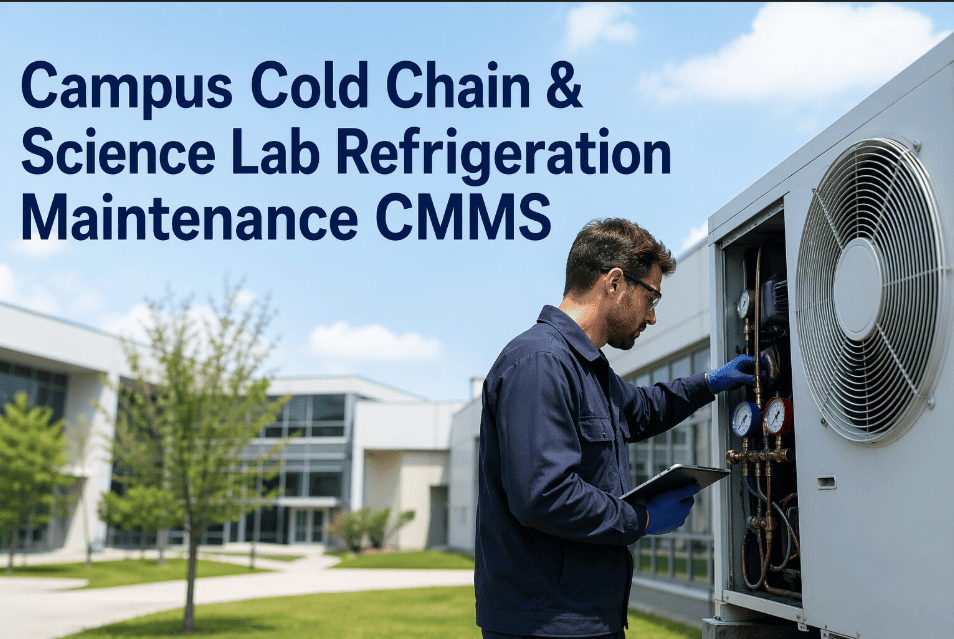
At 3:14 AM on a Saturday in November, a ULT freezer in the biochemistry wing of a research university in Chapel Hill failed silently. By the time the Monday morning lab technician opened the unit at 8:47 AM, the internal temperature had risen to -12°C from a working -80°C. Thirty-two irreplaceable tissue samples — two years of a doctoral candidate's PhD research — were destroyed. Total estimated research value: $1.8 million. The freezer had no temperature monitoring connected to any alert system. The university had no protocol for after-hours cold chain incidents. The compressor had been showing elevated run cycles for six weeks before failure — a detectable warning signal that a sensor and a CMMS PM schedule would have captured and converted into a work order well before the failure event. After the loss, the university deployed OxMaint with temperature sensor integration across all 47 cold storage units in four research buildings. In 18 months of operation, the system generated 14 alerts for units showing abnormal temperature trends — all 14 were investigated and resolved before any sample loss occurred. Sign in to OxMaint to deploy cold chain monitoring and PM scheduling for your campus research facilities, or book a demo to see how OxMaint protects campus cold storage assets.
A Failed Lab Freezer at 3 AM on a Saturday Doesn't Generate a Work Order — Unless Your CMMS Is Connected to a Temperature Sensor.
OxMaint provides 24/7 temperature sensor monitoring, PM scheduling, and after-hours alert protocols for every campus cold storage unit — from -196°C liquid nitrogen dewars to 4°C sample refrigerators — protecting years of research investment from silent equipment failure.
estimated research value lost in a single ULT freezer failure at a North Carolina university — 32 tissue samples, 2 years of doctoral research, no temperature alert
43%
of campus ULT freezer failures show detectable early warning signals in compressor run-cycle data 3–8 weeks before catastrophic failure — all preventable with sensor monitoring
14
pre-failure alerts generated in 18 months across 47 cold storage units after OxMaint sensor integration — all resolved before sample loss, zero incidents
24/7
temperature monitoring coverage required to close the 3 AM Saturday failure window — OxMaint sensor integration operates continuously regardless of facility staffing
Cold chain maintenance failures at research universities are not equipment problems — they are monitoring and response infrastructure problems. The compressor that failed in Chapel Hill had been generating data signals for 6 weeks. Without a sensor connected to a CMMS alert system, that data was invisible. The fix is not more expensive equipment — it is connecting existing equipment to systematic monitoring and PM protocols that create actionable work orders before failure, not incident reports after it.
Cold Storage Asset Types — OxMaint Temperature Monitoring Coverage
-196°C
Liquid Nitrogen Dewars
Cell lines, embryos, long-term biological specimens. OxMaint tracks liquid nitrogen level with automated fill alerts, dewar seal condition PM schedule, and vent system inspection.
Alert: Level below 30% or temp rise above -160°C
-80°C
ULT Freezers
Tissue samples, reagents, irreplaceable research specimens. Compressor run-cycle monitoring, door seal PM, condenser cleaning schedule, and 24/7 temperature alerts.
Alert: Temp above -70°C or compressor duty cycle >75%
-20°C
Laboratory Freezers
Enzymes, antibodies, frozen reagents. Continuous temperature logging, door gasket inspection, defrost cycle monitoring, and graduated alert escalation to lab staff and facilities.
Alert: Temp above -15°C sustained over 15 minutes
2–8°C
Pharmacy & Vaccine Refrigerators
Vaccines, biological drugs, temperature-sensitive pharmaceuticals. CDC-compliant temperature monitoring, twice-daily manual log verification, and deviation response protocol with documented chain of custody.
Alert: Temp outside 2–8°C for more than 30 minutes
15–25°C
Controlled Room Temperature Storage
Chemical reagents, reference standards, stability study samples. Humidity and temperature co-monitoring with environmental deviation alerts for compliance-sensitive storage.
Alert: Temp or RH% outside specified limits
Walk-in
Cold Rooms & Walk-in Coolers
Large-volume sample and reagent storage. Compressor bank PM, door gasket inspection, condenser coil cleaning, refrigerant level check, and drain pan maintenance — all scheduled in OxMaint.
Alert: Temp drift >2°C from setpoint over 1 hour
The Six Cold Chain Failure Points OxMaint Closes
No After-Hours Temperature Alert
Most campus lab refrigeration failures occur outside business hours — evenings, weekends, and holidays when facility staff are off-site. OxMaint's 24/7 temperature monitoring sends push alerts to the designated on-call technician and lab supervisor the moment a temperature deviation is detected, regardless of time of day or day of week.
No Early Warning from Compressor Data
ULT freezers signal impending failure through elevated compressor run cycles weeks before temperature deviation occurs. OxMaint monitors compressor duty cycle continuously — when run time exceeds the configured threshold, a predictive maintenance work order is created for technician investigation before any sample risk develops.
Condenser Cleaning Not Scheduled
Dust and particulate accumulation on condenser coils reduces heat rejection efficiency by up to 30% — a primary driver of compressor overload and ULT freezer failure. OxMaint schedules condenser cleaning at manufacturer-recommended intervals with a mobile checklist that requires photo documentation of condenser condition before and after cleaning.
Door Gasket Failure Undetected
Failed door gaskets cause continuous heat infiltration that forces the compressor to run at elevated duty cycles — the slow deterioration mode that precedes catastrophic failure. OxMaint's bi-monthly gasket inspection checklist documents gasket condition with photo, moisture indicators, and seal compression test at each inspection cycle.
Temperature Log Gaps in Compliance Records
FDA 21 CFR Part 211, College of American Pathologists (CAP), and AAALAC accreditation requirements mandate documented temperature records with defined retention periods. OxMaint's continuous temperature logging creates a complete, uninterrupted compliance record — exportable for inspection with gap analysis that identifies any recording interruptions.
No Escalation Protocol for Deviation Events
When a temperature deviation alert fires at 3 AM, who is responsible for responding, in what sequence, and within what time window? Without a documented escalation protocol, the alert goes to whoever happens to see it — if anyone. OxMaint's incident escalation chain notifies the lab PI, the facilities on-call technician, and the facilities director in a defined sequence if acknowledgement is not received within the configured window.
OxMaint · Cold Chain Protection · Campus Research Assets
Every Cold Storage Unit Connected. Every Deviation Alerted. Every PM Scheduled. Zero Silent Failures.
OxMaint temperature monitoring, PM scheduling, and escalation protocols — deployed for campus cold chain assets in 30 days.
OxMaint Cold Chain PM Schedule — What Gets Maintained and When
Maintenance Task
Frequency
Asset Type
Compliance Requirement
OxMaint Output
Temperature calibration verification
Quarterly
All cold storage
FDA 21 CFR · CAP · AAALAC
Calibration certificate + log
Condenser coil cleaning
Semi-annual
Refrigerators, freezers, ULT
Manufacturer PM spec
Photo before/after + WO record
Door gasket inspection
Bi-monthly
All refrigerators + freezers
Manufacturer PM spec
Condition rating + photo
Drain pan and defrost check
Monthly
Refrigerators, cold rooms
Internal hygiene standard
Checklist completion record
LN₂ level check and fill
Weekly or sensor-triggered
Liquid nitrogen dewars
Biosafety programme
Level log + fill record
Refrigerant charge verification
Annual
ULT freezers, cold rooms
EPA Section 608
Technician certification + log
Technology — How OxMaint Protects Campus Cold Chain Assets
IoT Temperature Sensors
Wireless temperature probes, data loggers, and compressor monitoring sensors feed OxMaint continuously — MQTT and REST API integration with major cold storage sensor platforms
AI Digital Twin
Each cold storage unit has an AI digital twin tracking compressor run-cycle trends, temperature variance, and degradation trajectory — predicting failure probability before any visible deviation
Compliance Record Export
FDA 21 CFR Part 211, CAP, and AAALAC temperature records exported in compliance-ready format — complete, uninterrupted, with gap analysis for any recording interruptions
Escalation Alert Chain
Configurable multi-level escalation — deviation alert to lab tech, 15-min acknowledgement to supervisor, 30-min no-response to facilities director and PI simultaneously, with full escalation audit trail
14
pre-failure alerts resolved before sample loss — 18 months across 47 cold storage units, zero research destruction events post-OxMaint deployment
$1.8M
research value protected per incident avoided — the cost of a single unmonitored ULT freezer failure in a research-active campus environment
43%
of ULT freezer failures show detectable early warning signals weeks before failure — all catchable with compressor monitoring and PM scheduling
"We lost $1.8 million in research samples in a single weekend. After deploying OxMaint with temperature sensor integration across all 47 cold storage units, we had 14 pre-failure alerts in 18 months — all resolved, zero sample losses. The system paid for itself 40 times over in the first year. The doctoral candidate whose samples we lost can't get those two years back. For every researcher after them, OxMaint ensures that outcome doesn't repeat."
— Director of Research Facilities, R1 research university, Chapel Hill NC, OxMaint user since 2022
Frequently Asked Questions
Which temperature sensor platforms does OxMaint integrate with for lab cold storage monitoring?
OxMaint integrates with Monnit, Onset HOBO, DeltaTrak, Rees Scientific, Comark, and most wireless temperature monitoring platforms via MQTT, REST API, and direct sensor-to-platform integration. USB and WiFi connected laboratory data loggers can also feed OxMaint via the platform API. Contact the OxMaint integration team for your specific sensor model.
How does OxMaint handle after-hours cold chain alerts when facilities staff are off-site?
OxMaint's escalation protocol sends push notifications to configured on-call staff immediately on threshold breach. If the initial alert is not acknowledged within the configured window (typically 10–15 minutes), the system escalates to the next person in the chain — lab supervisor, PI, facilities director — continuing escalation until acknowledged. All escalation steps are timestamped in the incident record.
Does OxMaint temperature logging satisfy FDA 21 CFR Part 211 and CAP requirements?
OxMaint generates continuous temperature logs with UTC timestamps, sensor ID, and measurement values — meeting the data integrity requirements of FDA 21 CFR Part 211, CAP checklist items for laboratory refrigerator monitoring, and AAALAC standards for research animal facility cold storage. Logs are exportable in CSV and PDF formats for inspector review and audit file submission.
Can OxMaint predict ULT freezer failure before temperature deviation occurs?
Yes — OxMaint's AI digital twin monitors compressor duty cycle, run time per hour, and power consumption trends for each ULT unit. When the AI model detects a compressor run pattern consistent with reduced cooling efficiency — typically 3–6 weeks before catastrophic failure — it generates a predictive maintenance work order for investigation while the unit is still maintaining temperature.
How does OxMaint track cold storage assets across multiple research buildings on campus?
OxMaint uses a location hierarchy — campus, building, floor, room, unit — to organise all cold storage assets. Each unit has its own asset record with temperature history, PM schedule, maintenance records, and sensor alert log. The campus-wide cold chain dashboard shows all unit statuses simultaneously — facilities managers see the entire cold storage estate from a single view, not building-by-building.
Connect Every Cold Storage Unit. Protect Every Research Sample. Deploy in 30 Days.
The next 3 AM Saturday failure is detectable weeks in advance — if the sensor is connected to OxMaint.