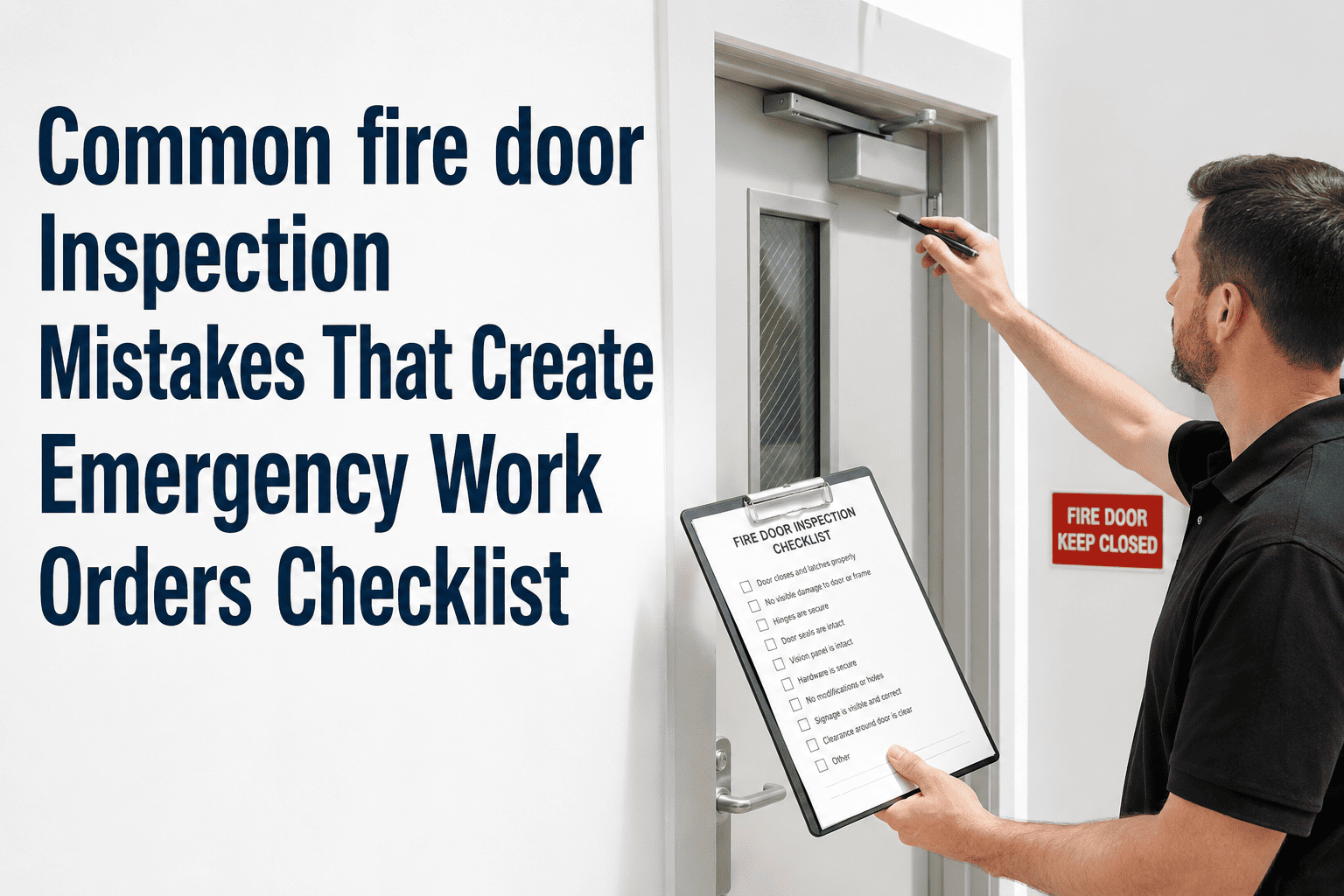
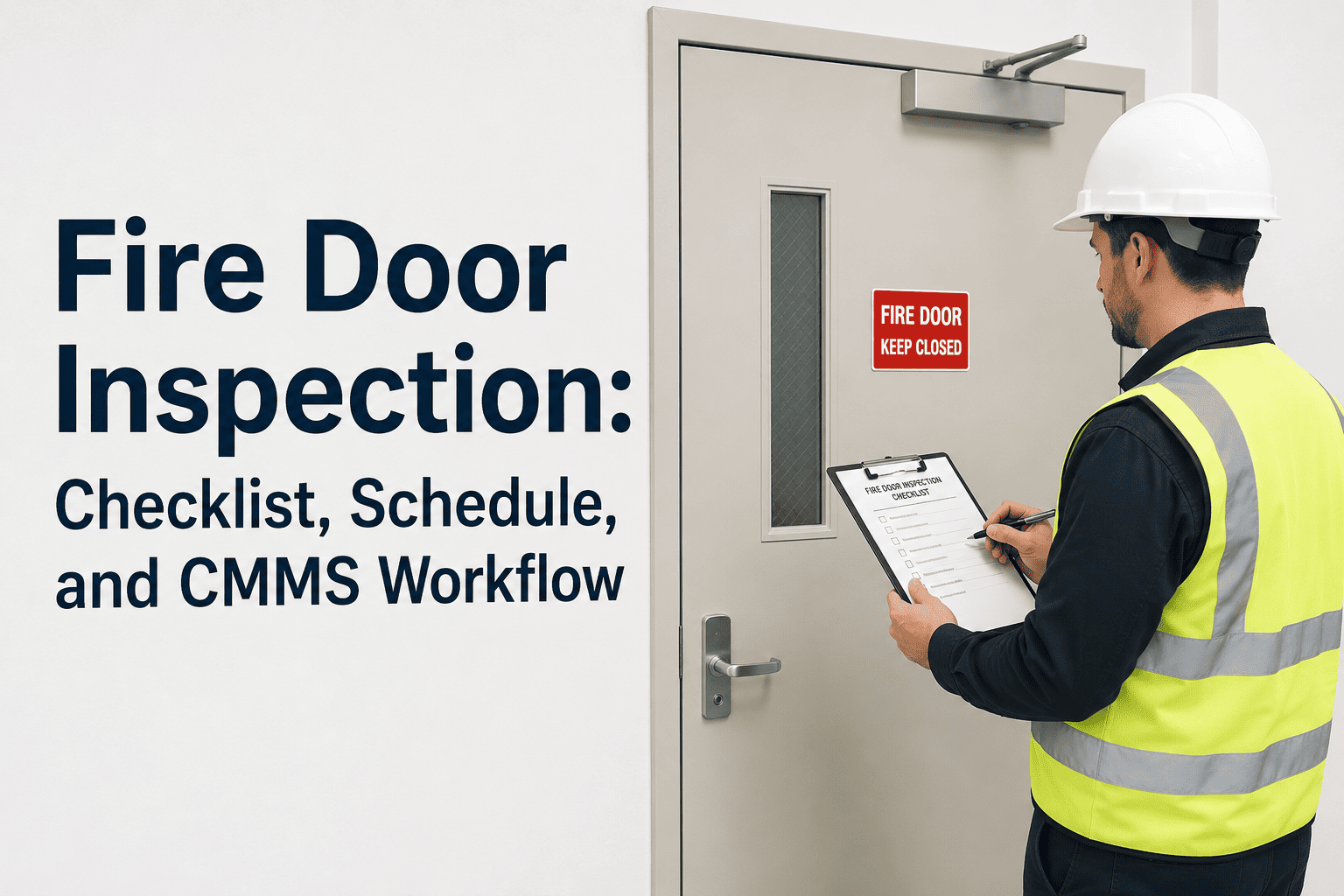
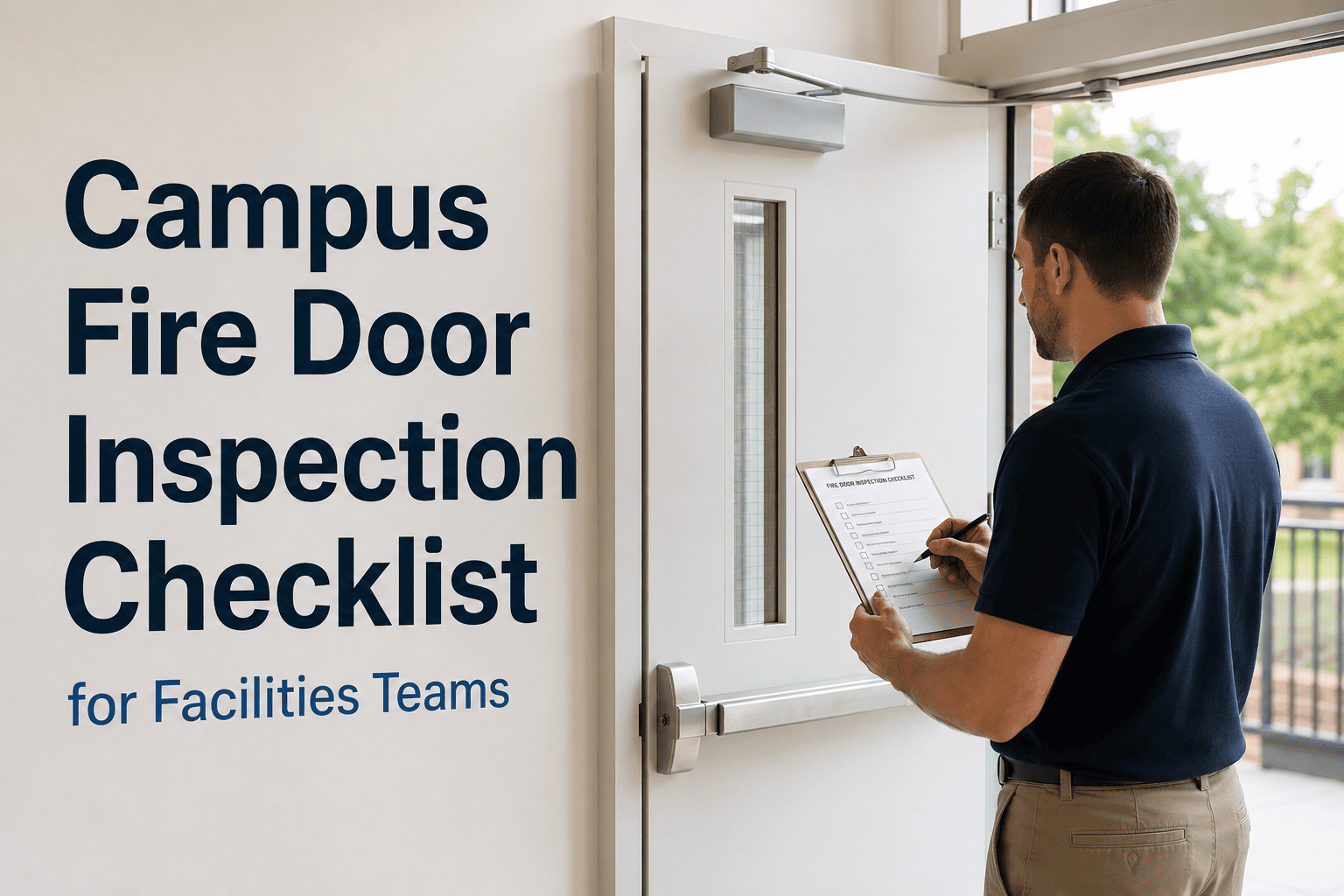
A fire marshal cited a 26,000-student university for 43 door hardware deficiencies across nine buildings during a single inspection — 17 panic bars that did not latch on release, 11 automatic closers that failed to fully close fire-rated doors, 8 magnetic hold-opens that did not release on alarm, and 7 exit devices with broken trim that created lockout conditions. Not one deficiency was reported by building occupants. Not one was discovered during the university's own "monthly" safety walks — which had quietly lapsed to quarterly, then semiannual, then whenever someone remembered. The fire marshal gave the university 30 days to remediate every deficiency with documented evidence of correction. Total emergency remediation cost: $67,000 in contracted locksmith and door hardware labor, $14,000 in replacement parts on rush delivery, and $9,000 in administrative time coordinating inspections across nine buildings simultaneously.
A CMMS-managed door hardware inspection program — checking every panic bar, closer, hinge, frame, threshold, and locking mechanism on a scheduled cycle with documented results — would have caught each deficiency as it developed and generated a repair work order before the fire marshal ever walked through the door. The remediation cost $90,000. The annual CMMS inspection program costs $4,200. Book a Demo — see how Oxmaint digitizes door hardware inspections across your entire campus.
This checklist covers every inspectable door hardware component on a university campus — panic bars, closers, hinges, frames, thresholds, locks, magnetic hold-opens, and auto-openers — organized by inspection frequency and building type priority. Sign Up — start scheduling door hardware inspections digitally today.
A $90,000 fire marshal remediation or a $4,200 annual inspection program — Oxmaint's inspection checklists give your team the structure to catch deficiencies one at a time instead of 43 at once.
Why Campus Door Hardware Demands Structured Inspections
Campus doors are the most numerous inspectable life safety assets in any university's portfolio — and the most neglected. A 40-building campus has 2,500+ doors with 12,000–20,000 individual hardware components requiring periodic inspection. Unlike fire alarm systems that announce their own failures with trouble signals, door hardware fails silently. A panic bar that doesn't latch, a closer that doesn't close, or a hold-open that doesn't release creates a life safety violation that persists invisibly until a fire marshal, an ADA auditor, or an intruder discovers it.
| Inspection Approach | No Structured Program | CMMS-Managed Checklists |
|---|---|---|
| Deficiency Discovery | Fire marshal finds 35–60 issues at once | Technicians catch 3–8 per quarter cycle |
| Remediation Timeline | 30-day emergency deadline | 72-hour routine repair |
| Annual Cost (40-bldg campus) | $60K–$90K per citation event | $12K–$18K in scheduled labor + parts |
| Documentation | None — scramble to create records | Every inspection timestamped with photos |
| ADA Compliance | Discovered only during complaints | Force-gauge measurements per door per cycle |
| Fire Marshal Outcome | Citations, fines, reinspection fees | Documentation of proactive program accepted |
When a single fire marshal visit can cost more than five years of structured inspections, the math is clear. Sign Up — register every inspectable door on your campus in one asset inventory.
How CMMS-Managed Door Inspections Work
Every exterior, fire-rated, stairwell, and accessible door registered with hardware profile and fire rating
Inspection checklists auto-generated per building on quarterly, semiannual, or annual cycles
Technician completes checklist on mobile device with force gauge readings, gap measurements, photos
Any failed checklist item auto-creates a prioritized repair work order routed to the right trade
Every inspection result feeds into a permanent compliance record — no clipboards, no spreadsheets, no gaps in documentation. Book a Demo — walk through the inspection-to-repair workflow for your campus door inventory.
Panic Bar and Exit Device Inspection Checklist
Panic bars and exit devices are the primary egress hardware on every exterior exit, stairwell, and assembly occupancy door. They are the most heavily cycled hardware component on campus — a residence hall main entry may cycle 500+ times daily. Inspection frequency: quarterly for high-traffic doors, semiannual for standard-traffic.
| Inspection Item | What to Check | Pass Criteria | Common Failure |
|---|---|---|---|
| Latch Engagement | Push bar fully, release, test latch engagement | Latchbolt fully extends into strike on every cycle | Latch doesn't engage — door appears closed but is unsecured |
| Operating Force | Measure push force with calibrated gauge | ≤15 lbf (ADA), ≤30 lbf maximum (IBC egress) | Exceeds 15 lbf — ADA violation on accessible routes |
| Dogging Function | Engage and disengage dogging mechanism | Latch retracts when dogged, re-engages when undogged | Stuck in dogged position — fire door cannot latch during alarm |
| Trim Hardware | Inspect exterior trim handle, cylinder, and mounting | Trim secure, handle operates freely, cylinder turns | Broken trim creates lockout condition from secured side |
| Vertical Rod Alignment | Check top/bottom rods and latch engagement (SVR/CVR devices) | Both rods retract and extend fully with bar operation | Bottom rod drags on threshold — doesn't fully engage |
| Weather Seal Condition | Inspect perimeter seal, astragal (double doors) | Continuous contact, no gaps, no material degradation | Worn seals allow water/air infiltration, compromise security |
| Electrified Connection | Test electric latch retraction or electric dogging function | Device responds to access control signal within 1 second | Wiring fault — access control cannot unlock door remotely |
Door Closer Inspection Checklist
Door closers are the most critical component for fire compartmentation — a closer that fails to fully latch a fire-rated door defeats the entire fire separation. NFPA 80 requires that fire doors self-close and positively latch from any open position. Inspection frequency: quarterly for fire-rated doors in high-traffic buildings, semiannual for standard.
| Inspection Item | What to Check | Pass Criteria | Common Failure |
|---|---|---|---|
| Full-Close Latching | Open door fully, release, observe closing and latching | Door closes completely and latchbolt engages in strike | Door stops 1–3mm short of frame — appears closed but not latched |
| Closing Speed | Time from full open to closed position | Minimum 5 seconds (NFPA 80 requirement) | Too fast (injury risk) or too slow (doesn't overcome latch) |
| Latch Speed | Observe final 10° of closing arc | Sufficient velocity to engage latchbolt in strike plate | Latch speed too weak — door bounces off strike without latching |
| Backcheck Function | Open door rapidly toward wall/stop | Closer resists door at 70–85° of opening arc | No resistance — door slams into wall, damages frame, loosens closer |
| Hydraulic Integrity | Inspect closer body and arm for oil leaks | No visible oil at shaft seal, arm pivot, or body seams | Oil leak at shaft — closer arm droops, door hangs open |
| Mounting Fasteners | Check all screws in closer body and shoe/bracket | All fasteners tight, no stripped holes, no visible movement | Closer arm leverage loosens screws — closer separates from door/frame |
| Arm Condition | Inspect main arm and forearm for bending or damage | Arms straight, pivot joints tight, no excessive play | Bent arm from forced entry or abuse — closer cannot control door |
Every failed closer on a fire-rated door is a compartmentation breach that persists until someone checks it. Oxmaint schedules the check, routes the checklist, and documents the result — for every fire door on campus.
Fire Door Assembly Inspection Checklist (NFPA 80)
NFPA 80 (Standard for Fire Doors and Other Opening Protectives) requires annual inspection of all fire door assemblies. This is not optional and not waivable. The inspection must verify the complete fire door assembly — door leaf, frame, glazing, hardware, gaskets, and clearances — as a listed system. Universities typically discover that 10–15% of "fire-rated" doors have no visible label after field modifications or repainting.
| NFPA 80 §5.2 Item | Inspection Requirement | Pass Criteria | Deficiency Action |
|---|---|---|---|
| Door & Frame Labels | Locate and read fire rating labels on door leaf and frame | Labels present, legible, and not painted over | Missing label requires listing confirmation or assembly replacement |
| Glazing Labels | Verify fire-rated glazing label on all vision panels | Listed glazing with matching or exceeding door rating | Non-listed glazing must be replaced with listed assembly |
| Door-to-Frame Clearance | Measure gap on hinge side, strike side, and top edge | Maximum ⅛″ clearance per listed assembly requirements | Excessive clearance requires frame adjustment or door replacement |
| Undercut Clearance | Measure gap between door bottom and floor/threshold | Maximum ¾″ (or per listing) — fire door bottom sweep may be required | Install listed door bottom or intumescent seal to reduce clearance |
| Surface Integrity | Inspect door and frame for holes, breaks, or damage | No open holes, no missing material, no unapproved penetrations | Holes must be patched per manufacturer listing or door replaced |
| Hardware Listing | Verify all hardware is listed for fire-rated assembly | No unapproved field modifications (added locks, viewers, kick plates) | Non-listed hardware must be removed or replaced with listed equivalent |
| Self-Closing Function | Open door to full open, release, verify full close and latch | Door self-closes and positively latches from any open position | Adjust or replace closer — fire door must latch unassisted |
| Gaskets and Seals | Inspect smoke gaskets and intumescent seals on frame | Continuous contact, no gaps, material not degraded or separated | Replace gaskets/seals — smoke seal is required on smoke-rated doors |
| Coordinator Function | Test coordinator on paired fire doors (double leaf assemblies) | Active leaf closes first, then inactive leaf overlaps correctly | Adjust coordinator — incorrect sequence defeats smoke/fire seal |
ADA Accessibility Door Inspection Checklist
ADA and ANSI A117.1 set specific, measurable requirements for doors on accessible routes. The 5 lbf interior door operating force limit is the single most commonly violated ADA standard on campuses — because door closer adjustment drifts over time and no one measures force unless inspected. Every campus ADA door checklist requires a calibrated push-pull force gauge ($30–$60). Sign Up — track ADA force measurements per door per cycle in your CMMS.
| ADA Requirement | What to Measure | Pass Criteria | Common Campus Violation |
|---|---|---|---|
| Interior Door Force | Push-pull force to open door from closed position | ≤5 lbf (ADA / ANSI A117.1) | Closer creep raises force to 8–12 lbf over months — invisible without gauge |
| Exterior Door Force | Push-pull force to open exterior door | No ADA maximum (local codes apply, typically ≤8.5 lbf) | Wind loading and closer tension combine to exceed 15+ lbf |
| Fire Door Force | Push-pull force to open fire-rated door | ≤15 lbf per code (ADA 5 lbf may not apply to fire doors) | Fire door closers often set heavy for positive latching — exceeds limits |
| Threshold Height | Measure threshold above floor surface | ≤½″ (or ¾″ with beveled edge at 1:2 max slope) | Settlement, wear, or replacement with non-compliant threshold |
| Hardware Type | Verify hardware does not require tight grasping, pinching, or twisting | Lever handles or push/pull hardware on accessible route doors | Round knobs on accessible route doors — requires hardware replacement |
| Closing Speed | Time from 90° open to 12° from latch (door closing time) | ≥5 seconds minimum closing time | Fast closer creates barrier for wheelchair/mobility aid users |
| Auto-Opener Response | Activate push button/sensor, time door response and hold-open | Door begins opening within 3 seconds, holds open minimum 5 seconds | Degraded opener response — door begins closing before wheelchair clears |
| Clear Width | Measure clear opening width with door at 90° | ≥32″ minimum clear width (36″ recommended) | Added surface-mount hardware reduces clear width below minimum |
Hinge, Frame, and Threshold Inspection Checklist
Hinges, frames, and thresholds are the structural foundation every other hardware component depends on. A sagging door from worn hinges won't latch, won't seal, won't meet ADA force requirements — and it destroys the closer and frame over time. Inspection frequency: semiannual for exterior and high-traffic doors, annual for interior.
| Inspection Item | What to Check | Pass Criteria | Common Failure |
|---|---|---|---|
| Hinge Pin Wear | Lift door at lock edge — check for vertical movement | No measurable sag; ≤⅛″ acceptable on non-fire-rated doors | Worn hinge pins allow door to sag — cascading failure of latch, closer, seal |
| Hinge Knuckle Tightness | Check for lateral play in hinge knuckles | No lateral movement — knuckles tight, no visible gap | Loose knuckles allow door to shift — strike alignment lost |
| Fire Rating Compliance | Verify hinge listing matches fire door rating (3 hinges min. on 7′ doors) | Hinges listed for fire-rated assembly, correct quantity installed | Non-listed or missing hinge after field replacement — NFPA 80 violation |
| Frame Anchoring | Push/pull frame at hinge and strike jambs — check for movement | Frame solid, no movement, anchors intact behind finished wall | Frame loosened by repeated forced-entry or impact damage |
| Frame-to-Wall Seal | Inspect caulking/sealant between frame and wall on fire-rated assemblies | Continuous seal, no gaps or cracks | Seal failure allows smoke passage — defeats fire compartmentation |
| Threshold Condition | Inspect threshold for damage, looseness, and height compliance | Secured to floor, ≤½″ height (ADA), no tripping hazard | Loose threshold creates trip hazard and compromises weather seal |
| Weather Stripping | Inspect perimeter seals, sweeps, and astragals (exterior doors) | Continuous contact on all edges, no gaps, material not degraded | Worn sweeps and seals allow water infiltration and energy loss |
Electromagnetic Hold-Open and Auto-Opener Checklist
Electromagnetic hold-opens and automatic door openers are the electrified hardware components connecting doors to fire alarm and access control systems. A magnetic hold-open that fails to release during a fire alarm defeats the entire fire compartmentation strategy. Inspection frequency: monthly for hold-open release verification, quarterly for auto-opener function. Book a Demo — see how Oxmaint coordinates fire alarm and door hardware inspection schedules.
| Inspection Item | What to Check | Pass Criteria | Common Failure |
|---|---|---|---|
| Hold-Open Release on Alarm | Activate fire alarm (panel test or local zone) — verify magnet releases | Magnet de-energizes, door releases and self-closes/latches within alarm sequence | Magnet fails to release — fire door held open during fire event |
| Hold-Open Magnet Strength | Attempt to pull door from magnet manually | Magnet holds door securely — no drift or release under normal force | Weak magnet — door drifts from hold-open position, blocks corridor |
| Wiring and Connections | Inspect visible wiring from magnet to power supply and FACP connection | No damaged insulation, connections secure, no exposed conductors | Loose connection — intermittent power loss causes random door release |
| Auto-Opener Activation | Press activation button or trigger sensor — time response | Door begins opening within 3 seconds of activation | Delayed response — ADA accessibility barrier for wheelchair users |
| Auto-Opener Hold Duration | Activate opener, time hold-open period before door begins closing | Minimum 5 seconds hold-open (check local code for longer requirements) | Shortened hold time — door closes on wheelchair or mobility aid user |
| Safety Sensor Function | Obstruct door path during auto-close — verify sensor stops or reverses door | Door stops or reverses within 2 seconds of obstruction detection | Failed sensor — door closes on person or obstacle without stopping |
| Backup Battery | Disconnect AC power — verify hold-open releases (fail-safe) or opener operates | Hold-opens release on power loss; openers operate on battery for rated duration | Dead battery — power failure leaves fire doors held open or openers non-functional |
Every magnetic hold-open must release on every fire alarm. Every auto-opener must respond within 3 seconds. Oxmaint schedules the tests, documents the results, and generates work orders when they don't.
Inspection Priority by Building Type
Not all campus doors need the same inspection frequency. A residence hall exterior door cycled 500+ times daily needs quarterly hardware inspection. A faculty office interior door cycled 20 times daily can operate on an annual schedule. The CMMS configures frequency by building type and door classification — concentrating resources where failure risk and consequences are highest.
| Building Type | Inspection Frequency | Priority Drivers | Key Door Types |
|---|---|---|---|
| Residence Halls | Quarterly | 500+ cycles/day, Clery Act security, sleeping occupancy fire egress | Main entries, stairwells, unit doors, fire doors, auto-openers |
| Dining Halls & Student Unions | Quarterly | High traffic, assembly occupancy, ADA auto-openers critical | Main entries, kitchen fire doors, auto-openers, service doors |
| Academic Buildings | Semiannual | Moderate traffic, fire compartmentation in multi-story buildings | Stairwell fire doors, corridor separations, main entries |
| Laboratories & Research | Semiannual | Chemical/biosafety containment, restricted access control | Lab entries, chemical storage, clean room doors, fire separations |
| Libraries & Performance | Semiannual | Assembly occupancy, ADA accessibility, multiple egress points | Main entries, emergency exits, fire doors, auto-openers |
| Administrative Offices | Annual | Low cycle count, standard occupancy classification | Fire-rated corridor doors still require NFPA 80 annual inspection |
Implementation Roadmap
Campus facilities teams can deploy a CMMS-managed door hardware inspection program within 8–12 weeks, covering asset registration, checklist configuration, pilot inspections, and campus-wide rollout. The key is starting with the highest-risk buildings and expanding based on documented results. Book a Demo — build a phased rollout plan matched to your fire marshal inspection schedule.
- Walk every building — tag and register every exterior, fire-rated, stairwell, and accessible-route door with location and hardware type
- Classify each door: fire rating (20/45/60/90 min), hardware type (panic bar, lever, knob), closer type, and electrification status
- Photograph fire labels on door leaf and frame — many campuses discover 10–15% of "fire-rated" doors have no visible label
- Build digital inspection checklists per door type — NFPA 80 fire door checklist, ADA accessibility checklist, panic bar functional test, closer test, hold-open release test
- Configure inspection frequencies by building type: quarterly for high-traffic, semiannual for moderate, annual for low-traffic
- Set up deficiency-triggered repair work orders — any failed checklist item auto-generates a prioritized repair WO routed by trade
- Run first inspection cycle on 3–5 pilot buildings — residence halls and dining halls first (highest traffic, highest risk)
- Train technicians on mobile CMMS checklists, force gauge usage, gap measurement tools, and photo documentation
- Remediate pilot deficiencies within 72 hours — document correction with before/after photos in the CMMS
- Expand inspection schedules to all remaining buildings using proven checklists and frequency assignments
- Build compliance dashboard showing inspection completion rates, open deficiencies, and repair response times by building
- Generate fire marshal-ready NFPA 80 compliance reports and ADA accessibility documentation per building
Frequently Asked Questions
How many doors does a typical university campus need to inspect?
A 40-building campus typically has 2,500–4,000 doors requiring some level of inspection — exterior entry doors, interior fire-rated doors, stairwell doors, corridor doors on fire-rated separations, and accessible-route doors with auto-openers. Each door has 5–8 hardware components (panic bar or lever, closer, hinges, frame, threshold, gaskets, lock/access control). The total component count runs 12,000–25,000 individual inspection points. Without a CMMS generating and tracking these inspections, the volume is simply unmanageable — which is why most campuses discover dozens of deficiencies during fire marshal visits. Sign Up — register your door inventory and auto-generate inspection schedules.
What does NFPA 80 require for fire door inspections?
NFPA 80 (Standard for Fire Doors and Other Opening Protectives) requires annual inspection of all fire door assemblies. The inspection must verify: no open holes or breaks in door or frame surfaces, glazing is intact and properly labeled, door and frame labels are present and legible, no unapproved field modifications, clearances comply with listed assembly requirements, self-closing device fully closes and latches, hardware is complete and operational, gaskets and edge seals are intact, and no missing or broken parts. Results must be documented in writing and retained for inspection authority review. Book a Demo — see the full NFPA 80 checklist built into Oxmaint.
How do we handle ADA door force requirements campus-wide?
ADA and ANSI A117.1 require interior doors on accessible routes to operate with no more than 5 pounds-force (lbf) to open. Exterior doors are exempt from the ADA force limit but must still have accessible hardware (no round knobs). A calibrated push-pull force gauge ($30–$60) is required for every door inspection. Oxmaint's ADA door checklist includes a force measurement field that flags any reading above 5 lbf, auto-generates a closer adjustment work order, and documents the corrected force reading for ADA compliance records.
Can door hardware inspections integrate with our access control system?
Yes — and this integration adds significant value. Access control systems log every door cycle (open/close event) providing exact usage data per door. High-cycle doors (500+ events/day) get higher inspection frequency automatically. The access control system also logs forced-open, held-open, and door-ajar alarms that indicate hardware problems in real time. When a door generates repeated held-open alarms, Oxmaint can auto-create an inspection work order to check the closer and latch mechanism — converting access control data from a security-only tool into a maintenance intelligence source.
What does a campus door inspection program cost to implement?
The CMMS platform cost is a fraction of a single fire marshal remediation event. The initial investment is primarily labor for the door inventory walk (Phase 1), typically 2–3 weeks of technician time for a 40-building campus. Ongoing inspection labor runs $8,000–$15,000 annually depending on campus size and frequency. Compare this to the $60,000–$90,000 emergency remediation cost when 35–60 deficiencies are discovered during a fire marshal visit. The program pays for itself by eliminating one citation cycle. Book a Demo — model costs for your campus.
Who should perform campus door hardware inspections?
Most campus door hardware inspections can be performed by in-house maintenance technicians trained on the specific checklist items and measurement tools. NFPA 80 does not require a licensed inspector for annual fire door inspections — only a "knowledgeable individual." However, technicians need training on gap measurement, force gauge use, fire label identification, and photo documentation standards. Complex assemblies (fire-rated glazed assemblies, specialized access control hardware) may warrant contractor support. Oxmaint's mobile checklists guide technicians through every step, making the training curve manageable.