Campus Wireless Network & IT Asset Maintenance with CMMS
By Jamie lanister on April 22, 2026
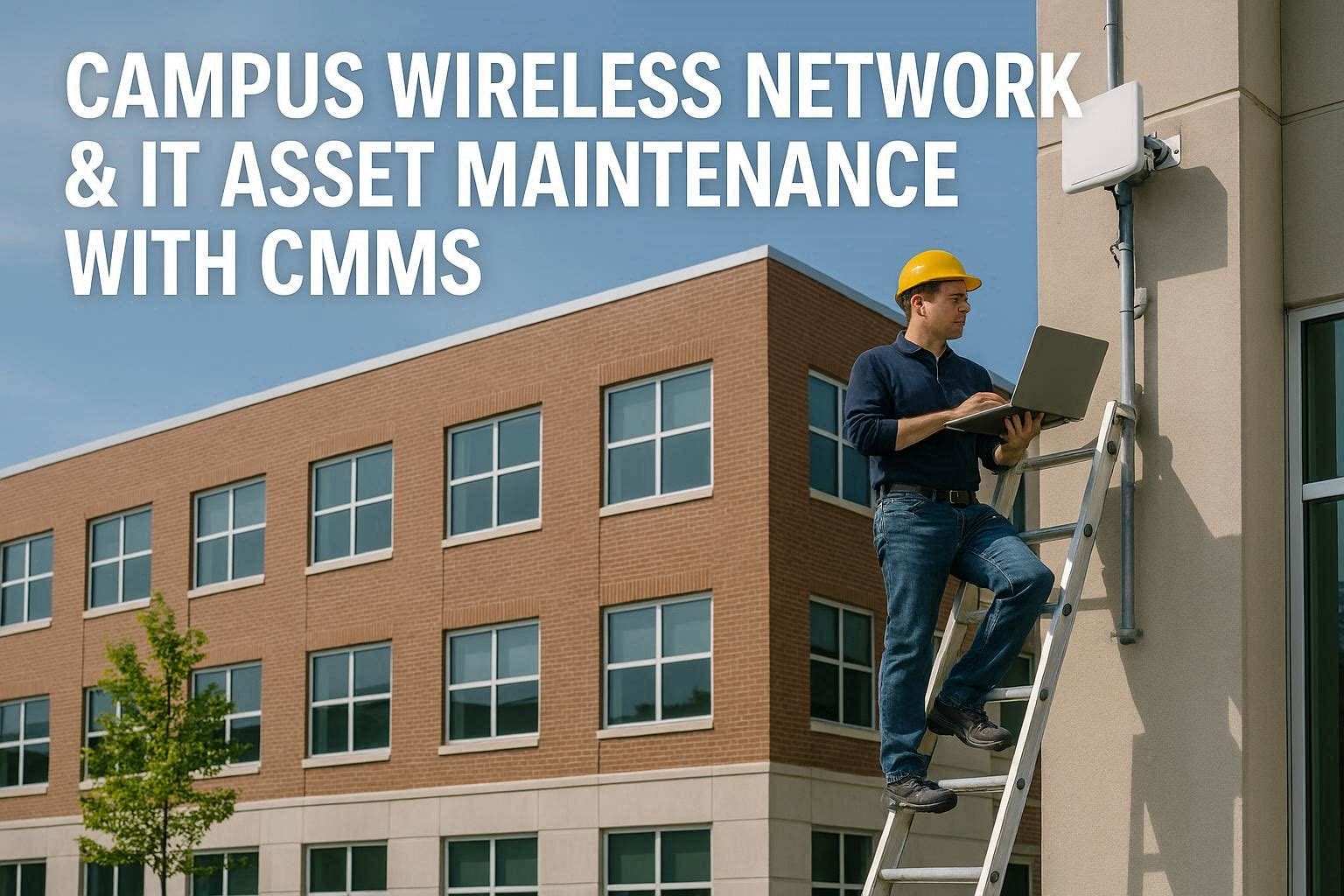
The IT director at a 22,000-student university in Arizona discovered that 340 of the 1,800 wireless access points on her campus had exceeded the 7-year manufacturer-recommended replacement lifecycle — and that 94 of those were running firmware that hadn't been updated in over 18 months because nobody had a systematic record of which access points needed attention. The resulting network degradation was being blamed on bandwidth and ISP capacity. It wasn't. It was aging hardware that the university had no systematic process for tracking, maintaining, or replacing because the IT asset management system and the facilities maintenance system had never been connected. The network infrastructure team was managing tickets reactively. The facilities budget for capital IT replacement didn't reflect actual hardware age because nobody had built the asset register that connected procurement records to physical location to current lifecycle status. When the university deployed OxMaint to manage IT infrastructure maintenance alongside facilities, the picture that emerged was more expensive than anticipated — and more actionable than anything the previous fragmented system could have produced. Sign in to OxMaint to build your campus IT infrastructure maintenance programme, or book a demo to see how OxMaint manages network IT asset lifecycle across campus locations.
Campus IT Asset Management · Network Maintenance · OxMaint CMMS
Hundreds of Campus WiFi Access Points and Network Switches Don't Maintain Themselves — and Nobody Else Is Either
OxMaint tracks campus wireless and wired network IT assets from procurement through end-of-life — scheduled firmware update cycles, hardware health monitoring, planned replacement programmes, and emergency outage response workflows — in the same CMMS that manages your facilities maintenance programme.
average wireless access point count at a 20,000-student university campus — each requiring firmware management, hardware health tracking, and lifecycle planning
7 yrs
manufacturer-recommended replacement lifecycle for enterprise wireless access points — most campus IT departments have no systematic tracking against this benchmark
$2.1M
average unplanned IT infrastructure replacement cost when network assets are managed reactively vs $680,000 with planned lifecycle replacement programme
47 min
average campus network outage duration reduced to when CMMS-managed emergency response protocols replace unstructured incident response
Campus network infrastructure is a maintainable asset — not an IT ticket queue. Access points, distribution switches, core routers, UPS units, and fibre patch panels all have defined maintenance cycles, firmware update schedules, hardware lifecycles, and failure modes that benefit from systematic CMMS management. Treating network infrastructure as a reactive ticket problem rather than a scheduled maintenance asset class produces the outcome the Arizona university experienced: 340 assets past lifecycle with no capital plan in sight.
Campus Network Asset Lifecycle Health Map — OxMaint Visibility
IT Asset Lifecycle Status · Campus Network Infrastructure · OxMaint Dashboard View
Year 1–2
Year 3–4
Year 5–6
Year 7+ EOL
WiFi Access Points
Optimal
Good
Monitor
Replace
Distribution Switches
Optimal
Good
Good
Plan Replace
UPS / Battery Units
Optimal
Battery Check
Replace Battery
Replace Unit
Core Routers
Optimal
Good
Good
Plan Replace
Fibre Patch Panels
Optimal
Optimal
Good
Good / Monitor
Current / GoodPlan maintenanceCapital action required
OxMaint populates this dashboard automatically from procurement dates, firmware records, and hardware health monitoring — updated continuously
Six Network IT Maintenance Activities OxMaint Manages Systematically
Firmware Update Cycle Management
Enterprise wireless access points and network switches require firmware updates on vendor-recommended schedules — typically quarterly for security patches and annually for major releases. OxMaint schedules firmware maintenance work orders by device model and firmware version, tracking update completion and flagging devices that missed scheduled update windows before security vulnerabilities accumulate.
Hardware Health Monitoring and Alerts
OxMaint integrates with network management platforms (Cisco DNA, Juniper Mist, Aruba Central, Meraki) via API — pulling hardware health alerts, CPU utilisation trends, power supply status, and temperature readings from managed network devices. Threshold breaches auto-create work orders before devices fail rather than after they stop responding to student connections.
Access Point Lifecycle Planning
OxMaint tracks every campus access point from installation date through end-of-life — calculating when each unit approaches the 7-year manufacturer lifecycle, aggregating replacement volumes by year, and generating capital budget projections for IT infrastructure replacement that finance teams can rely on for multi-year budget planning.
UPS and Power Infrastructure Maintenance
Network closet UPS units and their batteries have defined replacement cycles — batteries typically require replacement at 3–4 years, units at 8–10 years. OxMaint tracks every UPS unit's installation date and battery replacement history, generating scheduled work orders for battery testing and replacement before power interruptions take down network closets during campus events or severe weather.
Network Outage Emergency Response
When a network closet goes down or a building loses wireless connectivity, OxMaint's incident management module provides a structured emergency response protocol — guided troubleshooting steps, spare parts location, escalation to vendor support, and communication template for affected building notifications. Response time from incident to resolution is documented against SLA.
Physical Infrastructure Inspection
Cable management, fibre termination condition, patch panel labeling accuracy, environmental conditions in network closets (temperature, humidity), and access point mounting integrity — all require periodic physical inspection. OxMaint schedules network closet inspections with guided checklists and photo documentation, creating a maintenance record for physical IT infrastructure that purely digital IT management tools cannot provide.
OxMaint Integration with Campus Network Management Platforms
Cisco DNA Center / Catalyst Center
OxMaint pulls device health alerts, license expiry dates, and software version status from Cisco DNA Center via REST API. Health events exceeding configured thresholds auto-create OxMaint work orders — bridging the gap between network management visibility and maintenance action tracking in a single workflow.
Cisco Meraki Dashboard
Meraki device offline alerts, hardware replacement needs, and license renewal dates sync to OxMaint automatically. Capital replacement work orders and procurement requests are generated from Meraki hardware alert data — connecting the network dashboard to the campus procurement and finance workflow.
HPE Aruba Central
Aruba access point health status, firmware compliance gaps, and device replacement flags from Aruba Central feed OxMaint's maintenance queue. IT teams no longer manage two separate systems — Aruba alerts become OxMaint work orders with asset records, location data, and lifecycle context automatically attached.
Juniper Mist AI
Juniper Mist's AI-driven anomaly detection triggers OxMaint work orders for physical hardware issues that Mist's machine learning identifies as hardware degradation rather than environmental or configuration causes — prescribing replacement before device failure impacts campus connectivity.
ServiceNow / ITSM Integration
For campuses with existing ITSM platforms, OxMaint integrates with ServiceNow, Jira Service Management, and Freshservice — synchronising IT incident tickets with physical asset maintenance work orders. Network incidents in the ITSM automatically create physical inspection or maintenance tasks in OxMaint for the relevant hardware location.
SAP / Banner ERP Procurement Integration
When OxMaint's lifecycle tracking identifies a cohort of access points approaching end-of-life replacement, capital replacement requests push directly to SAP or Banner for budget approval — with device counts, model specifications, and cost estimates pre-populated from the OxMaint asset register and current vendor pricing.
Campus Type — IT Infrastructure Maintenance Priorities by Institution
Institution · Research University
Research Universities
Large, multi-building campuses with lab-grade network requirements and research computing infrastructure. OxMaint manages academic building APs alongside data centre network assets — unified asset register, unified maintenance programme, one capital lifecycle view.
5,000+
IT assets typical
Lab
grade requirements
Institution · Community College
Community Colleges
Lean IT teams managing multi-campus networks with shared maintenance capacity. OxMaint's mobile-guided maintenance protocols allow non-specialist technicians to perform systematic hardware inspection and scheduled maintenance without dedicated network engineers on every campus.
Multi
campus support
Non-specialist
guided protocols
Institution · K-12 District
K-12 School Districts
E-Rate funded network infrastructure with FCC programme compliance requirements. OxMaint tracks E-Rate eligible equipment through its lifecycle — procurement, installation, maintenance, and disposal — providing the documentation that supports E-Rate audit compliance and subsequent funding applications.
E-Rate
compliance tracking
FCC
audit ready
$1.4M
in unplanned replacement cost avoided vs $680,000 planned lifecycle replacement — the financial difference between reactive and systematic IT asset management
340
access points past manufacturer lifecycle identified at Arizona university — previously invisible, now managed in OxMaint capital replacement programme
47 min
average campus network outage resolution time with CMMS-managed response protocols — vs 2.3 hours without structured incident management
"When we put our 1,800 access points into OxMaint and mapped them against installation dates, we found 340 units past their 7-year lifecycle. I'd been blaming network performance on bandwidth for two years. It wasn't bandwidth. It was hardware. OxMaint gave us a 3-year capital replacement plan with annual cohort costs that went straight into our budget submission. We replaced 180 units in Year 1. Network complaints dropped 68%. The IT team's reactive ticket volume dropped by half. That's the difference between managing a symptom and managing the actual asset."
— Director of IT Infrastructure, 22,000-student university, Arizona, OxMaint user since 2023
Every campus access point past its 7-year lifecycle is a network performance degradation waiting to be misdiagnosed as a bandwidth problem. OxMaint finds them — and plans the replacement before the complaints start.
IT asset register, firmware tracking, hardware health monitoring, and capital lifecycle planning — all in the same CMMS that manages your facilities.
Can OxMaint manage both facilities maintenance and IT network assets on the same platform?
Yes — OxMaint manages all campus asset types in a unified system, including buildings, mechanical systems, and IT infrastructure. Facilities technicians and IT staff use the same work order, inspection, and asset lifecycle tools — reducing the fragmentation between facilities and IT budgets and maintenance records that most campuses currently manage in separate, unconnected systems.
How does OxMaint integrate with Cisco Meraki and other cloud-managed network platforms?
OxMaint integrates with Cisco Meraki, Cisco DNA Center, HPE Aruba Central, and Juniper Mist via their published APIs — pulling device health status, offline alerts, license expiry dates, and firmware compliance status into OxMaint. These network management alerts automatically create maintenance work orders with the device location, asset record, and troubleshooting context attached.
How does OxMaint support E-Rate compliance documentation for K-12 networks?
OxMaint tracks E-Rate funded network equipment from procurement through the required 5-year retention period — recording purchase date, installation location, maintenance history, and disposal method. The E-Rate asset documentation package for FCC Form 472 and Programme Integrity Assurance (PIA) review is exportable directly from OxMaint without manual record compilation.
Can OxMaint generate a multi-year IT capital replacement plan from the asset lifecycle data?
Yes — OxMaint's capital planner aggregates access points, switches, and UPS units by installation year and generates a rolling 5-year replacement projection showing annual unit counts and estimated costs by device category. The plan updates automatically as assets are replaced and new equipment is added — giving IT and finance teams a live capital plan rather than an annual spreadsheet exercise.
Does OxMaint work for campuses in UAE, UK, and other international locations?
Yes — OxMaint supports campus deployments globally, including UAE, UK, Germany, Australia, Canada, and India. The platform supports multi-currency cost tracking, regional compliance requirements, and multilingual technician interfaces. International campus deployments benefit from OxMaint's cloud architecture — there is no on-premise server infrastructure requirement, which is particularly valuable for international campuses with limited local IT capacity.
Build the IT Asset Register Your Capital Planning Team Needs. Start With the Access Points Already on Your Walls.
Every untracked device is a budget surprise. OxMaint makes every campus IT asset visible, planned, and replaced on schedule.