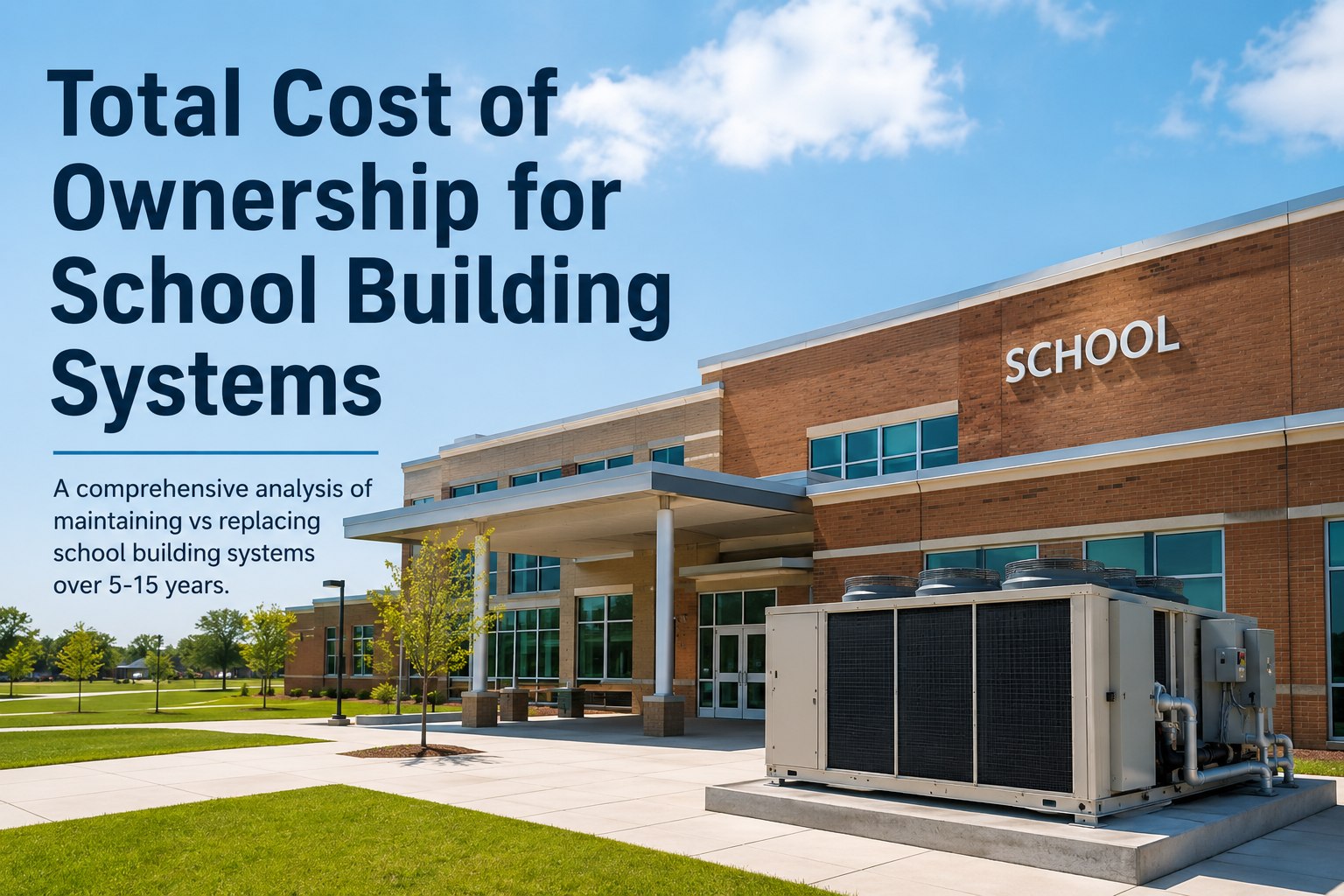
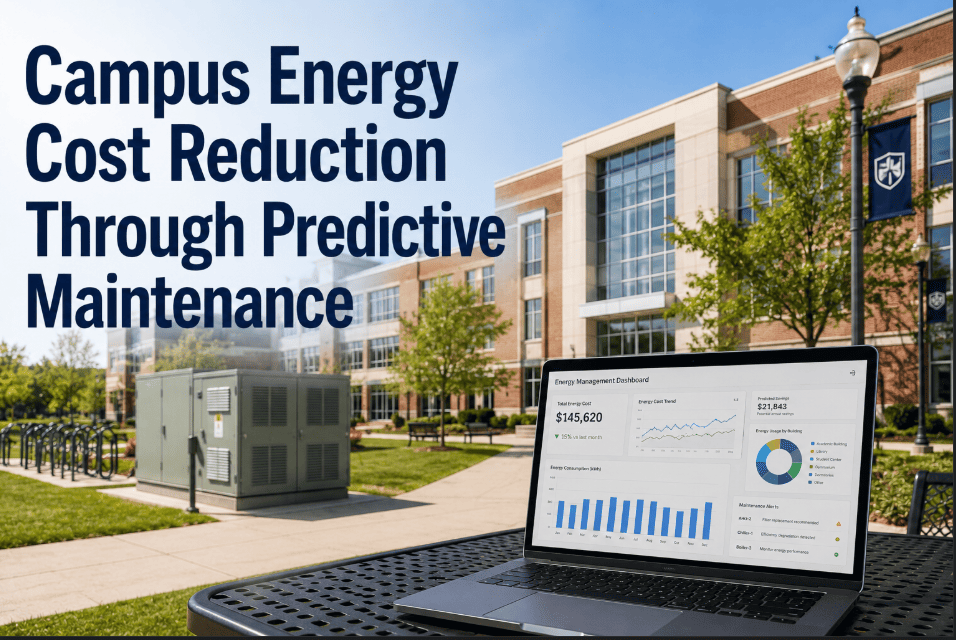
Facility maintenance is the largest controllable operating expense in American education — and the least understood line item on every CFO's budget. U.S. school districts spend $12–$18 per gross square foot annually on facility operations and maintenance, while universities spend $8–$14 per GSF. For a mid-size institution managing 1.2 million GSF, that translates to $9.6–$21.6 million per year flowing through HVAC systems, electrical distribution, plumbing infrastructure, roofing, fire safety systems, and the labor required to keep them functional. Yet most education CFOs and Chief Business Officers cannot answer three questions their boards will eventually ask: What is the true total cost of ownership for our facilities? Which buildings are consuming disproportionate resources and why? What is the documented return on every maintenance dollar we spend? The inability to answer these questions is not a data problem — it is a systems problem. Paper-based and spreadsheet-driven maintenance operations generate no usable financial data. Work orders are completed but not costed. Equipment is repaired but lifecycle costs are not tracked. Capital is requested but condition evidence is not documented. The result: boards defer maintenance capital because they cannot evaluate the claim, deferred maintenance backlogs grow 6–8% annually, and the $197 billion national higher education deferred maintenance backlog (APPA 2026) compounds while CFOs present budgets supported by anecdote rather than analysis. Oxmaint's CMMS platform transforms facility maintenance from an opaque cost center into a documented, measurable, ROI-generating operation — giving CFOs the per-building cost analytics, lifecycle planning data, and board-ready financial reporting that justify every dollar spent and every dollar requested.
The Three Budget Drains: Where Education Facility Dollars Disappear
Education facility budgets leak through three structural inefficiencies that paper-based and spreadsheet-driven systems cannot detect, quantify, or resolve. Each drain is invisible without digital cost tracking — and each compounds annually until addressed systemically:
Drain #1: The Emergency Repair Premium
Financial Impact by Institution Size
Drain #2: Energy Waste from Deferred Maintenance
Top Energy Waste Sources (Maintenance-Addressable)
Drain #3: Capital Deferral Compounding
Capital Deferral Impact Chain
The Four ROI Models: Quantifying Maintenance Return on Investment
CFOs and CBOs need documented, board-presentable ROI models — not maintenance department anecdotes. These four models provide the financial framework for justifying CMMS investment, maintenance staffing, and capital requests using metrics boards understand: cost avoidance, cost recovery, asset value preservation, and labor productivity.
ROI Model #1: Emergency Repair Avoidance
Immediate • Measurable • Year 1The most immediate and easily documented ROI. Track emergency repair invoices for 12 months pre-CMMS and post-CMMS. Digital CMMS with automated PM scheduling prevents 60–75% of emergency failures within the first year. For a mid-size district spending $200K/year on emergency repairs, a 65% reduction recovers $130K — against a CMMS cost of $12K–$30K. The ROI calculation: ($130K saved ÷ $30K invested) = 4.3:1 return, Year 1.
ROI Model #2: Energy Cost Recovery
Documented • No Capital • 6–18 MonthsMaintenance-driven energy optimization recovers 15–25% of campus energy costs without capital equipment purchases. BAS override clearing, economizer repair, coil cleaning, filter maintenance, chiller optimization, and steam trap repair are all maintenance actions — not capital projects. For a campus spending $3M/year on energy, 18% recovery = $540K annually. The CMMS enables this by scheduling energy-critical PM tasks and tracking efficiency metrics per building.
ROI Model #3: Equipment Life Extension
Compounding • Capital Deferral • 3–5 YearSystematic preventive maintenance extends equipment useful life 30–40% compared to run-to-failure management. A campus with $47M in MEP assets can defer $2.8–$4.7M in capital replacements over 5 years through optimal maintenance timing — not by neglecting equipment, but by maintaining it at rated performance longer. CMMS documents the condition data that proves equipment is performing well enough to defer replacement responsibly, or degrading enough to justify immediate capital.
ROI Model #4: Workforce Productivity
Quantifiable • Same Staff • 90 DaysAI-optimized scheduling, mobile work order tools, QR-code asset scanning, and location-grouped dispatching enable maintenance teams to complete 25–35% more work orders per week with the same headcount. For a 10-person team averaging $55K/person fully loaded, a 30% productivity increase delivers the equivalent output of 3 additional FTEs — $165K in labor value — without hiring. Simultaneously, administrative time (paperwork, parts lookups, verbal dispatching) drops 60–80%.
Your Board Doesn't Fund Maintenance Requests. It Funds Documented Business Cases.
Oxmaint gives CFOs and facilities directors the per-building cost data, equipment lifecycle analytics, and ROI documentation that transform maintenance budget requests from anecdotal appeals into evidence-based business cases boards approve.
Budget Optimization by Expense Category
Education facility budgets operate across three distinct expense tiers — each with different optimization strategies, different ROI timelines, and different board approval requirements. CMMS data enables optimization at every tier simultaneously:
Operating Expense Optimization (M&O Budget)
Capital Expense Planning (Bond / Capital Reserve)
Risk Mitigation & Compliance Budget
The CFO's CMMS Dashboard: Six Metrics That Matter
Oxmaint provides CFOs and CBOs the financial visibility into facility operations that paper systems cannot deliver. These six metrics, updated in real-time from actual work order data, transform facility management from an opaque cost center into a measurable, optimizable business operation:
Cost Per Building Per Year
Total maintenance spend (labor + materials + contracts + energy) per building, updated monthly. Identifies which buildings consume disproportionate budget and why. The single most important metric for capital planning conversations with boards — "Building 7 consumed 23% of our maintenance budget last year servicing 16-year-old HVAC units."
Reactive vs. Planned Ratio
Percentage of work orders and spend that is reactive (emergency, unplanned) vs. planned (scheduled PM, condition-based). Industry target: 80/20 planned/reactive. Most paper-based districts operate at 40/60 or worse. Every 10% shift from reactive to planned reduces total maintenance cost 8–12%. Track monthly to measure transformation progress.
Facility Condition Index (FCI)
Deferred maintenance backlog ÷ current replacement value, calculated per building from accumulated work order and condition assessment data. FCI <0.05 = Excellent, 0.05–0.10 = Good, 0.10–0.30 = Fair, >0.30 = Poor (renovation may exceed new construction cost). Updated continuously as work orders complete and new deficiencies are identified.
Compliance Status Dashboard
Real-time view of every regulatory inspection requirement across all buildings: NFPA fire systems, OSHA workplace safety, ADA accessibility, EPA environmental, state-specific mandates. Green/yellow/red status by building and by requirement type. When any inspection approaches its deadline, escalation alerts ensure completion. 100% audit readiness at all times.
Energy Cost Per GSF Trending
Monthly energy cost per gross square foot per building, weather-normalized and correlated with maintenance activities. Target: below $2.80/GSF (APPA top-quartile benchmark). When energy cost per building spikes, CMMS correlates with maintenance data to identify the cause — a BAS override, a degraded chiller, a failed economizer — and generates the corrective work order automatically.
Workforce Utilization Rate
Productive maintenance hours ÷ total available hours per technician per week. Paper-based districts average 45–55% (rest is travel, admin, parts hunting, waiting for assignments). CMMS-optimized districts achieve 75–85%. Each 10% utilization improvement equals 4 additional productive hours per technician per week — measurable, documentable staff productivity that justifies technology investment.
Stop Defending Maintenance Budgets. Start Documenting Maintenance ROI.
Oxmaint transforms facility maintenance from a cost center the board questions into a documented investment the board supports — with per-building analytics, lifecycle cost tracking, energy optimization data, and compliance documentation that make every budget conversation about evidence, not anecdote.
Frequently Asked Questions
What is the actual ROI of CMMS investment for an education institution?
Documented ROI varies by institution size but consistently falls in the 5–12× return range within 24 months across four value streams. (1) Emergency repair cost avoidance: 60–75% reduction in emergency repairs, typically saving $80K–$400K/year depending on district size, against $8K–$30K annual CMMS platform cost. (2) Energy cost recovery: 15–25% reduction through maintenance-driven optimization, typically $200K–$750K/year for a $2–$3M energy budget. (3) Equipment life extension: 30–40% longer useful life through systematic PM, deferring $500K–$5M in capital replacements over 5 years. (4) Workforce productivity: 25–35% more work orders completed with same staff, equivalent to 2–4 additional FTE value. The CFO presentation: sum all four value streams against total platform cost. No institution we've documented has achieved less than 3:1 return by Month 12. Sign up free to begin building your ROI documentation from Day 1.
How do we present the maintenance budget business case to the school board?
Boards respond to four categories of evidence presented in financial terms — not maintenance terminology. (1) Cost of the current state: Compile 24 months of emergency contractor invoices, after-hours service calls, and any collateral damage events (water damage, classroom relocations, temporary HVAC rentals). Most districts discover $80K–$400K in avoidable reactive costs they did not realize were avoidable. (2) Compliance risk exposure: List every regulatory inspection requirement and current status — any gap is quantifiable liability ($16K–$156K per OSHA violation, $85K–$500K+ per OCR finding). (3) Energy waste documentation: Compare current energy cost per GSF against APPA top-quartile benchmark ($2.80/GSF) — the gap multiplied by total GSF is the annual recoverable waste. (4) Insurance impact: Contact your carrier about documented maintenance program premium adjustments — 5–15% reductions are increasingly standard. Present all four as: "Our current paper-based approach costs [total]. CMMS investment costs [total]. Net savings Year 1: [amount]." Boards fund math, not stories.
How does CMMS data improve capital budget approval rates?
Capital requests fail at the board level for one reason: insufficient evidence. The facilities director says "we need a new chiller" and the board asks three questions the director cannot answer with paper records: (1) What is the current condition? CMMS provides documented maintenance history, work order frequency, parts consumption, efficiency measurements, and technician observations over time. (2) What has it cost to maintain? CMMS provides total maintenance spend on that specific asset — labor, materials, contractor costs — over its lifetime. (3) What happens if we defer? CMMS provides the documented cost trajectory showing maintenance costs accelerating 8–12% annually, efficiency degrading 2–5% per year, and the projected total cost of continued maintenance vs. replacement over 5 and 10-year horizons. This is the difference between "we need money" and "here is the documented cost of each option." Districts that present CMMS-documented capital requests report 40–60% higher approval rates than those presenting anecdotal requests. Schedule a consultation to build your first data-driven capital request.
What is Facility Condition Index (FCI) and why should the CFO track it?
FCI is the single most important metric for education facility financial planning. The formula: Deferred Maintenance Backlog ÷ Current Replacement Value = FCI. A building worth $20M in replacement value with $2M in deferred maintenance has an FCI of 0.10 (Good). The same building with $6M deferred has FCI 0.30 (Poor — approaching the point where renovation costs may exceed new construction). CFOs should track FCI per building because it directly affects four financial decisions: (1) Capital allocation priority — invest in buildings with deteriorating FCI before they cross the 0.30 threshold. (2) Bond measure sizing — aggregate FCI data determines total bond amount and per-building allocation. (3) Insurance valuation — FCI affects building condition assessments that insurers use for coverage and premiums. (4) Long-range financial planning — FCI trending shows whether the institution's facility portfolio is improving or deteriorating over time. CMMS generates FCI data from accumulated work order and condition data rather than expensive periodic consultant assessments — providing real-time FCI that updates as maintenance is completed and deficiencies are discovered.
How quickly can we generate usable financial data from CMMS deployment?
Usable financial data begins accumulating from Day 1 of CMMS deployment — every work order includes labor time, parts used, and contractor cost. The question is how quickly it becomes actionable for financial decisions. Timeline: Month 1: Real-time work order volume and response time per building — immediately reveals which buildings generate disproportionate demand. Month 3: Enough data to calculate reactive vs. planned ratio and identify the top 10 maintenance cost drivers across the district. Month 6: Per-building maintenance cost data sufficient for first board report showing cost allocation patterns and emergency spend reduction. Month 12: Full-year data enables year-over-year comparison, FCI calculation, equipment lifecycle analysis, and first data-driven capital replacement schedule. Month 18: Energy correlation analysis enabled with enough seasonal data to weather-normalize consumption patterns. The institutions that start now will present their first data-driven annual facility report to the board within 12 months. Institutions that wait another year will still be compiling spreadsheets. Sign up free to start generating financial data today.