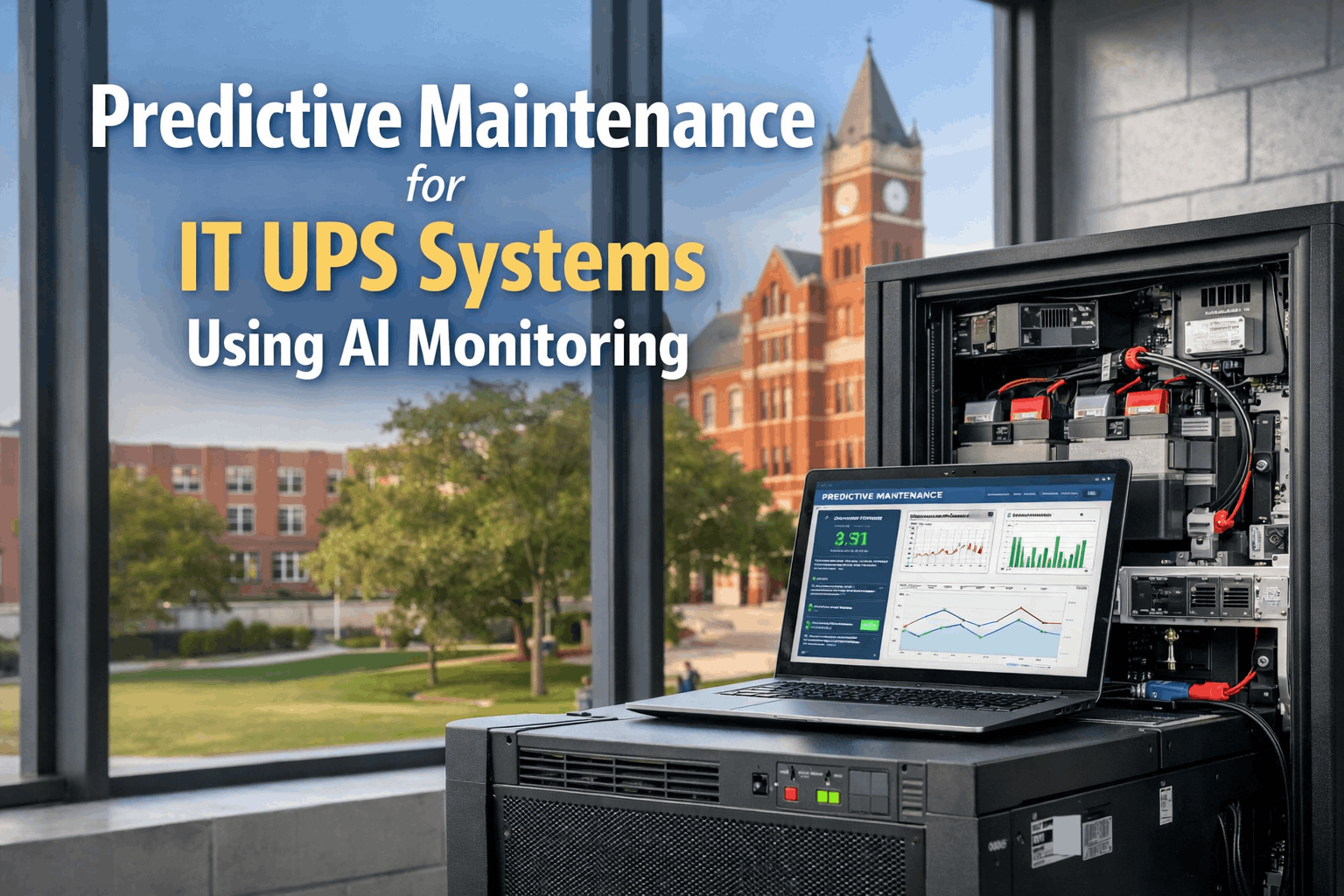
Your campus data center UPS battery monitoring system has detected a subtle pattern: cell voltage variance has increased from 0.02V to 0.09V over the past three weeks. The readings are still within "normal" range—nothing that would trigger a traditional alarm or catch attention during a monthly inspection. But an AI monitoring system recognizes this as the early signature of accelerated battery degradation. In 4-6 weeks, during a brief utility power interruption, those batteries will fail to hold load, bringing down 47,000 student records, $3.2 million in active research data, and every digital system your university depends on. The emergency battery replacement will cost $18,000 in expedited parts and after-hours labor. Or, you could schedule a $6,500 planned battery replacement next month during a maintenance window.
This is the difference between reactive and predictive maintenance in campus IT infrastructure. Traditional maintenance waits for failure or replaces on fixed schedules. Predictive maintenance detects the conditions that precede failure—weeks before systems go down. For campus technology operations where data protection, service continuity, and compliance all depend on power reliability, AI-driven predictive maintenance isn't a luxury. It's how modern IT operations protect their students, their data, and their institutional reputation. Schedule a demo to see predictive UPS monitoring in action.
This guide explains how AI-powered condition monitoring works for campus UPS systems, which metrics provide the most valuable predictive signals, and how to implement a system that catches power infrastructure problems before anyone loses access to critical systems. Start tracking UPS health digitally—sign up free.
What if you could see UPS failures coming weeks in advance? AI-powered monitoring makes it possible.
Why Campus IT Infrastructure Needs Predictive Maintenance
Campus IT operations face unique pressures that make UPS reliability non-negotiable. Unlike commercial data centers with N+1 redundancy and dedicated infrastructure teams, university data centers often operate with minimal redundancy while supporting 24/7 services—student information systems, learning management platforms, research computing, and administrative operations all depend on continuous power protection.
| Challenge | Traditional Approach | Predictive Approach |
|---|---|---|
| Data Protection | Discover battery failure when utility power drops | Alert when battery health degrades, before utility events expose weakness |
| Service Continuity | React to UPS failures during critical operations | Schedule maintenance during planned windows with minimal user impact |
| Budget Management | Unpredictable emergency repair and replacement costs | Planned maintenance with predictable capital and operating expenses |
| Compliance | Document failures after data loss or service disruption | Demonstrate proactive monitoring to auditors and administrators |
| Equipment Lifespan | Replace on fixed schedules regardless of condition | Optimize replacement timing based on actual degradation patterns |
How AI-Powered UPS Predictive Maintenance Works
Predictive UPS maintenance combines IoT sensors, network monitoring interfaces, machine learning algorithms, and your CMMS to detect power infrastructure degradation before it causes downtime. Here's the workflow that transforms continuous monitoring data into actionable maintenance decisions.
UPS interfaces and sensors track battery voltage, temperature, load, runtime, and environmental conditions 24/7
AI algorithms compare current readings against baseline performance and known failure signatures
System alerts IT team when degradation patterns emerge—weeks before critical failures
Work order generated automatically, scheduled for maintenance window with parts pre-ordered
What Makes AI Different from Simple SNMP Monitoring
Traditional UPS monitoring systems send SNMP traps when readings cross thresholds—battery voltage below 11V per cell, runtime below 10 minutes, temperature above threshold. By then, you're already in emergency response mode. AI-powered systems detect the subtle patterns that precede threshold violations—voltage drift, temperature trends, runtime degradation, load anomalies—weeks before they become critical.
| Capability | Traditional SNMP Monitoring | AI Predictive Monitoring |
|---|---|---|
| Detection Timing | After threshold is violated | 2-6 weeks before critical failure |
| Pattern Recognition | Single-variable threshold triggers | Multi-variable correlation and trending analysis |
| False Alarms | High—transient spikes trigger alerts | Low—AI filters normal variations and transients |
| Failure Prediction | None—only reports current state | Estimates time to failure with confidence intervals |
| Learning Capability | Static thresholds | Improves accuracy over time as it learns your systems |
| Maintenance Optimization | None | Recommends optimal intervention timing balancing cost and risk |
| Environmental Correlation | None | Detects how temperature, load, and aging interact |
UPS System Monitoring Applications
Predictive monitoring applies across all UPS subsystems, with each component providing distinct failure signatures that AI can detect. Focus on the metrics that provide the earliest warning with highest accuracy. Start building your UPS monitoring program—sign up free.
| UPS Subsystem | What Sensors Track | Failure Signatures AI Detects | Warning Lead Time | Prevented Cost |
|---|---|---|---|---|
| Battery Strings | Cell voltage, string voltage, temperature, impedance | Voltage drift, cell imbalance, impedance rise, thermal patterns | 3-8 weeks | $15,000-50,000 |
| Inverter Section | Output voltage regulation, THD, efficiency, temperature | Capacitor degradation, cooling issues, component strain | 2-6 weeks | $8,000-25,000 |
| Charging System | Charging current, float voltage, recharge time | Charger degradation, rectifier issues, voltage regulation drift | 2-4 weeks | $5,000-15,000 |
| Cooling System | Fan speed, internal temperature, airflow | Fan bearing wear, reduced airflow, thermal hotspots | 3-6 weeks | $2,000-8,000 |
| Input/Output Power | Load percentage, power factor, phase balance | Load growth trends, phase imbalance, power quality degradation | 4-12 weeks | Capacity planning |
| Bypass System | Bypass frequency, transfer times, duration on bypass | Increasing bypass events indicating internal faults | 1-4 weeks | $10,000-30,000 |
| Environmental | Room temperature, humidity, battery cabinet temp | HVAC degradation, temperature drift affecting battery life | 2-8 weeks | $3,000-12,000 |
See which UPS subsystems in your data center would benefit most from predictive monitoring.
Battery Health Monitoring Deep Dive
Battery monitoring represents the highest-value predictive maintenance opportunity for UPS systems. Battery failures account for 35% of all UPS-related outages, yet they provide weeks of advance warning through measurable degradation patterns. Failure costs include not just battery replacement but potential data loss, service disruption, and emergency response expenses.
| Metric Type | What It Measures | Normal Range | Warning Pattern | Indicates |
|---|---|---|---|---|
| Cell Voltage | Individual battery cell voltage | Within 0.05V of each other | Increasing variance >0.1V | Weak cells, accelerated aging |
| String Voltage | Total battery string voltage | Per manufacturer spec | Gradual decline over weeks | Overall string degradation |
| Battery Temperature | Cell and ambient temperature | 68-77°F optimal | Rising temperature trend | Thermal runaway risk, HVAC issues |
| Impedance | Internal cell resistance | Baseline ±15% | Rising impedance >25% from baseline | Sulfation, electrolyte degradation |
| Runtime Estimate | Predicted backup time | Rated capacity ±10% | Declining >20% from rated | Capacity loss, requires replacement planning |
| Discharge Cycles | Number of discharge events | Tracked over lifetime | Frequent deep discharges | Accelerated aging |
| Float Voltage | Charging voltage stability | 2.25-2.30V per cell | Drift outside range | Charging system issues |
Reactive vs. Predictive UPS Maintenance Comparison
The shift from reactive to predictive UPS maintenance represents the single biggest opportunity for risk reduction and cost avoidance in campus IT infrastructure management.
| Metric | Reactive Maintenance | Predictive with AI |
|---|---|---|
| Response Time | Hours to days after failure during utility event | Scheduled weeks in advance during maintenance windows |
| Average Battery Replacement Cost | $18,000-25,000 emergency with expedited delivery | $6,500-8,500 planned with standard lead times |
| User Impact | Service outages, data loss risk, productivity disruption | Minimal—work completed during scheduled windows |
| Data Protection Risk | High—failures discovered during power events | Low—intervention before capacity falls below safe levels |
| Battery Lifespan | 3-4 years average (premature replacement) | 4-5 years average (optimized replacement timing) |
| Annual Critical Failures | 2-4 per UPS system | 0-1 per UPS system |
| Budget Predictability | Unpredictable emergency costs, variance ±40% | Consistent planning, variance ±8% |
| Compliance Posture | Reactive documentation after incidents | Proactive monitoring demonstrates due diligence |
Implementation Roadmap
Implementing predictive UPS maintenance doesn't require replacing equipment or massive upfront investment. Start with your most critical systems and expand based on results and ROI. Schedule a demo to plan your implementation.
- Complete inventory of all UPS systems with age, capacity, protected load criticality
- Calculate failure cost for each system (downtime + data loss + emergency response)
- Review maintenance history and document past failures
- Identify top 5-8 highest-value monitoring candidates
- Verify existing SNMP/network interfaces and capabilities
- Connect predictive monitoring platform to UPS network interfaces (SNMP, Modbus)
- Install supplementary sensors where needed (battery temperature, room conditions)
- Configure CMMS integration for automated data collection and work order generation
- Establish baseline performance metrics for each UPS system
- Set initial alert thresholds based on manufacturer specifications
- AI system learns normal operating patterns for each UPS and battery string
- Refine alert thresholds based on actual operating data and environmental factors
- Conduct quarterly battery impedance testing to calibrate AI models
- Train IT staff on dashboard interpretation and response protocols
- Establish escalation procedures for different alert severity levels
- Analyze prediction accuracy and refine AI models continuously
- Expand monitoring to additional UPS systems and subsystems
- Integrate with procurement systems for automated parts ordering
- Benchmark performance across multiple data center locations
- Use trending data to optimize battery replacement schedules
Monitoring Technology Options
Modern UPS monitoring leverages existing network interfaces supplemented with targeted sensors where needed. Most implementations require minimal hardware investment beyond software and platform costs.
| Monitoring Method | Implementation | Data Granularity | Typical Cost | Best For |
|---|---|---|---|---|
| SNMP Polling | Connect to existing UPS network card | 1-5 minute intervals | Software only | Basic monitoring of all UPS metrics via existing interfaces |
| Modbus TCP/IP | Direct connection to UPS communications port | Real-time continuous | $200-500 gateway | Detailed real-time data collection for critical systems |
| Wireless Battery Monitors | Sensors on individual battery cells | Continuous per-cell data | $50-150 per sensor | Detailed battery health monitoring, early cell failure detection |
| Temperature Sensors | Battery cabinet and room monitoring | 1-minute intervals | $40-100 per sensor | Environmental monitoring, HVAC performance tracking |
| Current Transformers | Clamp around input/output cables | Continuous waveform | $75-200 per CT | Detailed load analysis, power quality monitoring |
| Cloud Analytics Platform | Software subscription with AI engine | Depends on data sources | $500-2,000/mo | AI prediction engine, trending, alerting, CMMS integration |
Get a customized monitoring recommendation for your UPS infrastructure.
Integration with Campus CMMS
Predictive UPS maintenance delivers maximum value when monitoring data flows directly into your maintenance management system, automatically generating work orders, updating asset records, and enabling data-driven infrastructure decisions.
| Integration Feature | What It Does | Value Delivered |
|---|---|---|
| Automated Work Orders | AI alerts trigger work orders with predicted failure mode and recommended action | No manual intervention, faster response, consistent documentation |
| Asset History Timeline | Battery voltage, temperature, runtime logged to equipment maintenance records | Complete UPS health history for replacement and budgeting decisions |
| Parts Pre-Ordering | Predicted battery failures trigger procurement workflow with lead time consideration | Parts ready when maintenance window arrives, no delays |
| Maintenance Scheduling | Work orders scheduled based on predicted failure timeline and resource availability | Optimal timing balancing urgency and operational impact |
| Compliance Documentation | Environmental conditions and performance metrics automatically archived | Audit-ready records demonstrating proactive monitoring |
| Executive Dashboards | Real-time power infrastructure health visibility for IT leadership | Risk awareness, capital planning support, trend identification |
| Capacity Planning | Load trending and growth analysis integrated with strategic planning | Proactive capacity expansion before overload conditions develop |
Measuring Predictive Maintenance ROI
Track these metrics to quantify the value of your predictive UPS maintenance program and justify expansion to additional systems and locations.
Track unplanned outages and degraded operations before and after implementation. Target: 75-85% reduction in UPS-related service disruptions.
Calculate difference between emergency replacement costs ($18K-25K) and planned maintenance costs ($6.5K-8.5K) for each intervention. Include estimated downtime costs.
Track battery replacement intervals and total cost per year of service. Target: Extend life from 3-4 years to 4-5 years through optimized environmental conditions.
Measure hours of protected system availability. Target: 99.99%+ availability (less than 53 minutes downtime per year).
Track percentage of AI alerts that result in actual maintenance interventions needed. Target: 88%+ accuracy after 6-month calibration period.
Monitor time spent with degraded UPS protection (on bypass, reduced runtime). Target: Zero hours of critical systems operating without adequate backup power.


.png)

