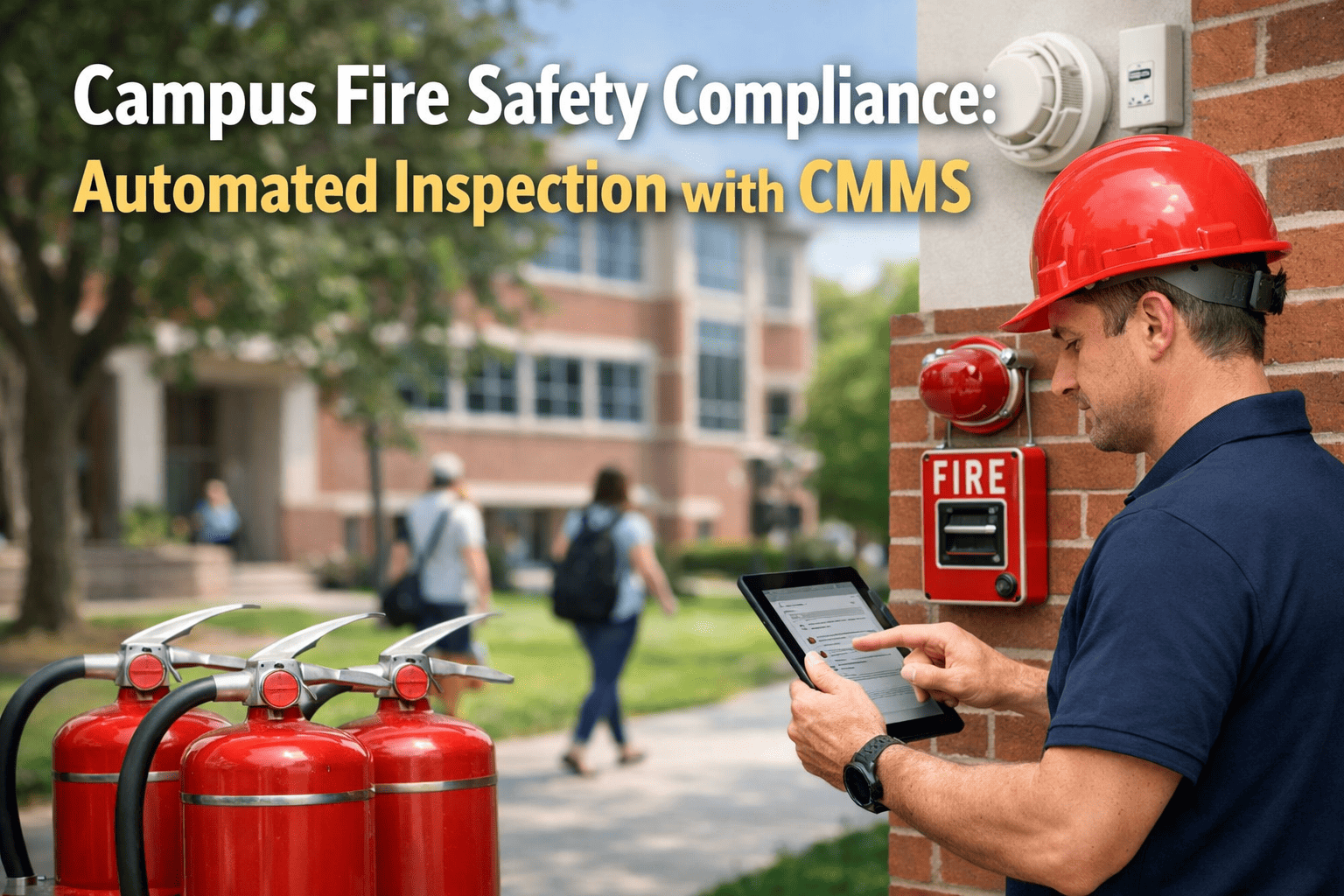
In the United States, K-12 and higher education institutions are responsible for the safety of over 70 million students and 7 million staff every day—across campuses that average 25+ buildings, aging HVAC systems, and sprawling grounds that no facilities team can physically monitor around the clock. In 2026, the gap between schools that respond to incidents and those that prevent them comes down to one operational capability: real-time visual intelligence. Manual walkthroughs miss wet corridors at 6 AM. Work-order backlogs hide the boiler room leak that becomes a $400K remediation. And paper-based fire-drill logs do nothing when a state auditor asks for 18 months of egress compliance data in a single afternoon. AI vision cameras—integrated directly with a CMMS like Oxmaint—have emerged as the definitive solution for institutions that refuse to treat student safety and facility health as separate problems. This guide compares the leading AI vision platforms purpose-built for education environments, breaks down their compliance and maintenance capabilities, and shows how CMMS integration converts raw camera data into automated work orders, audit-ready records, and measurable risk reduction. Request a personalized campus safety audit to identify the gaps your current monitoring cannot see.
The True Cost of Reactive Campus Safety and Deferred Maintenance
Before comparing camera platforms, decision-makers need to confront the financial and liability exposure that manual monitoring creates. These are not hypothetical numbers—they are the actuarial reality facing school boards, CFOs, and Directors of Operations across North America today.
$2.7B
Annual Cost of Slip-and-Fall Injuries in U.S. Schools
Wet floors, uneven surfaces, and obstructed corridors account for the largest share of preventable campus injuries—and the lawsuits that follow
$165K+
Average OSHA Fine Per Willful Violation
Educational institutions are not exempt from OSHA enforcement; boiler rooms, workshops, kitchens, and labs carry the same compliance burden as any commercial facility
68%
Of U.S. School Districts Report Deferred Maintenance Backlogs
GAO data shows most public schools need critical HVAC, roofing, and fire-safety system repairs that manual inspection cycles fail to prioritize before failure
Research shows that AI-powered visual monitoring reduces preventable campus incidents by up to 60% and cuts emergency maintenance spend by 30-45%. The question for school administrators is no longer whether to invest—it is how quickly you can close the gap between what you see and what is actually happening across your facilities.
Sign Up
What Separates Education-Grade AI Vision from Generic Surveillance
Standard security cameras record footage. Education-grade AI vision systems interpret it—identifying hazards, triggering maintenance workflows, and generating compliance documentation without a human reviewing hours of video. Here is what actually matters when your system must protect students, satisfy state fire marshals, and extend the useful life of a 40-year-old campus.
Automated Hazard Detection, Not Just Recording
AI models trained on campus-specific scenarios: standing water in hallways, blocked emergency exits, propped-open fire doors, lighting failures in stairwells, and unauthorized access to mechanical rooms. Detections are classified by severity and location—generating instant alerts and CMMS work orders before a student encounters the hazard.
Predictive Maintenance Through Visual and Thermal Analytics
Thermal overlays on HVAC units, electrical panels, kitchen equipment, and boiler systems detect performance degradation weeks before failure. Visual AI identifies corrosion, leaks, condensation patterns, and structural wear that would otherwise wait for a quarterly walkthrough. Every finding flows into
Oxmaint CMMS with asset ID, location, severity, and photographic evidence—replacing the clipboard forever.
Fire Code and Egress Compliance on Every Frame
Continuous monitoring of fire exits, extinguisher presence, AED station visibility, corridor obstruction, and emergency signage. Every observation is timestamped and geo-tagged—generating audit-ready logs that satisfy NFPA 101 Life Safety Code, state fire marshal inspections, and district insurance requirements without relying on subjective checklists.
CMMS Integration That Closes the Loop
Detections do not sit in a dashboard waiting for someone to notice. Oxmaint ingests AI vision alerts, matches them to asset records and building zones, applies priority logic, and auto-generates work orders routed to the right technician. The result: a leaking pipe detected at 11 PM has a work order assigned by 11:01 PM and a technician dispatched before students arrive.
Dashboards Built for Superintendents, Not Security Guards
Executive-level analytics: safety incident trends by building and month, maintenance spend by asset category, compliance completion rates by inspection type, and mean-time-to-repair benchmarks. Drill down by campus, floor, or individual asset to identify systemic issues—not just count problems after the budget is gone.
See These Capabilities Applied to Your Campus
Walk through Oxmaint's AI vision integration, automated work order generation, and compliance reporting with a specialist who understands K-12 and higher education operations.
2026 Top AI Vision Camera Platforms for Schools: Head-to-Head Comparison
We evaluated the most capable AI vision platforms against the criteria that matter to education facilities teams: hazard detection accuracy, CMMS integration depth, privacy compliance (FERPA, COPPA), and total cost of ownership for multi-building campuses. This is a focused comparison of solutions that K-12 districts and universities actually deploy in 2026.
Best for Education
Verkada + Oxmaint CMMS
Multi-campus K-12 districts and universities
On-camera AI analytics: spill detection, crowd density, blocked exits
Cloud-managed with zero NVR infrastructure required
Environmental sensors (air quality, temperature, humidity) in same platform
FERPA-compliant architecture with role-based access controls
Integrates with Oxmaint CMMS for auto work order generation from detections
Rhombus Systems
K-12 districts prioritizing unified security + maintenance
AI-powered alerts for vaping, unusual motion, and crowd anomalies
Smart sensors for air quality, noise levels, and environmental threats
Open API for CMMS and SIS integration
Edge processing with cloud management for bandwidth-constrained campuses
Avigilon (Motorola Solutions)
Large universities and multi-building campuses
Advanced object classification and unusual activity detection
Thermal camera integration for HVAC and electrical monitoring
Scalable to 1,000+ camera deployments across campuses
Enterprise-grade analytics with incident correlation
Spot AI
Budget-conscious districts upgrading existing camera infrastructure
Works with existing cameras—no rip-and-replace required
Natural language video search for incident investigation
AI dashboards for occupancy, traffic flow, and hazard detection
Lowest total cost of ownership for districts with legacy systems
Hanwha Vision (Wisenet)
Higher education and research campuses
On-camera AI analytics including loitering and PPE detection
Cybersecurity-hardened firmware (NDAA compliant)
Wide product range from indoor classrooms to outdoor perimeter
Open platform for third-party VMS and CMMS integration
Axis Communications + ACAP
Custom AI deployments and research institutions
Open analytics platform (ACAP) for custom AI model deployment
Thermal, radar, and audio analytics in unified ecosystem
Longest product lifespan with 5+ year firmware support
Extensive integrator network for complex campus architectures
Regulatory Compliance Gaps AI Vision Cameras Close for Schools
School administrators face overlapping compliance mandates from federal, state, and local agencies. Understanding which regulations drive audit risk helps you configure AI vision detection priorities and prove systematic compliance rather than relying on self-reported checklists.
NFPA 101
Life Safety Code
Common Violations
Blocked fire exits, propped-open fire doors, obstructed corridors, missing or expired extinguishers, inadequate emergency lighting
AI Vision + CMMS Solution
AI vision continuously monitors all egress paths, fire doors, and extinguisher stations—generating timestamped compliance logs and instant CMMS corrective actions when violations are detected
OSHA 1910
General Duty / Facilities
Common Violations
Slip-and-fall hazards in kitchens and custodial areas, unguarded machinery in workshops, chemical storage violations in labs
AI Vision + CMMS Solution
Automated spill and wet-floor detection, PPE monitoring in shop and lab environments, and chemical storage zone verification on every camera pass with CMMS work order generation
ADA / Section 504
Accessibility
Common Violations
Blocked wheelchair ramps, inaccessible building entries, obstructed accessible routes, out-of-service elevators without signage
AI Vision + CMMS Solution
AI detects obstruction of ADA-designated routes and access points, triggering immediate clearing work orders and documenting compliance status for OCR audits
EPA / IAQ
Indoor Air Quality
Common Violations
HVAC systems operating outside safe parameters, visible mold growth, water intrusion in classrooms, inadequate ventilation in occupied spaces
AI Vision + CMMS Solution
Thermal and environmental sensors integrated with visual AI detect HVAC performance degradation, condensation patterns, and water intrusion—triggering preventive maintenance before air quality degrades
FERPA / COPPA
Student Privacy
Common Violations
Unauthorized access to video feeds, student identification data in unsecured storage, lack of role-based access controls on surveillance systems
AI Vision + CMMS Solution
Education-grade AI platforms enforce role-based access, automated data retention policies, and anonymization protocols—ensuring monitoring enhances safety without compromising student privacy rights
A single serious OSHA violation costs over $16,000. A Title IX accessibility complaint can trigger years of federal oversight. AI vision monitoring ensures your compliance documentation is always audit-ready—and that hazards are resolved before an inspector or auditor arrives.
Schedule a campus compliance gap assessment to identify what your current monitoring misses.
Campus Facility Types and Their Unique Monitoring Demands
A 200,000 sq ft high school and a sprawling university research campus face fundamentally different hazard profiles and compliance requirements. The right AI vision strategy adapts to your institution rather than forcing a one-size-fits-all deployment.
K-12 School Buildings
Corridor slip hazards, cafeteria spills, playground equipment wear, locker room moisture damage, gym floor deterioration
Hallway hazard detection, cafeteria spill alerts, playground surface monitoring, HVAC performance tracking, fire-door compliance verification
University Lecture Halls & Libraries
Overcrowding and egress obstruction, elevator failures, lighting degradation, roofing leaks, ADA access blockages
Occupancy analytics, emergency exit monitoring, lighting-level verification, water intrusion detection, ADA route compliance checks
Science Labs & Workshops
Chemical spills, fume hood failures, PPE non-compliance, gas leak risk, eyewash station accessibility
PPE detection, chemical storage zone verification, fume hood airflow monitoring, emergency equipment accessibility audits, hazardous waste area compliance
Athletic Facilities & Stadiums
Bleacher structural wear, playing surface degradation, locker room mold, pool chemical imbalance, lighting outages
Structural condition monitoring, surface quality tracking, moisture and mold detection, equipment inspection logging, crowd safety management
Central Plant & Mechanical Rooms
Boiler overheat, chiller failure, electrical panel arcing, pipe corrosion, unauthorized access
Thermal monitoring of critical equipment, vibration and noise anomaly detection, access control verification, predictive maintenance alerting
Dormitories & Student Housing
Fire-door propping, kitchen appliance hazards, plumbing failures, HVAC complaints, pest indicators
Fire-code compliance monitoring, common-area hazard detection, plumbing leak alerting, HVAC performance dashboards, after-hours safety coverage
Measurable Impact: What AI Vision Monitoring Delivers for Schools
The return on AI vision deployment is not theoretical. School districts and universities that transition from manual walkthroughs to AI-powered visual monitoring consistently report measurable improvements within the first semester of deployment.
60%
Reduction in preventable slip-and-fall incidents within the first academic year
42%
Decrease in emergency maintenance spend through early detection and predictive alerting
85%
Faster hazard response time compared to scheduled walkthrough-based inspection cycles
4x
More compliance documentation generated per month enabling audit-ready records at any time
"
The cameras do not take a break between periods. They do not skip the east wing because the custodian called in sick. Every corridor, every mechanical room, every exit—monitored at the same standard, every hour. That consistency is what transformed our facilities operation from reactive to predictive—and it is what lets our team focus on the work that actually requires a human being.
============ INFOGRAPHIC BLUEPRINT ============
Infographic Blueprint: The AI Vision Decision Tree for Campus Safety ROI
The following visual maps how a single AI vision detection event flows through the Oxmaint CMMS to prevent a costly failure—quantifying the dollar impact at each decision node.
How One AI Vision Alert Prevents a $180K Campus Failure
AI Vision Camera detects thermal anomaly on Boiler #3 — 14°F above baseline at 2:17 AM
What Happens Next?
Alert sits in security dashboard unseen until Monday morning
Boiler fails Saturday — flooding basement mechanical room
Emergency repair: $47K | Water remediation: $83K | 3 weeks portable heating: $52K
Total Cost: $182,000
Detection auto-generates Priority-1 work order at 2:18 AM
On-call technician dispatched — arrives by 5:30 AM
Preventive repair completed: valve replacement + coolant flush
Total Cost: $2,400
Cost Comparison Per Incident
98.7% cost avoidance per incident
Annual Projection
Average school district experiences 4–6 critical equipment events per year
Projected Annual Savings: $540K – $1.08M
3.2xMTBF Improvement
99.1%Audit Pass Rate
18%OEE Uplift
From First Camera to Full Campus Coverage: Deployment Timeline
One of the biggest myths about AI vision deployment in education is that it requires a full network overhaul. Modern platforms can layer intelligence onto existing camera infrastructure and deliver automated CMMS workflows within weeks—not semesters. Book a walkthrough to get a customized timeline for your district.
Week 1–2
Campus Audit and Priority Zone Mapping
Identify highest-risk areas: mechanical rooms, egress paths, kitchens, labs, and high-traffic corridors. Map camera positions to Oxmaint asset records and building zones. Configure AI detection models for your campus-specific hazard profile.
Week 3–4
Pilot Deployment on Critical Buildings
Activate AI vision on 1-2 priority buildings. Calibrate detection thresholds against real campus conditions. Establish baseline readings for thermal, environmental, and compliance metrics to minimize false positives.
Week 5–8
Full Campus Integration and CMMS Automation
Expand coverage to all buildings. Activate automated work order generation for equipment anomalies and safety findings. Connect compliance dashboards to superintendent and board reporting workflows for real-time facility health visibility.
Ongoing
Optimize, Benchmark, and Scale Across the District
Use trend data to refine AI models and detection priorities. Benchmark MTBF, compliance rates, and cost avoidance by building. Replicate proven configurations across additional campuses in your portfolio.
Your Clipboards Cannot Protect a Campus. AI Vision with Oxmaint Can.
Manual walkthroughs do not catch the wet floor at 6 AM. Paper checklists do not track boiler performance trends over 18 months. Spreadsheets do not auto-generate a work order when a fire door is propped open at midnight. Oxmaint connects your AI vision camera network's hazard detection, safety compliance monitoring, and equipment health data into one platform your facilities team will actually use—from the central office to every building on campus.
Frequently Asked Questions
How does AI vision for schools differ from standard commercial security cameras?
Standard cameras record video for after-the-fact review. Education-grade AI vision platforms interpret visual data in real time—detecting hazards like wet floors, blocked exits, and equipment anomalies as they happen. More importantly, they integrate with a CMMS like Oxmaint to auto-generate work orders, route them to the right technician, and build compliance documentation automatically. The shift is from passive recording to active prevention.
Will AI vision cameras comply with FERPA and student privacy requirements?
Education-grade platforms like Verkada and Rhombus are built with FERPA and COPPA compliance architectures—including role-based access controls, automated data retention policies, encrypted storage, and audit trails for every access event. The focus of maintenance-oriented AI vision is on environmental conditions and equipment health, not student identification.
Schedule a walkthrough to review the specific privacy controls available for your deployment.
Do we need to replace our existing cameras to use AI vision?
Not necessarily. Platforms like Spot AI are specifically designed to layer AI analytics onto existing camera infrastructure—no rip-and-replace required. Other platforms (Verkada, Rhombus) offer purpose-built cameras with on-device AI processing. The right approach depends on your current infrastructure, network bandwidth, and budget. A campus audit will identify the most cost-effective path.
What is the ROI timeline for deploying AI vision in a school district?
Most districts see measurable returns within the first academic semester. Early wins come from preventing emergency equipment failures (a single avoided boiler failure can save $100K+), reducing slip-and-fall claims, and eliminating the labor cost of manual compliance documentation. When factoring in avoided litigation, reduced insurance premiums, and extended asset lifecycles, most deployments achieve full payback within 12-18 months.
Sign up for Oxmaint to start tracking campus savings from day one.
How does Oxmaint CMMS integration work with AI vision camera data?
AI vision platforms export detection events—thermal anomalies, hazard alerts, compliance observations—via API. Oxmaint ingests this data, matches it to your asset records and building zones, applies priority logic based on severity, and auto-generates work orders routed to the appropriate technician with full photographic evidence. The result is a closed-loop system where detection, assignment, resolution, and documentation happen without manual intervention.