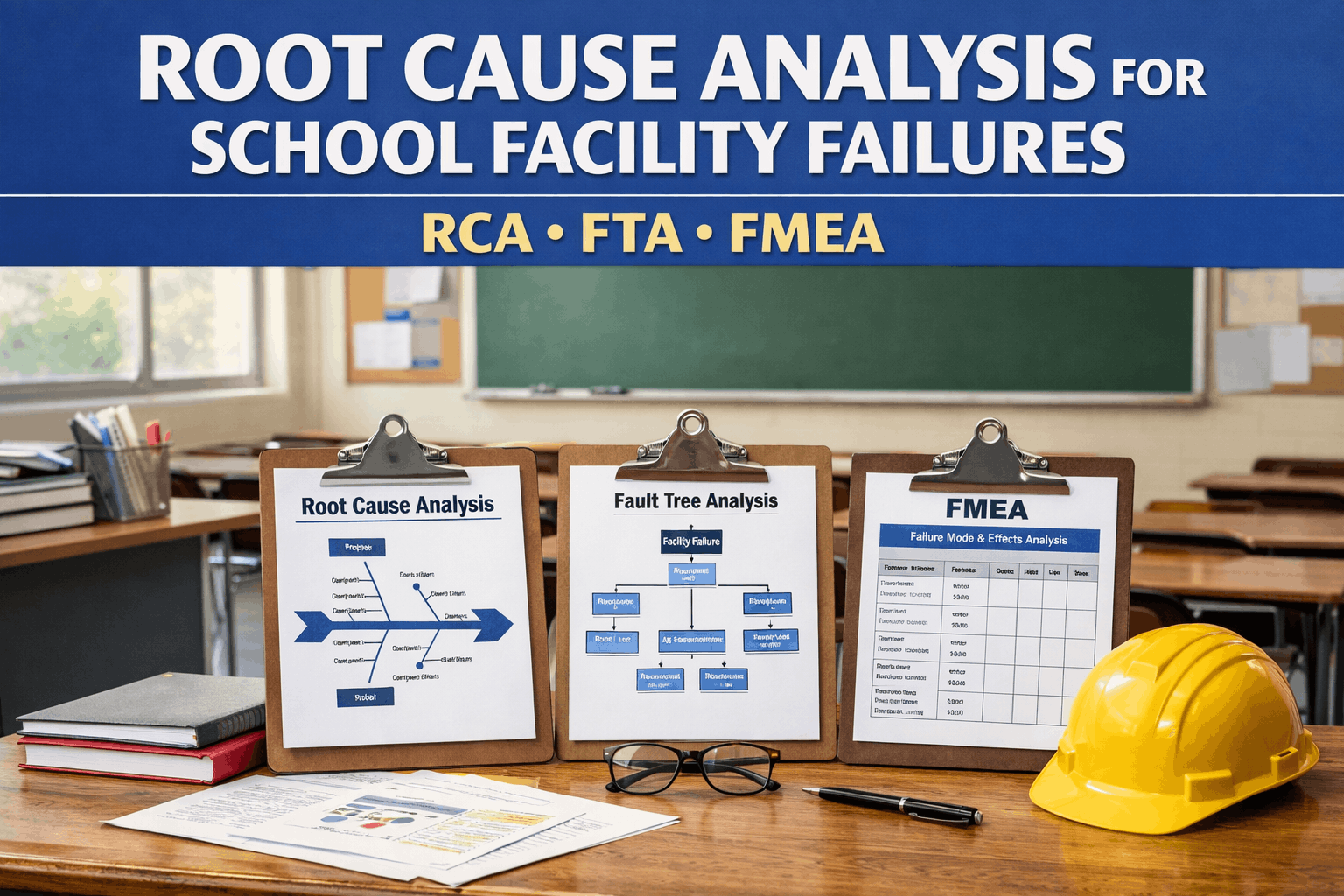
School facility failures often stem from a "maintenance-by-crisis" culture where teams react to broken boilers or leaking roofs rather than preventing them. When a critical HVAC system fails during finals week, it isn't just a mechanical issue; it is a breakdown in the troubleshooting methodology. Root Cause Analysis (RCA) provides the framework to move beyond the symptoms and identify why systems fail. By implementing structured tools like Fault Tree Analysis (FTA) and Failure Modes and Effects Analysis (FMEA), education facilities can transition from constant firefighting to strategic, predictive operations. Start your free trial to implement digital RCA workflows for your campus today.
RCARoot Cause Analysis: The process of finding the underlying "why" behind a system failure
FTAFault Tree Analysis: A top-down visual tool to map paths that lead to a specific failure
FMEAFailure Modes & Effects Analysis: A proactive method to rank and mitigate potential risks
85%Reduction in repeat failures when structured troubleshooting methodologies are applied
Three Essential Tools for School Maintenance Troubleshooting
Effective maintenance management requires a toolkit that addresses both current failures and future risks. For school facility managers, mastering these three methodologies—RCA, FTA, and FMEA—is the difference between a reliable campus and a constant backlog of emergency work orders.
Reactive
Root Cause Analysis (RCA)
RCA is the investigation performed after a failure occurs. It seeks to identify the physical, human, or organizational cause (e.g., why did the pump motor burn out?). It prevents the "Band-Aid" fix by ensuring the true source is addressed.
Application: Boiler explosions, major floods, recurring electrical trips.
Diagnostic
Fault Tree Analysis (FTA)
FTA uses a logic-based diagram to show how various combinations of hardware or software failures can lead to a specific "top event" (system failure). It is excellent for understanding complex campus systems like fire alarms or district cooling.
Application: Mapping why a fire suppression system failed to activate.
Proactive
FMEA (DFMEA & PFMEA)
FMEA looks forward to identify failure modes before they happen. DFMEA focuses on design (new building plans), while PFMEA (Process FMEA) focuses on maintenance procedures and operational workflows.
Application: Auditing the preventive maintenance schedule for a new dorm.
Quality
FMECA
An extension of FMEA that includes "Criticality." It ranks failures by their severity and probability, helping school boards decide which capital projects are the most urgent based on safety and academic impact.
Application: Prioritizing roof replacements vs. parking lot paving.
The 6-Step RCA Troubleshooting Workflow
When a facility failure occurs, teams often rush to fix the immediate problem without asking why it happened. Following a standardized troubleshooting methodology ensures that the "fix" actually lasts.
1. Data Collection
Photos, logs, interviews
CMMS Records
Evidence
2. Problem Definition
Define what, where, when
Work Order History
Clarity
3. Identify Causal Factors
What led to the event?
5 Whys / Ishikawa
Mapping
4. Identify Root Cause
The point of intervention
Fault Tree Analysis
The "Why"
5. Recommendation
Determine the solution
PFMEA
Prevention
6. Implementation
Track and verify fix
Predictive Sensors
Reliability
Build a Fail-Safe Maintenance Strategy
Stop chasing the same work orders every month. Oxmaint provides the data and RCA tools needed to solve facility problems permanently.
RCA Insights: Why Campus Systems Fail
Scenario 1
The "Bad" HVAC Compressor
Symptom: Compressor burns out every 6 months.
Root Cause: Faulty sensor in the BAS caused "short-cycling." Replacing the compressor didn't fix the sensor. RCA identified the sensor as the culprit, saving $5k/year in parts.
Reduced Repair Cost
↓
Scenario 2
Recurring Pipe Bursts
Symptom: Burst pipes in the South Wing every winter.
Root Cause: Insufficient insulation during a 2012 renovation (PFMEA failure). RCA led to a targeted insulation project rather than constant plumbing repairs.
Eliminated Floods
↓
Scenario 3
Fire Alarm Nuisance Trips
Symptom: Dorm fire alarms trip at 2 AM frequently.
Root Cause: Poorly placed sensors near showers (DFMEA failure). Fault Tree Analysis mapped the steam to the sensor trigger, leading to a simple relocation fix.
Improved Safety
RCA doesn't just fix equipment; it fixes the processes and decisions that led to the equipment's failure in the first place.
FMEA: Identifying Risk Before the Semester Starts
FMEA (Failure Modes and Effects Analysis) allows facility managers to rank risks using a Risk Priority Number (RPN). This ensures that limited maintenance budgets are spent on the most critical assets. Book a demo to learn how to generate RPN scores for your campus assets.
Step 1
Identify Failure Modes
What could go wrong? (e.g., Boiler pump leaks, belt breaks, electrical surge).
↓
Step 2
Rate Severity (1-10)
How bad is the impact? 10 = School closure/Safety risk; 1 = Minor annoyance.
↓
Step 3
Rate Occurrence (1-10)
How often does this happen? 10 = Weekly; 1 = Once in 10 years.
↓
Step 4
Rate Detection (1-10)
Can we see it coming? 10 = Impossible to detect until it breaks; 1 = Real-time monitoring.
The Formula:
Severity × Occurrence × Detection = Risk Priority Number (RPN)
Action Plan:
High RPNs get immediate PM schedules and predictive sensors.
Modernizing Your Maintenance Strategy
CMMS: Digitized work orders provide the history for RCA investigations
Foundational
IoT Sensors: Detect "Detection" failures in FMEA before they occur
Predictive
Digital FTA: Visual maps linked to live asset condition data
Advanced
AI Diagnostics: Automated RCA suggestions based on failure patterns
Next-Gen
The goal is to move up this maturity curve, reducing downtime and operational costs at every step.
Financial Impact: The ROI of "Doing it Right"
25%
Reduction in Emergency Labor Costs
Avoiding overtime and emergency contractor call-out fees through proactive FMEA planning
15%
Energy Waste Elimination
RCA on HVAC systems identifies efficiency losses that drive up utility bills
30%
Asset Life Extension
Finding root causes prevents equipment from burning out prematurely, deferring capital replacement
Estimated Total Value
$250k - $1M+
Depending on campus size and current maintenance maturity level
Ready to Simplify Your Troubleshooting?
Stop treating symptoms. Start solving problems. Oxmaint empowers education facility teams with the tools to perform Root Cause Analysis, manage FMEA risks, and track every work order to completion.
Frequently Asked Questions
What is the difference between RCA and FMEA?
RCA (Root Cause Analysis) is reactive—it happens after a failure to ensure it doesn't happen again. FMEA (Failure Modes and Effects Analysis) is proactive—it attempts to predict what might fail and the impact of that failure before it occurs. A good maintenance program uses both.
What does RCA stand for in maintenance?
RCA stands for Root Cause Analysis. It is a systematic process for identifying the origin of a problem and finding a solution that addresses that origin, rather than just the symptom.
Is Fault Tree Analysis (FTA) too complex for school janitorial or maintenance teams?
Not at all. While the name sounds technical, it is simply a visual map. For example, if "The School is Cold" is the top event, the branches below it might be "Boiler Failure," "Pipe Break," or "Thermostat Malfunction." It helps teams visualize the chain of events, making it a powerful communication tool for technicians and school boards alike.
What are the basic troubleshooting steps for a campus pump failure?
1. Check for immediate power/safety issues. 2. Verify flow/pressure readings. 3. Check for physical signs (leaks, heat, noise). 4. Use the "5 Whys" (e.g., Why did the pump stop? The motor tripped. Why? It overheated. Why? The filter was clogged. Why? The PM was skipped). 5. Fix the filter AND the PM schedule gap.