School District Maintenance KPIs: The Essential Metrics for Accountability
By Jamie lanister on March 30, 2026
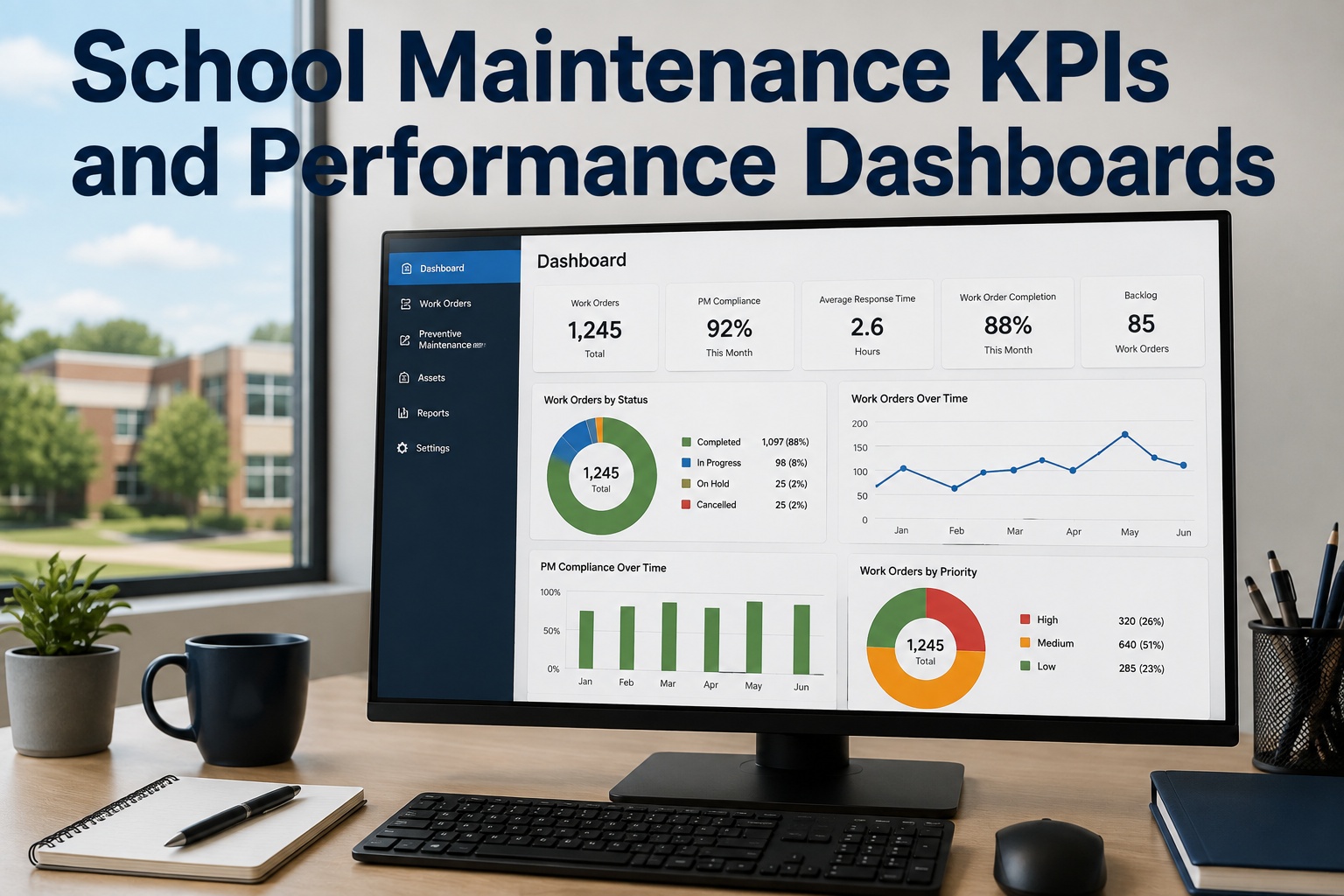
School district maintenance departments are under sustained pressure to demonstrate value and justify budgets to boards, administrators, and communities demanding data-driven accountability. The districts that manage this best have defined and consistently reported a clear set of KPIs that translate maintenance activity into language finance officers understand. PM completion rate, work order response time, cost per square foot, energy use intensity, and deferred maintenance ratio are not technical abstractions — they are the metrics that tell a board whether their maintenance investment is protecting or eroding the district's physical asset base. OxMaint provides a live KPI dashboard for every metric in this article — automatically calculated from work order and asset data, without any manual reporting effort from maintenance staff.
OxMaint · Article · School Maintenance KPIs · Performance Management
School District Maintenance KPIs: The Essential Metrics for Accountability
Work order response time · PM completion rate · cost per square foot · energy use intensity · deferred maintenance ratio · CMMS performance dashboards — KPI tracking for K–12 and higher education facilities management.
average PM completion rate for US school districts not using a CMMS — APPA Custodial & Maintenance Study
$9.80
average maintenance cost per square foot for US public schools — higher education averages $12.40
$85B
estimated national deferred school maintenance backlog — ASCE America's Infrastructure Report
94%
average PM completion rate for school districts actively using OxMaint — up from 61% at onboarding
The Six Essential School Maintenance KPIs
Not all metrics are KPIs. A true KPI directly reflects programme health, is actionable when it falls below target, and is meaningfully comparable against industry benchmarks over time. These six indicators meet all three criteria — together they give a board a complete picture of whether the district's maintenance investment is protecting or eroding its physical asset base.
PM Completion Rate
Percentage of scheduled preventive maintenance work orders completed on time within the measurement period.
Target: 90% or above
Below 80% — PM programme is failing; reactive maintenance will rise within 12–18 months
Work Order Response Time
Average elapsed time from work order creation to first technician action, by priority category.
Emergency <2 hr · Urgent <24 hr · Routine <5 days
Routine WO over 10 days — backlog growing faster than capacity
Maintenance Cost per Sq Ft
Total annual maintenance expenditure — labour, materials, contractors — divided by gross occupied square footage.
K-12 target: $6–$9/sqft · Higher Ed: $9–$14/sqft
Trending above target — reactive maintenance is inflating total cost
Energy Use Intensity (EUI)
Total site energy consumption (kBtu) divided by gross square footage. ENERGY STAR benchmarks this for school buildings nationally.
K-12 target: 60 kBtu/sf/yr or below (ENERGY STAR median: 68)
Estimated cost of identified but uncompleted maintenance as a percentage of total asset replacement value.
Target: 5% of asset replacement value or below
Above 10% — deferred maintenance is compounding; future costs exceed current PM spend
Reactive vs Planned Ratio
Proportion of total maintenance hours that are reactive (unplanned) versus preventive or predictive (planned).
Target: 20% reactive or below · 80% planned or above
Above 40% reactive — costs will be 3–5× higher per event than planned PM
KPI Benchmark: District Average vs OxMaint-Managed District
The comparison below shows average performance across six KPIs for US school districts without a CMMS versus districts using OxMaint for 12+ months — based on APPA benchmarks, ENERGY STAR school data, and OxMaint platform analytics. OxMaint generates every metric automatically from work order and asset data — no manual calculation required.
KPI BENCHMARK — DISTRICT AVERAGE vs OXMAINT MANAGED
District Average (no CMMS)
OxMaint-Managed District
PM Completion Rate higher is better
61%
94%
Work Order Response — Days lower is better
4.2 days
0.8 days
Reactive Maintenance % lower is better
68%
18%
Maintenance Cost per Sq Ft lower is better
$9.80
$5.80
Energy Use Intensity kBtu/sf lower is better
82 kBtu/sf
58 kBtu/sf
Deferred Maintenance Ratio lower is better
38%
9%
Technology: How OxMaint Tracks KPIs Automatically
KPI tracking requires data — and data requires a system that captures it at the point of activity. OxMaint captures every metric needed for all six KPIs as a natural output of normal CMMS operation — work order creation, technician assignment, completion timestamp, materials cost, and PM schedule status recorded automatically. No spreadsheet compilation, no manual calculation, no separate reporting tool.
Live KPI Dashboard
Real-time
Auto-calculated from work orders
PM completion rate, response time, and reactive ratio calculated live from all work order activity — no manual entry, no spreadsheet, no reporting lag.
OBD / Smart Metering
EUI auto
Energy use intensity tracked
Smart meter integration feeds energy consumption data into OxMaint — automatically calculating EUI per building and flagging anomalies against the ENERGY STAR baseline.
AI Digital Twin
FCI live
Facility Condition Index tracked
Digital twin asset condition data feeds the deferred maintenance ratio — giving boards a live FCI per building without the cost of a manual condition assessment.
SAP / Finance Integration
Cost/sqft
Automatic cost per sq ft
OxMaint pulls actual materials and labour costs from SAP and calculates cost/sqft automatically — no manual finance reconciliation for board reporting.
Board Report Export
2 min
Monthly board report generated
All six KPIs exported as a formatted board report — trend charts, building breakdowns, year-over-year comparison — in under two minutes from the OxMaint dashboard.
AI Camera Vision
Live
Deferred maintenance detection
AI camera scans identify physical deterioration — peeling paint, damaged fixtures, blocked drains — feeding the deferred maintenance ratio with real observed conditions, not estimates.
Using KPIs to Drive Budget Decisions
KPIs are decision-making tools, not just reporting tools. A deferred maintenance ratio trending upward tells a board that the current maintenance budget is insufficient to prevent asset value erosion. A PM completion rate below 80% tells a director that either the PM schedule is too aggressive for current staffing, or the work order system is not tracking completions accurately. These three budget decisions are directly connected to the six KPIs above.
Budget Increase Justification
A deferred maintenance ratio above 15% combined with a rising reactive percentage provides quantitative evidence for a capital maintenance budget increase that finance officers can evaluate against industry benchmarks — rather than rejecting as an anecdotal request.
Staffing Level Decision
Work order backlog growing month-over-month with response times increasing tells leadership that maintenance staff are at capacity — providing the data foundation for a hiring or contractor augmentation request that administration will find compelling.
Building Priority Setting
When KPIs are tracked per building, those with the worst deferred maintenance ratios and highest reactive work order rates can be prioritised for capital investment — making the case for building-specific allocation with objective performance data.
❝
Before OxMaint our board maintenance presentation was a narrative. Now it's six charts — PM completion, response time, cost per square foot, energy intensity, reactive ratio, and deferred maintenance — automatically updated every month. The board approved our first maintenance budget increase in seven years based on the deferred maintenance ratio trend alone. Data is the only language finance understands.
Director of Facilities — Large suburban K–12 district · 18 buildings · OxMaint user since 2022
Frequently Asked Questions
90% or above is the target for a well-functioning PM programme. Below 80% indicates that PM tasks are being deferred at a rate that will increase reactive maintenance within 12–18 months. OxMaint calculates this automatically from all scheduled work order data.
APPA benchmarks $6–$9 per square foot for K-12 school maintenance and $9–$14 for higher education. Districts consistently above $12/sqft typically have high reactive maintenance ratios that inflate total cost — which CMMS-enabled PM programmes directly correct over 12–18 months.
Total estimated cost of identified but uncompleted maintenance divided by total asset replacement value, expressed as a percentage. A ratio above 5% is concerning; above 10% represents a systemic maintenance funding gap. OxMaint tracks deferred work orders and calculates this automatically.
The APPA target is 20% reactive / 80% planned. Most districts without a CMMS run at 60–70% reactive. OxMaint-managed districts typically reach 15–20% reactive within 18 months of implementing a full PM schedule — representing a 3–5× reduction in average per-event cost.
OxMaint calculates all six KPIs automatically from live work order and asset data, with per-building breakdowns and year-over-year trends. The board report exports in under two minutes — replacing the multi-day manual compilation process most facilities directors currently use.
ENERGY STAR's national median for K-12 schools is approximately 68 kBtu/sf/year. Districts targeting 60 kBtu/sf or below typically have active CMMS-managed HVAC PM with controls calibration — energy savings that compound year over year and contribute directly to the district's sustainability goals.
Know Your PM Rate. Track Your Cost Per Sq Ft. Prove Your Budget Case. OxMaint Does All Three.
Live KPI dashboard · automated PM completion tracking · board-ready monthly reports · deferred maintenance ratio · energy use intensity monitoring. Free to start.