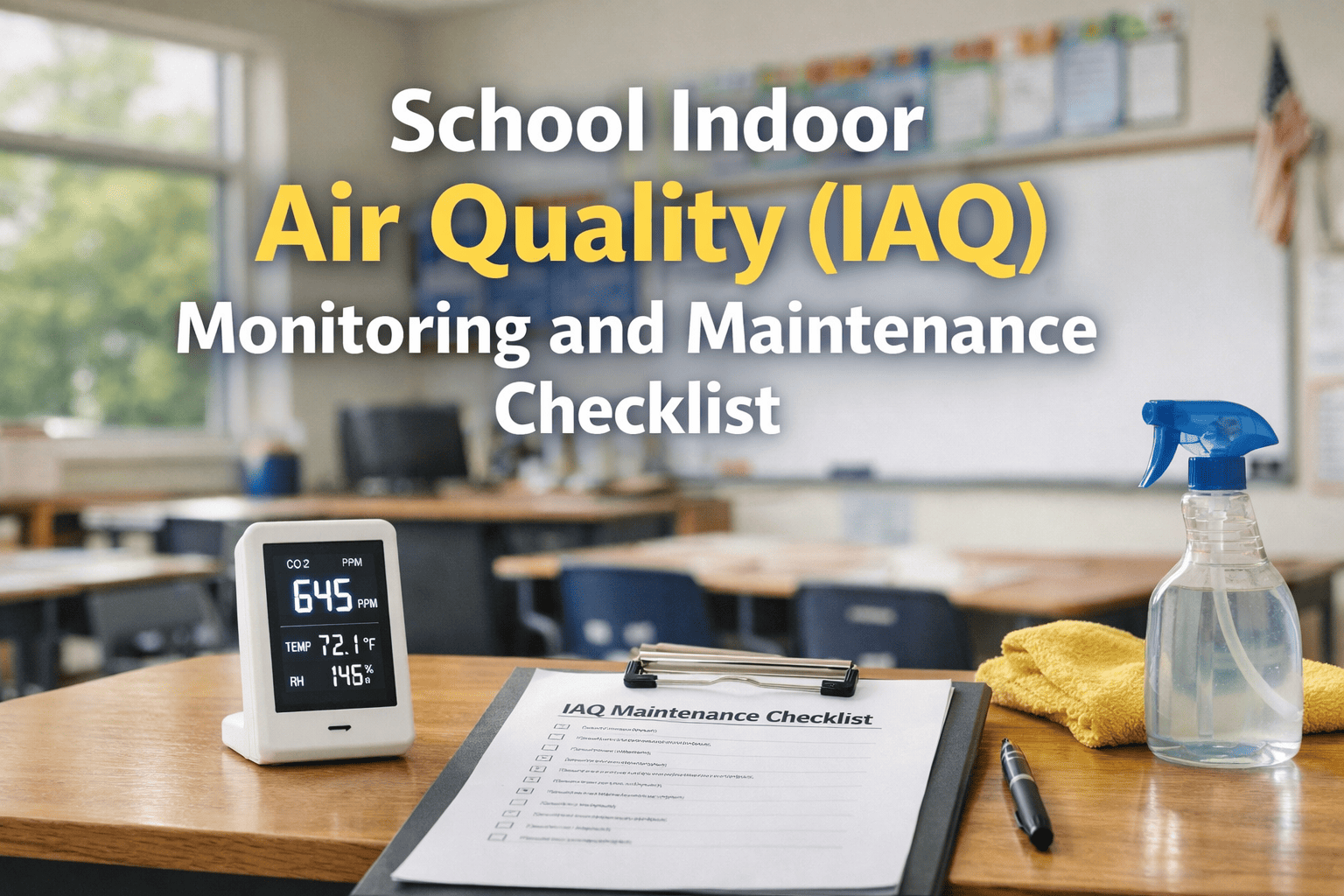
A school district in Michigan closed three elementary buildings for two weeks in 2022 after CO2 readings averaged 2,400 ppm during the school day — more than four times the ASHRAE 62.1 recommended maximum. The $180,000 HVAC remediation was covered by the district's deferred maintenance budget. The $340,000 in parent legal claims for alleged health impacts was not. Indoor air quality in schools is a documented student health issue, a post-pandemic regulatory priority, and an increasing source of district liability. This checklist covers the complete school IAQ monitoring and maintenance programme — CO2, humidity, temperature, HVAC filter replacement, ventilation rates, mould inspection, and compliance documentation — structured for deployment in OxMaint as an automated daily and seasonal monitoring programme. Book a demo.
1. CO2 Monitoring
CO2 is the most reliable proxy for ventilation adequacy in occupied classrooms. When CO2 exceeds 1,100 ppm — approximately 700 ppm above outdoor ambient — ASHRAE 62.1 ventilation standards are likely not being met. At 2,000+ ppm, students experience measurable cognitive impairment: a 2021 Harvard study found decision-making ability decreases by 50% at 2,500 ppm CO2. A $150 wall-mounted CO2 sensor in every classroom, connected to OxMaint, generates an alert before the air quality hurts student performance.
2. Humidity and Temperature
Relative humidity below 30% causes dry skin, increased susceptibility to respiratory infections, and static discharge that damages electronics. Humidity above 60% drives mould growth — a mould colony can establish on damp drywall in 48–72 hours. ASHRAE Standard 55 targets 30–60% relative humidity for occupied classrooms. Temperature outside the 68–76°F comfort range reduces student concentration and increases absenteeism.
3. HVAC Filter Replacement Programme
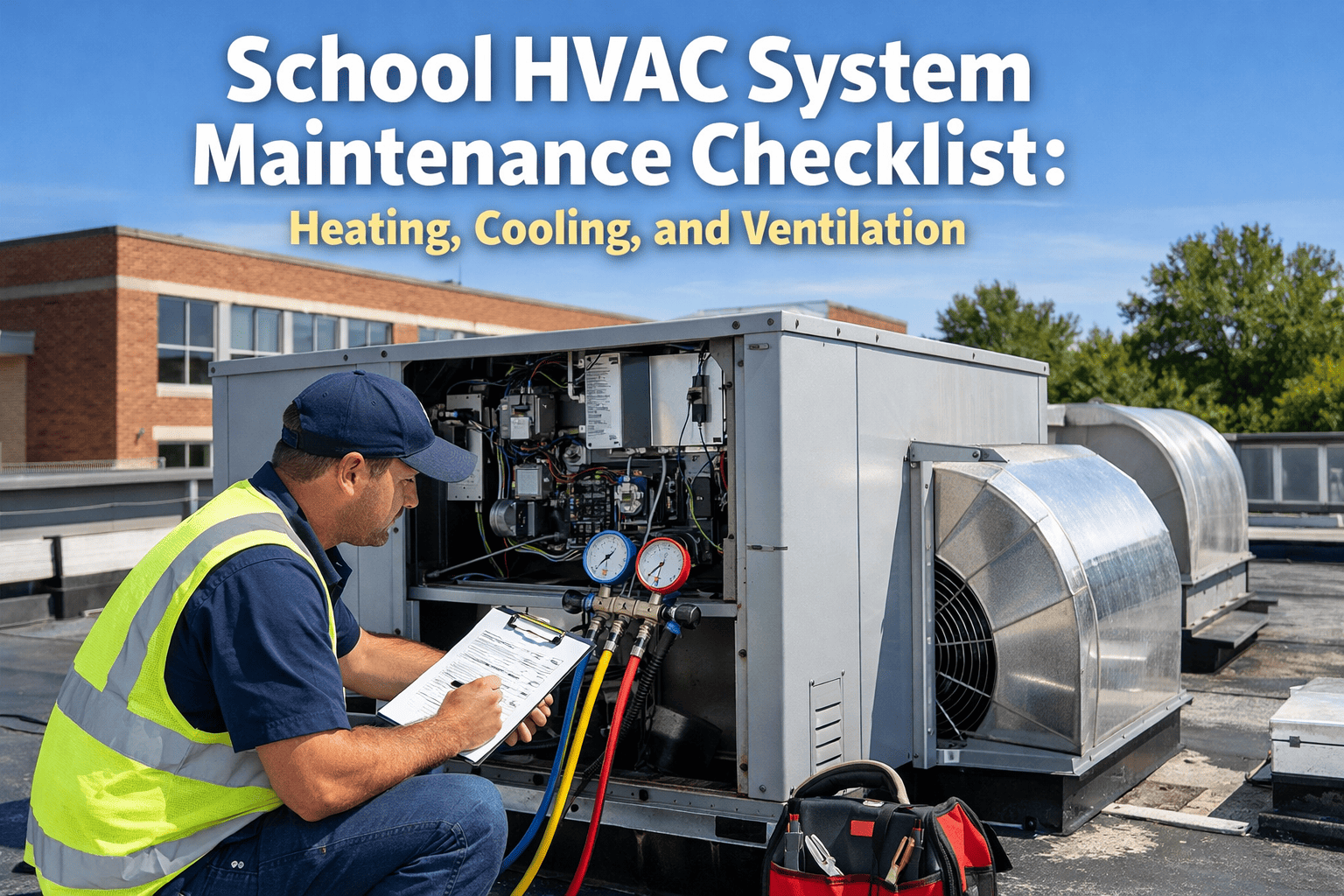
A clogged HVAC filter reduces airflow, increases energy consumption, and allows particulate to bypass the media and coat coils and ductwork. Post-pandemic, EPA and CDC guidance recommends MERV-13 filters or higher for school HVAC systems. A filter that costs $18 to replace on schedule costs the district $200–$400 in coil cleaning when it goes overdue for 6 months, plus the IAQ damage from reduced airflow in the interim.
4. Ventilation Rate Verification
ASHRAE Standard 62.1 defines minimum ventilation rates for school classrooms: 0.15 cfm per square foot of floor area plus 7.5 cfm per person (occupant component). A standard 900 sq ft classroom with 30 students requires approximately 360 cfm of outside air. Most school HVAC systems were designed to meet this rate when new — but damper actuator failure, belt-driven fan degradation, and ductwork leakage can reduce actual outside air delivery to 20–30% of design within 5–10 years without a measurement programme in place.
5. Mold and Moisture Inspection
EPA's document "Mold Remediation in Schools and Commercial Buildings" identifies moisture control as the only effective mold prevention strategy — once mould establishes in a school building, remediation costs $15–$50 per square foot and the district faces parent complaints, media coverage, and potential liability for student health impacts. The 48–72 hour window between water intrusion and mould establishment means the response programme is more important than the detection programme.
6. Chemical Pollutants and Source Control
School buildings contain numerous sources of volatile organic compounds (VOCs), particulates, and chemical pollutants — cleaning products, art supplies, laboratory chemicals, renovation materials, and vehicle exhaust from idling buses at the loading zone. The EPA's School IAQ guidance identifies source control as the most cost-effective IAQ strategy. A $0 policy change (idle-free bus zone) reduces exhaust infiltration as effectively as a $15,000 HVAC upgrade.
7. IAQ Complaint Response Protocol
A parent complaint about classroom air quality that goes unacknowledged for two weeks becomes a school board agenda item and a media story. The same complaint, acknowledged within 24 hours with a documented investigation and corrective action, becomes a closed case. The EPA's IAQ Tools for Schools framework requires a documented complaint response process — the response protocol matters as much as the underlying IAQ programme.
8. IAQ Documentation and Compliance
The EPA's IAQ Tools for Schools programme — adopted voluntarily by thousands of districts and required in some states — specifies that schools maintain an IAQ management plan with documented monitoring results, corrective actions, and training records. In the post-pandemic environment, boards, parents, and state education departments are increasingly asking to see IAQ data. Districts with documented monitoring programmes answer these requests in minutes instead of months.