School Parking Lot and Transportation Infrastructure Maintenance
By Jamie lanister on March 28, 2026
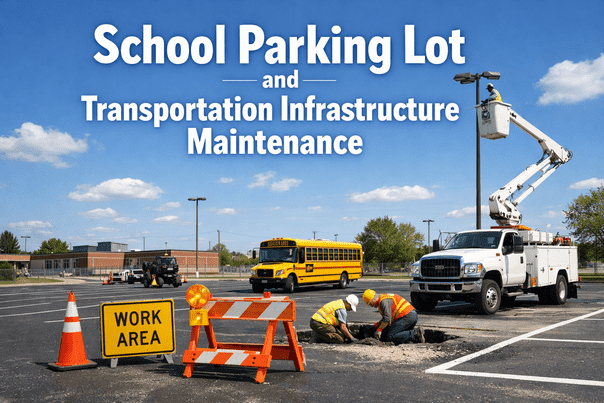
A school parking lot is the first and last physical touchpoint of every student arrival and departure — and in many districts it is also the most deferred maintenance asset in the entire facility portfolio. Faded crosswalk striping, potholed bus loop surfaces, malfunctioning lighting that leaves drop-off zones dark at 07:30, and ADA accessible parking bays that have not been audited in years create a compounding liability profile that most facilities teams do not systematically track until an incident triggers an insurance or legal review. OxMaint gives school facility directors a CMMS platform that maps and monitors every parking lot, bus loop, and transportation infrastructure asset — from pavement condition assessments and striping cycles to lighting PM schedules, seasonal maintenance triggers, and ADA compliance audits — generating timestamped, photo-evidenced work orders that close the gap between an observed defect and a documented, resolved maintenance record.
OxMaint · School Parking Lot Management · Transportation Infrastructure PM
Every Surface Assessed. Every Striping Scheduled. Every ADA Compliance Record Documented.
CMMS-powered school parking lot and transportation infrastructure maintenance — pavement, striping, lighting, signage, bus loops, drop-off zones, and ADA parking all scheduled, tracked, and compliance-documented from first deployment.
Of school parking lot accidents involve an unaddressed pavement defect or faded striping at the incident location
68%
Of schools identify ADA accessible parking compliance gaps during their first systematic CMMS-enabled inspection
<24 hrs
Average time from pavement hazard report to area cordoned and maintenance work order assigned and acknowledged
100%
Digital inspection records for pavement, lighting, signage, and ADA compliance — photo-evidenced and audit-ready
How CMMS Parking Lot Inspection Works: Four Steps from Hazard to Closed Record
A pothole at the entrance of the bus loop is a safety issue the first day it opens — and a liability issue every day it remains unrecorded and unaddressed. OxMaint turns every parking lot observation into a timestamped, location-tagged, photo-evidenced work order in under 90 seconds. Start free and deploy OxMaint parking lot management across your district in under 48 hours.
MOBILE REPORTING WORKFLOW — 4 STEPS FROM DETECTION TO CLOSED RECORD
Step
Action
Data Captured
What OxMaint Does
Time
01
Select zone and defect type
Parking zone, bus loop, drop-off, pedestrian crossing — defect type from pre-loaded infrastructure asset tree
Timestamps report. Maps GPS location. Routes to grounds or maintenance team. Cross-checks prior reports.
20 sec
02
Photograph and log dimensions
Photo of defect, estimated size, surrounding hazard context, proximity to pedestrian or vehicle routes
Compares defect size to repair trigger threshold. Flags P1 if in pedestrian crossing or bus route.
25 sec
03
Tag severity and traffic risk
P1 Immediate Hazard / P2 Repair Required / P3 Preventive PM — guided descriptions per surface type
Routes P1 immediately to grounds supervisor. P2 queues next-day repair. P3 to seasonal PM schedule.
10 sec
04
Submit and generate compliance record
Staff digital sign-off, timestamp, GPS coordinates, photo — area cordoned note if P1
Seals inspection record. Work order assigned to repair contractor or in-house grounds team. Tracked to close.
15 sec
Works offline — reports queue locally and sync when connectivity returns. Timestamp applied at submission.
Parking Lot Hazard Framework: Three Defect Tiers, Three Response Paths
A pothole in an active bus loop and a faded visitor parking line require completely different urgency levels. OxMaint routes every parking infrastructure defect automatically — grounds supervisors never need to manually decide whether a cracked kerb near the disabled bay is a P1 closure or a scheduled repair. Book a demo to see the parking infrastructure framework for your school sites.
RESPONSE FRAMEWORK — THREE TIERS, AUTOMATED ESCALATION
Defect poses immediate risk to vehicles or pedestrians. Area must be cordoned before next arrival or departure period. Grounds supervisor and facilities director alerted within 5 minutes of report.
Examples
Deep pothole in bus loop · Raised kerb at drop-off · Failed lighting in pedestrian crossing · Damaged speed bump · Blocked emergency vehicle access · ADA ramp failure
Alert time<5 min
Area actionCordon immediately
WO priorityP1
P2
Repair Required — Address Before Next School Day
Defect identified but not posing immediate injury risk. Repair scheduled before next peak arrival/departure period. Area monitored until repair completed.
Examples
Developing pothole · Significantly faded crosswalk · Damaged signage · Single lighting failure in car park · Minor ADA paint degradation · Bus stop pad cracking
Alert time<4 hrs
Area actionMonitor + schedule
WO priorityP2
P3
Preventive Maintenance — Schedule at Next PM Cycle
No current safety risk. Seasonal maintenance task due, cosmetic wear noted, or routine restriping cycle approaching. Scheduled at next planned grounds maintenance window.
Examples
Restriping schedule approaching · Crack sealing before winter · Signage fading · Lighting lamp approaching end of life · Annual ADA audit due · Drain inlet cleaning
Alert timePM schedule notice
Area actionFully operational
WO priorityP3
Most Common Parking Lot Maintenance Issues: Where School Transportation Risk Concentrates
PARKING LOT ISSUE CATEGORY FREQUENCY — % OF ALL MAINTENANCE REPORTS · SCHOOL TRANSPORTATION INFRASTRUCTURE 2024–25
Category
Share of Reports
Freq.
% P1
Action
Pavement Cracks / Potholes
30%
42% P1
Annual crack sealing + pothole repair cycle
Faded Striping
24%
18% P1
Restripe every 2-3 years or at first fade
Lighting Failure
18%
35% P1
Semi-annual lamp inspection + replacement PM
Signage Damage
14%
12% P1
Annual signage condition inspection
ADA Non-Compliance
10%
55% P1
Annual ADA accessible parking audit mandatory
Speed Bump Damage
4%
28% P1
Bi-annual speed bump condition inspection
ADA accessible parking non-compliance carries a 55% P1 escalation rate — failure to maintain accessible stall markings, signage, and ramp condition is a federal ADA violation regardless of how it occurred.
From Hazard Report to Closed Maintenance Record: The Full Parking Lot Lifecycle
An unresolved parking lot hazard that is photographed by a parent and shared on social media is a public relations and liability event — not just a maintenance backlog item. OxMaint tracks every defect from first report to closed, photo-evidenced work order. Start free — closed-loop parking infrastructure records from day one.
INCIDENT LIFECYCLE — FROM REPORT TO CLOSED COMPLIANCE RECORD
Stage
P1 Critical
P2 Scheduled
P3 Routine
Who Receives
01
Defect / Hazard Detected
Immediate — staff or parent report
Patrol observation — same day
Seasonal inspection — scheduled
Grounds supervisor + facility manager
02
Alert Fired
Push + SMS to supervisor immediately
Dashboard alert within 4 hrs
PM queue notification
Grounds supervisor · Facilities director
03
Work Order Raised
Auto-generated P1 within 5 min
P2 WO — overnight repair priority
P3 linked to seasonal PM
Grounds team or repair contractor
04
Area Cordoned / Repair Assigned
Cordon same session — same day
Repair scheduled next available
PM task assigned at window
Grounds team — cordon logged
05
Repair Completed
Emergency repair — same day
Repair completed — next day
PM task completed at schedule
Technician — digital sign-off + photo
06
Record Sealed
Full audit trail — PDF exportable
Full repair record — exportable
PM record linked — archived
Facilities director compliance dashboard
Technology Integration: AI Camera, IoT Sensors, Digital Twin, SAP, and Seasonal PM Scheduling
Manual patrol inspections catch defects that staff observe. Technology integration extends monitoring to the full parking lot perimeter — including areas that rarely get patrol attention until after an incident. Connect all monitoring layers through OxMaint.
HOW EACH TECHNOLOGY ENHANCES THE PL PROGRAMME
AI Camera
Surface and Striping Condition Scoring
Cameras monitor parking lot surface condition, striping visibility, and signage integrity — automatically scoring condition and flagging deterioration before it reaches P1 report threshold.
Continuous surface and striping condition scoring
IoT Sensors
Lighting Failure Detection
IoT circuit sensors on parking lot lighting columns detect lamp failure and circuit faults immediately — P2 work orders auto-generate without a night-time patrol inspection.
Lighting failure detected without overnight patrol
Digital Twin
Infrastructure Asset Mapping
Virtual map of all parking zones, bus loops, drop-off zones, accessible bays, and signage locations — with defect history, repair records, and ADA compliance status overlaid per zone.
Visual compliance and condition map per parking zone
SAP / ERP
Repair Cost and Contractor Tracking
Every parking lot work order writes contractor, cost, and material to SAP — pavement repair spend, restriping costs, and lighting replacement cycles tracked at site level for capital planning.
Full repair cost to ERP with zero manual entry
Seasonal PM
Weather-Triggered Maintenance Scheduling
Pre-winter crack sealing, post-winter pothole repair, spring restriping, and autumn drain clearing are scheduled as seasonal PM triggers in OxMaint — fired by date and weather threshold automatically.
Seasonal PM triggered automatically — no manual scheduling needed
GIS / Mapping
ADA Compliance Audit Tools
ADA accessible bay locations, ramp grades, and surface condition are mapped in OxMaint — annual ADA audit work orders generate automatically with photo evidence requirements per bay.
Annual ADA audit auto-scheduled — photo evidence required per bay
"Our insurance broker asked for three years of parking lot inspection and repair records after a slip incident at our main entrance. I exported the complete OxMaint record — every defect report, cordon date, repair work order, and sign-off — in about 10 minutes. The broker said it was the most thorough documentation they had seen from a school district. It resolved the claim in our favour.",
Director of Facilities
Pinewood Unified School District — 16 Schools · Georgia, USA
Frequently Asked Questions
Q1Does OxMaint satisfy ADA accessible parking documentation and compliance requirements?
Yes. OxMaint generates annual ADA parking audit records per bay — photo-evidenced condition assessments, sign-off by responsible officer, and repair work orders for any non-compliance — all exportable for ADA compliance reviews. Book a demo to see ADA audit workflows.
Q2How does OxMaint manage seasonal parking lot maintenance schedules?
Pre-winter crack sealing, spring restriping, and autumn drainage clearing are set as recurring seasonal work orders in OxMaint — triggered by date or weather threshold. Staff receive mobile work order notifications automatically at the right time of year.
Q3Can OxMaint track both in-house grounds crew and external pavement contractors?
Yes. Work orders are assignable to internal grounds staff or external contractors. Contractor completion sign-offs, insurance documents, and repair warranties are tracked in OxMaint alongside in-house maintenance records — single compliance record per site.
Q4How does OxMaint help prevent liability from unresolved parking lot hazards?
Every defect report creates an immediate, timestamped record. P1 hazards auto-notify the supervisor and facility director. The repair work order and completion sign-off are linked to the original report — creating a continuous documentary record that demonstrates due diligence.
Q5Can OxMaint manage bus loop and drop-off zone safety requirements separately from general parking?
Yes. Bus loops, drop-off zones, pedestrian crossings, and general parking zones are managed as separate asset categories in OxMaint — each with its own inspection frequency, repair priority thresholds, and compliance documentation requirements. Start your free trial.
Q6Does OxMaint integrate with school district capital planning and budget systems?
Yes. OxMaint exports infrastructure condition trend data and repair cost histories that feed directly into capital planning cycles — enabling facility directors to build an evidence-based case for pavement resurfacing, lighting upgrades, and ADA improvement projects.
Every Hazard Reported. Every Repair Completed. Every Compliance Record Sealed.
CMMS-powered school parking and transportation infrastructure management — deployed across your district in one day.