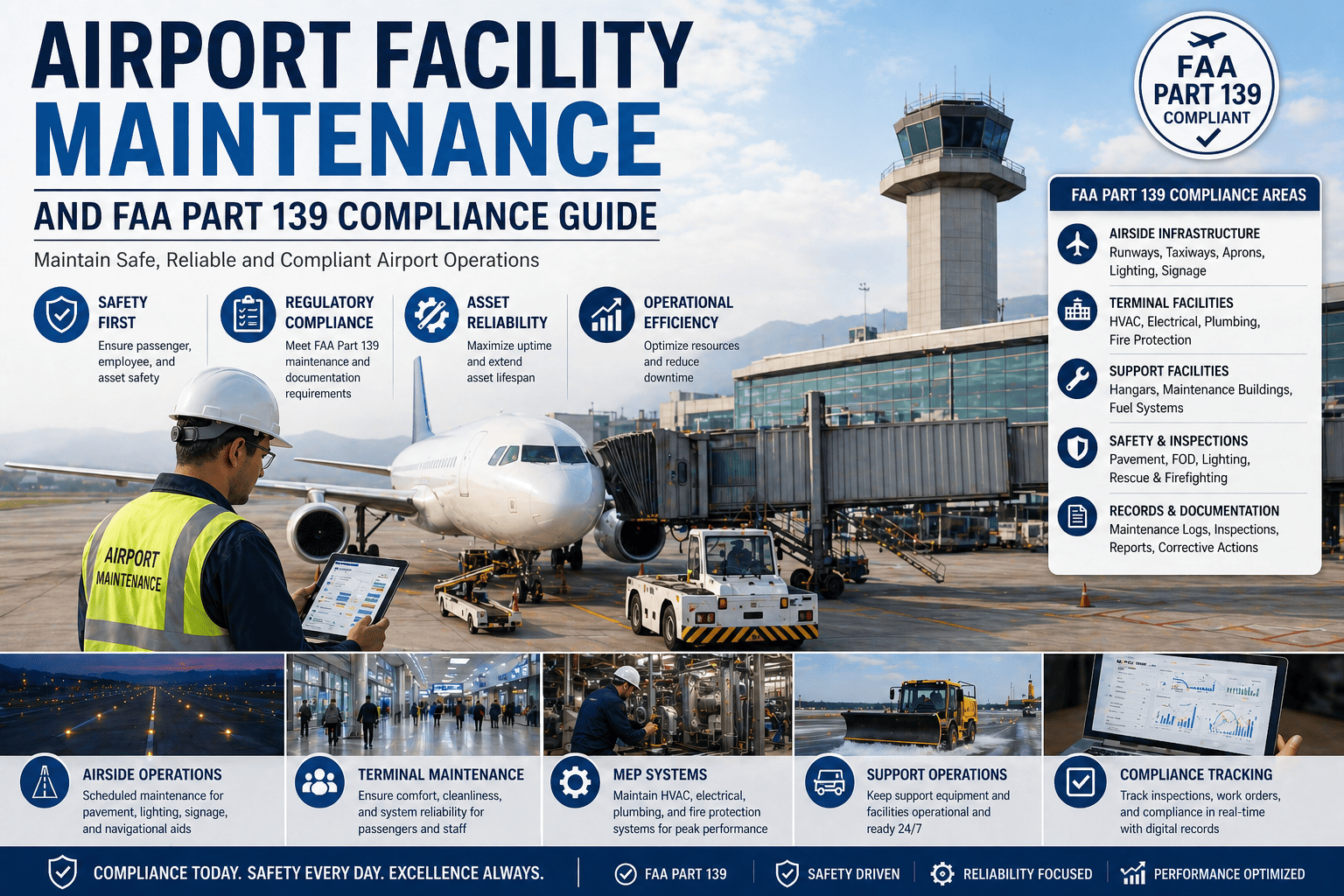
Airport facility directors operate under one of the most complex regulatory environments in infrastructure management — FAA Part 139 certification requires documented evidence of airside inspections, wildlife hazard programs, and emergency response readiness across every operational hour. Airports using OxMaint's compliance tracking and asset management platform reduce inspection documentation time by 60% while maintaining a continuously audit-ready record system that survives FAA Safety Assurance System reviews without emergency mobilization.
FAA Part 139 · OSHA · Transportation Infrastructure
Airport Facility Maintenance and FAA Part 139 Compliance Guide
A practical framework for managing airside, terminal, and groundside infrastructure while satisfying FAA Part 139 certification requirements — with automated inspection tracking built for airport operations teams.
5,000+
Commercial service airports covered by FAA Part 139
$25K
Maximum FAA civil penalty per violation per day
60%
Reduction in inspection admin time with digital CMMS
24/7
Airside self-inspection requirements under Part 139.327
Regulatory Landscape
What FAA Part 139 Actually Requires from Facility Teams
Part 139 is not a maintenance standard in the traditional sense — it is an operational certification that makes documented facility maintenance a condition of airport operating authority. Here is what the regulation demands from your facilities program.
§139.319
Aircraft Rescue and Firefighting
ARFF equipment must be inspected daily and maintained at defined readiness levels. Records must document equipment availability, maintenance dates, and personnel certifications — all accessible to FAA inspectors on demand.
§139.327
Self-Inspection Program
Requires airports to conduct systematic airside self-inspections at prescribed intervals, with written records of each inspection retained for at least 12 months showing conditions observed and corrective actions taken.
§139.337
Wildlife Hazard Management
Airports experiencing significant wildlife strikes must develop a Wildlife Hazard Management Plan with documented habitat control, depredation, and airside inspection protocols that integrate directly with the maintenance record system.
§139.339
Airport Condition Reporting
NOTAMs must be issued when facility conditions affect aircraft operations — pavement damage, lighting outages, markings deficiencies — which requires a real-time maintenance alert system feeding into the condition reporting workflow.
Infrastructure Zones
Airport Maintenance by Zone — What Gets Inspected and When
| Zone |
Key Assets |
Inspection Frequency |
Regulatory Driver |
OxMaint Feature |
| Runways and Taxiways |
Pavement, markings, lighting, signs |
Daily minimum |
§139.327, AC 150/5370-2 |
Mobile inspection forms |
| ARFF Equipment Bay |
ARFF vehicles, foam systems, PPE |
Daily pre-shift |
§139.319 |
Scheduled PM with escalation |
| Airfield Lighting |
PAPI, REIL, approach lights, edge lights |
Nightly inspection |
§139.311, FAR Part 77 |
Fault logging with NOTAM trigger |
| Terminal Building |
HVAC, escalators, jetways, electrical |
Monthly PM cycles |
OSHA, local building codes |
Asset lifecycle tracking |
| Fuel Storage Area |
Underground tanks, dispensers, containment |
Monthly + annual |
EPA RCRA, NFPA 30 |
Compliance calendar alerts |
| Wildlife Perimeter |
Fencing, gates, drainage structures |
Weekly |
§139.337 WHMP |
Photo documentation capture |
Documentation Gap Analysis
Where Airport Compliance Programs Break Down
01
Inspection records live in paper binders
FAA inspectors request records from the last 12 months. Staff spend two days pulling binders, photocopying forms, and reconciling gaps — and still miss entries that were filed incorrectly. Digital CMMS makes this a two-minute export.
02
Corrective actions not linked to findings
A pavement crack is logged in the inspection form. The repair work order lives in a separate system. The FAA wants to see the finding-to-resolution chain — and your team cannot produce it quickly. OxMaint links every finding to its corrective work order automatically.
03
PM schedules not tied to certification requirements
Maintenance schedules are managed by individual technicians using calendars or spreadsheets. When someone leaves, institutional knowledge goes with them. OxMaint stores every PM schedule against the regulatory requirement it satisfies — persistent and auditable.
04
How OxMaint closes all three gaps
Every inspection form, corrective work order, and PM record is linked in one system. FAA audit requests are satisfied by a filtered export — not a manual search. Certification evidence is always current, always complete, always exportable in under five minutes.
FAA Part 139 Compliance Ready
Make Your Next FAA Safety Assurance Review a Non-Event
OxMaint connects inspection findings, corrective work orders, and PM schedules into one audit-ready record system — so your team stops scrambling when the FAA calls and starts managing the airport instead of managing paperwork.
Asset Lifecycle Management
Airport Asset Lifecycle Data — Industry Benchmarks
| Asset Category |
Useful Life |
Major Rehab Trigger |
Annual Maintenance Cost |
Key Risk if Deferred |
| Runway Pavement (asphalt) |
15–20 years |
PCI below 55 |
$0.40–$0.80/sq ft |
FOD risk, NOTAM required |
| Airfield Lighting System |
20–25 years |
30%+ lamp failure rate |
$8K–$15K per mile |
Approach visibility loss |
| ARFF Vehicle |
10–15 years |
Response time standard breach |
$40K–$80K annually |
Part 139 certification loss |
| Jet Bridge |
20–30 years |
Structural inspection failure |
$25K–$50K annually |
Aircraft damage, injury liability |
| Perimeter Fence |
20–25 years |
TSA security inspection gap |
$5K–$15K per mile |
Airport security violation |
Expert Review
Perspectives from Airport Operations Professionals
The FAA Safety Assurance System has fundamentally changed what an airport needs to show during certification reviews. It is no longer enough to say maintenance was done — you need a documented chain from the inspection finding to the corrective action to the close-out. Paper-based systems cannot produce that chain efficiently.
Airport Operations Director, Class III Commercial Airport
Former FAA Part 139 compliance officer, 15 years in airport operations
Asset lifecycle planning is where most airport maintenance budgets leak. We defer a $200K pavement overlay and end up with a $1.2M emergency replacement three years later. Digital maintenance tracking makes deferred maintenance visible before it becomes a capital crisis — and gives you the data to argue the capital budget case.
Director of Infrastructure, Regional Airport Authority
AAAE Accredited Airport Executive, 20 years in airport management
Frequently Asked
FAA Part 139 Maintenance Compliance Questions
Which airports are required to hold FAA Part 139 certification?
FAA Part 139 certification is required for airports that serve scheduled or unscheduled air carrier operations conducted with aircraft having more than 9 passenger seats. The FAA classifies certified airports into four categories — Class I through Class IV — based on the type of air carrier operations they serve, with Class I airports having the most comprehensive requirements. All certificate holders must maintain documented facility maintenance and inspection programs regardless of class.
Talk to our team about building a Part 139 compliant maintenance program.
How long are airport self-inspection records required to be retained under Part 139?
FAA Part 139.339 requires airports to retain self-inspection records for at least 12 consecutive calendar months. However, most airport compliance attorneys recommend retaining records for three to five years given the potential for delayed FAA enforcement actions and the fact that prior records often become relevant during certification renewal reviews. OxMaint stores all records with immutable timestamps and makes them instantly exportable for any FAA request.
Start building your compliant inspection record system.
What is the maximum civil penalty the FAA can impose for Part 139 violations?
The FAA can impose civil penalties of up to $25,000 per violation per day for Part 139 non-compliance under 49 U.S.C. §46301. In cases involving operational safety risks, the FAA also has authority to suspend or revoke airport operating certificates entirely, which would halt all air carrier operations. Most enforcement actions stem from documentation deficiencies rather than actual safety incidents — meaning a digital maintenance record system directly reduces your enforcement exposure.
Speak with our airport compliance specialists.
Can a CMMS platform satisfy FAA Part 139 recordkeeping requirements?
Yes. FAA Part 139 does not specify the format of maintenance and inspection records — only that they be maintained and available for FAA inspection. A cloud-based CMMS like OxMaint satisfies these requirements and provides stronger evidence than paper systems through automatic user authentication, timestamped entries, and version-controlled records. Multiple FAA-certified airports have successfully used digital maintenance platforms during Safety Assurance System reviews.
See how OxMaint structures airport compliance records.
Compliance Tracking · Airport Infrastructure · Audit-Ready
Your FAA Certification Depends on Records You Can Produce in Minutes
OxMaint gives airport facility teams one platform for airside inspections, ARFF maintenance, pavement condition tracking, and Part 139 compliance records — with the audit trail the FAA expects and the efficiency your operations team needs.