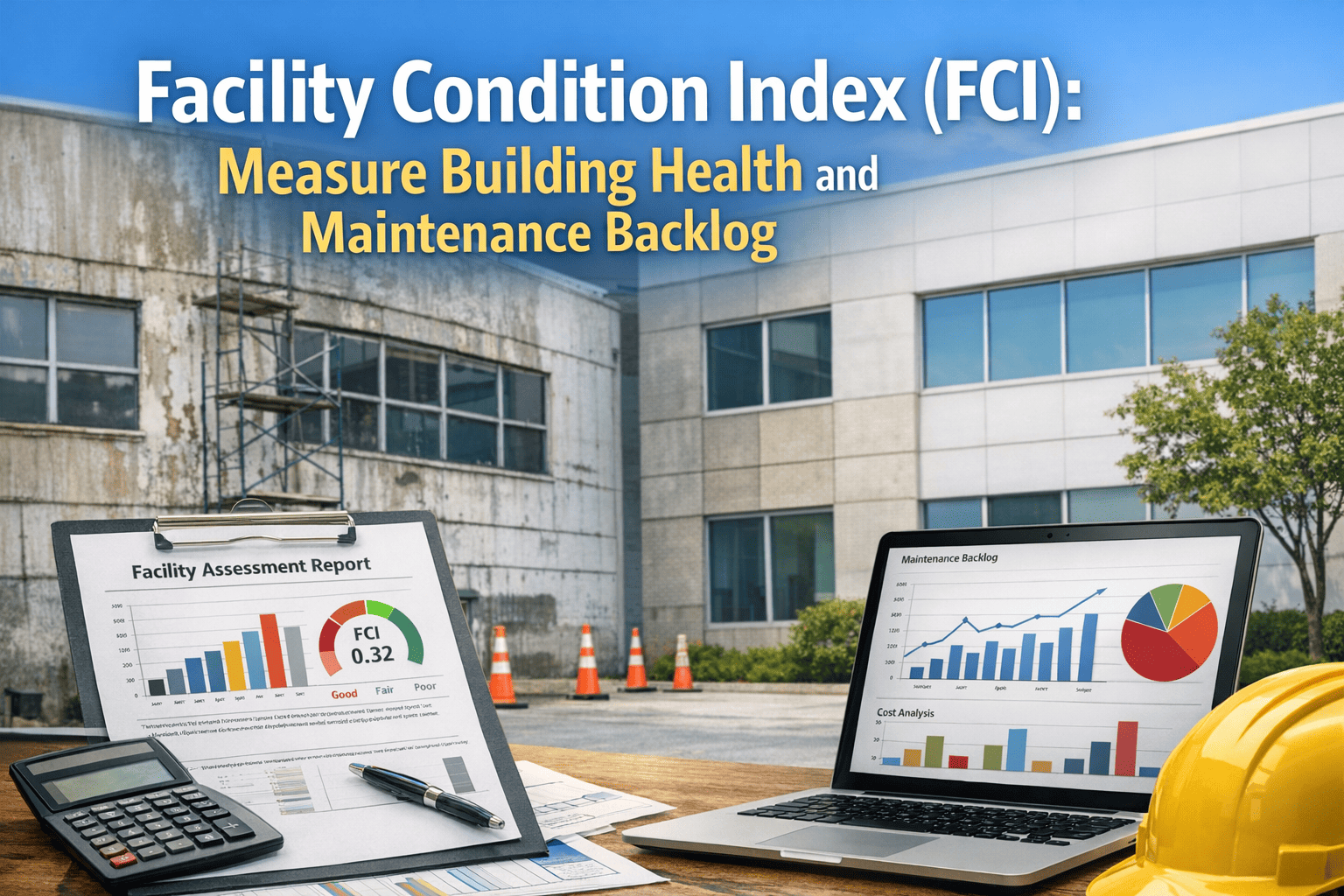
The deferred maintenance backlog across U.S. K-12 school buildings has reached an estimated $85 billion — and the GAO found that 53% of school districts report buildings in fair or poor condition. Most districts have no systematic way to answer the three questions school boards, bond attorneys, and state funding agencies ask before releasing capital: which buildings are worst, which repairs are most urgent, and what does inaction cost over five years. The Facility Condition Index (FCI) is the industry-standard formula that answers all three — but only when it is calculated from current, documented data rather than a three-year-old consultant assessment. At 5–7% annual construction cost inflation, $100,000 of deferred work today becomes $128,000 in five years — without the underlying problem improving. This guide covers the complete K-12 deferred maintenance prioritization framework: FCI calculation, four-category prioritization scoring, CMMS integration, and the data package needed to support a credible bond referendum. Book a demo to see how Oxmaint calculates live FCI scores across your entire district portfolio.
Education Facilities
Analytics & Reporting
P1 — Critical
$85B
U.S. K-12 deferred maintenance backlog — ASCE 2021
53%
Districts with buildings in fair or poor condition — GAO 2020
$4 : $1
Cost of reactive repair for every $1 deferred beyond year 5
5–7%
Annual construction cost inflation — making deferral exponentially expensive
Step 1 — The FCI Formula
Facility Condition Index: The Number Every School Board Needs to See
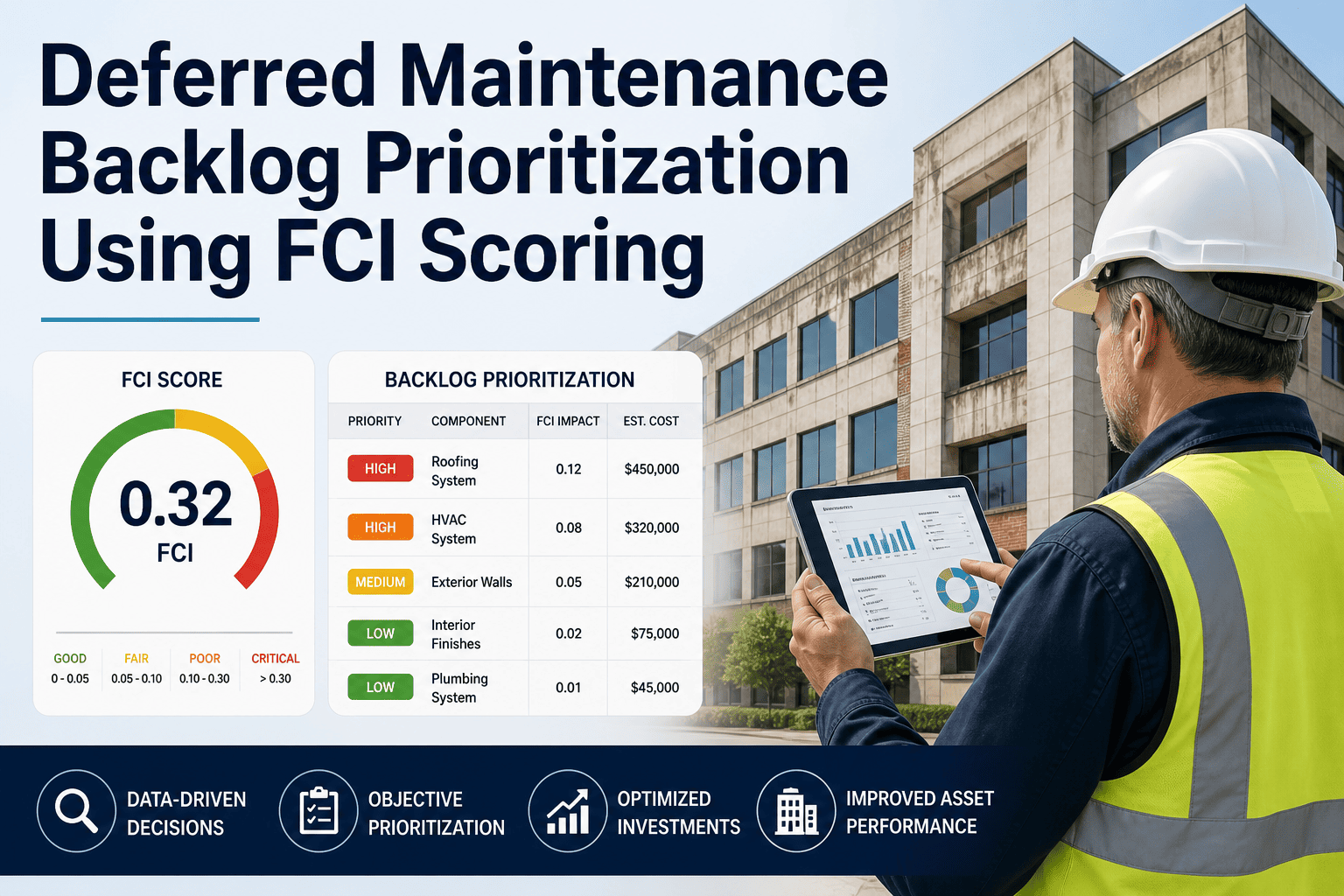
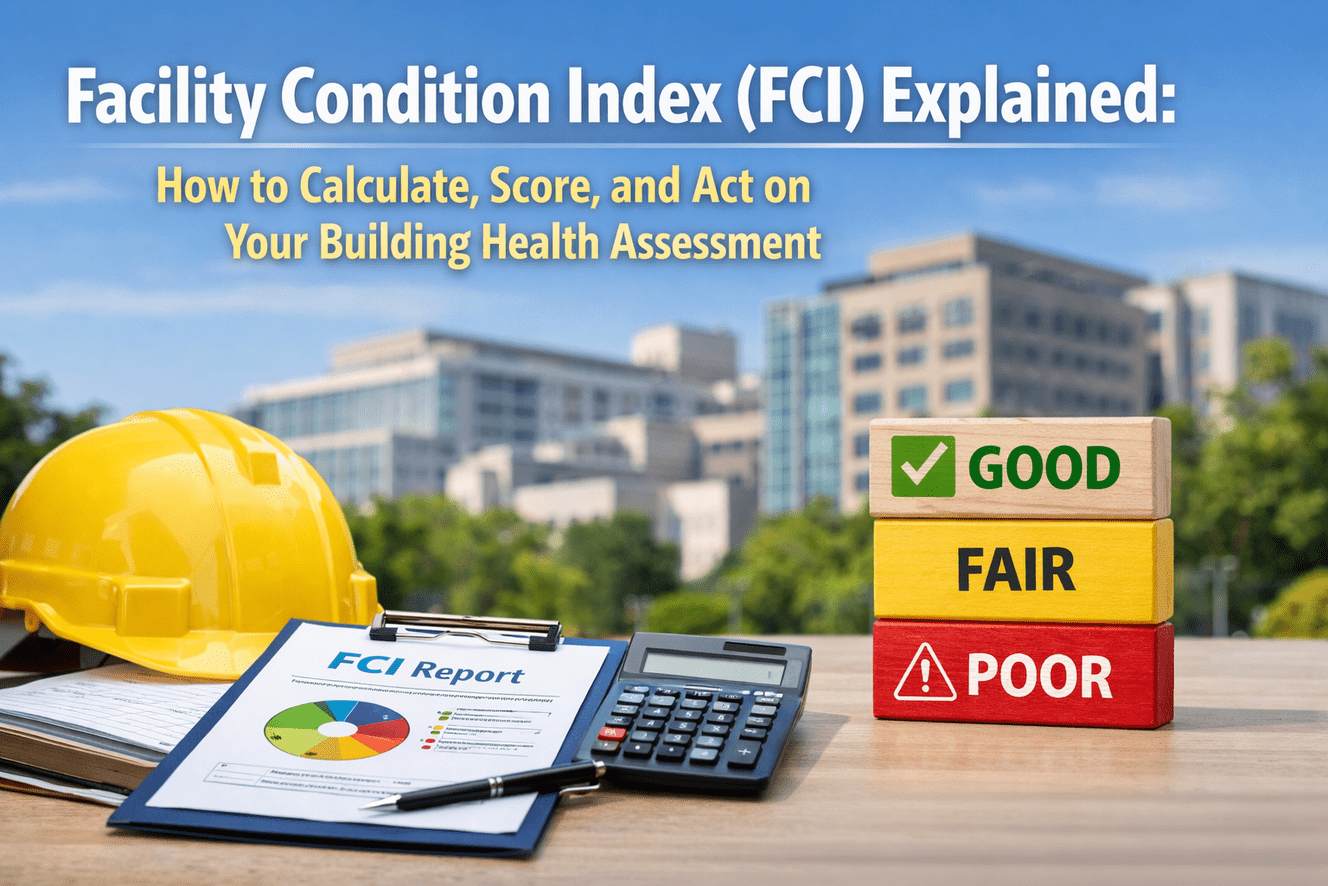
FCI < 0.10
Good
Well-maintained — planned reinvestment sufficient
0.10 – 0.30
Fair
Increased investment needed to prevent deterioration
0.30 – 0.60
Poor
Major investment required — bond referendum likely needed
FCI > 0.60
Critical
Economic analysis likely favors replacement over repair
Worked Example — Lincoln Elementary School
Documented deferred maintenance
$1,850,000
Current replacement value (RS Means)
$6,200,000
FCI score
0.30 — Poor Band
5-year cost if deferred (6% inflation)
$2,476,000
Step 2 — Prioritization Framework
Four-Category Priority Scoring — Beyond FCI to Actionable Rankings
FCI tells you which buildings need the most investment. It does not tell you which repair inside that building to fund first. A district with 30 buildings and an average FCI of 0.22 may still have life-safety roof failures that require immediate action, alongside deferred HVAC replacements that can safely wait 24 months. The four-category scoring model assigns a numeric priority score to each deferred item based on its urgency, escalation rate, educational impact, and funding eligibility.
Priority 1
Life Safety & Code
Score: 90–100
Fire suppression, structural deficiencies, roof failures causing active water intrusion, electrical safety hazards, ADA access barriers. Non-deferrable — address within 90 days regardless of budget cycle. CMMS generates automatic escalation alert if not assigned within 7 days.
Examples: Failed fire suppression zone, partial roof collapse, non-functional emergency exits, exposed electrical wiring
Priority 2
Rapid Escalation Risk
Score: 70–89
Failures that are not immediately dangerous but escalate cost rapidly if deferred. Deteriorating roof membrane before water infiltration, HVAC beyond service life running on borrowed time, aging electrical distribution equipment. Address within 12 months — each year of deferral adds 15–40% to repair cost.
Examples: End-of-life chiller, cracking roof membrane, boiler at year 25 of 20-year service life
Priority 3
Educational Impact
Score: 50–69
Failures affecting learning environment quality — HVAC comfort in classrooms, lighting, acoustics, indoor air quality. Direct correlation to attendance, test performance, and teacher retention. Research shows classroom temperature above 77°F reduces student performance by up to 13%. Plan within 24 months.
Examples: Underperforming classroom HVAC, inadequate lighting, poor acoustics in special education spaces
Priority 4
Planned Renewal
Score: 20–49
Maintenance-stage issues approaching end of service life but still functional. Track in CMMS with projected replacement dates and cost escalation projections. These items become Priority 2 or 1 if not funded — the cost-of-deferral projection is the most powerful tool for securing school board approval on a 5-year capital plan.
Examples: Aging windows, interior finishes, paving, non-critical mechanical replacements
Oxmaint Calculates Live FCI Per Building — Updated Every Time a Work Order Is Closed
Districts using Oxmaint for 18 months have everything needed for a credible bond referendum: FCI per building, prioritized project list with 5-year cost escalation, and a repair-vs-replace analysis per asset — all from maintenance data already in the system.
Step 3 — District Portfolio View
Building-Level FCI Dashboard — What a 15-School District Looks Like
Sample district portfolio — Oxmaint generates this view automatically from work order data, updated in real time as items are added or completed.
Step 4 — Cost of Deferral
The Compounding Cost of Inaction — What Your School Board Needs to See
$1M Roof Repair Deferred — 6% Annual Inflation
+$338K
Additional cost of waiting 5 years on a $1M repair — before water damage
3–5×
Multiplier when active water infiltration turns a roofing repair into structural replacement
25–40%
Higher referendum approval rate when capital requests include documented FCI and cost-escalation projections
Expert Review
What School District Facilities Leaders Say
"The board does not respond to 'our buildings are old.' They respond to 'Jefferson High School has an FCI of 0.43, the HVAC is beyond useful life, and if we defer the replacement for three more years the cost increases by $400,000 while the system operates at 60% efficiency.' FCI converts facilities problems into financial decisions. That is the language school boards understand, and it is the language that wins bond referendums."
Director of Facilities
K-12 School District — 22 Buildings, 14,000 Students, Midwest U.S.
"We discovered through our first FCI analysis that Adams K-8 — our oldest building — had an FCI of 0.56. The repair-vs-replace analysis showed that continuing to invest in repairs would cost more over 10 years than a planned replacement. That data is what convinced the board to include a new school in the bond rather than another round of patchwork repairs. The FCI did not just tell us the building was bad — it told us continuing to repair it was economically irrational. That is the conversation CMMS data makes possible."
Assistant Superintendent for Operations
Public School District — 31 Schools, 19,000 Students
Frequently Asked Questions
K-12 Deferred Maintenance Prioritization — Common Questions
How is the Facility Condition Index calculated for a K-12 school building?
FCI equals total deferred maintenance cost divided by current replacement value. Deferred maintenance must come from a documented Facility Condition Assessment covering all systems — structural, mechanical, electrical, plumbing, envelope, and life safety. Work orders alone undercount the backlog because they capture reported failures, not proactively assessed end-of-life components. Current replacement value should be updated annually using RS Means construction cost data — a three-year-old CRV figure understates replacement cost by 15–21% at current inflation rates.
Start a free trial to see how Oxmaint calculates live FCI per building from your existing work order and asset data.
At what FCI level should a school district consider building replacement rather than renovation?
Economic analysis typically favors replacement over continued repair investment when FCI exceeds 0.60 — at that point, deferred maintenance exceeds 60% of replacement value. At FCI 0.40–0.60, a Net Present Value (NPV) analysis comparing continued repair investment against a planned replacement event is required to make a defensible capital decision. Oxmaint's lifecycle analytics compare the NPV of continued maintenance spend against replacement, accounting for avoided energy costs and reduced PM expenditure on new versus aged assets.
Book a demo to walk through the repair-vs-replace analysis for your district's highest-FCI buildings.
What documentation does a school district need for a successful bond referendum?
Bond referendums require three documents: a quantified FCI per building showing the condition of each facility with documented backlog, a prioritized project list with 5-year cost escalation projections showing what each deferred item costs in years 1, 3, and 5, and a repair-vs-replace analysis for major assets. Boards that see FCI scores, escalation projections, and NPV comparisons approve bond requests at 25–40% higher rates than boards presented with narrative facility descriptions and cost estimates.
Start a free trial — districts using Oxmaint for 18 months generate all three documents from maintenance data already in the system.
How often should a K-12 district update its Facility Condition Assessment?
The traditional FCA cycle is every 3–5 years, commissioned from an outside consultant. The limitation of this model is that the FCI becomes stale within 12 months as systems age, new failures are discovered, and completed repairs improve condition. A CMMS-integrated approach updates FCI continuously — every time a deferred work order is added, completed, or revalued, the building FCI adjusts automatically. This gives districts a live, defensible FCI at all times rather than a snapshot that is out of date before the capital plan is approved.
Book a demo to see how Oxmaint's live FCI dashboard works for a multi-building district portfolio.
Your District's Backlog Is Growing. The FCI Data to Address It Should Be Growing Too.
Oxmaint gives K-12 facilities directors a live FCI per building, a prioritized deferred maintenance register with cost escalation projections, and board-ready capital planning reports — all generated automatically from the work order and inspection data your team already creates.