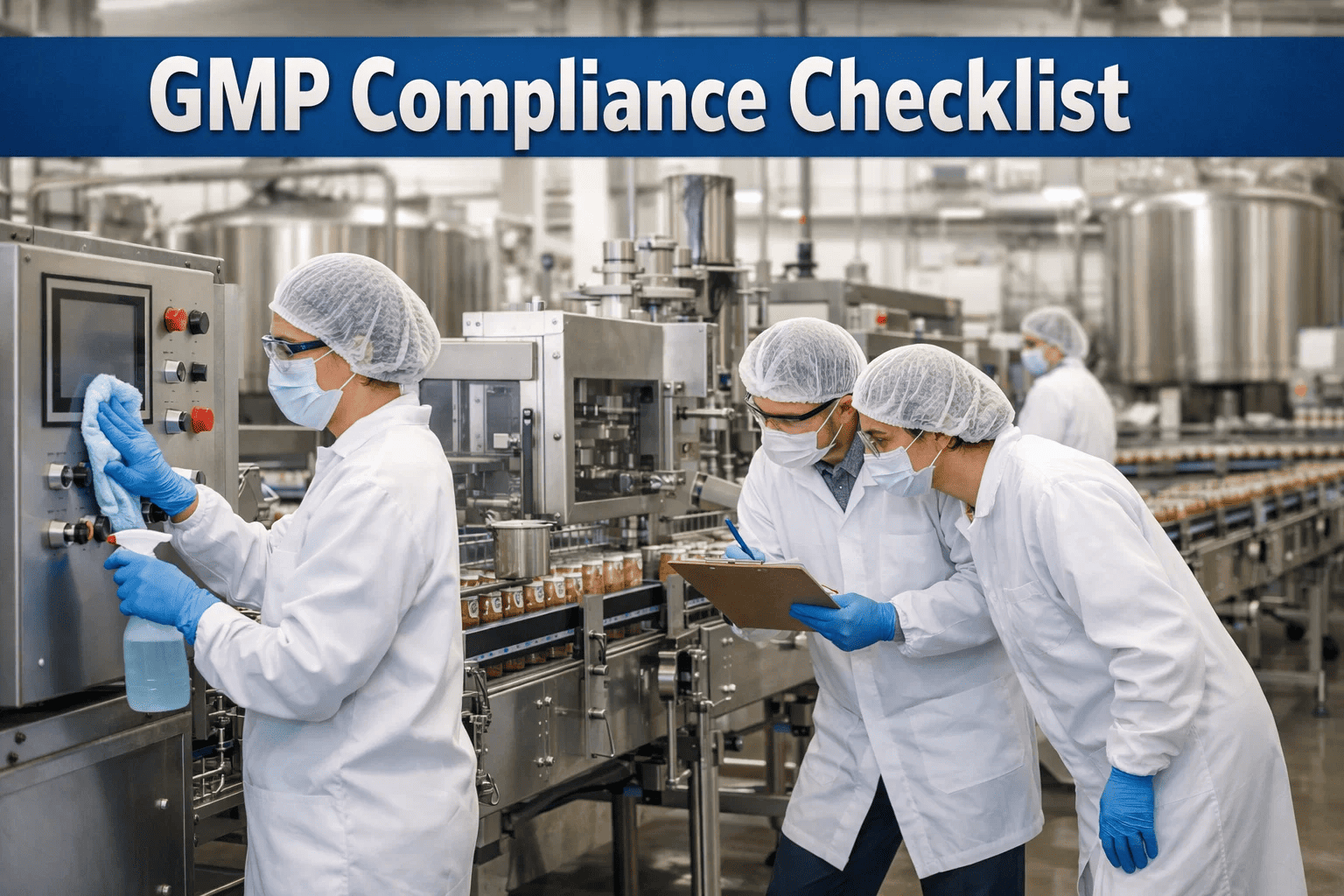
FMCG Plant Safety Equipment Inspection Checklist

By Jonas park on March 23, 2026

fmcg-plant-safety-equipment-inspection-checklist

In FMCG manufacturing, safety equipment failures don't announce themselves — they fail silently until the moment they're needed. An emergency stop that doesn't actuate costs seconds. A machine guard that's been bypassed costs fingers. A LOTO device that wasn't documented costs lives. This checklist covers every safety system a plant safety team must inspect and document — emergency stops, machine guarding, lockout/tagout, fire suppression, ventilation, and PPE compliance. Structured by frequency, aligned to OSHA 29 CFR 1910 and 1910.147 LOTO standards, and built for direct import into Oxmaint's Compliance and Audit Trail module — so every inspection generates a timestamped, auditable record.

2026 Edition · FMCG Manufacturing · All Plant Types
FMCG Plant Safety Equipment Inspection Checklist
Inspection tasks for emergency stops, machine guards, LOTO devices, fire suppression, ventilation, and PPE compliance — with regulatory alignment and CMMS-ready structure.
7
Safety systems

100+
Inspection tasks

OSHA
Aligned

Free
CMMS import
How to Use This Checklist
Tasks are organised by inspection frequency: Daily/Pre-Shift Weekly Monthly Quarterly Annual. Regulatory reference is noted for each compliance-critical task. All items are structured for direct import into Oxmaint as scheduled work orders with audit trail documentation.

1. Emergency Stop Systems

Emergency stops are the last line of defence in a machine hazard event — and a non-functioning e-stop is a documented OSHA violation under 29 CFR 1910.217. Every e-stop must be tested at its documented frequency, and every test result must be recorded and retained. "It worked last time we checked" is not an audit response.

Daily / Pre-ShiftE-Stop Visual Inspection
WeeklyE-Stop Function Test
QuarterlySafety Circuit Integrity
AnnualE-Stop Compliance Audit

2. Machine Guarding

Machine guarding violations are among the most frequently cited OSHA findings in food and beverage manufacturing. A guard that is physically present but fastened incorrectly, damaged, or with an unprotected gap still constitutes a violation. Guard inspections must document condition, not just presence.

Daily / Pre-ShiftGuard Presence Check
WeeklyGuard Condition Inspection
MonthlyGuard Integrity Assessment
AnnualMachine Guarding Risk Review
Every Safety Inspection Automatically Creates an Audit Trail in Oxmaint
When your team completes safety inspections in Oxmaint, every task generates a timestamped record — technician, result, timestamp, and photos — that satisfies OSHA documentation requirements and is instantly available for audit review.

3. Lockout / Tagout (LOTO) Devices

LOTO is the single highest-penalty OSHA standard in manufacturing — 1910.147 citations regularly exceed $15,000 per violation. The device inspection programme is only half the requirement. Every energy control procedure must be current, accessible at the machine, and demonstrated by the authorised employee performing the task.

MonthlyLOTO Device Inventory and Condition
QuarterlyLOTO Procedure Review
AnnualLOTO Programme Certification

4. Fire Suppression and Detection

FMCG facilities present elevated fire risk from combustible dust (flour, sugar, starch), flammable solvents, cooking oils, and high-temperature equipment. Suppression system inspection must account for the specific hazard class of each production zone — a standard wet pipe sprinkler is not appropriate in all areas.

Daily / Pre-ShiftFire Safety Visual Check
WeeklySuppression System Checks
QuarterlyFire Protection Testing
AnnualCertified Fire System Inspections

5. Ventilation, Exhaust, and Gas Detection

Ventilation failures in FMCG facilities carry two distinct risks: combustible atmosphere from solvent vapours or dust, and oxygen deficiency or toxic gas accumulation in confined spaces. Both require continuous and periodic inspection programmes — gas detection alone is not sufficient without a documented response protocol.

Daily / Pre-ShiftGas Detector and Ventilation Check
WeeklyVentilation System Inspection
MonthlyConfined Space Pre-Entry Readiness
QuarterlyGas Detection System Calibration
OSHA Audit-Ready Safety Records — Automatically Generated
Oxmaint's Compliance and Audit Trail module timestamps every safety inspection, attaches photo evidence, logs the responsible technician, and flags overdue inspections before they become violations. Every record is exportable for OSHA inspection review.

6. Electrical Safety Systems

Electrical safety in FMCG manufacturing covers three distinct hazard categories: arc flash from high-energy distribution equipment, shock hazard from food-zone equipment operating in wet conditions, and static discharge in flammable material handling areas. Each requires a specific inspection programme.

Daily / Pre-ShiftElectrical Hazard Visual Check
WeeklyElectrical Protection Device Testing
QuarterlyElectrical System Inspection
AnnualElectrical Compliance Review

7. PPE Compliance and First Aid Readiness

PPE programme compliance in FMCG manufacturing requires more than stocking the right equipment — it requires documented hazard assessments that justify each PPE selection, and inspection records that confirm equipment condition at the frequency required by the specific hazard. First aid programme readiness is a separate but equally critical inspection item, particularly for facilities with high-risk processes.
Daily / Pre-ShiftPPE Station Check
WeeklyFirst Aid and Emergency Equipment
MonthlyPPE Condition and Compliance Audit
AnnualPPE Programme Certification

Frequently Asked Questions

OSHA inspection frequency varies by device and standard. Emergency stops and machine guards require pre-shift visual checks and functional testing at frequencies specified in the machine's safety design documentation. LOTO periodic inspections require at least annual employee observation per 1910.147(c)(6). Fire extinguishers require monthly visual inspection and annual service. Eyewash stations require weekly activation. For all safety devices, the controlling document is the written programme — if your programme specifies weekly testing, OSHA expects weekly records regardless of the regulatory minimum.
OSHA 1910.212 requires guards to be in place but does not specify a written inspection record format. However, in a citation defence, the burden of proof is on the employer to show the guard was present and functional. Best practice — and what most insurers require — is a dated inspection record with the inspector's name, equipment ID, guard type, and condition finding. In Oxmaint, each guard inspection work order generates this record automatically and links it to the asset's maintenance history.
The most cited LOTO violations in food and beverage manufacturing are: failure to develop written energy control procedures for each machine, failure to conduct the required periodic inspection (at least annually), and failure to retrain employees when a procedural change occurs. Physical compliance — having locks and tags — is rarely the citation. Documentation compliance is. A CMMS that automatically schedules LOTO inspections, tracks completion, and retains records eliminates the documentation compliance gap entirely.
Oxmaint's Compliance and Audit Trail module converts every safety inspection task into a scheduled work order — automatically assigned to the responsible technician at the correct frequency. When completed on mobile, each task generates a timestamped record with the technician's name, completion time, pass/fail result, and optional photo evidence. Overdue inspections trigger alerts before they become violations. The full audit trail is exportable for OSHA inspection, insurance audit, or internal safety review. Start your free trial to import this checklist today.
Facilities processing combustible dust materials (flour, sugar, starch, spice, grain) must comply with NFPA 652 (fundamentals) and the commodity-specific standard (NFPA 61 for agricultural, NFPA 664 for wood, etc.). Standard wet pipe sprinklers are generally acceptable for the building envelope, but dust collection systems, bucket elevators, and enclosed processing equipment may require dedicated suppression or explosion venting designed to NFPA 68 and NFPA 69. A hazard-specific fire protection engineer review is required — not a general sprinkler contractor. Book a demo to see how Oxmaint tracks combustible dust inspection compliance.
Compliance & Audit Trail — Oxmaint
Never Miss a Safety Inspection — and Always Have the Record to Prove It.
100+
safety tasks tracked

OSHA
audit-ready records

48 hrs
to go live

Free
to start
Auto-scheduled safety work orders — right technician, right frequency, every time
Timestamped audit trail — technician, result, photo, and timestamp per task
Overdue alerts before violations — flagged before the inspection window closes
OSHA export-ready records — one-click export for inspection review

Share This Story, Choose Your Platform!