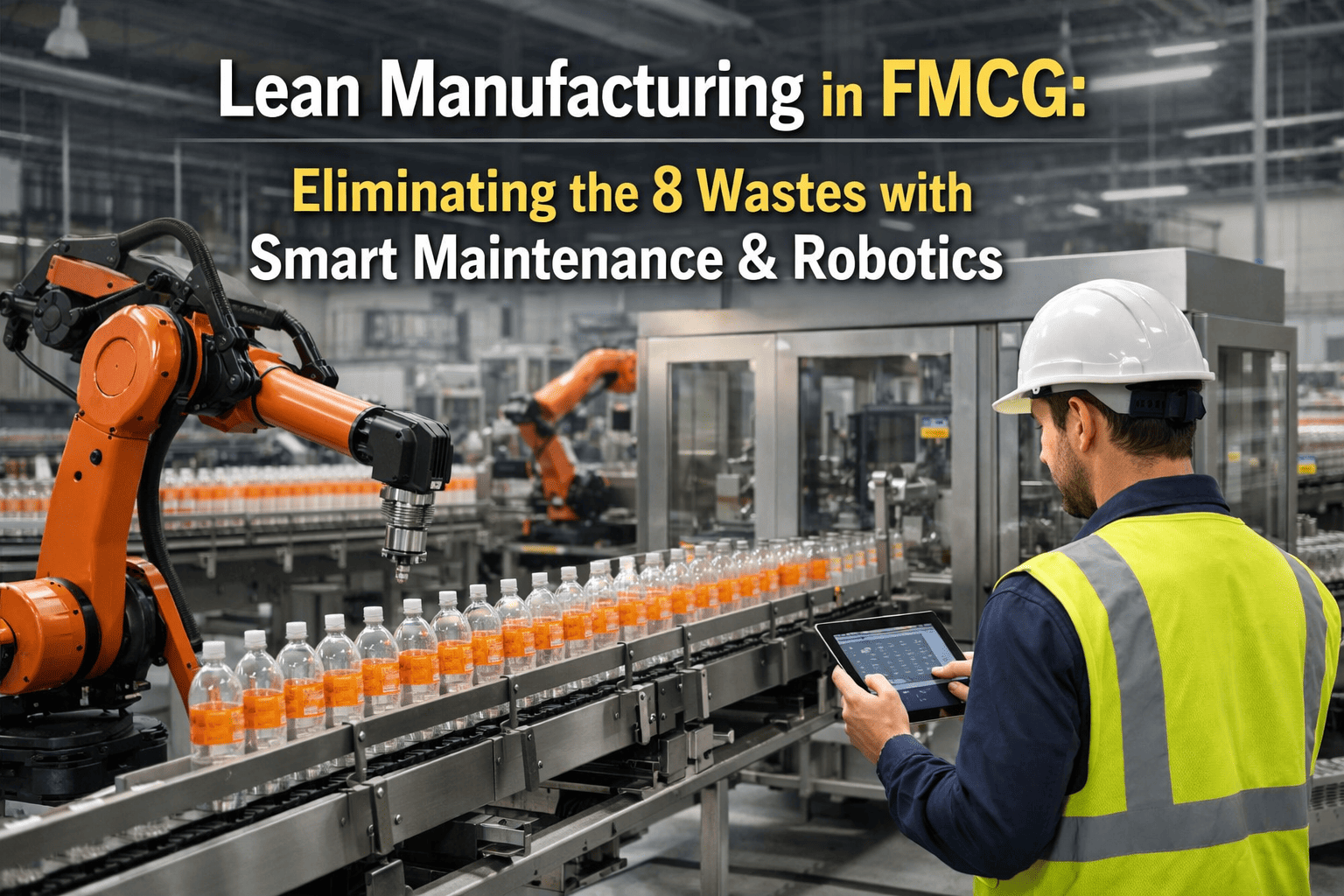
Lean manufacturing in FMCG is not a philosophy discussion — it is a direct attack on the 8 categories of waste that silently consume 30 to 40 percent of every food and consumer goods plant's productive capacity. From overproduction that fills refrigerated warehouses with product nobody ordered yet, to waiting time while a packaging line idles for a material replenishment that should have arrived 20 minutes ago, the 8 wastes are present in every FMCG operation. The plants closing the gap between average 60 percent OEE and world-class 85 percent are systematically identifying, measuring, and eliminating these wastes — not by accident, but through structured lean tools backed by real-time data. Start a free trial and give your lean program the digital backbone it needs to deliver lasting results, or book a demo to see how Oxmaint surfaces waste across your FMCG operation in real time.
30–40%
Productive Capacity Lost
to the 8 wastes in a typical FMCG plant before lean implementation
25pts
OEE Improvement
achievable from structured lean waste elimination across FMCG production lines
20–35%
Maintenance Cost Reduction
from eliminating motion waste, over-processing, and reactive repair cycles
90 days
First Lean Results
typical time to measurable waste reduction on a pilot production line
Lean only works when waste is visible — Oxmaint makes it visible
Oxmaint's FMCG platform connects OEE data, downtime causes, asset condition, changeover times, and work order activity into one lean management command center — making every category of waste measurable, traceable, and eliminatable.
What Is Lean Manufacturing in FMCG?
Lean manufacturing in FMCG is the systematic application of Toyota Production System principles to food, beverage, and consumer goods manufacturing — identifying and eliminating all activities that consume resources without creating value for the end customer. In FMCG, lean is complicated by high SKU variety, frequent changeovers, strict hygiene and GMP requirements, short shelf-life pressure, and volatile demand patterns. The starting point for every FMCG lean program is the 8 wastes — the universal categorization of non-value-adding activity that applies across every food and packaging line type.
The 8 Wastes in FMCG Manufacturing — Identified and Costed
The 8 wastes (originally 7, with an 8th — unused talent — added in the lean evolution) manifest differently in FMCG than in other sectors. Understanding their FMCG-specific expressions is the first step toward targeted elimination. Start a free trial to begin measuring which of these wastes is hitting your plant hardest, or book a demo and walk through a waste identification exercise with your data.
01
Overproduction
FMCG Expression: Producing more than demand requires — creating inventory that occupies cold storage, risks spoilage, blocks production scheduling, and ties up working capital in product that may require markdown or disposal.
Typical cost: 3–8% of product value per overproduction cycle
02
Waiting
FMCG Expression: Production lines idling while waiting for packaging materials, ingredient replenishment, maintenance technicians, quality approval, or changeover preparation that should have been completed during the previous run.
Typical cost: $3,000–$5,000 per minute of line waiting time
03
Transportation
FMCG Expression: Unnecessary movement of materials, WIP, and finished goods — double-handling products between storage and production, inefficient warehouse layouts that require multiple pallet moves per unit, and fragmented supply chain flows that add zero product value.
Typical cost: 10–15% of total logistics labor cost
04
Over-Processing
FMCG Expression: Performing more processing steps than the product specification requires — over-filling containers to avoid checkweigher rejects, re-cleaning equipment that is already clean, conducting redundant quality checks, or running CIP cycles longer than validated minimum time.
Typical cost: 5–12% of processing cost in over-processing-heavy plants
05
Inventory Excess
FMCG Expression: Holding more raw material, packaging, WIP, or finished goods than current production requires — tying up capital, consuming chilled and dry storage space, increasing spoilage and obsolescence risk, and masking underlying demand planning and supply chain failures.
Typical cost: 20–30% of inventory value per year in carrying costs
06
Motion Waste
FMCG Expression: Unnecessary physical movement by operators and technicians — walking to retrieve tools that should be at point of use, searching for documentation or spare parts, and performing tasks in ergonomically inefficient sequences that add time and fatigue without adding product value.
Typical cost: 15–25% of operator productive time on high-motion lines
07
Defects
FMCG Expression: Product rejected at any stage — fill weight deviation, seal failure, label misapplication, contamination, or pack integrity failure. In food manufacturing, defects have a dual cost: the product loss value plus the regulatory compliance and brand risk if defects reach the customer.
Typical cost: 2–6% of production cost in high-defect-rate plants
08
Unused Talent
FMCG Expression: Failing to use the operational knowledge of frontline operators and technicians — the people who know exactly where the recurring jams are, which machine runs better with a specific adjustment, and which supplier's material causes the most waste. Lean plants build structured improvement cycles around this knowledge.
Typical cost: Unmeasured, but consistently cited as the highest-impact uncaptured resource
Lean Tools That Eliminate Each Waste Category in FMCG
Before Lean vs. After Lean: FMCG Plant Performance
How Oxmaint Supports Lean Waste Elimination in FMCG
Lean without data is guesswork. Oxmaint gives FMCG lean programs the real-time visibility infrastructure that transforms waste identification from a periodic workshop exercise into a continuous, data-driven operational discipline.
Waiting Waste
Real-Time Downtime Capture and Pareto
Every line stoppage automatically captured with cause, duration, and asset — giving lean teams a live Pareto of waiting waste sources to eliminate, not a monthly spreadsheet to compile.
Defect Waste
Asset Condition to Quality Correlation
Quality deviation rates linked to asset condition scores — identifying which equipment state generates the most defects and dispatching preventive maintenance before the next production run.
Motion Waste
Digital Work Instructions at Point of Use
Mobile work orders with embedded procedure steps eliminate search time. Technicians arrive with the right information, right parts, and right tools — removing motion waste from every maintenance task.
Over-Processing
Production-Triggered PM — Not Calendar PM
Maintenance performed based on actual production cycles, run hours, and condition scores — eliminating the over-processing waste of unnecessary maintenance activities performed on schedule rather than need.
Lean Implementation ROI
25pts
OEE Gain
Sustained OEE improvement from full lean waste elimination program on FMCG lines
28%
Cost per Unit Down
Reduction in total manufacturing cost per unit from combined waste elimination initiatives
60%
Defect Reduction
Typical defect rate reduction from lean quality tools applied to FMCG packaging and filling lines
9 days
Inventory Down from 18
Days of inventory reduction from pull-based demand scheduling replacing push-based overproduction
Frequently Asked Questions
What are the 8 wastes of lean manufacturing in FMCG?
The 8 wastes in FMCG lean manufacturing are: Overproduction (making more than demand requires), Waiting (lines idling between SKU runs or material arrivals), Transportation (unnecessary material movement and double-handling), Over-Processing (doing more than the product specification demands), Inventory Excess (holding more stock than needed), Motion Waste (unnecessary operator and technician movement), Defects (product rejected at any quality checkpoint), and Unused Talent (failing to capture frontline operator improvement knowledge). FMCG plants with all 8 wastes unaddressed consistently lose 30 to 40 percent of their productive capacity to non-value-adding activity.
How is lean manufacturing different from TPM in FMCG?
Lean manufacturing is the overarching philosophy of waste elimination — it includes TPM as one of its tools. TPM (Total Productive Maintenance) specifically addresses equipment reliability and the Autonomous Maintenance pillar of operator-led equipment care. In FMCG, lean and TPM are complementary: lean defines what wastes to eliminate, while TPM provides the structured maintenance program to eliminate the equipment-related wastes of waiting, defects, and breakdowns. Most high-performing FMCG plants run both concurrently.
Which of the 8 wastes has the highest financial impact in food manufacturing?
In most FMCG plants, the three highest-financial-impact wastes are Waiting (at $3,000 to $5,000 per minute of line downtime), Defects (with a dual cost of product loss plus regulatory risk), and Overproduction (tying capital in inventory that risks spoilage and obsolescence). The combination of these three typically accounts for 20 to 35 percent of total manufacturing cost in plants that have not implemented lean systematically. Targeting these three first delivers the fastest financial ROI from lean investment.
How long does lean manufacturing implementation take in an FMCG plant?
First measurable waste reductions are typically visible within 30 to 60 days on a pilot line — particularly by targeting the most visible Waiting and Defect wastes with SMED and SPC tools. Substantive OEE improvement of 8 to 12 points is achievable within 6 months of consistent lean program execution. Full lean maturity across all lines — with all 8 waste categories systematically managed through data-driven improvement cycles — takes 2 to 4 years, but delivers compounding returns from year one.
Turn waste identification into a data-driven competitive advantage
Oxmaint gives FMCG lean teams the real-time OEE, downtime, asset condition, and changeover data they need to identify, prioritize, and eliminate each of the 8 wastes with precision — continuously, not just during periodic lean workshops. Join FMCG plants running structured, digitally-supported lean programs that deliver sustained OEE improvement year after year.