A leading FMCG snack manufacturer was losing $170,000 annually to unplanned equipment breakdowns across four
production lines. Packaging machines averaged 62% OEE, changeover times stretched to 90 minutes per SKU switch, and
reactive maintenance consumed 78% of the maintenance budget. Within 14 months of implementing Total Productive
Maintenance across all eight pillars, OEE climbed to 86%, changeover time dropped to 28 minutes, and unplanned
downtime fell by 71%. The annual maintenance cost reduction alone was $70,000 — but the real gains came from 2,400
additional production hours recovered per line. TPM is not a maintenance program — it is a production system that
treats equipment reliability as a competitive advantage. Start
your free trial today to digitize your TPM program across all eight pillars. Schedule a 30-minute demo with our FMCG TPM specialists.
Overall Equipment Effectiveness55–65% Average OEE
Unplanned Downtime12–18% of Production Time
Maintenance Approach78% Reactive / Breakdown-Based
Quality Defect Rate3.2–5.8% Batch Rejection
Overall Equipment Effectiveness82–90% Average OEE
Unplanned Downtime2–4% of Production Time
Maintenance Approach85% Planned / Predictive
Quality Defect Rate0.4–1.1% Batch Rejection
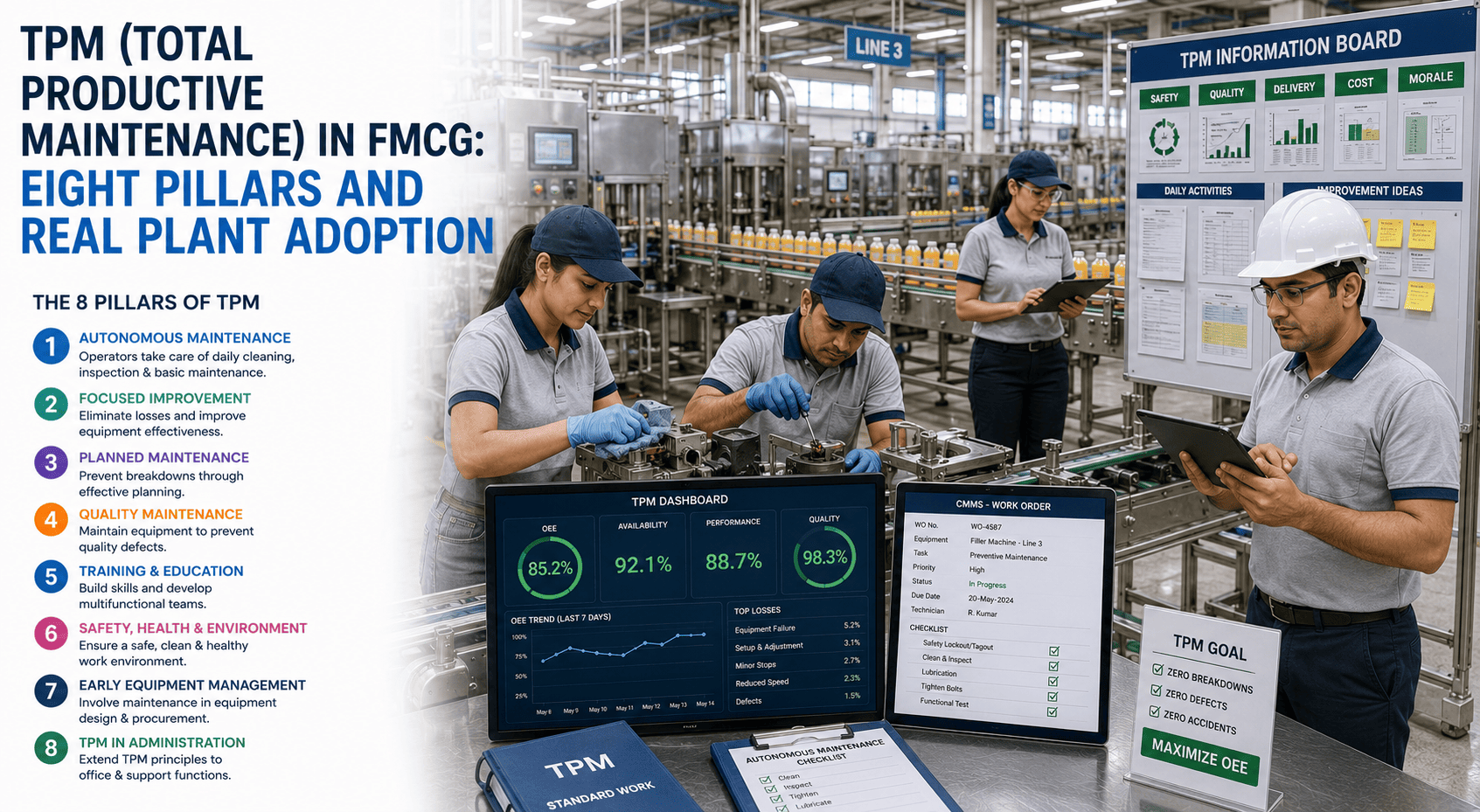
The 8 Pillars of TPM: Complete FMCG Implementation Framework
TPM is built on eight interdependent pillars — each addressing a specific dimension of equipment effectiveness,
operator capability, and organizational discipline. In FMCG manufacturing, where lines run 20+ hours daily across
hundreds of SKUs, every pillar must function together to deliver world-class OEE. Skipping even one pillar creates
gaps that undermine the entire program. FMCG manufacturers deploying structured TPM through Oxmaint implement all eight pillars with digital tracking and accountability.
01
Autonomous Maintenance (Jishu Hozen)
Operators own routine equipment care — cleaning, lubricating, inspecting, and detecting abnormalities before they escalate into breakdowns.
Daily CIL (Clean-Inspect-Lubricate) checklists
Operator abnormality tagging and escalation
Visual management standards at each workstation
FMCG Impact: 40% Fewer Breakdowns
02
Planned Maintenance (Keikaku Hozen)
Shift from reactive firefighting to scheduled, condition-based maintenance driven by equipment history data and failure pattern analysis.
Risk-based PM scheduling by criticality
Spare parts inventory optimization
MTBF/MTTR tracking and trend analysis
FMCG Impact: 60% Less Unplanned Downtime
03
Quality Maintenance (Hinshitsu Hozen)
Establish equipment conditions that produce zero defects — linking machine parameters directly to product quality outcomes.
Equipment-quality correlation mapping
Process parameter monitoring at source
Defect root cause elimination programs
FMCG Impact: 75% Fewer Quality Defects
04
Focused Improvement (Kobetsu Kaizen)
Cross-functional teams tackle the biggest OEE losses through structured problem-solving — eliminating chronic equipment and process losses.
Six major loss analysis and elimination
Why-why analysis and fishbone diagrams
Before/after OEE impact measurement
FMCG Impact: 15–25% OEE Gain
05
Early Equipment Management
Apply lessons from existing equipment failures to design and commission new equipment that is easier to maintain, clean, and operate from day one.
Maintenance prevention design inputs
Life-cycle cost analysis before procurement
Vertical startup targets for new lines
FMCG Impact: 50% Faster Line Startup
06
Training & Education
Build multi-skilled operators and maintenance technicians who understand both the why and the how of equipment care and process control.
Skill matrix assessment and gap closure
One-Point Lessons (OPLs) at workstations
Cross-training between operations and maintenance
FMCG Impact: 35% Higher Skill Coverage
07
Safety, Health & Environment
Zero accidents through proactive hazard identification, risk assessment, and safe operating procedures embedded into every TPM activity.
Near-miss reporting and hazard elimination
Safety audits integrated with AM routines
LOTO and permit-to-work compliance
FMCG Impact: Zero Lost-Time Incidents
08
Office TPM (Administrative)
Extend TPM principles to support functions — procurement, planning, quality lab, and logistics — eliminating administrative waste that delays production.
Order-to-dispatch cycle time reduction
Planning accuracy and schedule adherence
Spare parts procurement lead time optimization
FMCG Impact: 30% Faster Support Cycles
Your Equipment Is Running. But Is It Running at Its Full Potential?
Oxmaint digitizes all eight TPM pillars — from autonomous maintenance checklists to OEE dashboards — giving your teams real-time visibility into every loss category.
OEE and the Six Big Losses: What TPM Eliminates in FMCG
Overall Equipment Effectiveness is the single metric that captures the combined impact of availability, performance,
and quality losses. In FMCG, the six big losses represent the gap between theoretical maximum output and actual
production — and TPM systematically eliminates each one.
Equipment Breakdowns
Seal jaw failure, filler valve jam, conveyor motor burnout, labeler crash
AM + PM
Setup & Changeover
SKU format change, flavor switch, packaging size transition, CIP between products
Focused Improvement
Minor Stops & Idling
Sensor trips, product jams, starved infeed, blocked discharge, carton misfeeds
AM + Kaizen
Speed Losses
Running below rated speed due to vibration, product sensitivity, operator caution
PM + Quality Maint.
Startup Rejects
First 15–30 minutes of production after changeover producing out-of-spec product
Early Equipment Mgmt
Production Defects
Underfill, seal leaks, label errors, contamination, wrong batch coding
Quality Maint.
World-class FMCG OEE target: 85%+. Average OEE before TPM: 55–65%. Average after 18-month TPM deployment: 82–90%. TPM eliminates losses across all three OEE components simultaneously.
ROI of TPM Implementation in FMCG Manufacturing
The financial case for TPM is built on recovered production capacity, eliminated waste, and reduced maintenance
costs. Every percentage point of OEE improvement translates directly to additional sellable output from existing assets — without capital investment in new equipment.
Recovered Production Capacity
24% OEE gain × 4 lines × $21,600 revenue/line/month = additional sellable output
$250,000
Maintenance Cost Reduction
Shift from 78% reactive to 85% planned — 42% lower total maintenance spend
$70,000
Quality Defect Elimination
Batch rejection drops from 4.2% to 0.8% — fewer rework cycles and waste
$41,000
Changeover Time Reduction
SMED-driven reduction from 90 min to 28 min — 620 additional hours/year
$51,000
Energy & Utility Savings
Optimized equipment operation reduces energy consumption by 12–18%
$19,000
Safety Incident Reduction
Zero lost-time incidents eliminates investigation costs, penalties, insurance hikes
$14,500
Total Annual Value Delivered
$445,000
Program investment: $26K–$54K/year including training, digital tools, and dedicated TPM coordinator. Net ROI: $385K–$420K. Return: 8–16x in first 18 months. ROI accelerates as operator capability and equipment reliability compound over time.
TPM Implementation Roadmap for FMCG Plants
Deploying TPM in FMCG manufacturing follows a proven phased approach that builds capability while delivering
measurable OEE improvements at each stage. The critical success factor is leadership commitment and operator
engagement from day one. Schedule a demo to design a TPM deployment plan for your facility.
- TPM steering committee and pillar teams formed
- OEE baseline measurement on all critical lines
- 5S deployment as the foundation for AM
Output: Baseline & Teams
- AM Steps 1–3 on one model line
- Planned maintenance system for critical equipment
- First focused improvement projects launched
Output: 10–15% OEE Gain
- Roll out AM and PM across all production lines
- Quality maintenance and training pillars activated
- SMED changeover optimization projects
Output: 20–25% OEE Gain
- All 8 pillars operational and self-sustaining
- Predictive maintenance and condition monitoring
- Office TPM and early equipment management active
Output: 85%+ World-Class OEE
Real-World TPM Wins in FMCG Manufacturing
The most compelling evidence for TPM comes from documented transformations where FMCG plants moved from reactive
maintenance cultures to world-class equipment reliability — with measurable financial and operational results.
ChallengeFiller valve failures causing 14% unplanned downtime and 3.8% product loss
TPM Pillars AppliedAM (daily valve inspection) + PM (condition-based seal replacement)
Result After 8 MonthsUnplanned downtime at 2.1%, product loss at 0.6%
Annual Savings$87,000 (Recovered Output + Waste Reduction)
Challenge72-minute average changeover and 340 minor stops per week across 3 wrappers
TPM Pillars AppliedFocused Improvement (SMED) + Quality Maintenance (jam root cause)
Result After 6 MonthsChangeover at 22 min, minor stops reduced to 85 per week
Annual Savings$65,000 (Additional Production Hours + Quality Gains)
Ready to Replicate These Results at Your Plant?
See how Oxmaint's TPM platform delivers the same OEE gains, maintenance cost reductions, and changeover improvements — with digital tracking across all eight pillars from day one.
Frequently Asked Questions
What is Total Productive Maintenance and why is it critical for FMCG?
Total Productive Maintenance is a holistic equipment management system built on eight interdependent pillars that engage every employee — from operators to senior management — in maximizing equipment effectiveness. In FMCG, where production lines run near-continuously across hundreds of SKUs with tight margins, TPM is critical because even small improvements in OEE translate to significant revenue gains. A 1% OEE improvement on a high-speed FMCG line can recover $10K–$18K in annual sellable output without any capital investment.
Sign up free to start tracking OEE and implementing TPM digitally.
How long does it take to implement TPM and see measurable OEE improvements?
Most FMCG plants see measurable OEE improvements within 3–4 months of starting TPM on a pilot line. The first two months are invested in forming pillar teams, establishing OEE baselines, deploying 5S, and training operators on autonomous maintenance fundamentals. By month 4–6, pilot lines typically show 10–15% OEE improvement. Full plant-wide deployment across all eight pillars takes 12–18 months, with world-class OEE (85%+) achievable by month 18–24 with sustained leadership commitment.
What is autonomous maintenance and how do operators participate?
Autonomous Maintenance transfers routine equipment care activities from maintenance technicians to production operators — the people who run the equipment every day. Operators learn to clean, inspect, lubricate, and detect abnormalities through a structured seven-step progression. In FMCG, this means operators on a packaging line learn to identify seal jaw wear patterns, detect abnormal vibrations in filling machines, and maintain lubrication points on conveyor systems — catching 40% of potential breakdowns before they occur.
How does TPM integrate with existing quality systems like HACCP and ISO 22000?
TPM strengthens existing quality and food safety systems rather than replacing them. The Quality Maintenance pillar directly supports HACCP by ensuring equipment at Critical Control Points operates within validated parameters. The Safety, Health & Environment pillar aligns with ISO 45001. Autonomous Maintenance checklists incorporate GMP and hygiene requirements. Many FMCG manufacturers find that TPM implementation accelerates FSSC 22000 and BRC certification by systematically documenting equipment conditions that affect product safety.
Book a demo to see how Oxmaint connects TPM activities to your quality management system.
What is the typical investment and ROI for a TPM program in FMCG?
For a mid-size FMCG plant running 4 production lines with 200 SKUs, expect annual TPM program investment of $26K–$54K including dedicated TPM coordinator, training programs, digital tools, and cross-functional team time. Against recovered production capacity ($240K+), maintenance cost reduction ($70K), quality improvement ($41K), and changeover optimization ($51K), the total annual value delivered typically exceeds $420K — an 8–16x return within the first 18 months.
Every Hour of Downtime Is Revenue You Never Recover. TPM Stops the Bleeding.
Oxmaint digitizes all eight TPM pillars — autonomous maintenance checklists, OEE dashboards, planned maintenance scheduling, and focused improvement tracking — in a single platform built for FMCG.
-for-fmcg-implementing-the-8-pillars.png)