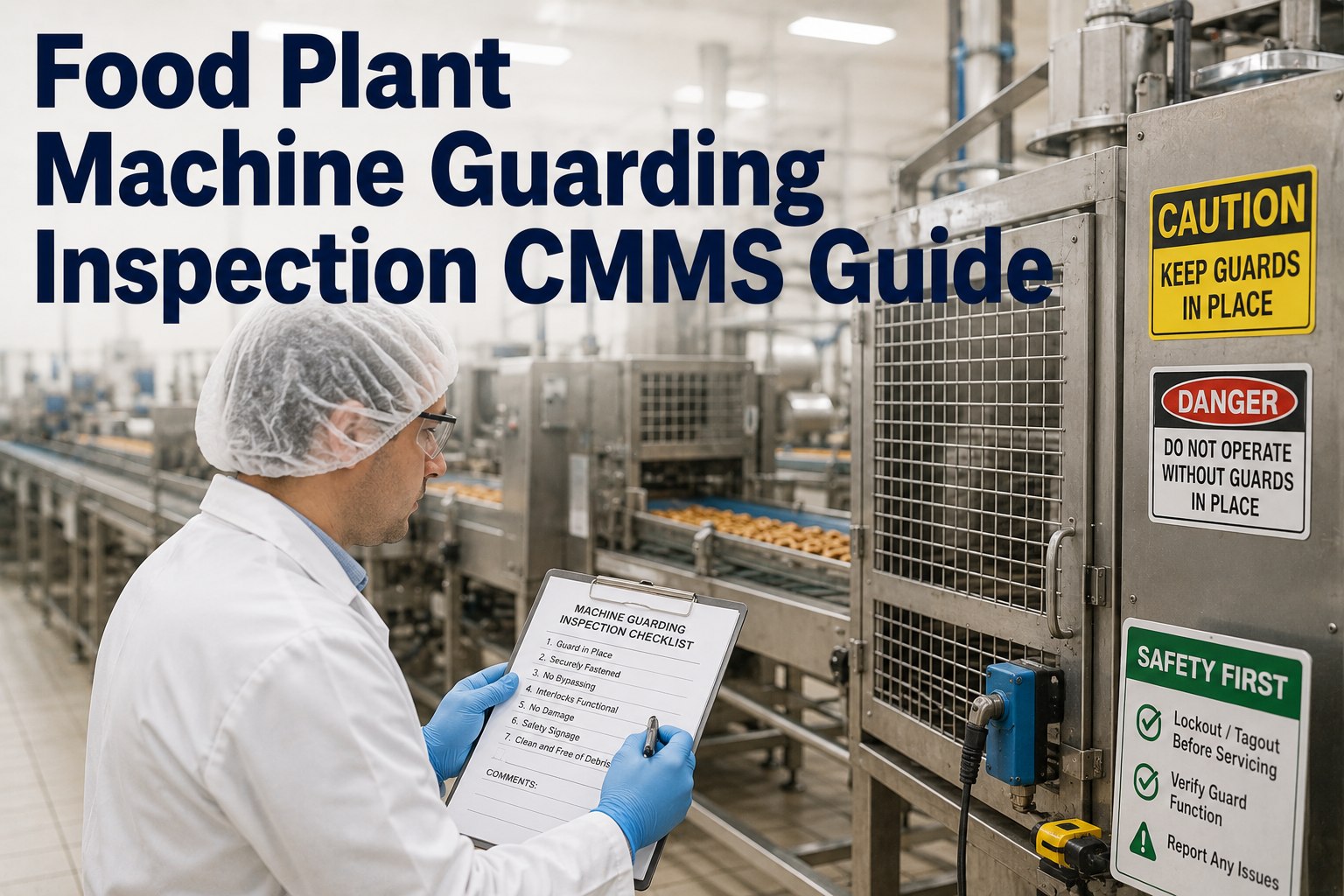
Machine guarding sits at or near the top of OSHA's most-cited violation list year after year — and on a food processing floor, every finding on that list is a pinch point, nip point, or blade that can take a finger, a hand, or worse in the second it takes to reach in. The regulation is unforgiving on timing: a guard that was compliant at installation isn't compliant if it's cracked, removed for cleaning and never reinstalled, or has an interlock someone bypassed to speed up a washdown. That's the trap in food plants specifically — guards live in a high-pressure, high-sanitation environment where they're constantly removed, hosed down, and reinstalled, and the one that goes back on wrong is invisible until an inspection or an injury finds it. This guide covers the machine guarding inspection program a food plant actually needs: the OSHA framework under 29 CFR 1910 Subpart O, the hazards and guard types to verify, interlock testing, and the CMMS-driven workflow that keeps it defensible. Book a free guarding-program review for your plant.
A Guard Is Only Compliant While It's Correct
Removed for washdown, cracked, or bypassed — a guard fails silently until an inspection or injury finds it.
Subpart O
29 CFR 1910 — the machinery and machine-guarding standard governing the floor
Top-cited
Machine guarding is perennially among OSHA's most-cited violations
4 motions
Rotating, reciprocating, transverse, cutting — each a guarding trigger
¼ inch
Guard opening at the point of operation must block finger entry
The Four Hazardous Motions That Trigger Guarding
OSHA's guarding requirement flows from mechanical motion. Under 1910.212, one or more guarding methods must protect workers from hazards at the point of operation, nip points, rotating parts, and flying debris — and those hazards come from four basic motions. An inspection starts by knowing which apply to each machine.
Rotating
Shafts, gears, couplings, mixer paddles. Even a smooth slow shaft can grip clothing and pull a hand in — the danger rises with any exposed bolt or key.
Reciprocating
Up-and-down or back-and-forth movement — press rams, fillers, formers. A body part caught in the stroke is a crush or amputation risk.
Transverse
Straight-line movement — conveyor belts and their in-running nip points where the belt meets a roller, a classic food-plant catch hazard.
Cutting
Slicer blades, saws, dicers, grinders. The point-of-operation hazard most associated with severe laceration and amputation in food processing.
Guard Types · What You're Verifying on Each Machine
Food equipment uses four guard types, and the inspection question differs for each. Knowing the type tells the inspector exactly what "correct" looks like — and washdown environments add a durability check on top.
01
Fixed Guards
A permanent barrier over the hazard. Verify it's securely attached with fasteners not readily removable by the operator, undamaged, and hasn't been left off after cleaning.
02
Interlocking Guards
Automatically stop the machine when opened or removed. The highest-value inspection: confirm the interlock actually cuts power and hasn't been bypassed, taped, or defeated for speed.
03
Adjustable Guards
Repositioned for different product sizes. Verify it's set correctly for the current job, still blocks the danger zone, and the adjustment hasn't opened a gap a hand can pass.
04
Self-Adjusting Guards
Move to expose only the working portion, then return. Verify free movement, correct return to the safe position, and no debris or product buildup jamming it open.
Turn This Into a Scheduled Guarding Program in 30 Minutes
Working session with our team — bring your equipment list. We'll map each machine's motions and guard types, build the inspection checklist, and show how OxMaint schedules guard and interlock checks with photo capture and auto-escalation on every fail.
The Guard Inspection Checklist · Every Machine, Every Cycle
These are the points a guarding inspection covers on each machine. Capture each with a photo and a pass/fail — the interlock test especially, because a defeated interlock is both the most dangerous finding and the easiest to hide.
01
Guard Present & Attached
Confirm the correct guard is in place on every point of operation, nip point, and rotating part — securely fastened, not left off after the last washdown or maintenance.
02
Guard Condition & Integrity
Inspect for cracks, corrosion, bent bars, and washdown damage. A guard degraded by high-pressure cleaning or caustic chemicals may no longer block the hazard it was rated for.
03
Opening Dimensions
Verify guard openings prevent reaching through, over, under, or around to the danger zone — with point-of-operation openings small enough to block finger entry per the standard.
04
Interlock Function Test
Actively test that opening the guard stops the machine, and confirm no interlock has been taped, jumpered, or bypassed. The single most critical — and most defeated — check.
05
No New Hazard Created
Confirm the guard itself doesn't create a hazard — no sharp edges, pinch points, or sanitation traps — and doesn't obstruct safe operation or cleaning.
06
Document & Sign Off
Record the result, photo, and any corrective action against the machine — the timestamped, defensible evidence an OSHA inspector or internal audit will ask to see.
Paper Checklist vs CMMS-Driven Program
A guarding program on paper has a fatal gap: it can't prove the interlock was tested, when, or that a defeated guard was actually fixed. On a floor where guards come off for every washdown, that gap is where the citation — and the injury — lives.
Paper Checklist
Inspections scheduled by memory, skipped when busy
A checkmark — no proof the interlock was tested
Defeated guards depend on someone reporting them
Findings lost between shifts
Records scattered when OSHA arrives
CMMS-Driven Program
Guard and interlock checks auto-scheduled per machine
Photo capture and pass/fail on every guard
A failed interlock auto-escalates to a work order
Findings tracked to closure with deadlines
Full history per machine, retrievable in seconds
How OxMaint Runs the Machine Guarding Program
OxMaint turns the Subpart O guarding checklist into a live safety program — guard and interlock inspections scheduled per machine, mobile execution with mandatory fields and photo capture, auto-escalation on any fail, and a full audit trail against the asset that keeps the plant OSHA-defensible.
Schedule
Guard Checks Per Machine
Guard and interlock inspections auto-generate on cadence per machine — no skipped checks after a busy washdown shift.
Mobile
Execution With Photo Proof
Technicians complete guard checks on mobile with mandatory fields and a photo on every item — proof of condition, not just a tick.
Test
Interlock Verification Logged
The interlock function test is a required, recorded step — a defeated or failed interlock can't be quietly skipped.
Escalate
Fail Becomes a Work Order
A missing guard, damaged barrier, or bypassed interlock auto-generates a tracked corrective-action work order with a deadline.
Isolate
LOTO & Out-of-Service
Tie guarding findings to lockout/tagout and out-of-service status so an unguarded machine is controlled until it's fixed.
Trail
OSHA-Defensible History
Every inspection, photo, interlock test, and fix logged against the machine — retrievable in seconds for an OSHA visit or audit.
Keep Every Guard Correct, Every Shift
Stop letting a guard left off after washdown become a citation or an amputation. See how OxMaint schedules guard and interlock checks, enforces photo proof, escalates every fail, and keeps an OSHA-defensible trail per machine. Free forever plan available.
Frequently Asked Questions
What OSHA standard governs machine guarding in food plants?
The core standard is 29 CFR 1910 Subpart O, Machinery and Machine Guarding. Within it, 1910.212 sets the general requirements for all machines — one or more guarding methods must protect workers from hazards at the point of operation, in-running nip points, rotating parts, and flying chips. More specific sections apply to certain equipment, and 1910.263 addresses bakery equipment such as dough hoppers and mixers. The requirement isn't optional and applies whether a machine is old or new, automated or manual — which is why a documented inspection program matters as much as the guards themselves.
Book a program review.
Why is guarding a bigger challenge in food processing?
Because of the washdown environment. Food equipment — mixers, grinders, slicers, conveyors — must be guarded like any machinery, but the guards also have to withstand high-pressure cleaning, caustic sanitation chemicals, and constant removal and reinstallation for cleaning. That creates two failure modes conventional plants see less of: guards degraded by the wash environment until they no longer block the hazard, and guards removed for sanitation and reinstalled incorrectly — or not at all. Both are invisible without a structured inspection, which is why food plants need guard checks tied to the cleaning cycle, not just an annual review.
What is an interlock and why test it every time?
An interlocking guard automatically stops the machine when the guard is opened or removed, so the equipment can't run while a worker is exposed to the hazard. It's one of the most effective safeguards — and one of the most commonly defeated, because operators sometimes tape, jumper, or bypass an interlock to work or clean faster. A guard that looks perfect can have a dead interlock. That's why the interlock function test — actively confirming that opening the guard cuts power and that nothing has been bypassed — is the single most important check in the whole inspection, and why it should be a required, recorded step.
How often should machine guards be inspected?
OSHA requires guards to be maintained and regularly inspected but doesn't fix a universal interval — the right cadence depends on the equipment, its risk, and how often guards are handled. In food processing, where guards come off for every sanitation cycle, best practice ties a guard-and-interlock verification to the cleaning routine so a guard reinstalled wrong is caught before the next run, layered with more comprehensive periodic inspections and immediate checks after any maintenance. The key is consistency and documentation: a defensible program proves the check happened, when, and that any failure was corrected.
Sign up free to schedule guard checks.
Does OxMaint support machine guarding compliance?
Yes. OxMaint schedules guard and interlock inspections per machine, supports mobile execution with mandatory fields and photo capture, makes the interlock function test a required recorded step, auto-escalates any missing guard, damaged barrier, or defeated interlock into a tracked corrective-action work order, ties findings to lockout/tagout and out-of-service status, and logs a full audit trail against each machine. Whether you run one plant or a multi-site network, guarding inspections stay standardized and every record is retrievable in seconds for an OSHA inspection or internal audit. A free forever plan is available to trial the full workflow.