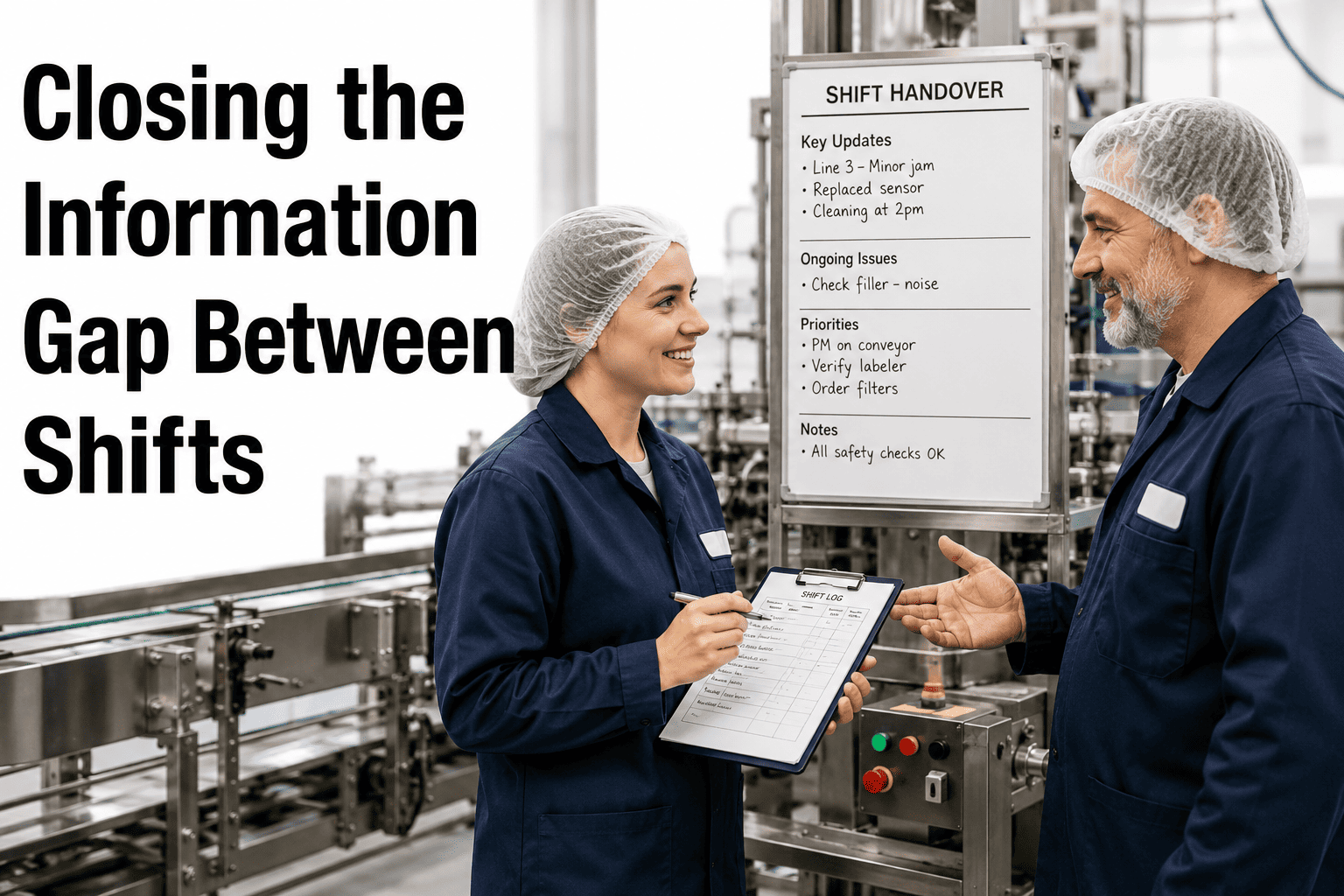
In a 24/7 food plant, the most expensive failures rarely start during a shift — they start in the silence between shifts, when a leaking valve, an abnormal vibration reading, or a half-finished repair gets lost in translation. Research from maintenance operations consistently shows that poorly structured handovers contribute to 20–30% of preventable downtime events, as incoming teams re-diagnose problems the outgoing team already understood. Closing this gap means moving from paper logs and verbal briefings to a CMMS-anchored digital logbook where work-in-progress, event history, and operator notes live inside the work order itself. This guide walks through the architecture of a modern shift handover built for three-shift food manufacturing — and you can pilot it on your floor today by starting a free trial of the platform.
What if your incoming shift knew exactly what your outgoing shift just learned?
The 12-minute window between shifts is where recurring failures are either caught — or quietly repeat for weeks. A CMMS-anchored digital logbook turns that window into unified operational awareness across all three shifts.
Three shifts, one plant, zero shared memory
A typical 24/7 food plant runs 8,760 hours a year across morning, evening, and night shifts — yet most maintenance teams lose 3–5 hours per week re-diagnosing problems the previous shift already understood.
The information gap is not a people problem — it is a system problem. Paper logbooks sit in a single office. Whiteboards get erased before the night shift arrives. WhatsApp messages scroll away within hours. When the institutional knowledge of one shift cannot transfer cleanly to the next, the plant pays for the same diagnosis twice, the same spare part is hunted twice, and the same intermittent fault is "first noticed" three shifts in a row.
Four capabilities that close the gap
A CMMS-driven shift handover is built on four operational pillars. Each one replaces a manual, paper-based habit with a persistent digital record that every shift can see in real time.
Real-time messaging inside work orders
Technicians leave timestamped notes, photos, and readings directly on the work order — not in a separate chat thread that gets lost. The incoming shift opens the same ticket and sees the full diagnostic trail, including what was tried and what failed.
Work-in-progress visibility
Every open work order shows its current state — parts on order, repair 60% complete, awaiting electrician — so the incoming shift picks up exactly where the outgoing shift stopped, without a 20-minute verbal briefing.
Event logging and digital logbook
A chronological, tamper-evident log captures every event: alarms, adjustments, breakdowns, and operator concerns. The logbook is searchable by asset, shift, or fault type — replacing the paper binder that lived in the maintenance office.
Shift coordination dashboard
A single screen shows the outgoing shift's open items, the incoming shift's priority list, and any safety-critical carryovers — giving supervisors a 90-second overview before keys change hands.
Paper handover vs. CMMS digital handover
The difference between a paper-based handover and a CMMS-anchored one is not incremental — it is the difference between a plant that learns from every shift and a plant that repeats the same lesson.
| Handover Dimension | Paper Logbook / Verbal | CMMS Digital Logbook |
|---|---|---|
| Average handover duration | 30–45 minutes | 10–15 minutes |
| Information persistence | Lost within one shift cycle | Permanent, searchable record |
| Photo / diagnostic evidence | Rarely attached, often deleted | Embedded in work order timeline |
| Cross-shift accountability | "Who said what" disputes | Timestamped, name-stamped entries |
| Audit readiness (FDA, SQF, BRC) | Hours of manual reconstruction | Instant filtered export |
| Recurring fault detection | Noticed after 4–6 weeks | Flagged within 2–3 shifts |
A 4-week rollout for three-shift food plants
Closing the information gap does not require a multi-month IT project. Most food plants can move from paper to a fully digital CMMS-driven handover in four weeks, with measurable results by week three.
Audit & map current handover process
Document what information currently changes hands, where it gets lost, and which assets cause the most cross-shift confusion. Identify the 10–15 critical work orders that will pilot the digital logbook.
Configure CMMS logbook & messaging
Set up real-time messaging inside work orders, configure the shift coordination dashboard, and define event-logging categories aligned to your food-safety and HACCP requirements.
Pilot on one production line, all three shifts
Run the digital handover on a single line for seven consecutive days. By day four, most plants see handover time drop below 15 minutes and the first recurring fault pattern surface from the event log.
Roll plant-wide & set KPIs
Extend to all lines and assets. Establish weekly KPIs: average handover time, open-item carryover rate, and mean time between repeated faults. Target a 50% reduction in handover time within 60 days.
A 180-asset frozen-food plant, three shifts, one logbook
Consider a mid-sized frozen-food plant running 180 maintained assets across three shifts — fryers, freezers, conveyors, packaging lines, and ammonia refrigeration. Before digitizing, the maintenance team spent an average of 38 minutes per handover on paper logbooks, and an internal audit found that 11 recurring faults had been "newly discovered" by multiple shifts without being connected.
After implementing a CMMS with real-time work-order messaging and a digital logbook, the plant reduced average handover time to 14 minutes — saving roughly 7.5 hours of maintenance labor per week. More importantly, the event log revealed that a freezer conveyor bearing was failing on a 6-day cycle, a pattern no single shift had ever seen because each shift only witnessed one failure. The bearing was replaced proactively during scheduled downtime, averting an estimated $11,500 in lost production and product hold.
Give every shift the same operational picture
Stop losing diagnostic knowledge at every shift change. See how a CMMS digital logbook unifies your three-shift operation in under a month.
Shift handover in a CMMS — what teams ask
How long does it take to transition from paper logbooks to a CMMS digital handover?
Most three-shift food plants complete the transition in 3–4 weeks. Week one is process mapping, week two is CMMS configuration, and weeks three and four cover piloting on one line and rolling plant-wide. The key is starting with a single production line and a defined set of 10–15 critical work orders rather than attempting a big-bang launch.
Will a digital handover system work if some technicians are not comfortable with software?
Yes — modern CMMS interfaces are designed for tablet and mobile use, with photo capture, voice-to-text notes, and one-tap status updates that are faster than writing on paper. Most teams reach full adoption within two shift cycles. You can Book a Demo to see the interface your technicians will actually use.
Does a CMMS shift handover help with food-safety audits like SQF, BRC, or FDA inspections?
Significantly. A digital logbook creates a timestamped, tamper-evident record of every maintenance event, adjustment, and alarm — exactly what auditors look for. Instead of reconstructing paper logs over hours, you can export a filtered maintenance history for any asset, shift, or date range in seconds.
What happens to the digital logbook if the plant loses internet connectivity?
A robust CMMS for food plants includes offline mode — technicians can log events, update work orders, and capture photos on a tablet without connectivity. The system syncs automatically once the connection is restored, ensuring no handover data is lost even during network outages on the night shift.
How quickly can we expect to see measurable results after implementation?
Most plants see handover time drop by 50–65% within the first two weeks of piloting. Recurring fault detection — the deeper value — typically surfaces within 10–14 days as the event log accumulates enough data to reveal cross-shift patterns that were previously invisible. You can start measuring these results immediately — Start Free Trial and pilot it on your floor this week.
Close the information gap between your shifts
Give your maintenance team a single, shared operational picture across morning, evening, and night shifts — built inside the work orders they already use.
Free 14-day trial · No credit card