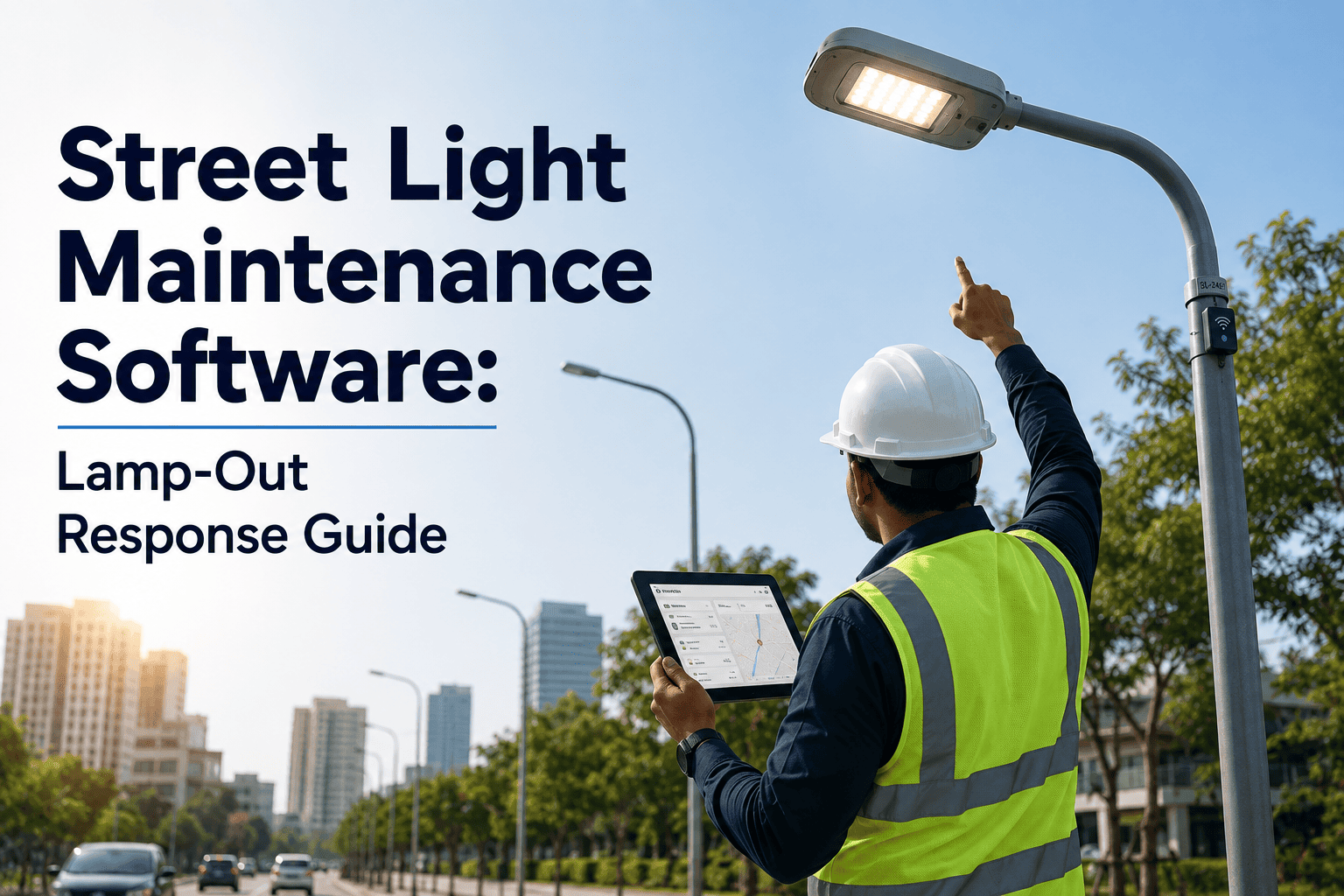
Municipal street lighting accounts for 20-40% of an average city's energy budget. Yet, when a lamp goes out, the detection method is often archaic: waiting for a resident to complain. This reactive model leaves streets dark for days, increasing accident risks and public dissatisfaction.
This executive brief outlines how transit agencies and public works departments are shifting from reactive patrols to predictive maintenance using AI and IoT. By detecting lamp failures before they are reported and predicting end-of-life based on burn hours and voltage patterns, cities can modernize their grid. Start your smart lighting pilot today.
The Reactive Maintenance Crisis
Managing street lights is logistically complex. A city with 50,000 lights relies on night patrols or citizen 311 calls to identify outages. This approach is inefficient, costly, and dangerous. By the time a crew is dispatched, the light may have been out for weeks. Assess your lighting network's efficiency.
How AI Detects and Predicts Lamp Failures
Modern smart city technology uses IoT nodes on each fixture to report status. AI analyzes this data stream to not only detect current outages but predict future failures based on voltage irregularities and spectral shifts. See the AI detection model in action.
□ Current draw during day = Day Burner (Photocell failure)
□ Fluctuating current = Cycling/Flickering (Driver failing)
□ Identify "voltage sag" patterns that degrade drivers
□ Predict remaining useful life (RUL) for budget planning
□ Flag batches of fixtures approaching failure simultaneously
□ "Replace-on-failure" shifts to "Group Replacement"
□ Route optimization reduces fuel and labor travel time
□ Auto-verifies repair via telemetry (no return trip needed)
Digital Work Orders: The Smart Grid Backbone
IoT data is useless without action. Digital work orders bridge the gap between detection and repair. When the AI flags a lamp out, the CMMS automatically creates a work order, assigns it to the nearest technician, and provides GPS coordinates and part numbers. Automate your lighting workflow today.
From Reactive to Predictive: Cost Comparison
Moving to predictive maintenance dramatically lowers the Total Cost of Ownership (TCO) for street lighting networks. By eliminating night patrols and optimizing truck rolls, agencies see ROI in less than 24 months. Request a customized ROI calculation.
Implementation Roadmap for Smart Cities
Transitioning to a smart, predictive lighting network is a phased process. Agencies can start small with a pilot and scale up. Get your smart city roadmap.
Deliverable: Digital Twin of lighting grid
Success Metric: 100% asset visibility
Deliverable: Real-time data stream
Success Metric: Auto-generated work orders
Deliverable: Predictive maintenance ecosystem
Success Metric: >50% reduction in truck rolls. Start your journey
Case Study: Metropolitan Lighting District
Transform Urban Illumination
Predictive maintenance for street lighting isn't just about changing light bulbs efficiently; it's about building a safer, more sustainable city. By leveraging AI and IoT, agencies can reduce energy waste, lower maintenance costs, and improve public safety.
Don't wait for the next blackout or citizen complaint. Take control of your grid with data-driven insights. Schedule your smart city briefing or start your predictive maintenance pilot today.