Water Treatment Plant Maintenance Checklist & Guide
By Mark Strong on April 4, 2026
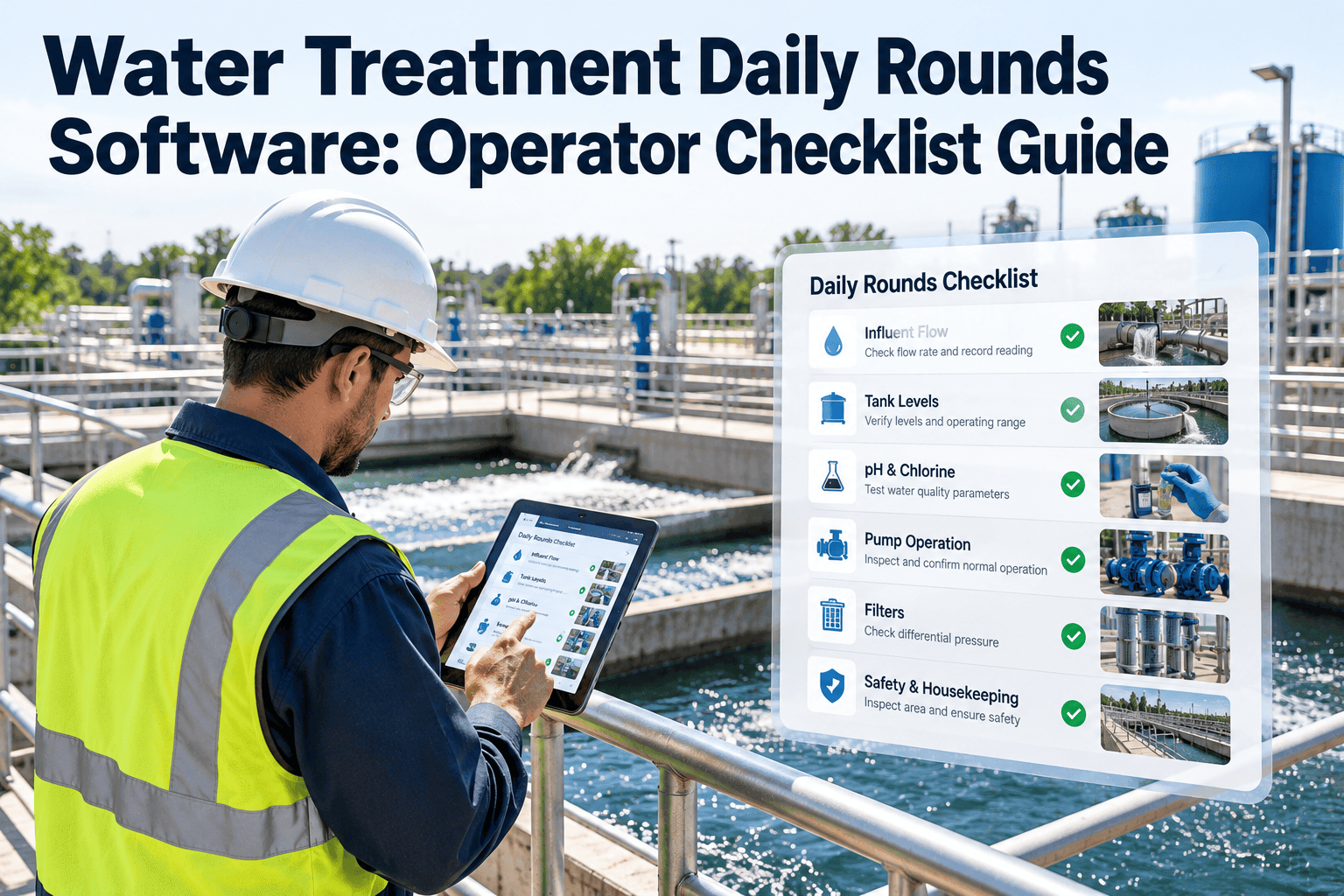
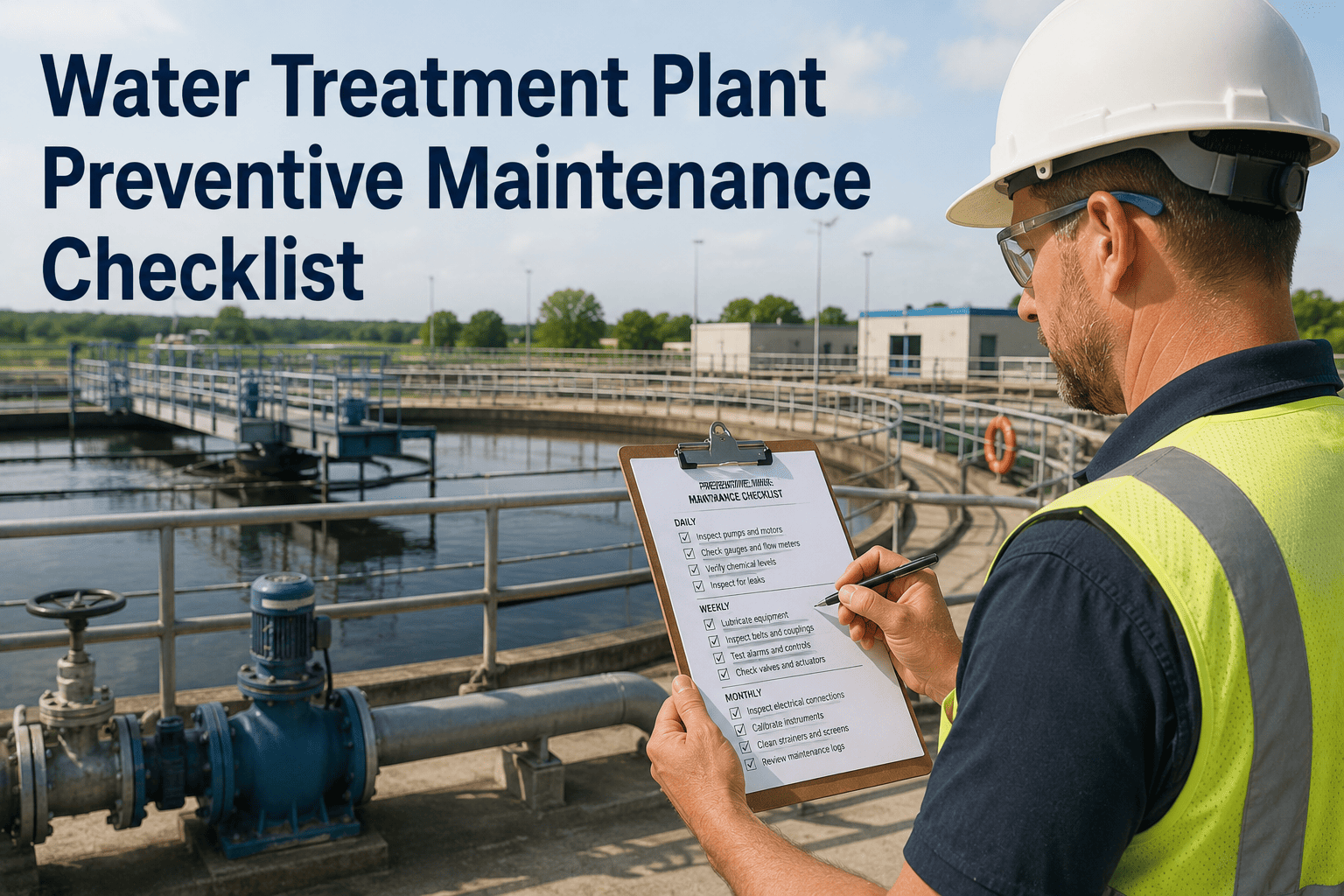
Water treatment plants operate under zero-failure expectations — a chemistry imbalance, a failed pump, or an undocumented inspection puts public health at risk and triggers regulatory enforcement. This checklist gives water utility operators and maintenance engineers a structured zone-by-zone inspection protocol covering every critical process area: intake and pre-treatment, filtration, disinfection, pumping, chemical systems, and instrumentation. Complete daily, weekly, and monthly rounds using this framework and route every deficiency to a documented corrective work order. For digital completion with automatic routing, deploy via OxMaint's zone-based inspection module. Book a demo to see OxMaint configured on your water treatment facility asset hierarchy.
67%
Of water utility equipment failures are repeat events — the same root cause recurring because prior corrective actions were never closed
$480K
Average cost of a single unplanned high-lift pump failure at a municipal water treatment plant including emergency labour, parts, and regulatory response
6
Inspection zones covered — intake and pre-treatment, filtration, disinfection, pumping, chemical systems, and SCADA and instrumentation
2 hrs
Time to generate a full EPA, state primacy agency, or DWI audit-ready maintenance record package from OxMaint — versus 3 days manual
Checklist Scope and Usage
This checklist covers six operational zones: raw water intake and coagulation, filtration and backwash, disinfection and CT compliance, high-lift pumping and distribution, chemical dosing systems, and SCADA and instrumentation. Priority ratings are assigned per item based on regulatory consequence and failure impact. Critical items are regulatory-mandatory or carry immediate public health consequence. Monitor items require a work order and defined re-inspection interval. Routine items are documented and trended over time. All deficient findings require photo documentation before the corrective work order is raised.
The intake zone is the first and last line of defence against turbidity exceedances and chemical treatment failures. Coagulation performance determines the quality of every downstream process. Readings from this zone cannot be substituted by control room SCADA data review — physical inspection is required at every shift change.
Intake Flow and Screen Condition
Coagulation and Flocculation
Zone 2 — Filtration and Backwash
Filtration is the critical process barrier between coagulation performance and safe water delivery. Filter effluent turbidity is a regulatory parameter in every jurisdiction — a reading above the permit limit is an immediate compliance event, not a maintenance note. Filter condition monitoring must be completed at every operator shift, not only when a visual issue is observed.
Disinfection is the most heavily regulated process in any water treatment plant. CT (concentration × time) compliance is a federal requirement in every jurisdiction with a surface water treatment rule. A CT shortfall is not a process adjustment — it is a regulatory violation requiring immediate corrective action and regulatory notification. These items must be completed at every shift without exception.
Chlorine Residual and CT Calculation — Regulatory Critical
Chlorination Equipment Condition
Zone 4 — High-Lift Pumping and Distribution
High-lift pumps are the highest-consequence single-point failure in a water distribution system. A pump failure during peak demand — summer afternoon, major event, or firefighting demand — cannot be masked by storage drawdown for more than a few hours. Pump condition monitoring requires quantitative readings at every shift, not visual observation alone.
Pump Operating Condition
Distribution System Pressure
Replace Paper Logbooks With Compliance-Ready Digital Records
OxMaint captures every reading, photo, and technician sign-off at the point of inspection — creating a tamper-evident compliance audit trail that satisfies EPA, DWI, and state primacy agency requirements. Start your free trial today.
Chemical dosing systems are low-visibility, high-consequence assets. A failed coagulant pump or an incorrect polymer dose does not trigger a SCADA alarm — it produces deteriorating filter performance 4 to 8 hours later, by which time the compliance record shows a turbidity exceedance with no documented precursor. Dosing system inspection must be a documented physical round, not a control room assumption that pumps are running correctly because no alarm has appeared.
Chemical Pump and Tank Condition
Zone 6 — SCADA, Instrumentation, and Standby Power
SCADA and instrumentation failures are the second leading cause of process control gaps in water treatment — after operator complacency. A pH probe drifted by 0.3 units produces incorrect coagulant dosing for every hour it goes unchecked. A UPS failure that takes out the telemetry system during a pump alarm event is the precondition for an undetected distribution pressure exceedance. These items require documented physical verification, not dashboard assumption.
Instrumentation Calibration and Status
Standby Power and Emergency Systems
Inspection Zone Summary — Frequency and Priority Distribution
Inspection Zone
Every Shift
Weekly
Critical Items
Monitor Items
Total Items
Zone 1 — Intake and Pre-Treatment
All items
Equipment condition
3
5
10
Zone 2 — Filtration and Backwash
All items
Media inspection
3
4
9
Zone 3 — Disinfection (CT)
All items
Analyser calibration
5
4
10
Zone 4 — Pumping and Distribution
All items
Vibration survey
4
4
9
Zone 5 — Chemical Dosing
All items
Bund and safety
3
3
7
Zone 6 — SCADA and Standby Power
All items
Generator load test
3
4
10
Total Checklist Items
55
Selected
21
24
55
OxMaint Compliance Coverage for Water Treatment Inspection Records
Region
Applicable Regulatory Frameworks
OxMaint Inspection Record Output
USA / Canada
EPA Safe Drinking Water Act, Surface Water Treatment Rule, Long-Term 2 ESWTR, state primacy agency rules, AWWA standards
SDWA-aligned CT log templates, filter turbidity audit trail, operator certification sign-off on every record, sanitary survey export in under 2 hours
United Kingdom
Water Industry Act 1991, Water Supply Regulations 2016, Drinking Water Inspectorate (DWI) standards, WaterSafe scheme
DWI inspection-ready PM records, process performance logs, certified operator authentication on every inspection record, DWI submission export
Australia
Australian Drinking Water Guidelines (NHMRC), state water authority regulations, Drinking Water Quality Management Plan framework
DWQMP evidence records, HACCP-aligned CCP monitoring logs, treatment compliance audit trail exportable for state regulator review
Germany / EU
EU Drinking Water Directive 2020/2184, TrinkwV 2023, DVGW technical standards, DIN standards for water supply
TrinkwV-aligned inspection records, DVGW PM compliance documentation, annual technical report data export, certified technician records
Saudi Arabia / UAE
Saudi Water Authority regulations, SASO standards, UAE ESMA water quality standards, Gulf Council drinking water standards
Inspection Records That Satisfy Every Regional Framework — Without Post-Processing
OxMaint structures every water treatment inspection record, work order, and corrective action to meet the documentation requirements of your regulatory jurisdiction — so audit preparation takes hours, not weeks.
OxMaint vs. Competitors: Water Treatment CMMS Capabilities
Most CMMS platforms are built for general facilities management. OxMaint is designed for the regulatory intensity of water utility operations — where every inspection record is compliance evidence and every deferred PM is a potential enforcement event.
Capability
OxMaint
MaintainX
UpKeep
Fiix
Limble
IBM Maximo
Hippo/Eptura
Water utility compliance documentation (EPA, DWI, TrinkwV)
Yes
No
No
Generic
No
Custom build
No
SCADA and historian data integration
Yes
No
No
Limited
No
Yes
No
AI predictive maintenance on pumps and dosing systems
Yes
No
No
Limited
No
APM add-on
No
Zone-based mobile inspection with photo capture
Yes
Yes
Yes
Basic
Yes
Limited
Basic
Regulatory audit export — structured and jurisdiction-specific
Yes
No
No
Generic PDF
Generic PDF
Custom reports
No
Mobile offline operation — plant floor without connectivity
Yes
Yes
Yes
Limited
Yes
Limited
Limited
CAPA tracking with escalation on open corrective actions
Yes
Basic
Basic
Yes
Basic
Yes
Basic
Deployment without IT project — live in weeks
4–6 weeks
4–6 weeks
4–6 weeks
6–10 weeks
4–8 weeks
3–6 months
6–10 weeks
Competitor capabilities based on publicly available product documentation as of 2025. OxMaint capabilities reflect current platform feature set.
OxMaint Results at Water Utility Sites
89%
PM Completion Rate
Up from 44% on prior paper-based schedules — driven by mobile delivery and automated escalation on outstanding tasks
67%
Fewer Repeat Failures
Reduction in repeat equipment failure events within 12 months — AI RCA closing corrective actions that paper systems left open
4–6 wks
Deployment Time
Average time from contract to live digital inspection and PM on a mid-sized water treatment facility — including asset hierarchy build and team training
Zero
Audit Record Gaps
Regulatory findings related to maintenance record gaps for OxMaint-deployed utilities in their most recent sanitary survey or DWI inspection
Frequently Asked Questions
QWhat water treatment inspection records are required for an EPA sanitary survey?
EPA sanitary surveys require evidence of: daily turbidity logs per filter, CT calculation records for each operating shift, disinfectant residual monitoring at entry point and distribution, filter performance records, and operator certification documentation. OxMaint generates all of these records as structured digital outputs — exportable as a sanitary survey package in under 2 hours. See the SCADA-CMMS integration guide for how SCADA data connects to OxMaint inspection records.
QHow does OxMaint integrate with existing SCADA systems at water treatment plants?
OxMaint connects to existing SCADA, historian databases, and process control systems via standard APIs — ingesting sensor data without replacing your control room infrastructure. SCADA readings appear alongside OxMaint inspection data in the same asset record. See the SCADA-CMMS integration guide for full protocol and connection detail.
QHow should CT records and disinfection logs be structured to satisfy regulatory audits?
CT records must show: the chlorine residual at point of application (with method and analyst identification), the contact time used in the CT calculation, the log inactivation credit achieved versus the required credit, and the operator certification number of the person completing the record. OxMaint's disinfection log template includes all mandatory fields — populated at the point of inspection on mobile with operator credential authentication built into the sign-off workflow.
QCan OxMaint manage both water treatment and distribution system maintenance on the same platform?
Yes — OxMaint supports the full water utility asset hierarchy: treatment plant, pumping stations, distribution network, reservoirs, and wastewater assets on a single platform. See the water distribution system maintenance guide and wastewater treatment maintenance guide for asset-specific coverage beyond the treatment plant.
QHow does OxMaint protect sensitive water utility operational data?
OxMaint operates on SOC 2 Type II-aligned infrastructure with AES-256 encryption at rest and TLS 1.3 in transit. Role-based access controls restrict maintenance and SCADA-connected data to authorised personnel. On-premise deployment is available for utilities with air-gap requirements or national security data residency mandates. Full cybersecurity documentation is available for CISA critical infrastructure review. See the water utility asset management guide for the full OxMaint data governance framework in a regulatory context.
Deploy This Checklist as Live Digital Zone Inspections in OxMaint
Every zone and every item in this checklist is available as a structured digital inspection in OxMaint — assigned to your water treatment facility asset hierarchy, triggered on shift schedule, completed on mobile with photo capture, and automatically routing every deficiency to a corrective work order with the evidence attached.