Run one clinical lab and CLIA documentation is a discipline. Run ten across a health system and it becomes a governance problem: every site keeps records a little differently, one lab's calibration binder is immaculate while another's lives in scattered printouts, and a single surveyor's visit to the weakest site can put the whole network's credibility in question. Under CLIA, the standard is unforgiving — if a surveyor can't see the evidence that maintenance and calibration were performed, the lab is treated as out of compliance, whether the work happened or not. This guide lays out a multi-site CLIA maintenance documentation workflow and shows how OXMAINT AI, the AI-powered CMMS, makes every site's records consistent, current and audit-ready.
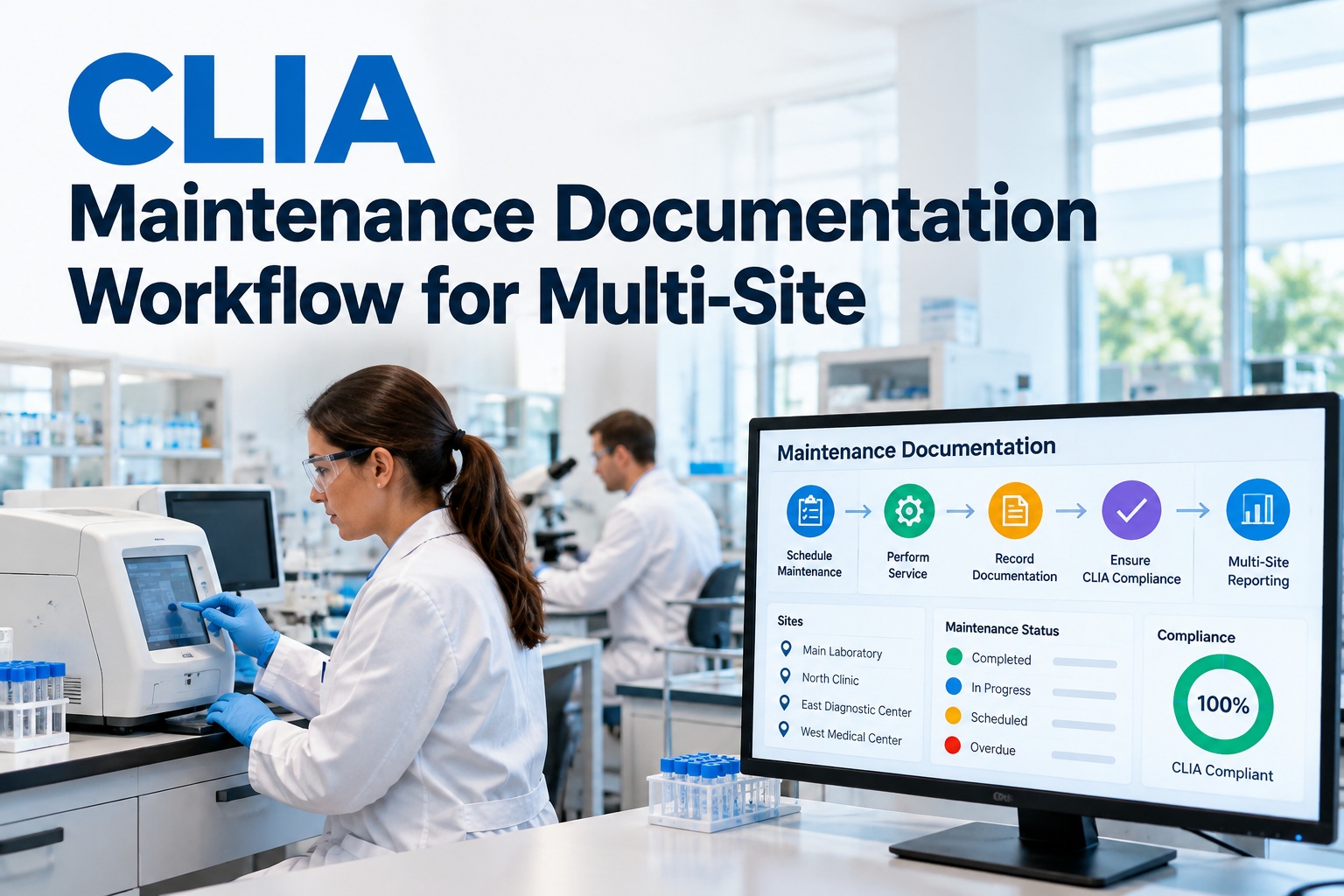
CLIA Maintenance Documentation Workflow for Multi-Site
Across a lab network, compliance is only as strong as the weakest site's paperwork — and reconstructing records before a survey is a recurring fire drill. OXMAINT AI standardizes the workflow across every location: manufacturer-scheduled maintenance, calibration verification and function checks logged against each instrument, with a single, retrievable evidence trail per site. So audit-readiness is a standing state, not a scramble.
Why Multi-Site Makes CLIA Harder
Documentation that works for a single lab breaks quietly at scale. Ten sites mean ten interpretations of "current," ten filing habits, and ten chances for a gap that only surfaces when a surveyor walks in. The regulation doesn't grade the network — it grades the site in front of the inspector.
Start free and put every site on one workflow in OXMAINT AI.
- Each lab documents maintenance its own way
- Scattered printouts, notebooks and spreadsheets per site
- No central view of which instruments are overdue
- Calibration after a lot change missed at one location
- Survey prep is a reconstruction, site by site
- One documentation standard applied at every site
- All records tied to the instrument, in one system
- Network-wide view of what's due, done and overdue
- Lot-change and trigger-based recalibration enforced
- Audit-ready evidence standing by, per site, on demand
The CLIA Record Set — Per Instrument
CLIA compliance rests on a defined body of evidence for every analyzer and instrument. These are the records a surveyor expects to see — current, complete and linked to the specific device.
Book a review to map these records onto your instruments.
Specific intervals and requirements are set by the manufacturer's instructions and the CLIA regulations (42 CFR 493) — always follow those and your accrediting organization's checklist. This guide organizes the workflow; it does not replace the official requirements.
If a Surveyor Can't See It, It Didn't Happen.
Labs get cited for missing evidence, not just missed work — scattered printouts have escalated into condition-level deficiencies even when the equipment ran fine. OXMAINT AI keeps the proof organized and retrievable, per instrument, per site.
The Recalibration Trigger Workflow
Routine intervals aren't the only driver. Certain events require recalibration before patient testing resumes — and each one must be documented. This is exactly the sequence that fails when records live in a notebook at one busy site.
Sign up free and enforce this sequence at every site in OXMAINT AI.
One Standard Across Every Site
The value of a shared workflow is that it erases the variance between locations. The same records, the same schedule, the same retrievability — whether a surveyor visits your flagship lab or your smallest satellite.
Book a review to see multi-site standardization in OXMAINT AI.
Single-Site Habits vs. Multi-Site Governance
| What matters | Per-site, ad hoc | Standardized in OXMAINT AI |
|---|---|---|
| Documentation format | Varies by site | One standard everywhere |
| Where records live | Binders & scattered files | On the instrument, in one system |
| Overdue visibility | Per-site, if tracked at all | Network-wide, live |
| Lot-change recalibration | Easy to miss | Triggered and enforced |
| Survey preparation | Reconstruction fire drill | Standing readiness |
Frequently Asked Questions
Make Audit-Readiness a Standing State — Not a Scramble.
Put every clinical lab on one CLIA documentation workflow — manufacturer-scheduled maintenance, calibration verification and instrument-linked records, consistent and retrievable across every site — with OXMAINT AI.