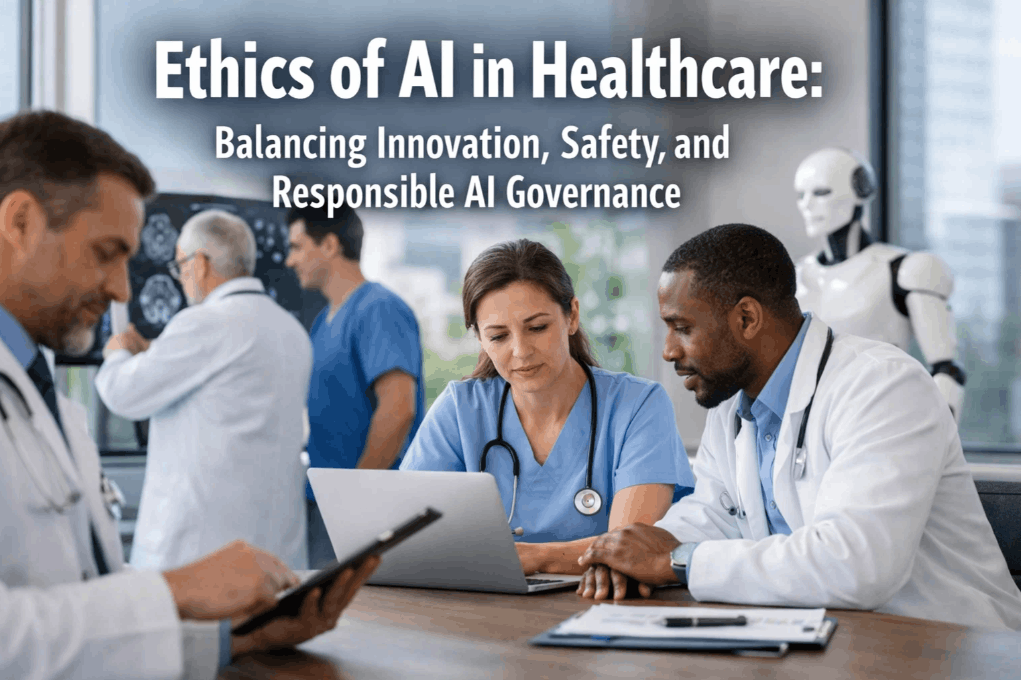
Artificial intelligence is reshaping healthcare at an unprecedented pace — accelerating diagnostics, personalizing treatment protocols, and streamlining clinical workflows that once demanded enormous human effort. Yet as AI systems grow more embedded in patient care, a critical question emerges not just for technologists, but for clinicians, ethicists, regulators, and patients alike: are we deploying these systems responsibly? The ethics of AI in healthcare is no longer a philosophical afterthought — it is a foundational pillar of safe, equitable, and trustworthy medical innovation. Sign up for OxMaint to see how responsible AI governance is built into modern healthcare compliance platforms.
Responsible AI governance starts with the right tools and a commitment to transparency across your healthcare organization.
OxMaint helps healthcare leaders embed ethical AI practices, audit-ready documentation, and accountability frameworks into every layer of operations.
Why AI Ethics in Healthcare Demands Urgent Attention
Healthcare occupies a uniquely sensitive position in any discussion of AI ethics. Unlike other industries where algorithmic errors might produce financial inconvenience or service disruptions, mistakes in medical AI carry life-or-death consequences. A diagnostic model trained on biased data can recommend inadequate treatment for underrepresented patient populations. A risk stratification algorithm that disadvantages certain demographic groups can systematically deny care to those who need it most. And when AI systems operate as opaque black boxes, clinicians are left without the interpretive tools needed to question, override, or understand automated recommendations. The stakes — patient safety, clinical trust, and equitable access to care — demand that healthcare organizations approach AI deployment with rigorous ethical discipline.
The regulatory landscape is responding accordingly. The U.S. Food and Drug Administration has issued guidance on Software as a Medical Device. The European Union's AI Act classifies certain healthcare applications as high-risk, requiring conformity assessments and transparency disclosures. Professional bodies including the American Medical Association have published principles governing physician use of AI. These frameworks signal an emerging consensus: innovation without accountability is not progress — it is liability. Sign up free for 15 days and see how OxMaint helps your organization stay ahead of evolving AI governance requirements.
The Six Core Pillars of Ethical AI in Healthcare
Building a trustworthy AI ecosystem in healthcare requires more than compliance checkboxes. It demands a principled architecture that weaves ethical considerations into every phase of an AI system's lifecycle — from data collection and model development through deployment, monitoring, and decommissioning. Six foundational pillars define what responsible healthcare AI governance looks like in practice.
AI systems must be trained and validated across diverse patient populations to ensure diagnostic and treatment recommendations do not systematically disadvantage individuals based on race, gender, age, or socioeconomic status.
Clinicians and patients deserve meaningful explanations of how AI systems reach their conclusions. Explainable AI frameworks allow healthcare providers to interrogate model outputs rather than accept them uncritically.
Clear lines of responsibility must exist when AI systems cause harm. Governance frameworks must define who is accountable — developers, deployers, or clinicians — and establish mechanisms for redress.
Informed consent must extend to AI-assisted care. Patients have the right to know when automated systems influence their diagnosis, treatment, or care pathway, and to opt out where clinically appropriate.
Healthcare AI relies on vast quantities of sensitive personal data. Ethical governance requires data minimization principles, robust de-identification protocols, and strict controls on secondary use of patient information.
AI systems must be validated in real-world clinical environments before deployment, with continuous post-market surveillance to detect performance degradation, distributional shift, and emergent safety risks.
Understanding AI Bias in Healthcare: Where It Originates and How It Harms
Algorithmic bias in healthcare is not a hypothetical risk — it is a documented reality with measurable consequences for patient outcomes. Bias enters AI systems through multiple pathways, each requiring distinct mitigation strategies. Historical training data often reflects longstanding disparities in healthcare delivery: if certain populations were historically undertreated or underrepresented in clinical trials, those patterns are absorbed into models trained on that data. Sampling bias occurs when training datasets systematically exclude patient subgroups, producing models that generalize poorly to those populations in deployment. Label bias emerges when the outcomes used to train models are themselves influenced by human prejudice — for example, when models are trained to predict healthcare utilization rather than healthcare need, they inherit the systemic inequities baked into utilization patterns.
The consequences manifest across clinical domains. Dermatological AI tools trained predominantly on lighter-skinned patient populations have demonstrated significantly lower diagnostic accuracy for patients with darker skin tones. Cardiac risk models have historically underestimated disease probability in women because foundational cardiovascular research was conducted predominantly on male subjects. Sepsis prediction algorithms have shown disparate performance across racial groups when validated in diverse hospital settings. Addressing these disparities requires proactive bias auditing throughout model development, disaggregated performance reporting across demographic subgroups, and ongoing monitoring after deployment to detect emergent bias as patient populations and clinical practices evolve.
The AI Ethics Governance Lifecycle
Embed ethical requirements — fairness criteria, transparency standards, consent protocols — into AI system design before development begins
Conduct bias audits and performance validation across diverse patient subgroups in representative clinical environments prior to deployment
Establish AI governance committees with clinical, ethical, legal, and patient representation to oversee deployment decisions and escalation pathways
Deploy continuous post-market surveillance systems to detect performance drift, demographic disparities, and emergent safety signals in real time
Feed surveillance findings back into model retraining cycles and governance reviews, creating a continuously improving ethical AI infrastructure
Transparency and Explainability: The Clinical Case for Interpretable AI
One of the most consequential ethical debates in healthcare AI concerns the tradeoff between model performance and interpretability. Deep learning architectures capable of analyzing medical imaging at superhuman accuracy often function as black boxes, producing outputs clinicians cannot meaningfully interrogate. This creates a profound tension: should healthcare organizations deploy high-performing opaque models and accept their conclusions on faith, or should they favor more interpretable models whose reasoning is accessible even if their performance ceiling is lower?
The emerging consensus in responsible AI governance favors explainability as a near-mandatory requirement for high-stakes clinical decision support. When an AI system flags a patient as high risk for readmission, the responsible clinician needs to understand which clinical features drove that prediction — not to blindly override the model, but to exercise informed clinical judgment. Explainable AI methods such as SHAP values, LIME, and attention visualization provide partial interpretability for complex models, surfacing the features most influential in individual predictions. Healthcare organizations investing in ethical AI governance should demand explainability documentation from AI vendors, require that clinical staff receive training in interpreting AI outputs, and establish protocols for documenting when and why clinicians override automated recommendations.
Regulatory Frameworks Governing Healthcare AI Ethics
The global regulatory landscape for healthcare AI is evolving rapidly, creating an increasingly complex compliance environment for healthcare organizations. Understanding the key frameworks and their implications is essential for any healthcare leader developing an AI governance strategy.
Global Regulatory Frameworks for Healthcare AI
| Framework | Jurisdiction | Key Requirements | Healthcare AI Scope |
|---|---|---|---|
| FDA SaMD Guidance | United States | Pre-market review, real-world performance monitoring, algorithm change protocol | Software meeting device definition, clinical decision support |
| EU AI Act | European Union | Conformity assessment, transparency obligations, human oversight requirements | High-risk AI systems in medical devices and safety-critical applications |
| HIPAA Privacy & Security Rule | United States | Data use agreements, de-identification standards, breach notification | Any AI system processing protected health information |
| GDPR | European Union | Lawful basis for processing, data subject rights, automated decision-making restrictions | AI systems processing personal data of EU residents |
| MHRA AI Framework | United Kingdom | Safety, transparency, fairness, accountability, and contestability principles | AI medical devices and clinical decision support tools |
| ONC Health IT Certification | United States | Transparency disclosures for EHR-integrated predictive algorithms | Predictive algorithms embedded in certified health IT modules |
Building an AI Ethics Committee: Structure, Scope, and Authority
Healthcare organizations serious about responsible AI governance are establishing dedicated AI ethics committees as standing governance bodies. These committees are not academic exercises — they are operational infrastructure with real authority over AI procurement, deployment, and decommissioning decisions. The most effective AI ethics committees in healthcare share several structural characteristics. First, they bring together diverse expertise: clinical informaticists, frontline clinicians, ethicists, legal and compliance officers, patient advocates, and data scientists. This cross-functional composition ensures that governance decisions reflect the full range of perspectives affected by AI deployment. Second, they operate with defined scope and authority — clear mandates over which AI systems require committee review, what evidence is required for approval, and what conditions trigger mandatory reassessment.
The committee's operational mandate typically encompasses four domains: pre-deployment review of new AI systems against fairness, safety, and transparency standards; ongoing surveillance of deployed systems with defined performance thresholds that trigger escalation; incident investigation when AI systems are implicated in adverse events or near-misses; and vendor governance, including assessment of AI vendor ethics practices, audit rights, and contractual requirements for transparency documentation. Organizations that formalize these governance structures position themselves not only for better patient outcomes but for stronger regulatory posture as AI-specific oversight requirements intensify across jurisdictions.
Is your organization equipped to govern AI responsibly across every department and clinical domain?
OxMaint provides the compliance infrastructure healthcare leaders need to document, monitor, and audit AI governance activities — keeping your organization accountable, transparent, and survey-ready.
Patient Trust and Informed Consent in AI-Assisted Care
Patient trust is the currency on which healthcare operates, and AI deployment practices that undermine that trust carry costs far beyond regulatory penalties. Studies consistently show that patients are more willing to accept AI-assisted care when they receive clear explanations of how AI is being used, when they retain meaningful ability to request human review, and when they believe their data is being handled responsibly. Informed consent frameworks developed for traditional clinical interventions are increasingly being extended to cover AI-assisted decision making, particularly in high-stakes contexts such as cancer screening, psychiatric risk assessment, and surgical planning support.
Healthcare organizations should develop patient communication strategies that disclose AI use in care pathways in plain language, explain the role AI plays relative to clinician judgment, and describe how patient data contributes to AI system training and improvement. These disclosures should be integrated into existing consent processes rather than buried in supplementary documentation patients rarely read. Where patients exercise their right to opt out of AI-assisted care, organizations must have operationally viable pathways for delivering equivalent care quality through alternative means. Building patient trust in healthcare AI is not simply an ethical obligation — it is a strategic necessity for organizations that intend to sustain AI-enabled care models over the long term.
Data Ethics: The Foundation of Trustworthy Healthcare AI
Every healthcare AI system is built on data, and the ethical quality of that data determines the ethical quality of everything built upon it. Healthcare data ethics encompasses principles and practices governing how patient data is collected, curated, used to train AI models, and governed across its entire lifecycle. Several principles are foundational to ethical healthcare data practice. Data minimization requires that AI systems collect and retain only the patient data strictly necessary for their intended function — a principle increasingly mandated by privacy regulations but also independently justified as an ethical obligation. Purpose limitation restricts the use of patient data to the specific purposes for which consent was obtained, preventing health systems from repurposing clinical data for commercial AI development without explicit patient authorization. Sign up for OxMaint to build a data governance foundation your patients and regulators can trust.
De-identification and synthetic data generation are increasingly important tools for enabling AI development without compromising patient privacy. However, healthcare organizations should understand that de-identification is not a binary state — sophisticated re-identification attacks can reconstruct patient identities from ostensibly anonymized datasets, particularly when combined with external data sources. Robust data governance frameworks establish tiered access controls, audit logging for all data access events, and regular re-identification risk assessments to ensure that de-identified datasets remain adequately protected as the technical landscape for re-identification continues to evolve. Book a demo to explore how OxMaint's data governance tools keep your AI infrastructure ethically sound and audit-ready.
Systematic evaluation of model performance across demographic subgroups catches discriminatory patterns before they propagate into clinical workflows and patient care decisions
Requiring vendor-provided explainability documentation enables clinicians to interrogate AI outputs and exercise informed judgment rather than uncritical deference to algorithmic conclusions
Cross-functional AI ethics committees with defined authority and scope provide the organizational infrastructure needed to make consistent, accountable deployment decisions at scale
Post-deployment monitoring systems detect model performance drift and emergent safety signals before they accumulate into systemic patient safety events or regulatory findings
The Path Forward: Responsible Innovation as Competitive Advantage
Healthcare organizations that treat AI ethics as a compliance burden to be minimized miss a fundamental strategic insight: responsible AI governance is a source of durable competitive advantage. In a healthcare landscape where patient trust is increasingly fragile, where regulatory scrutiny of AI systems is intensifying, and where workforce concerns about AI-driven deskilling are mounting, organizations that demonstrate genuine commitment to ethical AI deployment differentiate themselves on dimensions that matter deeply to patients, clinicians, payers, and regulators alike.
Responsible AI governance — encompassing bias auditing, transparency requirements, accountability frameworks, and patient consent practices — does not slow innovation. It channels innovation toward directions that can sustain long-term clinical and organizational value. AI systems that earn clinician trust because they are explainable get used more consistently and generate better outcomes than opaque high-performing models that clinicians route around. AI deployments built on ethical data practices attract partnerships with health systems, academic medical centers, and payers who apply increasingly rigorous vendor due diligence. The future of healthcare AI belongs not to organizations that move fastest, but to those that move wisely — building the ethical infrastructure today that will define trustworthy healthcare technology for the decades ahead. Sign up for OxMaint to start building your responsible AI governance foundation now.
Frequently Asked Questions
01 What are the primary ethical risks of AI deployment in clinical settings?
The primary risks include algorithmic bias producing inequitable care recommendations, lack of transparency preventing meaningful clinical oversight, accountability gaps when AI-driven decisions cause harm, patient privacy violations through improper data use, and safety risks from deploying AI systems without adequate validation in representative clinical populations.
02 How can hospitals detect and address algorithmic bias in AI systems?
Hospitals should require vendors to provide disaggregated performance metrics across demographic subgroups before procurement, establish internal bias auditing protocols for post-deployment monitoring, include fairness criteria in AI governance committee review processes, and mandate contractual provisions giving health systems audit rights over model training data and validation methodologies.
03 Is patient consent required for AI-assisted clinical decision making?
Consent requirements for AI-assisted care vary by jurisdiction, clinical context, and the degree of AI influence over care decisions. Emerging regulatory frameworks and professional guidelines increasingly favor disclosure as a minimum standard, with consent required where AI substantially influences high-stakes clinical decisions. Organizations should develop proactive consent policies that exceed minimum legal requirements to build patient trust.
04 What role do clinicians play in ethical AI governance?
Clinicians are indispensable to responsible AI governance. They provide domain expertise during pre-deployment review, serve as the frontline safeguard against erroneous AI recommendations, generate incident reports that feed surveillance systems, and advocate for patient interests in governance committee deliberations. AI governance frameworks that exclude frontline clinical voices produce policies that fail in operational reality.
05 How do healthcare organizations stay current with evolving AI ethics regulations?
Healthcare organizations should designate responsibility for AI regulatory monitoring to qualified compliance and legal professionals, subscribe to regulatory agency update services from FDA, CMS, and applicable international bodies, participate in professional association working groups on AI governance standards, and build AI governance frameworks with sufficient flexibility to incorporate new requirements without full-scale restructuring. Integrated compliance platforms that maintain continuously updated regulatory libraries are increasingly valuable for tracking the rapid evolution of AI-specific requirements across jurisdictions.




.png)