The global healthcare industry is in the middle of a maintenance revolution — and the facilities still running on manual rounds, paper logs, and reactive repair cycles are falling behind in ways that affect patient outcomes, regulatory standing, and operating budgets simultaneously. AI-powered maintenance is no longer an experiment confined to flagship teaching hospitals in Boston or London. It is now standard infrastructure at hospital networks across Singapore, Riyadh, Sydney, Frankfurt, and Toronto. Healthcare leaders who understand this shift are investing now. Those who do not are absorbing costs their competitors have already eliminated. If your network is ready to modernize its maintenance infrastructure, start a free 30-day trial today or book a demo with Oxmaint's healthcare operations team to see what AI-integrated facility management looks like in your specific context.
Your Competitors Have Already Switched. Has Your Hospital?
Oxmaint gives healthcare facility managers a single connected platform — AI-triggered work orders, asset condition scoring, mobile technician dispatch, and investor-grade CapEx forecasting — without heavy implementation or long onboarding. Deployed across hospitals in the US, UK, UAE, Australia, and beyond.
What Does AI-Powered Maintenance Actually Mean for Hospitals?
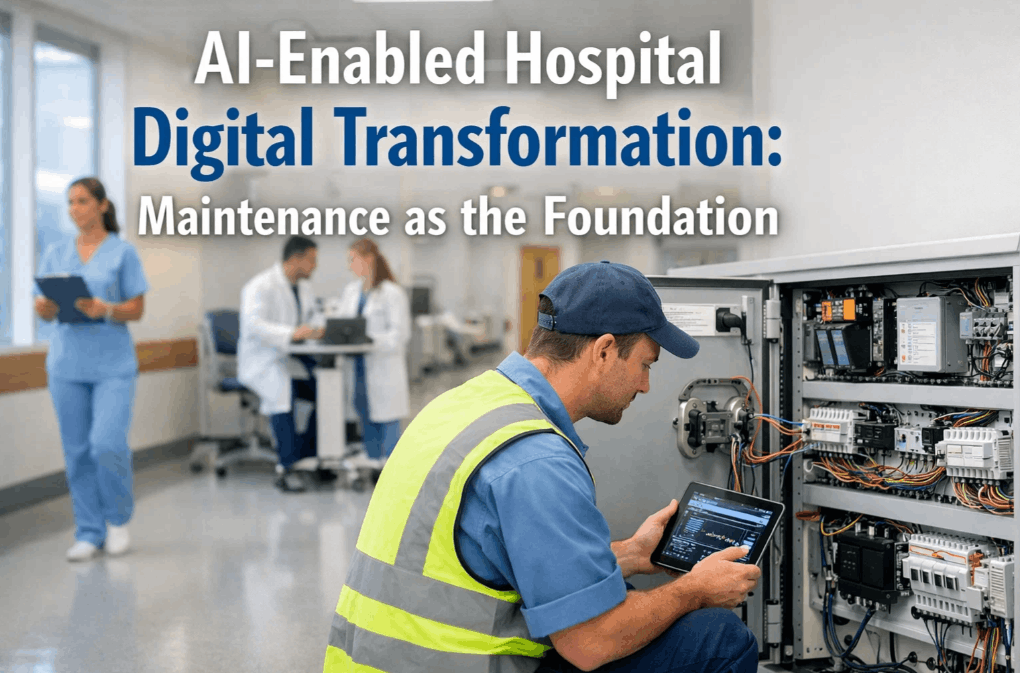
AI-powered maintenance in healthcare combines IoT sensor data, machine learning condition models, and automated workflow engines to shift hospital operations from reactive to predictive. Where traditional facility management relies on scheduled rounds, paper-based inspection logs, and technicians responding to failures already in progress, AI-powered platforms monitor equipment condition in real time, generate maintenance triggers before failure occurs, and produce fully documented audit trails without a single manual entry. The scope covers everything from HVAC and boiler plant to sterilizers, medical gas systems, elevators, and electrical infrastructure — the same critical systems that Joint Commission surveyors, CMS auditors, and local health authority inspectors examine in every review cycle. The operational gap between hospitals running on spreadsheets and those running on AI-integrated CMMS platforms is now measurable in patient safety outcomes, equipment uptime percentages, and maintenance cost per bed. To see how this works in your facility type and region, start a free trial and connect your first asset registry, or book a demo and our team will walk you through a live implementation relevant to your network.
The regulatory environment across every major healthcare market is accelerating adoption. US hospitals face OSHA 300 log requirements and Joint Commission Environment of Care standards. UK NHS trusts operate under HTM maintenance compliance frameworks. Australian hospital networks manage under ACHS accreditation. UAE facilities align to Vision 2030 smart building directives. German industrial safety laws apply to hospital plant with the same rigor as manufacturing. In every region, manual documentation cannot keep pace — and AI-integrated maintenance platforms are becoming the compliance baseline, not a competitive advantage.
AI moves beyond fixed-interval PM schedules by monitoring real condition data — triggering maintenance only when equipment signals it is needed, not when the calendar says it is due.
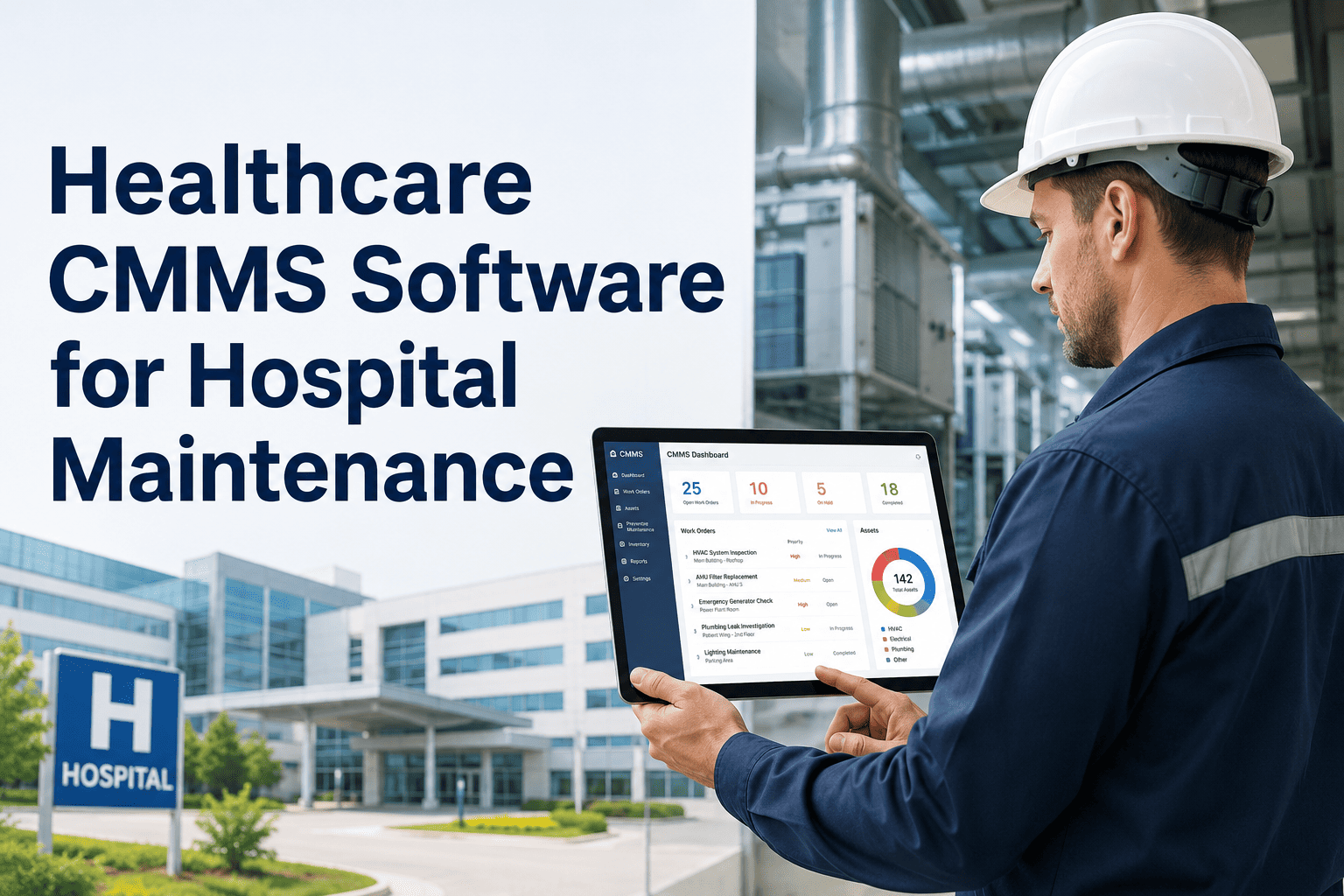
Each asset in the registry carries a live condition score updated by sensor readings, inspection results, and work order history — giving managers a live equipment health picture across every property.
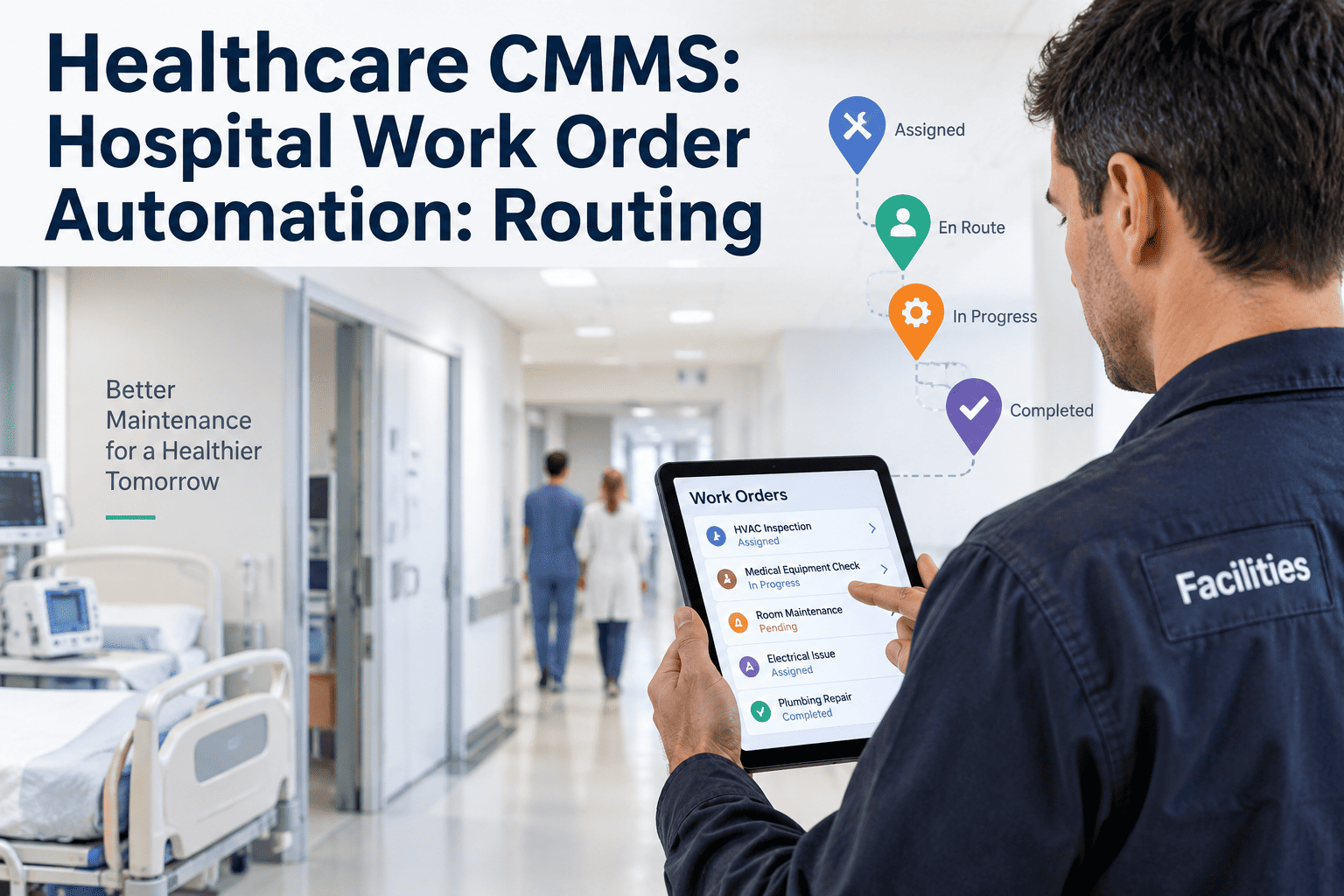
Condition breaches and IoT anomalies automatically create structured work orders assigned to the right technician — eliminating the verbal handoff, the email chain, and the documentation gap between detection and resolution.
Rolling condition histories build 5 to 10 year CapEx models based on actual asset degradation trends — replacing calendar-based budget guesses with investor-grade replacement forecasts for hospital leadership.
Healthcare networks managing multiple hospitals, clinics, and care facilities access a unified dashboard showing maintenance compliance, open work orders, and asset condition scores across every property simultaneously.
Every inspection, work order, and resolution carries digital signatures, timestamps, and technician attribution — producing a complete compliance record that surveyors can access on demand, not assembled under pressure.
How 8 Major Healthcare Markets Are Driving AI Maintenance Adoption
AI-powered maintenance adoption in healthcare is not uniform — each region is shaped by its regulatory environment, labor market, infrastructure age, and investment priorities. Understanding where your market sits in this adoption curve determines how urgently you need to act and what specific compliance pressures make the ROI case strongest.
Aging hospital infrastructure combined with CMS and Joint Commission audit frequency is accelerating CMMS adoption. Average US hospital facility management budget: $2.1M annually. AI maintenance ROI documented at 312% over 3 years in multi-hospital networks.
NHS trusts face a documented £11.6B maintenance backlog. HTM compliance frameworks for medical gas, HVAC, and fire safety systems require structured documentation that paper-based processes cannot sustain. AI CMMS adoption is becoming an NHS board-level priority.
UAE health authority directives under Vision 2030 explicitly require smart building integration for new and upgraded healthcare facilities. Hospital networks in Dubai and Abu Dhabi are deploying IoT-integrated CMMS as baseline infrastructure, not as an upgrade option.
Australia's healthcare labor market — among the world's most expensive — makes every avoided emergency repair a significant cost event. ACHS accreditation requirements add documentation pressure. Australian hospital networks report the fastest payback periods globally, averaging 11 months to full ROI.
German hospital maintenance operates under industrial safety law (BetrSichV) applied to medical equipment and building services with the same rigor as factory plant. Digital maintenance documentation is effectively mandatory. German hospital networks deploying AI CMMS report 44% fewer compliance incidents per audit cycle.
Canadian provincial health authorities operating multi-hospital portfolios are standardizing on AI CMMS platforms to achieve portfolio-level visibility across geographically distributed networks. Alberta Health Services and Ontario Health have both documented substantial maintenance cost reductions from preventive maintenance program modernization.
Singapore's Smart Nation initiative has made hospital AI infrastructure a national priority. SingHealth and National University Health System have deployed condition-based maintenance across flagship facilities, with results now being replicated across regional networks in Thailand, Malaysia, and Indonesia.
India's private hospital sector — Apollo, Fortis, Max Healthcare, and others — is deploying AI maintenance management as part of JCI accreditation and NABH compliance programs. With 500+ hospitals expanding their networks annually, multi-site CMMS adoption is growing faster in India than any other major market.
6 Operational Failures Holding Hospital Networks Back
These are not hypothetical risks. They are documented failure patterns reported by facility managers at hospitals across every major market — the same problems that AI-powered maintenance platforms have been specifically engineered to eliminate.
Without condition monitoring, the first signal of equipment failure is the failure itself — an HVAC unit down in a surgical suite, a sterilizer offline during morning caseload, or a medical gas pressure drop flagged by nursing staff. Each event triggers emergency response at 4.8x planned maintenance cost and carries patient safety exposure no incident report can fully address.
Joint Commission, CMS, and regional health authority surveys create multi-week documentation sprints for facilities relying on paper logs and spreadsheet records. 61% of hospital facilities managers report spending more than 40 hours preparing documentation for a single survey cycle — time drawn from active maintenance operations.
Portfolio managers overseeing multiple hospital campuses, outpatient facilities, and care centers have no real-time view of maintenance compliance or asset condition across properties without AI-integrated platforms. Risk accumulates invisibly across the portfolio until it surfaces as an incident or a failed survey.
Without condition-based asset lifecycle data, hospital capital planning relies on manufacturer age estimates and experience-based judgment. This produces either over-investment in assets with remaining service life or underinvestment in assets approaching failure — both of which impose costs that condition-based forecasting eliminates.
Hospital maintenance technicians in manual environments spend an average of 2.4 hours per shift on work order paperwork, verbal handoffs, and dispatch coordination. AI-automated work order creation and mobile dispatch eliminates this overhead entirely — returning that time to productive maintenance work.
Safety incident reports, security logs, and maintenance records stored in separate systems create blind spots that only become visible when an incident involves all three. AI-integrated platforms consolidate this data — providing the complete operational picture that manual processes fragment across departments and spreadsheets.
How Oxmaint Connects Global Healthcare Networks to AI-Powered Maintenance
Oxmaint is purpose-built for multi-site healthcare operations — combining full asset lifecycle management, condition-based maintenance scheduling, automated work order creation, and investor-grade reporting in a single platform that requires no heavy implementation and no lengthy onboarding. Whether you are managing a single 400-bed hospital or a 30-property healthcare portfolio, the operational model is the same. Want to see it for your network? Start a free trial today and run your first asset assessment, or book a demo and we will build a preliminary impact model using your facility data.
Every asset is registered in Oxmaint's hierarchy — Portfolio, Property, System, Asset, Component — with a live condition score updated by inspections, IoT data, and work order history. Facility managers see which assets are healthy, which are degrading, and which need immediate attention across every property simultaneously.
Preventive maintenance schedules are tied directly to asset condition scores and production metrics — not just calendar intervals. Maintenance triggers are generated by actual asset state, reducing unnecessary PM activities by up to 30% while preventing failures that fixed-interval schedules miss entirely.
IoT anomalies, inspection findings, and AI-detected condition breaches automatically generate structured work orders assigned to the correct technician based on asset type, location, and skill requirement. Zero manual handoff. Zero documentation gap. Every event tracked from detection to resolution.
Technicians access work orders, asset records, maintenance history, and digital checklists on mobile devices at the point of work. Completed tasks are documented in real time with photo capture, digital signatures, and timestamped entries — eliminating the paper-to-system transcription step entirely.
Every inspection, work order, and resolution is stored with full technician attribution, digital signatures, and timestamps — generating a complete audit trail for Joint Commission, CMS, HTM, ACHS, and local regulatory review. Surveys become evidence retrieval, not documentation reconstruction.
Condition data accumulated through ongoing monitoring feeds Oxmaint's CapEx models — producing rolling 5 to 10 year equipment replacement forecasts based on actual asset degradation curves, not manufacturer lifespan estimates. Hospital boards and ownership groups get investor-grade reporting out of the box.
Legacy Hospital Maintenance vs AI-Integrated Operations
The performance difference between a hospital running on manual maintenance processes and one running on an AI-integrated CMMS platform is not marginal. It is structural — measurable across every operational dimension from cost per repair to compliance survey outcomes. The following table compares these two operational states across eight critical dimensions relevant to global hospital networks.
| Operational Dimension | Legacy Manual Operations | AI-Integrated CMMS (Oxmaint) |
|---|---|---|
| Equipment Failure Detection | Detected at point of failure — reactive response only | Condition anomalies flagged 2 to 6 weeks before failure occurs |
| Maintenance Cost per Asset | Emergency repairs at 4.8x planned maintenance cost | Condition-triggered PM reduces cost per asset by up to 30% |
| Work Order Creation | Manual report, verbal handoff, delayed system entry | Automatic creation from IoT event — zero manual steps required |
| Compliance Audit Preparation | 40+ hours of manual document assembly per survey cycle | Audit-ready records available on demand — no preparation required |
| CapEx Budget Accuracy | Age-based estimates with 35 to 50% variance from actuals | Condition-based rolling forecasts within 8% variance from actuals |
| Multi-Site Visibility | No real-time cross-property view — siloed property reports | Unified portfolio dashboard across unlimited properties in real time |
| Technician Admin Overhead | 2.4 hours per shift on paperwork and dispatch coordination | Mobile-first workflow eliminates paperwork — full time returned to maintenance |
| IoT and Sensor Integration | Data exists in isolated systems with no maintenance connection | Native IoT and SCADA integration feeds condition scoring and PM triggers |
Real Results from Healthcare Networks Using AI-Powered Maintenance
These outcomes reflect published benchmarks and operational performance data from healthcare facilities that have deployed AI-integrated condition monitoring and CMMS platforms. The numbers represent measurable results, not projected estimates. If you want to model the specific ROI case for your hospital network, start a free trial and run your first asset condition baseline, or book a demo and we will build a preliminary impact model using your facility and asset data.
Frequently Asked Questions
How long does it take to deploy Oxmaint across a multi-hospital network?
Most single-facility deployments covering critical asset classes — HVAC, boiler plant, sterilizers, elevators, and medical gas — are fully operational within 4 to 6 weeks. Multi-site network deployments across 5 to 10 properties typically complete initial rollout within 8 to 12 weeks, with portfolio-level reporting available from the first property go-live. Oxmaint's onboarding process is designed for rapid deployment without heavy implementation fees or lengthy consulting engagements. The asset import, technician onboarding, and workflow configuration steps are completed through guided setup tools accessible to facility managers without IT support. Most healthcare networks report their first measurable outcomes — reduced emergency repair frequency, first compliance documentation cycle, and initial CapEx forecast — within 60 days of going live. To understand what deployment looks like for your specific network size and configuration, book a demo and our implementation team will walk through a timeline specific to your situation, or start a free trial and begin with your highest-priority facility immediately.
Does Oxmaint integrate with existing hospital IoT sensors and SCADA systems?
Oxmaint includes native IoT and SCADA integration capability — connecting directly to building management systems, sensor networks, and control systems already deployed in your facility. Supported integration types include API connections, direct data feeds from IoT middleware platforms, and condition threshold alerts from SCADA environments. When a connected sensor detects a condition anomaly — elevated HVAC vibration, irregular boiler pressure, abnormal electrical load on a distribution panel — Oxmaint receives that data and generates a condition-based work order automatically, assigned to the correct asset record and technician. For facilities that do not yet have IoT infrastructure, Oxmaint's condition scoring system works from digital inspection results and manual readings, progressively building the same predictive capability as sensor-fed data accumulates over time. The platform is designed to deliver value from day one regardless of existing IoT maturity level.
How does Oxmaint support Joint Commission and CMS compliance requirements specifically?
Oxmaint generates audit-ready documentation for every maintenance activity — inspections, work orders, PM completions, and condition events — with full technician attribution, digital signatures, and timestamps. Joint Commission Environment of Care standard documentation, CMS Conditions of Participation equipment management records, and OSHA 300 log supporting documentation are all produced automatically through normal platform operation. When a surveyor requests documentation, the retrieval takes seconds rather than days. The platform also supports customizable inspection checklists aligned to specific regulatory requirements, GMP compliance documentation for sterile processing environments, and digital equipment inspection records that satisfy the written documentation requirements in EC.02.05.01 through EC.02.05.09 Environment of Care standards. Surveyors across Joint Commission and CMS review cycles consistently respond positively to the completeness and organization of Oxmaint-generated documentation packages.
What is the ROI model for a mid-size hospital network adopting AI-powered maintenance?
The ROI model for a mid-size hospital network — typically defined as 3 to 8 facilities, 1,200 to 4,000 beds total, and an annual facilities management budget of $8M to $25M — typically generates positive ROI within 12 to 18 months of full deployment. The primary value drivers are maintenance cost avoidance from prevented emergency repairs (typically 18 to 24% of total maintenance spend), technician productivity recovery from eliminated administrative overhead (average 2.4 hours per technician per shift), and compliance cost reduction from eliminated survey preparation time (40 to 60 hours per survey cycle). CapEx forecast accuracy improvement generates additional value by preventing both premature equipment replacement and delayed replacement that results in failure. Networks in high-labor-cost markets — Australia, UK, UAE, and Canada — report the fastest payback periods, averaging 11 months. US hospital networks report 14 to 18 months to full payback, driven primarily by the maintenance cost avoidance component. For a preliminary ROI model specific to your network, book a demo and our team will build one using your facility and budget data.
Your Hospital Network. Your Assets. One Platform That Connects All of It.
Oxmaint delivers everything a healthcare facility manager needs to move from reactive to predictive — full asset registry with condition scoring, AI-triggered work orders, mobile-first technician dispatch, compliance documentation, and investor-grade CapEx forecasting. Built for single hospitals and multi-site portfolios alike. Deployed across healthcare networks in the US, UK, UAE, Australia, Canada, and beyond. No heavy implementation. No long onboarding. No spreadsheets.
Trusted by facility managers across 6 continents. No credit card required. 30-day free trial. Cancel anytime.