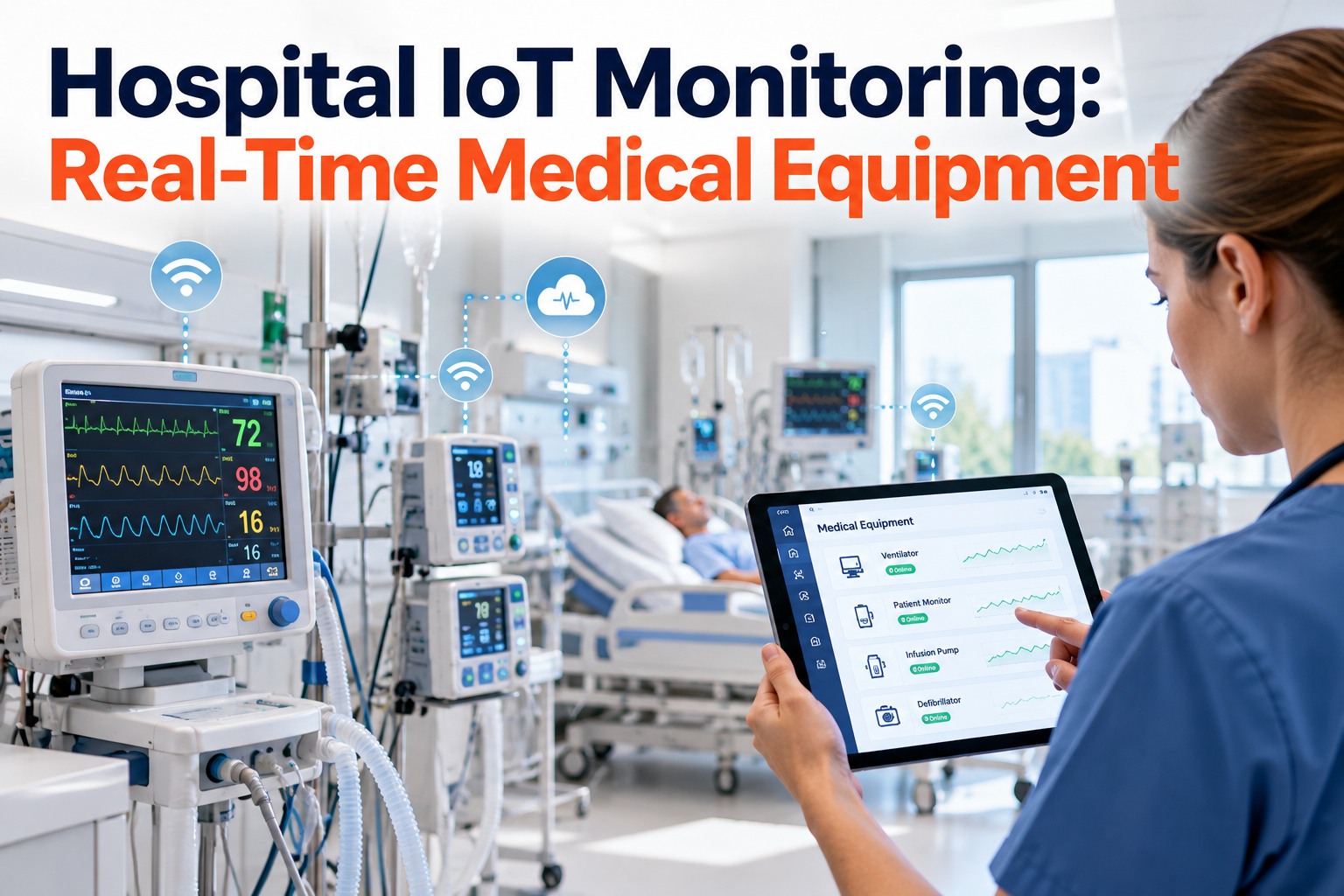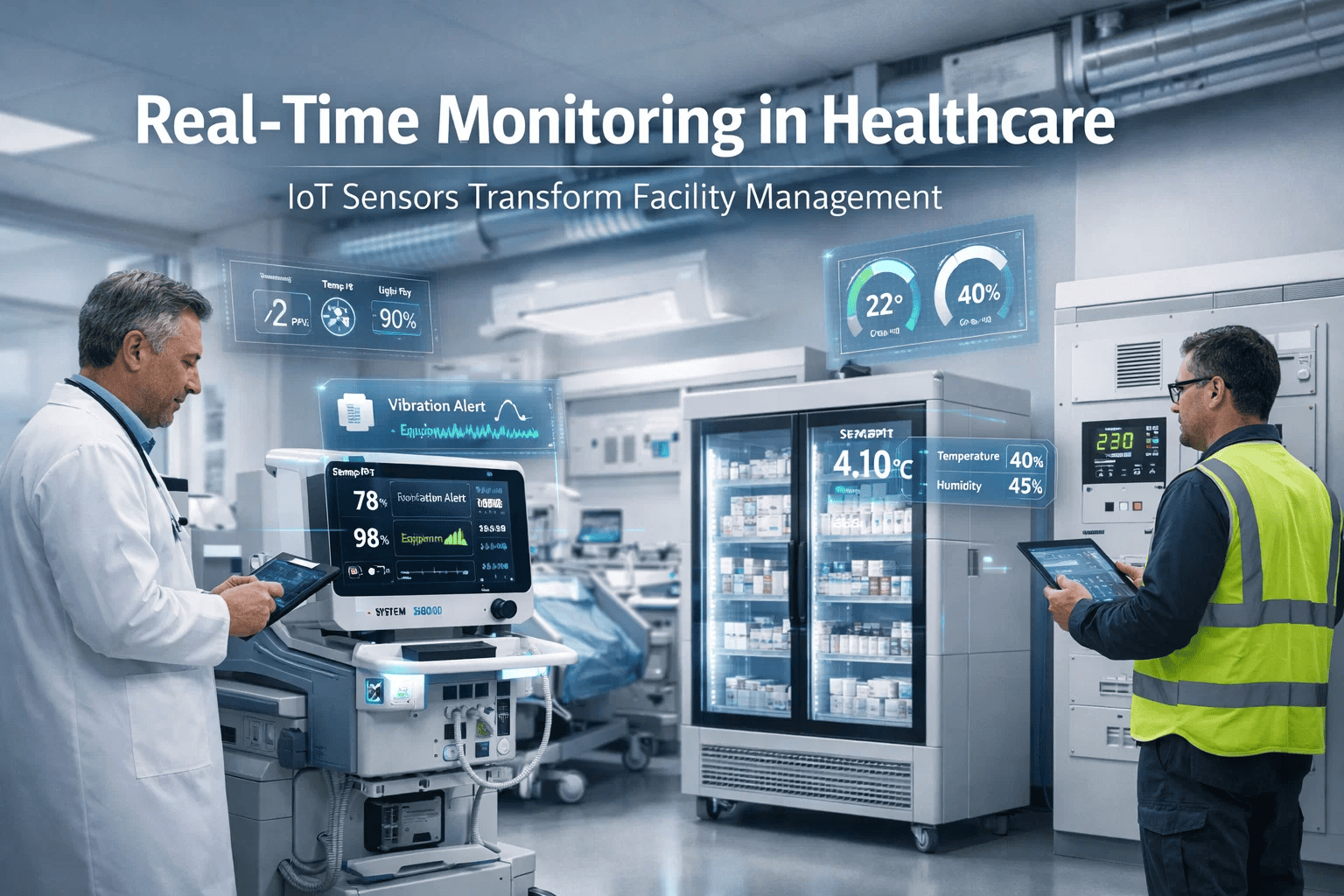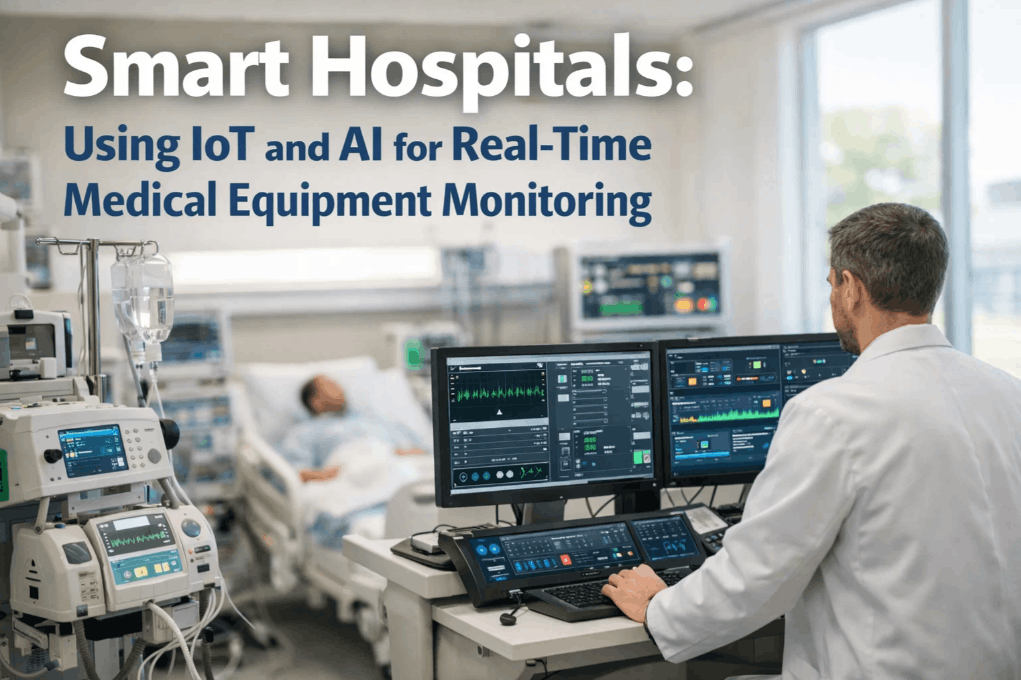
Modern hospitals are undergoing a profound transformation — one driven not by a single breakthrough, but by the convergence of two powerful technologies: the Internet of Things (IoT) and Artificial Intelligence (AI). Together, they are enabling a new category of healthcare infrastructure commonly called the smart hospital, where medical equipment is no longer passively maintained on a fixed schedule but actively monitored, analyzed, and managed in real time. This shift is reducing equipment failures, improving patient safety, and fundamentally changing how hospital operations teams approach asset management and clinical readiness. Sign up for OxMaint to start managing your medical equipment operations from a single connected platform.
Optimize Your Hospital Equipment Operations with AI
Ready to connect your medical equipment to a real-time monitoring and predictive maintenance platform? OxMaint gives hospital operations teams complete visibility across every asset — from imaging systems to life-support devices.
What Makes a Hospital "Smart"?
The term "smart hospital" describes a facility that uses digital technology — sensors, connected devices, data analytics, and AI — to automate and optimize its operational and clinical processes. While the concept extends across patient monitoring, building management, and supply chain logistics, the most impactful applications are centered on medical equipment: the ventilators, infusion pumps, imaging systems, sterilization units, and surgical tools that hospital care depends on every hour of every day.
In a traditionally managed hospital, equipment maintenance is reactive. Devices are serviced after they fail or on fixed preventive schedules that do not account for actual usage patterns or real-time condition data. In a smart hospital, every connected device generates continuous operational data that AI systems analyze to detect anomalies, predict failures, and trigger proactive maintenance — before clinical care is ever disrupted.
How IoT Sensors Enable Real-Time Equipment Monitoring
IoT-based medical equipment monitoring works by attaching or embedding sensors directly into devices — or leveraging sensors already built into modern equipment — to continuously capture operational parameters. These parameters vary by equipment type but commonly include power consumption, temperature, vibration signatures, cycle counts, fluid pressure, error code frequencies, and runtime hours. The sensor data streams in real time to a centralized cloud or on-premise monitoring platform where it is aggregated, normalized, and made available for analysis.
The architecture of a hospital IoT monitoring system typically consists of three layers: the edge layer (sensors and connected devices), the connectivity layer (hospital Wi-Fi, HL7 interfaces, or dedicated IoT gateways), and the analytics layer (the platform where AI processes the incoming data). Each layer must be designed with clinical-grade reliability and cybersecurity standards, as the devices being monitored are life-critical assets operating in regulated environments. Facilities ready to deploy this architecture can book a demo with OxMaint to explore how IoT monitoring integrates with existing hospital infrastructure.
Sensor Deployment and Device Connectivity
IoT sensors are installed on or integrated with medical equipment to capture real-time operational data — temperature, vibration, pressure, cycle counts, and error codes — and transmit it continuously to the monitoring platform.
Data Aggregation and Normalization
Raw sensor feeds from heterogeneous devices and manufacturers are aggregated into a unified data pipeline. Data normalization ensures that equipment from different vendors is analyzed on consistent parameters and comparable baselines.
AI Anomaly Detection and Pattern Analysis
Machine learning models analyze streaming equipment data against established performance baselines, identifying deviations that indicate degradation, early-stage failure, or calibration drift — often weeks before a device would fail under conventional monitoring.
Predictive Alert Generation
When AI models detect anomalous patterns that cross configurable risk thresholds, automated alerts are generated and routed to biomedical engineering teams, facilities managers, or clinical equipment coordinators — with contextual diagnostic detail, not just a generic notification.
Maintenance Execution and Loop Closure
Maintenance work orders are generated automatically in the CMMS, assigned to qualified technicians, and tracked through completion. Post-maintenance performance data is fed back into the AI model to refine future predictions and validate intervention effectiveness.
AI Analytics: Turning Equipment Data into Operational Intelligence
Raw sensor data alone does not make a hospital smart — it is the AI layer that transforms continuous data streams into actionable operational intelligence. Modern healthcare AI analytics platforms apply a range of techniques to medical equipment monitoring data, from simple threshold alerting to sophisticated machine learning models that detect multivariate failure signatures invisible to conventional monitoring systems.
The most operationally valuable AI capabilities in smart hospital equipment monitoring include the following areas, each of which addresses a distinct challenge in managing complex clinical asset portfolios:
Equipment Failure Prediction
AI models trained on historical failure data and real-time sensor feeds identify equipment approaching failure before symptoms are clinically apparent. Ventilators, infusion pumps, and anesthesia machines are among the highest-priority assets for predictive failure detection given their direct impact on patient safety.
Asset Utilization Optimization
AI platforms analyze how frequently and intensively equipment is used across departments, shifts, and locations — identifying underutilized assets that can be redeployed, overutilized devices at elevated failure risk, and capital investment patterns that can be optimized based on actual demand data.
Automated Calibration Drift Detection
Precision medical devices including patient monitors, laboratory analyzers, and imaging calibration phantoms require regular calibration verification. AI continuously monitors performance parameters and flags calibration drift before it affects measurement accuracy — replacing fixed-interval calibration checks with condition-based scheduling.
Power Consumption Anomaly Detection
Abnormal power draw patterns in medical equipment often precede mechanical or electrical failure. AI monitoring systems track energy consumption signatures and identify equipment consuming power outside normal operational envelopes, triggering investigation before critical failure occurs.
Condition-Based Service Scheduling
Rather than servicing equipment on calendar-based intervals, AI-driven condition monitoring schedules maintenance when actual device condition data indicates it is needed — extending equipment lifespan, reducing unnecessary service labor, and ensuring high-risk devices receive attention before failure rather than after.
Multi-Site Equipment Fleet Management
For health systems operating across multiple campuses, AI fleet analytics provide a consolidated view of equipment condition, utilization, and maintenance status across the entire asset portfolio — enabling centralized biomedical engineering teams to manage distributed equipment populations with consistent standards and visibility.
Critical Medical Equipment Categories Transformed by IoT Monitoring
While IoT monitoring can be applied broadly across hospital assets, the highest clinical return on investment comes from deploying connected monitoring on equipment where unplanned downtime or calibration failure carries direct patient safety consequences. The following equipment categories represent the primary targets for smart hospital IoT initiatives in 2024 and beyond. Sign up for OxMaint to connect real-time monitoring across all your critical device categories from one platform.
Operational Impact: What Smart Hospital Monitoring Delivers
The case for IoT and AI investment in hospital equipment monitoring is increasingly supported by measurable operational outcomes across early-adopter health systems. The following comparison illustrates the operational difference between traditional equipment management and AI-powered smart hospital monitoring across key performance dimensions.
| Operational Dimension | Traditional Management | Smart Hospital IoT + AI | Impact |
|---|---|---|---|
| Equipment failure detection | Post-failure or scheduled inspection | Continuous real-time anomaly detection | 40–60% fewer unplanned failures |
| Maintenance scheduling | Fixed calendar intervals | Condition-based dynamic scheduling | 25–35% reduction in maintenance cost |
| Equipment downtime | Reactive repair after failure | Proactive intervention before failure | 50%+ reduction in clinical downtime |
| Asset utilization visibility | Manual tracking or none | Real-time utilization dashboards | 15–20% improvement in asset ROI |
| Compliance documentation | Paper logs and manual records | Automated digital audit trails | Near-zero manual compliance overhead |
| Biomedical team efficiency | Reactive dispatch and manual rounds | Priority-ranked AI-generated work orders | 30–40% increase in technician productivity |
Integration Architecture: Connecting IoT, AI, and CMMS Platforms
Smart hospital equipment monitoring does not operate as a standalone system. Its full operational value is realized when IoT sensor data, AI analytics, and the hospital's Computerized Maintenance Management System (CMMS) are integrated into a unified operational platform. This integration creates a continuous data loop: sensors capture equipment condition, AI interprets condition data, the CMMS acts on AI-generated alerts, and post-maintenance data flows back to the AI system to improve future predictions.
Cybersecurity and Compliance Considerations for Connected Medical Devices
Deploying IoT sensors and AI analytics platforms in a hospital environment introduces cybersecurity and regulatory compliance considerations that must be addressed as part of any smart hospital technology initiative. Medical devices connected to hospital networks are subject to FDA cybersecurity guidance, HIPAA requirements for data that intersects with patient care records, and Joint Commission standards for medical equipment management.
Effective smart hospital IoT deployments address these requirements through network segmentation that isolates connected medical devices from general hospital IT infrastructure, end-to-end encryption of sensor data transmissions, role-based access controls within monitoring and CMMS platforms, audit logging that satisfies regulatory documentation requirements, and vendor management processes that ensure IoT platform partners maintain appropriate security certifications including SOC 2 Type II and ISO 27001. Hospital technology teams evaluating IoT monitoring platforms should require documented cybersecurity frameworks and evidence of regulatory compliance before deployment — not as an afterthought, but as a baseline procurement requirement.
Implementation Roadmap: Building a Smart Hospital Equipment Monitoring Program
Transitioning from traditional equipment management to a smart hospital IoT monitoring model is a multi-phase initiative that requires clinical, operational, and IT stakeholder alignment. Hospitals that approach implementation in structured phases — rather than attempting enterprise-wide deployment simultaneously — consistently achieve faster time to value and higher adoption rates among biomedical and facilities teams.
Asset Inventory and Priority Stratification
Begin with a complete medical equipment inventory that classifies devices by clinical criticality, replacement cost, failure frequency, and current maintenance cost. This stratification identifies the highest-priority assets for initial IoT monitoring deployment — typically life-support equipment, high-value imaging systems, and devices with historically high failure rates.
Platform Selection and Integration Planning
Select an IoT monitoring and CMMS platform that integrates with existing hospital information systems including the EMR, ERP, and any existing biomedical maintenance databases. Evaluate platforms on connectivity standards support, AI analytics maturity, cybersecurity certification, and implementation support methodology — not just feature lists.
Pilot Deployment and Baseline Establishment
Deploy IoT monitoring on a defined pilot cohort of high-priority assets — typically 50 to 150 devices across two or three equipment categories. Establish baseline performance metrics including current failure rates, maintenance costs, and downtime events. The pilot phase validates AI model accuracy against your specific device population before enterprise rollout.
Biomedical Team Training and Workflow Integration
Smart hospital technology delivers value only when biomedical engineering teams adopt AI-generated alerts as primary maintenance drivers rather than continuing to rely on legacy scheduling methods. Structured training, clear escalation protocols for AI alerts, and change management support are essential to achieving behavioral adoption alongside technical deployment.
Enterprise Rollout and Continuous Optimization
Scale IoT monitoring to the full equipment portfolio in phases, using pilot phase performance data to refine AI model thresholds, alert routing logic, and maintenance protocols. Establish quarterly performance reviews that compare AI prediction accuracy, maintenance cost trends, and equipment uptime against pre-implementation baselines to demonstrate ROI and drive continuous program improvement.
The Future of Smart Hospital Infrastructure
The smart hospital is not a destination — it is a continuously evolving operational model. As AI models grow more sophisticated, IoT sensor costs continue to fall, and hospital digital transformation programs mature, the scope of real-time equipment monitoring will expand from individual device health to integrated facility intelligence. Future smart hospital platforms will correlate equipment performance data with patient outcome data, environmental monitoring from building management systems, and supply chain availability to optimize care delivery across the entire hospital operating environment.
Hospitals that begin building connected equipment monitoring capabilities today are laying the foundation for this broader operational intelligence model. The clinical and financial case for IoT and AI investment in medical equipment management is already compelling — and it will only strengthen as healthcare systems face continued pressure to deliver higher acuity care with constrained capital and workforce resources. Book a demo with OxMaint to see how your facility can begin building this foundation today.
Connect Your Medical Equipment to Real-Time AI Monitoring
OxMaint brings IoT-powered predictive maintenance and AI-driven equipment analytics to hospital operations teams — connecting asset monitoring, work order management, and compliance documentation in a single platform built for healthcare environments. Join 1,000+ facilities managing smarter maintenance programs.
Frequently Asked Questions
What is IoT medical equipment monitoring in hospitals?
IoT medical equipment monitoring uses network-connected sensors to continuously capture operational data from clinical devices — including ventilators, infusion pumps, imaging systems, and sterilizers. This data streams to a centralized analytics platform where AI models analyze equipment condition in real time, detect anomalies, and generate predictive maintenance alerts before devices fail. The result is a shift from reactive, schedule-based maintenance to proactive, condition-driven equipment management.
How does AI predict medical equipment failures?
AI predictive failure models are trained on historical equipment performance data and labeled failure events to learn the sensor signatures that precede specific failure modes. When these models are applied to real-time IoT data streams, they compare current equipment behavior against known failure precursor patterns and generate risk-scored alerts when a device's operational profile indicates elevated failure probability — often days or weeks before the failure would manifest clinically.
Which medical equipment benefits most from IoT monitoring?
The highest clinical and financial return from IoT monitoring comes from life-critical equipment where failure has direct patient safety consequences — ventilators, infusion pumps, patient monitors, and anesthesia systems — and from high-capital assets where unplanned downtime is operationally disruptive, such as CT scanners, MRI systems, and surgical robots. Secondary priorities include sterilization equipment, laboratory analyzers, and any device with a historically high failure or recall rate in your facility.
How does smart hospital IoT monitoring integrate with existing CMMS systems?
Modern IoT monitoring platforms integrate with hospital CMMS systems through standard API connections, enabling AI-generated maintenance alerts to automatically create and assign work orders without manual dispatcher intervention. Completed maintenance data flows back to the monitoring platform to update equipment history records and refine AI failure prediction models. Platforms purpose-built for healthcare environments, such as OxMaint, are designed with this bidirectional integration as a core architectural feature rather than an add-on capability.
What are the cybersecurity requirements for connected medical devices?
Connected medical devices must comply with FDA cybersecurity guidance for networked medical devices, HIPAA requirements where device data intersects with patient information, and institutional IT security policies. Best practice implementations include network segmentation isolating medical IoT devices from general hospital networks, encrypted data transmission between sensors and analytics platforms, role-based access controls, and comprehensive audit logging. Hospitals should require vendors to provide evidence of SOC 2 Type II certification and documented FDA 510(k) compliance pathways for any device-connected monitoring platform.
What metrics should hospitals track to measure smart monitoring ROI?
The most meaningful ROI metrics for hospital IoT monitoring programs include unplanned equipment downtime events by device category (pre- and post-implementation), mean time between failures for monitored assets, total maintenance cost per device per year, biomedical technician labor hours spent on reactive versus proactive maintenance, and critical equipment availability rates across departments. Establishing pre-implementation baselines for these metrics before deploying IoT monitoring is essential for demonstrating measurable program value to hospital leadership and finance teams.