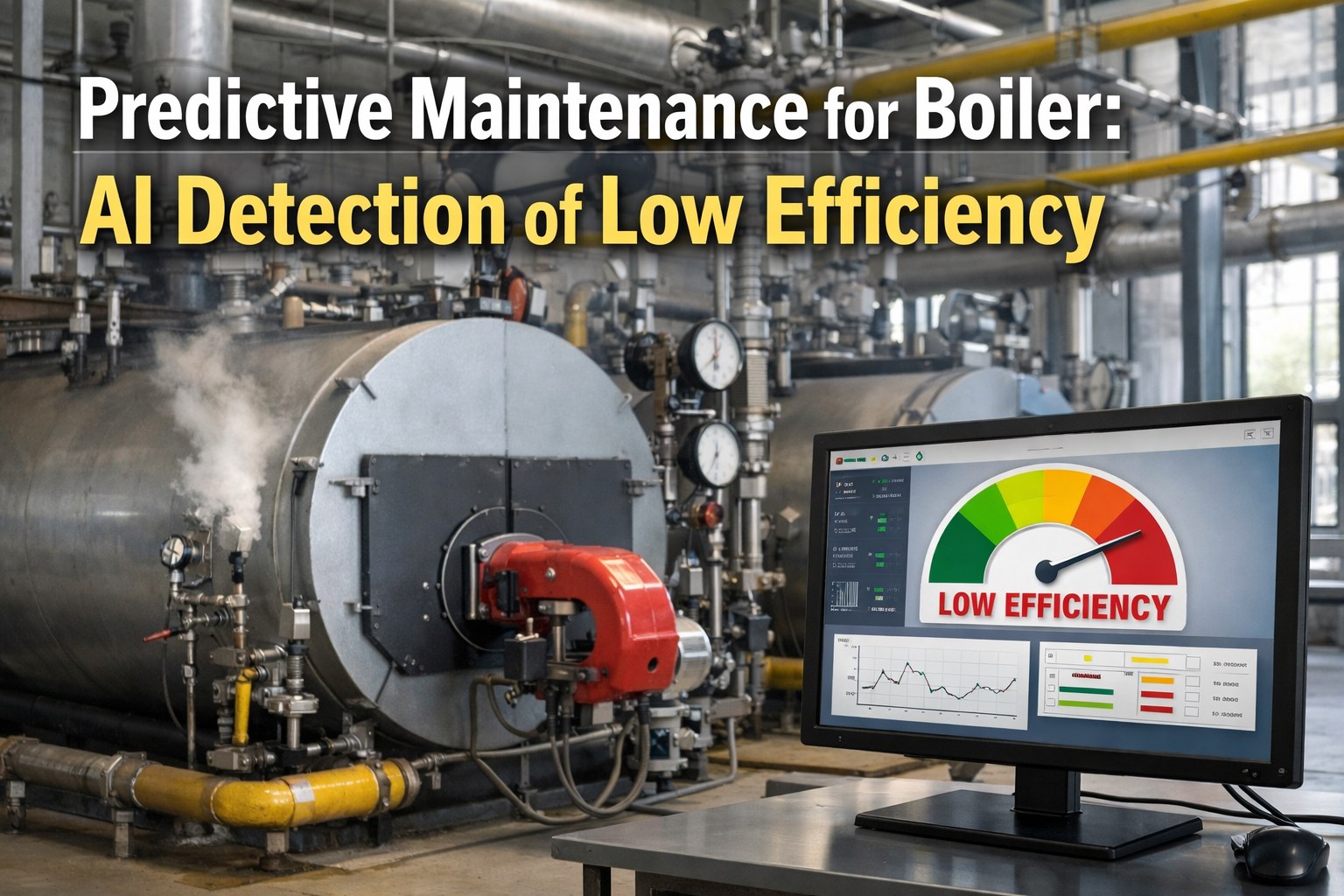
The plant engineer stared at the monthly utility report in disbelief—fuel costs had climbed 23% over the previous quarter despite identical production volumes. The facility's 15-year-old firetube boiler was consuming 847,000 therms annually when its rated efficiency should have required only 680,000 therms. Heat exchanger fouling had been building for 11 months. Combustion air ratios had drifted from optimal for 19 weeks. Economizer bypass dampers were partially stuck for 8 months. Nobody connected the dots. Annual excess fuel cost: $312,000. Deferred maintenance now required: $145,000. Carbon emissions penalty under new regulations: $67,000. An AI efficiency monitoring system would have detected the degradation pattern 9 months earlier—when a $28,000 combustion tune-up and cleaning would have maintained 84% efficiency instead of the current 67%.
Excess Fuel Costs
$200K-1M/yr
AI Prevents: 85%
Carbon Penalties
$50K-250K
AI Reduces: 80%
Deferred Repairs
3-5x Cost
AI Reduces: 70%
Steam Shortfalls
$75K-400K
AI Prevents: 90%
Equipment Life Loss
15-30%
AI Mitigates: 75%
78%
Of industrial boilers operate 8-15% below their rated efficiency due to undetected degradation
4-8 wks
Average detection window when AI monitors efficiency parameters continuously
94%
Accuracy rate for AI systems predicting efficiency degradation root causes
AI-powered predictive maintenance transforms boiler efficiency management from periodic manual audits to continuous intelligent optimization. Instead of discovering efficiency losses during annual tune-ups or when fuel bills spike—which often means months of wasted energy and accelerated wear—machine learning algorithms detect the subtle combustion, heat transfer, and operational patterns that signal developing efficiency problems weeks in advance. When facility teams implement AI-powered efficiency monitoring, they're not just preventing fuel waste—they're building the operational intelligence that maximizes steam production per dollar spent while extending equipment life and reducing emissions compliance risk.
How AI Detects Boiler Efficiency Degradation Before Energy Waste Compounds
Traditional boiler efficiency monitoring relies on periodic stack tests, annual combustion analyses, and monthly fuel-to-steam calculations—methods that only reveal problems after significant energy has been wasted. AI takes a fundamentally different approach: analyzing dozens of correlated variables including flue gas composition, heat exchanger temperature differentials, combustion air ratios, and steam production metrics to identify the conditions that cause efficiency degradation before losses become financially significant. This predictive capability provides weeks of advance warning instead of reactive discovery during routine audits.
1
Combustion Analysis
O2 Levels, CO Concentration, Excess Air Ratio, Flame Quality
Air-Fuel Ratio
Combustion Efficiency
Flame Stability
2
Heat Transfer Analysis
Stack Temperature, Approach Temperature, Delta-T Patterns
Fouling Index
Scale Detection
Transfer Rate
3
Fuel Consumption
Flow Rate, BTU Content, Fuel-to-Steam Ratio, Load Patterns
Specific Consumption
Load Efficiency
Cost per MMBtu
4
Steam Production
Steam Flow, Pressure, Quality, Condensate Return
Output Efficiency
Blowdown Rate
Steam Quality
5
Auxiliary Systems
Economizer Performance, Air Preheater, Feedwater Temperature
Heat Recovery
Preheater Efficiency
System Losses
6
Environmental Factors
Ambient Temperature, Humidity, Barometric Pressure, Load Cycles
Seasonal Baseline
Load Correlation
Weather Impact
The AI Detection Process: From Sensor Data to Efficiency Alert
Understanding how AI transforms raw boiler operating data into actionable efficiency intelligence helps facility teams evaluate and implement predictive systems. The process runs continuously, analyzing thousands of data points every minute to identify developing efficiency degradation invisible to traditional periodic testing. When your team can see how AI detection works on your boiler systems, the potential for preventing energy waste becomes immediately clear.
1
Continuous Data Capture
IoT sensors stream combustion gases, temperatures, pressures, flow rates, and fuel consumption data every 15-30 seconds
2
Dynamic Baseline Calculation
AI calculates expected efficiency based on current load, ambient conditions, fuel quality, and equipment age factors
3
Deviation Analysis
Machine learning identifies efficiency gaps between actual and expected performance, filtering normal variations from concerning trends
4
Root Cause Identification
AI determines probable cause—fouling, combustion drift, air leaks, scale buildup, or mechanical wear—with system location
Discover What's Draining Your Boiler Efficiency
AI-powered monitoring detects efficiency degradation weeks before it shows up on fuel bills. Find out what predictive analytics would reveal about your boiler's true performance.
Common Boiler Efficiency Loss Causes: What AI Detects Early
Boiler efficiency doesn't drop suddenly—it degrades through specific mechanisms that AI can identify weeks before losses become financially significant. Understanding these patterns helps facility teams appreciate why AI monitoring succeeds where traditional periodic testing fails. Each efficiency loss mode has distinct signatures that machine learning recognizes from historical data across thousands of boiler installations worldwide.
AI Detection Signals: Rising stack temperatures, increased approach temperature differentials, declining heat transfer coefficients, elevated flue gas exit temperatures, reduced steam output per fuel unit
6-10 weeks advance warning
AI Detection Signals: Elevated O2 levels in flue gas, excess air ratio drift, CO concentration spikes, flame pattern instability, fuel-air ratio deviations from optimal curves
4-8 weeks advance warning
AI Detection Signals: Water-side temperature anomalies, increased fuel consumption per steam pound, conductivity and TDS trends, blowdown frequency changes, localized hot spots
8-14 weeks advance warning
AI Detection Signals: Modulation curve deviations, firing rate inconsistencies, linkage wear patterns, damper position anomalies, control valve response degradation
3-6 weeks advance warning
Traditional Monitoring vs. AI Predictive Efficiency Detection
The fundamental difference between traditional efficiency monitoring and AI predictive monitoring is timing and granularity. Traditional methods tell you efficiency has dropped; AI tells you efficiency is beginning to degrade and why. This shift from reactive to predictive changes everything about how facilities optimize their fuel consumption and maintain peak performance. DOE studies confirm that continuous efficiency monitoring can reduce fuel costs by 5-15% annually. Properties ready to see the difference can create a free account and start monitoring immediately.
Detection Timing:
During annual tune-up or audit
Warning Time:
Zero - losses already accumulated
Root Cause:
Manual diagnosis required
Cost Impact:
Unknown until bill analysis
Optimization:
Periodic, reactive adjustments
Detection Timing:
Real-time deviation detection
Warning Time:
4-14 weeks advance notice
Root Cause:
AI-identified degradation source
Cost Impact:
Real-time waste quantification
Optimization:
Continuous auto-recommendations
12-18%
fuel cost reduction
85%
fewer efficiency losses
Implementation Lifecycle: From Pilot to Full Deployment
Successful AI boiler efficiency monitoring implementations follow a proven lifecycle—starting with baseline establishment, progressing through algorithm training, and culminating in fully automated efficiency optimization. This phased approach validates savings, builds internal expertise, and ensures the AI system learns your specific boiler characteristics, fuel types, load patterns, and seasonal variations before making critical recommendations.
Baseline
Sensor deployment, Data collection, Efficiency mapping, Load profiling
Calibration
AI model training, Seasonal adjustment, Fuel normalization, Threshold setting
Validation
Prediction testing, Alert verification, Operator feedback, Model tuning
Automation
CMMS integration, Auto work orders, Dashboard deployment, Report automation
Optimization
Continuous improvement, Fleet expansion, ROI tracking, Benchmark reporting
ROI: What Facilities Actually Achieve with AI Efficiency Monitoring
The business case for AI-powered boiler efficiency monitoring extends far beyond fuel savings. Avoided carbon penalties, extended equipment life, reduced maintenance costs, improved steam reliability, and optimized operations all contribute to ROI. Properties that receive customized ROI projections based on their boiler inventory, fuel costs, production requirements, and current efficiency baselines.
Weeks 1-4
Baseline & Training
Sensor deployment, Data collection, AI learning operational patterns and efficiency curves
Foundation building
Months 2-3
Quick Wins
First efficiency alerts, Combustion optimization, Low-hanging fruit identified
8-12% savings begin
Months 4-6
Full Optimization
Mature AI models, Predictive maintenance scheduling, Comprehensive monitoring
12-18% savings
Year 1+
Sustained Value
Continuous optimization, Life extension, Zero efficiency surprises
15-20% sustained
Typical Payback Period
2-4 Months
Expert Perspective: Why AI Succeeds Where Traditional Monitoring Fails
Industry Insight
"Boiler efficiency doesn't degrade linearly—it cascades. A small combustion drift causes slightly elevated stack temperatures, which accelerates fouling, which raises temperatures further, which stresses refractory, which affects flame patterns. By the time your annual tune-up catches the 8% efficiency loss, you've been bleeding fuel dollars for nine months and created three additional maintenance problems. AI monitoring catches that initial combustion drift in week two—when a $2,000 adjustment prevents $200,000 in annual fuel waste and $50,000 in accelerated wear. The facilities hitting 88%+ sustained efficiency aren't running better boilers—they're running smarter monitoring."
— Senior Energy Engineer, CEM, 25 years industrial boiler optimization experience
Multi-Variable Correlation
AI correlates combustion, heat transfer, and steam production data to identify efficiency degradation patterns invisible to any single measurement.
Dynamic Baseline Adjustment
Machine learning adjusts expected efficiency for load, ambient conditions, and fuel quality—eliminating false alarms while catching real degradation.
Cost Impact Quantification
AI calculates real-time fuel waste in dollars, enabling maintenance prioritization based on financial impact rather than arbitrary thresholds.
Implementation Requirements: What AI Efficiency Monitoring Needs
AI boiler efficiency monitoring builds on existing infrastructure where possible but requires specific technical foundations for accurate degradation prediction and optimization recommendations. Understanding these requirements helps facility teams evaluate implementation feasibility and plan integration strategically while maximizing return on investment.
Flue gas analyzers, Temperature sensors, Flow meters, Pressure transmitters, Fuel meters
Comprehensive efficiency data
Industrial gateway, Edge computing, Cloud connection, Secure transmission, Data logging
Real-time data streaming
Cloud AI platform, Efficiency models, CMMS integration, Mobile dashboards, Reporting suite
Predictive optimization
Stop Losing Money to Silent Efficiency Degradation
Oxmaint's AI-powered efficiency monitoring gives facility teams 4-14 weeks advance warning before efficiency losses compound. Protect your fuel budget, protect your equipment, protect your emissions compliance.
Frequently Asked Questions
How accurately can AI predict boiler efficiency degradation?
Modern AI predictive maintenance systems achieve 91-96% accuracy in detecting conditions that lead to boiler efficiency degradation 4-14 weeks before losses become financially significant. This compares to essentially 0% predictive capability from traditional periodic testing, which only reveals problems after fuel has been wasted for months. Accuracy improves continuously as AI learns your specific boiler characteristics, fuel types, load patterns, and seasonal variations. The key is comprehensive sensor integration—systems monitoring combustion gases, temperatures, pressures, and flows achieve the highest accuracy by correlating multiple efficiency indicators.
What efficiency problems can AI detect before they increase fuel costs?
AI excels at detecting the gradual degradation mechanisms that reduce efficiency: heat exchanger fouling (35-45% of cases), combustion air imbalance (25-35%), scale and deposit buildup (15-20%), and burner/control drift (10-15%). Each has distinct signatures—fouling shows as rising stack temperatures and declining heat transfer, combustion issues appear as O2 and CO deviations, scale correlates with water chemistry and temperature anomalies. Traditional annual tune-ups only catch these after months of waste; AI catches them at onset when correction costs are minimal.
How much can AI efficiency monitoring actually save on fuel costs?
Facilities implementing comprehensive AI efficiency monitoring typically achieve 12-20% fuel cost reduction within the first year, with some achieving 25%+ when starting from significantly degraded baselines. For a facility spending $500,000 annually on boiler fuel, this translates to $60,000-100,000+ in annual savings. Implementation costs typically recover within 2-4 months through fuel savings alone, with additional value from avoided carbon penalties, extended equipment life, and reduced emergency repairs. The ROI accelerates with higher fuel costs and larger boiler installations.
Does AI efficiency monitoring help with emissions compliance and carbon reporting?
Yes—AI efficiency monitoring directly supports emissions compliance by maintaining optimal combustion, which minimizes NOx, CO, and CO2 per unit of steam produced. The system automatically tracks and reports efficiency metrics required for EPA, state environmental agencies, and corporate sustainability programs. Many facilities use AI monitoring data for carbon footprint calculations, emissions trading documentation, and sustainability certifications. The continuous monitoring provides audit-ready documentation that periodic testing cannot match.
Will AI monitoring work with my existing boiler controls and BMS systems?
Yes—AI efficiency monitoring platforms are designed to integrate with boiler controls and building management systems from all major manufacturers including Honeywell, Siemens, Johnson Controls, Cleaver-Brooks, and others. The AI operates as an analytics layer above existing systems, enhancing monitoring without replacing controls or affecting safety systems. Modern platforms use standard protocols (BACnet, Modbus, OPC) and can pull data from existing sensors where available, minimizing additional hardware requirements. The system provides recommendations through your existing interfaces and can integrate with CMMS platforms for automated work order generation.
Ready to Maximize Your Boiler Efficiency with AI?
Join thousands of facility managers using Oxmaint to detect efficiency degradation weeks in advance. Start optimizing your fuel consumption and protecting your bottom line today.