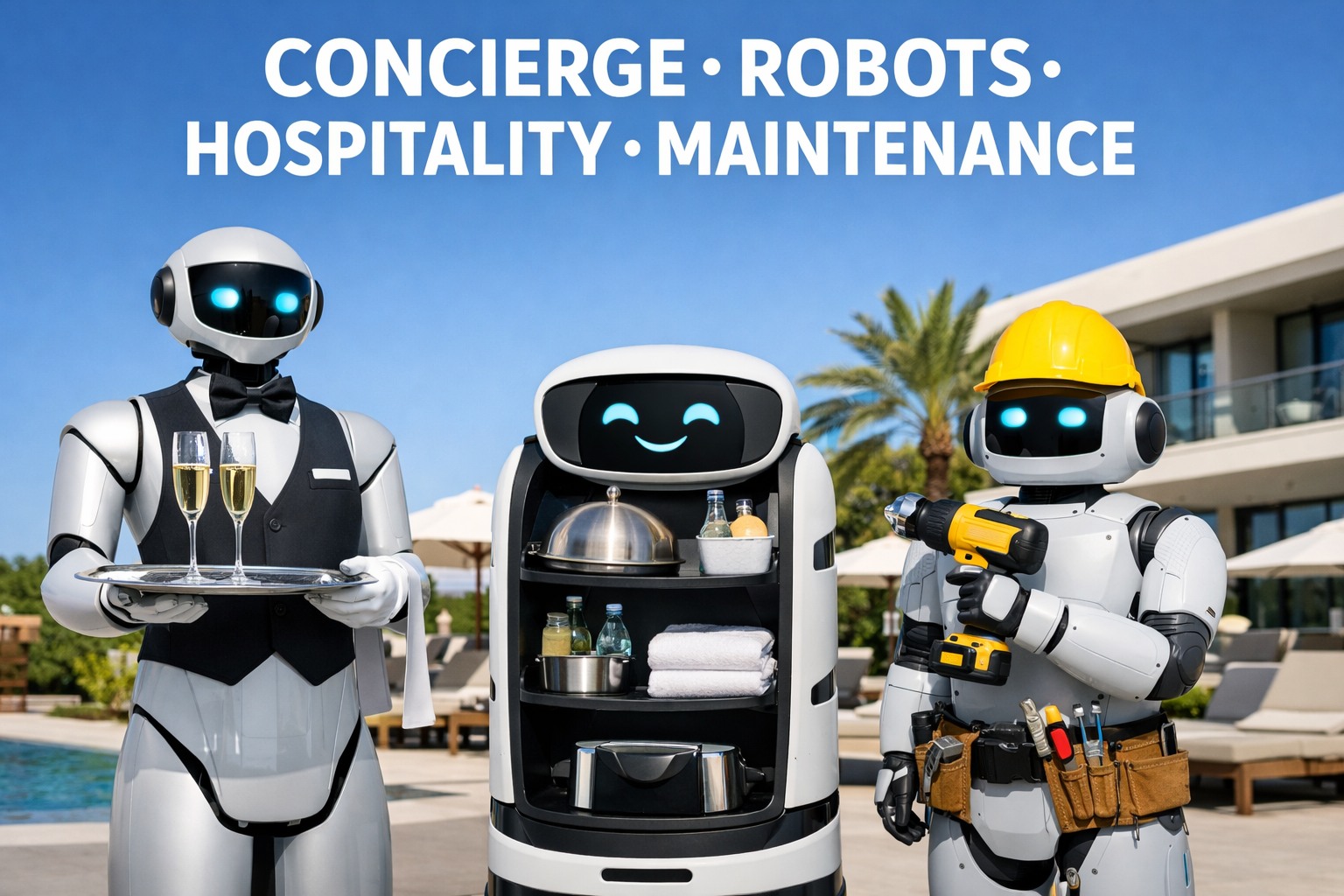
Concierge Robots in Hospitality: Maintenance & Guest Experience

By Angelina Joile on February 21, 2026

concierge-robots-hospitality-maintenance

The lobby of a 420-room convention hotel in Orlando averaged 47 guests waiting at the front desk during peak check-in hours—3:00 to 5:00 PM daily. The concierge team of three couldn't keep up. Guests needing restaurant recommendations, directions to the pool, WiFi passwords, shuttle schedules, and local attraction information competed for attention with check-in queues, luggage inquiries, and complaint resolution. Average wait time for a simple concierge question: 11 minutes. Guest satisfaction for "staff responsiveness" on post-stay surveys: 64%. The hotel deployed two AI-powered concierge robots in the lobby and one at the pool entrance—handling wayfinding, FAQ responses, restaurant recommendations, local attraction information, and multilingual guest greetings in 30+ languages simultaneously. Within 60 days, the robots handled 58% of routine guest inquiries autonomously, average wait time for concierge questions dropped to under 90 seconds, and the human concierge team was freed to focus on complex requests, VIP handling, and the personalized interactions that actually drive loyalty. Guest satisfaction for responsiveness jumped to 89%. But the robots themselves needed a maintenance program nobody planned for—touchscreen calibration drifting after 10,000+ daily interactions, microphone arrays degrading in noisy lobby environments, wheel motors wearing from 16-hour daily operation on marble floors, and battery capacity dropping 20% within six months without optimized charge cycling. Hotels that implement CMMS-based concierge robot maintenance tracking ensure these guest-facing systems maintain the reliability that drives satisfaction scores—because a concierge robot displaying error screens in your lobby creates worse impressions than no robot at all.

Concierge Robot Impact on Hotel Guest Experience
How AI-powered concierge systems transform lobby operations and guest satisfaction
Guest Experience Transformation
90-Second Response
30+ Languages
89% Satisfaction
AI Concierge Service Capabilities
Wayfinding
Recommendations
Check-In Assist
Multilingual NLP
Robot Hardware Maintenance & Fleet Reliability
Touchscreen
Microphone Array
Battery Health
Drive System
CMMS Tracking

Concierge Robot Platforms Deployed in Hotels

The concierge robot market has matured from novelty to operational necessity as 67% of hotels report persistent staffing shortages and 72% cannot fill open positions. Modern AI concierge systems combine natural language processing, facial expression recognition, guest preference integration through PMS connectivity, and multilingual capability that no single human concierge can match. Properties evaluating concierge robot deployment can schedule a fleet integration consultation to model staffing impact and maintenance requirements before purchase.

Leading Concierge Robot Platforms for Hotels
Capabilities, deployment examples, and maintenance requirements by platform
01
SoftBank Pepper
Function: Guest greeting, FAQ responses, emotion recognition, check-in assistance, entertainment interaction
Languages: 20+ with real-time NLP processing
Deployed: Henn-na Hotel Japan, Marriott properties, Mandarin Oriental—handles 40-60% of routine inquiries
Humanoid form, facial/emotion recognition, tablet chest display, 12-hr battery, 4 directional mics
02
Hilton Connie (IBM Watson)
Function: Local attraction info, restaurant recommendations, hotel amenity guidance, personalized suggestions
AI Engine: IBM Watson NLP with continuous learning
Pioneer: First major chain concierge robot—learns from every interaction, improves recommendations over time
Watson AI backbone, speech recognition, context awareness, guest interaction logging, PMS integration
03
LG CLOi GuideBot
Function: Lobby wayfinding, property tours, event guidance, promotional content, interactive directory
Display: Large touchscreen with interactive maps and media
Best for: Large convention hotels and resorts with complex wayfinding needs across multiple buildings
Autonomous navigation, SLAM mapping, obstacle avoidance, scheduled route patrols, content management
04
Temi Personal Robot
Function: Guest escort to rooms/facilities, video concierge, telepresence for remote staff, mobile info point
Mobility: Autonomous navigation with escort capability
Unique: Physically escorts guests to destinations—spa, restaurant, meeting rooms—eliminating verbal directions
LiDAR+SLAM navigation, 10-inch touchscreen, 8-hr battery, telepresence video, app-controlled
05
Keenon Dinerbot T10
Function: Hybrid concierge-delivery—greets guests, answers questions, then delivers amenities to rooms
Dual Role: Concierge + delivery in single platform
Cost-efficient: Combines two robot functions, elevator integration via KONE/Otis API, 10+ hr runtime
Dual SLAM navigation, multi-tray delivery, voice interaction, PMS integration, fleet management platform
06
Sony Aibo Companion
Function: Guest entertainment, emotional engagement, lobby ambiance, brand differentiation, social media driver
Engagement: Learns guest preferences, adapts personality over time
Social impact: 40%+ increase in guest-generated social media content featuring robot interactions
AI personality engine, camera sensors, OLED eyes, touch sensors, 2-hr active battery, charging dock
Your Concierge Robot Is Your Lobby's First Impression
OXmaint tracks every concierge robot in your fleet—touchscreen calibration, microphone health, battery cycle optimization, drive motor wear, software updates, and interaction performance metrics—ensuring your guest-facing AI never displays error screens when it matters most.

Guest Experience: Concierge Robot vs. Traditional Service

Performance Metrics Across Guest Interaction Points
Data from hotel concierge robot deployments at major chains worldwide
Average Wait for Concierge Response
AI Concierge Robot

< 90 sec
Human Concierge (Off-Peak)

4-5 min
Human Concierge (Peak Check-In)

11-18 min
Robots eliminate wait times entirely—guests walk up and interact immediately, even during peak hours
Routine Inquiry Resolution Rate
AI Robot (FAQs, directions, recs)

85%
Human Concierge (all inquiry types)

97%
Robots handle 85% of volume (simple queries) so humans focus on the 15% requiring empathy and judgment
Language Capability
AI Concierge Robot

30-40 languages
Typical Concierge Team

2-4 languages
International resorts see highest ROI—robot handles every language without multilingual hiring challenges
Guest Social Media Impact
Properties with Concierge Robots

+40% UGC
Properties without Robots

Baseline
Guests photograph and share robot interactions—free marketing that drives booking curiosity

Concierge Robot Maintenance: What Keeps Them Guest-Ready

Critical Concierge Robot PM Requirements
CMMS-tracked maintenance for guest-facing AI systems that must never fail publicly

Touchscreen & Display
PM Frequency
Daily clean, weekly calibration check
Key Metrics
Touch accuracy, brightness, dead pixels
Failure Impact
Unresponsive screen in lobby—worst optics
Lifespan
3-5 years; recalibrate every 10K touches
Touchscreens are the primary guest interface—calibration drift after 10,000+ daily interactions causes frustration

Microphone & Speaker Array
PM Frequency
Weekly audio test, monthly calibration
Key Metrics
Speech recognition accuracy, noise floor
Failure Impact
Robot can't understand guests—defeats purpose
Environment Factor
Noisy lobbies degrade mic performance 30%
Lobby ambient noise (65-75 dB) degrades speech recognition—noise-cancellation firmware updates are critical

Battery & Power System
PM Frequency
Weekly health check, quarterly deep test
Key Metrics
Capacity %, charge cycles, cell balance
Failure Impact
Robot dies mid-interaction—guest frustration
Lifespan
18-24 months with optimized cycling
Concierge robots run 12-16 hours daily—battery degradation is the #1 cause of midday downtime

Drive System & Mobility
PM Frequency
Monthly wheel check, quarterly motor test
Key Metrics
Wheel tread, motor current, bearing noise
Failure Impact
Immobile robot blocking lobby traffic
Surface Factor
Marble floors = 2x wheel wear vs. carpet
Lobby robots travel 3-8 miles daily on hard surfaces—wheel replacement timing depends on floor material

AI Software & NLP Engine
PM Frequency
Monthly firmware, weekly knowledge update
Key Metrics
Intent accuracy, response relevance, uptime
Failure Impact
Wrong answers, outdated info, confused guests
Content Refresh
Restaurant hours, events, promos—weekly
Outdated restaurant hours or wrong event info damages credibility—content updates are maintenance tasks

Camera & Facial Recognition
PM Frequency
Weekly lens clean, monthly alignment check
Key Metrics
Recognition accuracy, response latency
Failure Impact
Can't identify returning guests, lost personalization
Privacy Compliance
GDPR/CCPA audit quarterly
Facial recognition enables "Welcome back" greetings—dirty lenses or misaligned cameras break the magic

Expert Analysis: Concierge Robotics in Practice

Industry Perspective
Where Concierge Robots Create Value vs. Where They Fail

"We deployed Pepper in our lobby expecting it to be a novelty that wore off in weeks. Eighteen months later, it handles 840 guest interactions daily—WiFi passwords, restaurant hours, pool directions, spa bookings, and local attraction recommendations in 28 languages. Our human concierge team went from answering the same 15 questions 200 times a day to focusing exclusively on VIP experiences, complex itineraries, and the relationship-building that drives our loyalty program enrollment. But the maintenance learning curve was steep. The touchscreen drifted twice before we caught it. The microphones needed recalibration for our lobby's acoustics. Battery capacity dropped 22% in five months because we weren't managing charge cycles. Once we put Pepper into our CMMS with scheduled PM tasks—daily screen cleaning, weekly mic testing, monthly battery health checks—uptime hit 97.8% and we haven't had a public failure since."

Volume Handler, Not Human Replacement
Concierge robots excel at absorbing the 85% of interactions that are repetitive FAQs—freeing human staff for the 15% that require empathy, creative problem-solving, and the personal touch that builds loyalty and drives upsells.
Maintenance Makes or Breaks ROI
Properties with CMMS-tracked robot PM achieve 97-98% uptime. Properties without maintenance programs average 70-80%—meaning their $40,000 concierge robot sits broken in the lobby 20-30% of the time, creating negative impressions.
The Marketing Value Is Real
85% of guests rate robot interactions positively. Properties report 40% more guest-generated social media content. Some hotels see guests booking specifically to experience the robot—turning a service tool into a marketing asset.
A Broken Concierge Robot in Your Lobby Is Worse Than No Robot at All
OXmaint ensures every guest-facing robot maintains the reliability your brand demands—touchscreen calibration tracking, microphone health monitoring, battery cycle optimization, drive system wear alerts, AI content freshness audits, and facial recognition accuracy verification—all automated through preventive maintenance work orders.

Frequently Asked Questions

What do concierge robots do in hotels?
Concierge robots serve as AI-powered guest interaction points that handle routine inquiries autonomously—providing wayfinding directions, restaurant and attraction recommendations, hotel amenity information, WiFi credentials, shuttle schedules, event details, and multilingual support in 20-40 languages simultaneously. Advanced models like SoftBank Pepper incorporate facial expression recognition to detect guest mood and adjust responses, while platforms like Hilton's Connie (powered by IBM Watson) learn from every interaction to improve recommendation quality over time. Hybrid models like Keenon Dinerbot T10 combine concierge functions with delivery capability, greeting guests and then physically delivering requested items. Hotels deploying concierge robots report handling 40-60% of routine guest inquiries without human involvement, reducing front desk queue times 35% and freeing concierge staff for complex requests that require empathy and creative problem-solving.
How much do concierge robots cost for hotels?
Concierge robot platforms range from $15,000-$60,000 per unit depending on capabilities. SoftBank Pepper units cost $25,000-$35,000 purchased or $800-$1,500 monthly leased. LG CLOi GuideBots run $20,000-$40,000. Temi robots start around $15,000-$20,000 for basic models. Lease programs including manufacturer maintenance are increasingly popular at $1,000-$2,500 per robot monthly. A typical lobby deployment of 2-3 concierge robots costs $50,000-$120,000 purchased or $24,000-$90,000 annually leased. ROI comes from three sources: reduced concierge staffing requirements during peak periods ($45,000-$80,000 annually), increased guest satisfaction driving rebooking revenue, and social media marketing value from guest-generated robot interaction content. Most hotels achieve payback within 8-14 months—faster at international properties where multilingual capability replaces the cost of hiring polyglot staff.
What maintenance do concierge robots need?
Concierge robots require structured maintenance across six critical systems: touchscreen displays (daily cleaning, weekly calibration—10,000+ daily touches cause drift), microphone and speaker arrays (weekly audio quality testing, monthly noise-cancellation calibration for lobby acoustics), batteries (weekly health monitoring, optimized charge cycling—18-24 month replacement cycle), drive motors and wheels (monthly tread inspection, quarterly motor testing—marble floors double wheel wear versus carpet), AI software and knowledge base (monthly firmware updates, weekly content refresh for restaurant hours, events, and promotions), and cameras/facial recognition (weekly lens cleaning, monthly alignment verification, quarterly privacy compliance audit). CMMS platforms like OXmaint automate PM work orders for all maintenance tasks, track component lifecycles, and flag degradation before it causes a public-facing failure.
Do guests actually like interacting with concierge robots?
Guest reception is overwhelmingly positive—85% of hotel guests rate concierge robot interactions favorably, with highest satisfaction among the 25-40 age demographic. Properties report 40% increases in guest-generated social media content featuring robot interactions, with some hotels noting that guests book specifically to experience the technology. The key insight is that guest satisfaction depends on robot reliability: a well-maintained concierge robot that responds quickly, understands questions accurately, and provides relevant information creates a positive impression. A robot displaying error messages, failing to understand speech, or sitting powered off in the lobby corner creates actively negative impressions worse than having no robot at all. This is why CMMS-tracked maintenance is essential—guest satisfaction with concierge robots correlates directly with hardware uptime and software freshness, not just the technology itself.

Share This Story, Choose Your Platform!