A hotel is a city in miniature. Thousands of assets move, get borrowed, break, get replaced, and get lost — every single day. The tag you choose to identify those assets determines how fast you find them, how accurately you track maintenance, and how much you spend doing both. This guide cuts through the noise: what each technology actually does, where it breaks down, and exactly which assets in your property belong on which tag.
The Three Technologies, Plainly Explained
Before comparing costs and read ranges, it helps to understand what each technology fundamentally does — because the differences are architectural, not just incremental.
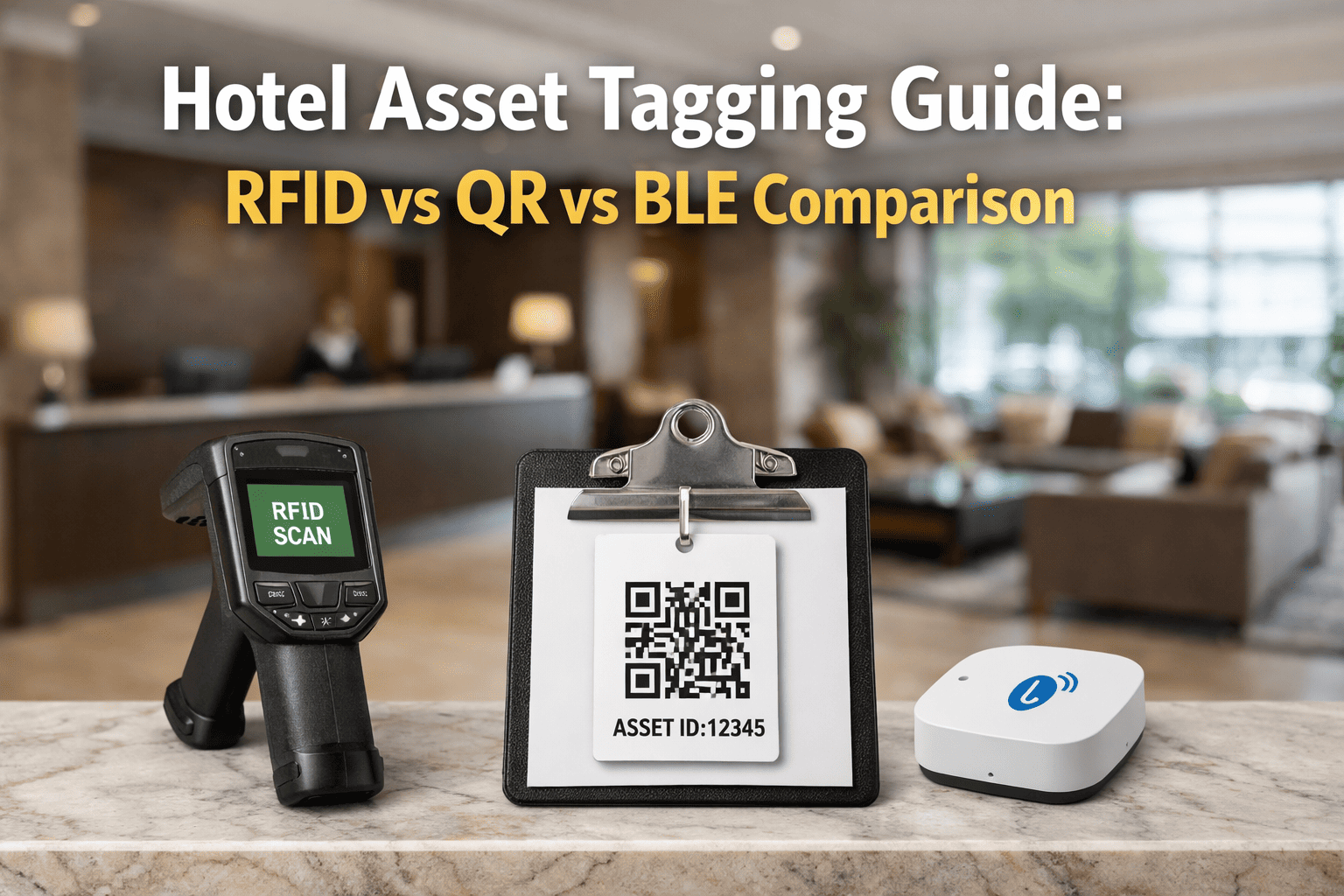
A QR code stores a unique identifier printed on a label. A smartphone camera or handheld scanner reads it on demand. The tag itself is passive and static — it does nothing until someone points a device at it. No radio, no battery, no signal. Just optically encoded data waiting to be scanned.
RFID tags communicate via radio frequency. Passive UHF RFID tags require no battery — they power up when an RFID reader energises them. A single reader can scan hundreds of tags simultaneously at up to 10 metres without line-of-sight. A full laundry cart can be audited in seconds without unloading a single item.
Bluetooth Low Energy tags broadcast their own signal continuously. Any nearby gateway or smartphone picks up that signal — no active scan required. Unlike RFID, BLE tells you where an asset is right now, not just where it passed through a checkpoint. Battery-powered, with a typical lifespan of one to five years per tag.
Side-by-Side: The Full Comparison Matrix
| Attribute | QR Code | RFID | BLE |
|---|---|---|---|
| Tag cost per unit | $0.01–$0.10 | $0.05–$0.50 | $3–$15 |
| Reader / infrastructure | Smartphone (any) | Fixed readers or handhelds | BLE gateways per zone |
| Scanning method | Manual, one-by-one | Bulk, no line-of-sight needed | Automatic, continuous |
| Real-time location | No | Checkpoint-based | Yes — zone level |
| Battery required | None | None (passive) | Yes — 1 to 5 years |
| Works on metal surfaces | Yes | With on-metal tag only | Yes |
| Works through water / fabric | No | HF/LF: yes; UHF: limited | Yes |
| Sensor data (temp, motion) | No | No (passive) | Yes |
| Setup complexity | Minimal — print and stick | Moderate — reader placement | Moderate — gateway deployment |
| Ideal asset volume | Low to medium | High — thousands of items | Medium — high-value items |
| Maintenance required | Replace damaged labels | Minimal — passive tags | Battery replacement cycle |
Which Tag Belongs on Which Hotel Asset
The right tag depends on the asset — its volume, mobility, value, and the question you most need to answer. Use this asset-by-asset breakdown as your tagging blueprint.
Volume is too high for manual scanning — a 200-room hotel manages tens of thousands of items. Washable RFID tags sewn into fabric survive repeated laundry cycles and enable full-cart audits in seconds. UHF RFID bulk-reads an entire laundry trolley without unloading a single item. Hotels using RFID on linens report 20–40% reduction in annual replacement costs.
High-value, frequently moved between banquet halls, meeting rooms, and storage. BLE gives you continuous zone-level visibility — you know which room the projector is in right now, not just which corridor it passed through last Tuesday. Real-time location data directly reduces the time staff spend searching for equipment before events.
Static, permanently placed assets that rarely move. A QR code gives maintenance staff instant access to the asset record, service history, and inspection checklist from a mobile scan. No infrastructure required. At $0.05 per label across 300 rooms, the entire asset register costs less than a dinner for two. This is where QR genuinely wins on ROI.
High-turnover environment with frequent cleaning, staff changes, and shared equipment between banquet prep and the main kitchen. RFID tags rated for metal surfaces and high temperatures track asset location and maintenance intervals without requiring manual scans at handover. RFID readers at kitchen exits flag unauthorised equipment removal automatically.
Tools checked in and out by engineering staff on every shift. A QR scan at checkout and return creates an instant accountability record linked to the technician, time, and job. No RFID reader infrastructure needed — any smartphone works. The scan also pulls up the last calibration date and maintenance due intervals in one tap.
Fixed, infrequently accessed assets that require detailed inspection records. A QR code on each unit gives maintenance staff — and third-party contractors — instant access to service history, compliance certificates, and the next scheduled PM date. For critical monitored equipment (chillers, generators), a BLE sensor alongside the QR tag adds real-time temperature and vibration data.
High mobility across every floor of the property. BLE gives managers real-time cart location without requiring staff to scan anything — the cart broadcasts its position passively. Combined with your PMS, cart location data helps coordinate room readiness, track cleaning workflows, and flag carts left in guest corridors after hours automatically.
Same logic as linens at scale: high volume, frequent laundering, and significant replacement cost when items go missing through contractor laundry handovers. Washable RFID labels sewn into garments track each item through the full uniform lifecycle — issue, laundering cycles, condition assessment, and retirement — without any manual counting or checklist.
Three Scenarios: Choosing the Right Starting Point
Start with QR codes across the entire property. Label every guest room fixture, every piece of plant room equipment, and every maintenance tool. The complete setup costs under $500 in labels and is operational within a week. Your engineering team gains a scannable asset register, instant access to service history, and PM checklists from any smartphone — with zero additional infrastructure. Add RFID to linens if linen loss is a recurring budget problem.
A hybrid approach delivers the best coverage. Use QR codes on all fixed assets for maintenance visibility. Deploy RFID on linens, uniforms, and kitchen equipment where volume justifies bulk scanning. Add BLE tags to high-value AV and event equipment, and to housekeeping carts — the real-time location data pays for itself by eliminating the daily "where is the projector?" problem and helping coordinate room turns on checkout days.
Full three-technology deployment with RFID readers at all laundry and storage checkpoints, BLE gateways on every floor, and QR codes on all fixed plant and infrastructure. Real-time asset dashboards show location, maintenance status, and utilisation data across the entire property or portfolio simultaneously. At this scale, the ROI case is clear: RFID inventory audits that previously took a full day are completed in under two hours, and unplanned equipment downtime drops materially from continuous BLE condition monitoring.
Connect Your Asset Tags to a Maintenance System That Uses the Data
A QR scan, RFID read, or BLE signal is only valuable when it connects to a work order, a PM schedule, or a compliance record. OxMaint integrates with QR, RFID, and BLE tagging to turn every scan into a maintenance action — automatically. Start free or book a demo to see the asset tagging workflow live.
Common Mistakes That Kill Hotel Tagging Programs
No single tag type is optimal across all hotel assets. Teams that deploy only QR codes miss the efficiency gains of RFID on high-volume items. Teams that deploy RFID everywhere overspend on tags for static assets that a $0.05 QR label would serve equally well.
A QR code that scans to a spreadsheet is not an asset management system. Every tag must link to a live record that includes service history, PM schedule, and compliance status. Without that connection, tagging is just labelling — and labelling does not prevent breakdowns.
Paper or thin-film QR labels fail quickly in laundry rooms, pool plant areas, and commercial kitchens. Polyester or metal-backed labels rated for the environment cost marginally more and last years longer. Using the wrong label material in the wrong zone is the leading cause of tag programs failing in the first six months.
Tags are addresses — they need somewhere to point. Deploying tags without first building a complete asset register means scans lead to empty records, which destroys staff confidence in the system within weeks. Build the register first, even if it takes an extra week. The tagging deployment will be faster and stickier for it.
Standard UHF RFID tags perform poorly when mounted directly on metal. Kitchen equipment, HVAC units, and steel storage racks require on-metal RFID tags — a specific tag format with a spacer layer that compensates for surface interference. Standard tags on metal will result in read failures that appear random and are difficult to diagnose.
BLE tag cost is higher than RFID, but the real budget surprise is the gateway infrastructure. A 200-room hotel needs BLE gateways on every floor to achieve zone-level resolution. Factor installation, cabling, and gateway hardware into the budget before committing — or the system delivers far less coverage than expected.
Frequently Asked Questions
Can QR codes and RFID tags be used on the same asset?
Yes, and it is sometimes the best approach for critical assets. A QR code provides easy maintenance access for technicians with a smartphone, while an RFID tag on the same asset enables bulk inventory audits at checkpoints. Many hotels use this dual-tag approach on items like audio-visual equipment that is both audited in bulk storage and individually serviced by maintenance staff.
How many RFID tags can be read simultaneously?
Passive UHF RFID systems can read in excess of 1,000 tags per second under optimal conditions, and reliably audit a full laundry trolley of several hundred items in a few seconds. This bulk-scanning capability is the primary reason RFID is the right technology for linens, uniforms, and other high-volume soft goods where individual scanning is impractical.
How long do BLE tag batteries last in a hotel environment?
Most BLE tags in typical hotel deployment last one to five years depending on broadcast interval and operating temperature. Tags broadcasting every few seconds for real-time location drain faster than tags transmitting every minute for periodic check-ins. Factor battery replacement cycles into total cost of ownership when sizing your BLE deployment budget.
Do RFID tags work on all surfaces in a hotel?
Standard passive RFID tags work poorly on metal and near liquids. For kitchen equipment, HVAC units, and other metal assets, use specifically designed on-metal RFID tags that include a spacer layer. For items in contact with water — pool equipment, cleaning trolleys, laundry areas — ensure tags are rated to the relevant IP standard for moisture resistance.
How does OxMaint connect with hotel asset tags?
OxMaint supports QR code scanning natively via the mobile app — any iOS or Android device can scan a tagged asset and pull up its full maintenance record, compliance history, and next scheduled PM task. The platform also integrates with RFID and BLE systems via API, allowing scan events to automatically trigger work orders, update asset records, and flag overdue inspections in real time. Start free to configure your first assets today, or book a demo to see the integration live.
Turn Your Asset Tags Into a Live Maintenance Program
OxMaint connects every QR scan, RFID read, and BLE signal to a work order, PM schedule, and compliance record — giving your team instant context every time they touch an asset. No IT resource. No setup fees. Start free and have your first tagged assets in the system this week, or book a live demo with a hospitality specialist.