Quarterly and annual preventive maintenance is where the big-consequence, low-frequency work either gets done on schedule — or quietly slips through the cracks and becomes a six-figure emergency. In a hotel operation, the tasks that fall outside the daily and weekly cadence (boiler inspections, backflow testing, chiller overhauls, pest control contracts, elevator certifications) are precisely the ones regulators, insurers, and brand auditors scrutinize first. A CMMS built for hospitality converts these long-interval obligations into automatic, auditable work orders — with rotating sample logic for plumbing fixtures, vendor coordination for pest control, and a defensible paper trail for every asset. You can Start Free Trial to see how a properly configured quarterly and annual PM calendar behaves before the next audit cycle, or read on for the full task library and scheduling model.
What is the one PM task your hotel will forget this quarter — and what will it cost when it fails?
Low-frequency, high-consequence maintenance is the single largest source of unplanned downtime in hospitality. Properties that rely on spreadsheets miss 18–24% of quarterly and annual PM tasks; CMMS-scheduled properties miss under 3%. The difference shows up in guest complaints, insurance claims, and brand audit scores.
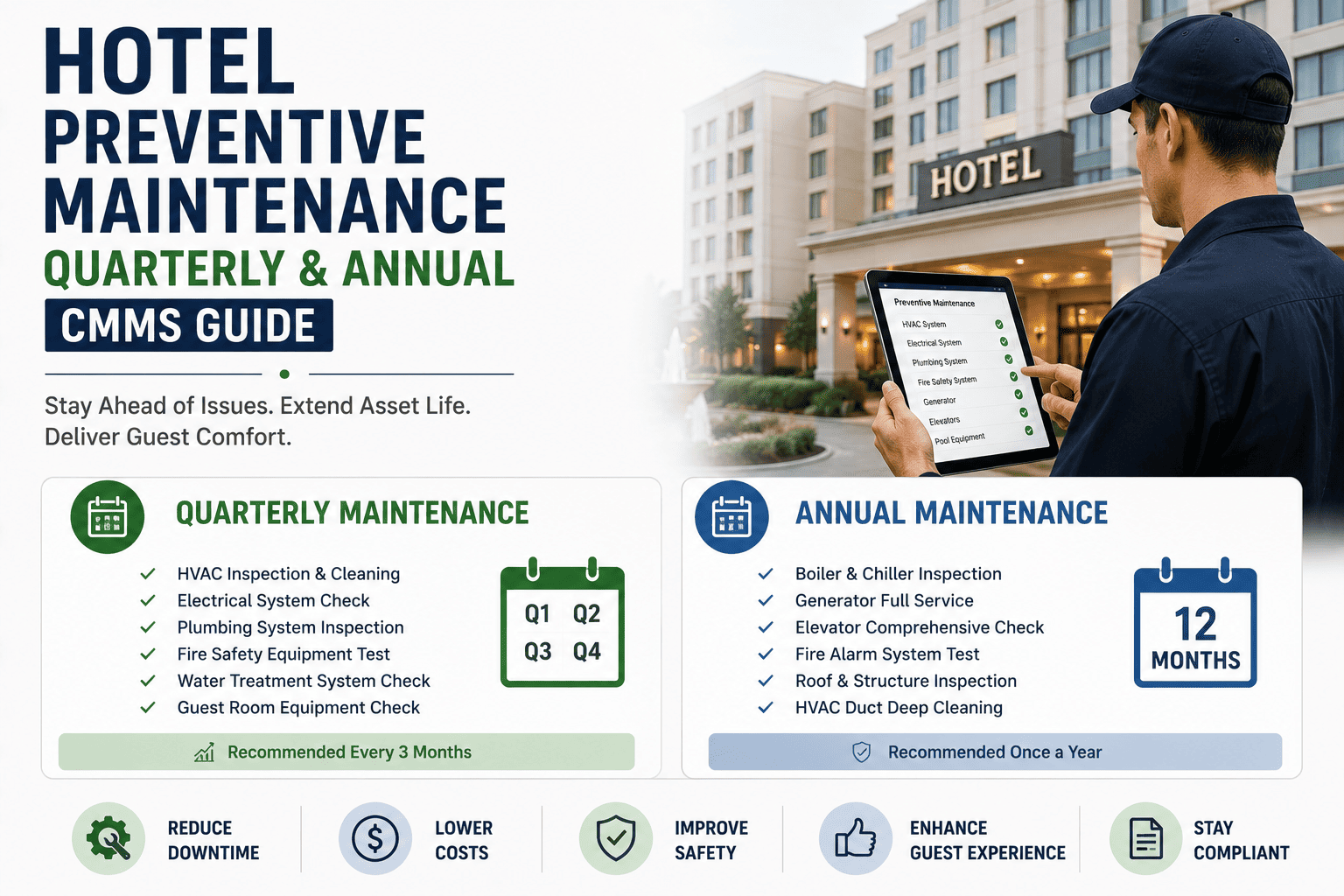
Quarterly PM task library by system
A 250-room hotel carries between 1,800 and 2,400 maintainable assets. Roughly 22% of those require a quarterly PM event. Below is the task library that a CMMS should auto-generate every 90 days — grouped by system, with the failure mode each task prevents.
HVAC & Boilers
- Quarterly boiler combustion analysis — log flue gas O₂ and CO ppm
- Condenser coil cleaning on rooftop units (impacts EER by 8–12%)
- Chiller refrigerant level and oil sampling for lab analysis
- VFD parameter check on supply and return fans
Plumbing Fixtures
- Rotating sample test — 25% of guestroom fixtures (flow rate + leak)
- Backflow preventer quarterly inspection per local code
- Domestic hot water recirculation pump amperage check
- Grease trap inspection in F&B outlets — log solids depth
Electrical & Life Safety
- Quarterly emergency generator load-bank test (30 min minimum)
- Fire pump churn test — record pressure at no-flow
- Infrared scan of main distribution panel (hotspot threshold 15°C)
- Exit light and emergency lighting 90-second illumination test
Pest Control & Specialty
- Quarterly pest control service — vendor WO auto-generated 7 days prior
- Elevator quarterly inspection per ASME A17.1 — door reopen devices
- Pool chemistry log review and cyanuric acid level check
- Laundry dryer exhaust cleaning — lint depth under 3 mm
Annual PM calendar — when each task is due, and why the timing matters
Annual PMs are not evenly distributed across the year. A CMMS staggers them to avoid peak occupancy windows, align with seasonal load (heating before winter, cooling before summer), and bundle vendor visits to cut mobilization fees by up to 35%.
Pre-peak cooling & heating season
Annual cooling tower cleaning and descaling (before summer load). Boiler annual shutdown inspection if dual-fuel redundancy exists. Water heater anode rod replacement on a 3-year rotation. Fire sprinkler full-flow test per NFPA 25.
Spring readiness & envelope
Roof membrane inspection and drain clearing before storm season. Exterior building wash. Cooling system full commissioning — refrigerant charge verified against nameplate. Annual pest control contract review and re-bid.
Peak occupancy — vendor coordination
Annual elevator certification (often timed to shoulder season within this window). Kitchen hood and duct deep clean during low-occupancy nights. Pool filter media replacement. Laundry equipment annual — extractor bearing grease.
Winter prep & year-end audit
Heating system combustion efficiency test. Window and door weather-seal audit. Backflow preventer annual certification (licensed contractor). Generator annual full-load test — 2 hours minimum, oil sample sent to lab.
How CMMS rotating-sample testing works for guestroom fixtures
Testing every fixture in every room every quarter is economically irrational for a 200-room property (400+ fixtures). The CMMS industry standard is a rotating 25% sample — room groups A, B, C, D — so that 100% of fixtures are tested across the year without displacing guests from full floors.
A 200-room hotel tests 50 rooms per quarter. Group A = rooms 101–150 in Q1, Group B = 151–200 in Q2, Group C = 201–250 in Q3, Group D = 251–300 in Q4. The CMMS auto-assigns the correct room block each cycle and flags any room that was not tested (skipped) within its scheduled quarter.
If a fixture in Group C develops a slow leak in Q1, it will not be caught until Q3 — that is the accepted trade-off. CMMS drift detection compensates: any guest-reported complaint in an untested room instantly promotes that room to the current queue, collapsing the worst-case detection gap from 9 months to 24 hours.
| Fixture Type | Test Method | Pass Threshold | Frequency |
|---|---|---|---|
| Showerhead flow rate | Calibrated flow bag, 15-second draw | 1.8–2.5 GPM (Energy Star) | Quarterly, 25% sample |
| Faucet aerator flow | Flow bag, both hot and cold | 0.5–1.5 GPM | Quarterly, 25% sample |
| Toilet leak test | Dye tablet in tank, 10-min observation | Zero color migration to bowl | Quarterly, 25% sample |
| Hot water delivery time | Stopwatch at faucet, max draw | Under 30 seconds to 110°F | Quarterly, 25% sample |
| PTMT valve (shower) | Pressure gauge at outlet | Holds 20–30 psi under flow | Annual, 100% coverage |
External contractor scheduling — pest control as the model workflow
Pest control is the textbook case for CMMS-managed vendor coordination: it recurs quarterly, requires property access coordination, generates a compliance document, and carries penalties if missed. The same workflow pattern applies to fire sprinkler, elevator, backflow, and kitchen hood contractors.
Auto-generate vendor work order
14 days before the scheduled quarter-end, the CMMS creates a purchase-order-linked work order and emails it to the contracted pest control vendor with scope, room count, and site access window.
Front desk & housekeeping notification
Concurrent notifications go to front desk and housekeeping so treatment rooms are blocked from assignment. The CMMS holds those rooms out of the sellable pool automatically for the treatment plus re-entry interval.
Service ticket capture on-site
The vendor technician uploads the signed service ticket and chemical usage log directly into the CMMS via mobile. The work order cannot be closed without the attached compliance document — a hard stop.
Auto-reschedule next cycle
On closure, the CMMS calculates the next due date (current date + 90 days), regenerates the work order, and pushes it to the calendar. No human has to remember to reschedule — the loop is closed by the system.
A 180-room limited-service hotel in the Southeast was spending $42,000 annually on reactive plumbing and pest callbacks. After implementing CMMS rotating-sample testing and auto-scheduled pest control, callback spend dropped to $9,100 in year one — a 78% reduction. The missed-PM rate fell from 19% to under 2%.
— Worked example, mid-scale hotel portfolio, 2024 internal benchmarkWhat changes when quarterly and annual PM is CMMS-scheduled
The measurable shift is not in labor hours — those stay roughly flat. The shift is in completion rate, audit readiness, and emergency spend. Below are the four metrics that move most when a hotel moves from spreadsheet-based PM to CMMS-scheduled PM.
Stop trusting quarterly PM to memory and spreadsheets.
Configure your full quarterly and annual PM calendar in OxMaint in under a day — task library, rotating samples, vendor workflows, and audit-ready logs included.
Hotel quarterly and annual PM — the questions that come up first
These are the five questions hotel engineering directors and general managers ask most often when evaluating a CMMS for long-interval preventive maintenance.
How does the CMMS handle the rotating 25% plumbing sample without manual room assignment?
The CMMS segments your room inventory into four groups at setup (A, B, C, D) based on floor or room number range. Each quarter it automatically assigns the next group to the plumbing PM work order and excludes the other three. If a guest complaint is logged in an untested room, that room is injected into the current cycle regardless of its group. You can see this behavior live when you Start Free Trial and load the sample hotel property.
What happens if a quarterly pest control visit is skipped or the vendor no-shows?
The work order remains open past its due date and escalates: first to the engineering director at 24 hours overdue, then to the general manager at 72 hours. The CMMS flags it red on the compliance dashboard and includes it in the monthly missed-PM report. Because the next cycle is auto-generated from closure date, a delayed Q2 visit pushes Q3 out by the same delay — preventing silent drift in the annual cadence.
Can the CMMS produce an audit-ready document trail for annual certifications (elevator, backflow, fire)?
Yes. Every annual PM work order stores the vendor service ticket, the technician's certification number, the chemical or part manifest, and a timestamped completion record. Auditors and brand inspectors receive a single shareable link per asset that shows the full compliance history — no more scrambling for PDFs three days before an audit.
How long does it take to implement a full quarterly and annual PM calendar for a 200-room hotel?
Typically 4 to 8 hours of configuration time: 2 hours to import the asset register, 2 hours to map the quarterly task library, and 1 to 4 hours to set up vendor workflows and notification rules. Most properties go live within a single week. You can walk through the setup with our team by booking a demo at Calendly.
Does the CMMS integrate with the hotel PMS to block rooms during PM?
OxMaint integrates with major hotel PMS platforms via API. When a PM work order is scheduled for a specific room or block of rooms, the CMMS sends a hold to the PMS so those rooms are not assigned to arriving guests. Once the work order is closed, the hold is released and the room returns to sellable inventory — typically within the same shift.
Your next quarterly PM cycle starts in 90 days. Build the calendar now.
Deploy a full hotel quarterly and annual PM program in OxMaint — task library, rotating samples, vendor coordination, and audit-ready documentation. Configure it once; let the system run it for the next decade.
Free 14-day trial · No credit card