Hospitality and resort facility operations in 2026 face an unprecedented convergence of financial and compliance challenges: rising energy rates, technician labor shortages, strict municipal health department mandates, and direct guest review feedback loops that immediately impact RevPAR (Revenue Per Available Room). Historically, hotel maintenance has been reactive, responding only after a critical asset—like a guestroom PTAC unit, a domestic hot water boiler, or a central BOH chiller—fails completely. A reactive breakdown strategy is incredibly expensive, costing up to 4x more than planned inspections and resulting in room blocks, guest compensation payouts, and rapid asset depreciation. Today, leading B2B hospitality groups are leveraging AI-driven CMMS platforms to transition from reactive crisis management to true predictive maintenance. By utilizing smart sensor data, automated work order escalation, and historic failure trend analytics, hotels are reducing operational maintenance spend by 40% while extending equipment lifespans. OxMaint's AI-enabled hotel CMMS empowers Chief Engineers, GMs, and regional facilities directors with the predictive workflows, mobile parities, brand audit readiness, and integration pipelines needed to protect luxury assets and optimize engineering wrench time. Schedule a 30-Minute AI Hotel CMMS Consultation
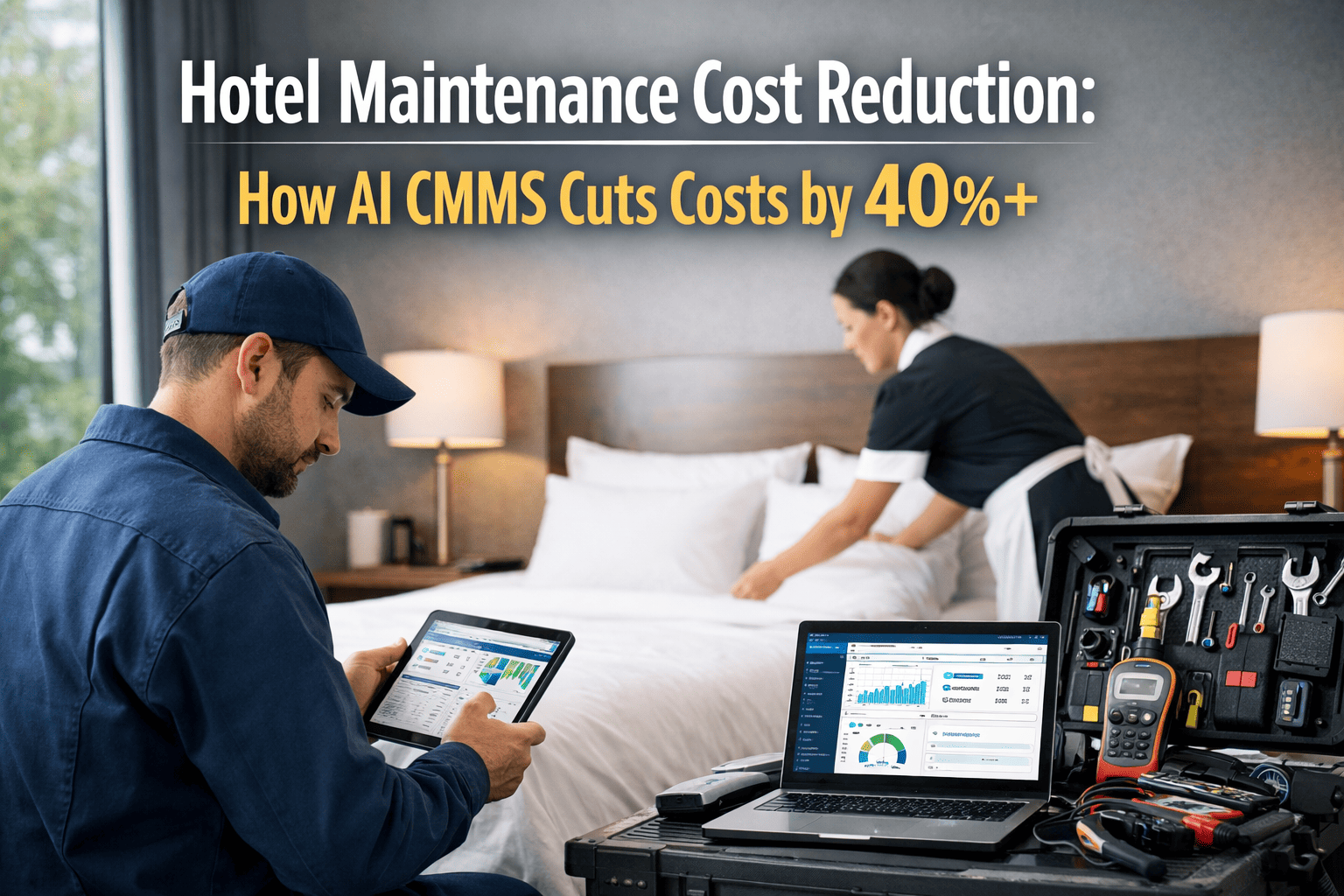
How Hotels Are Using AI to Cut Maintenance Costs by 40% in 2026
A deep-dive, data-driven analysis of predictive maintenance ROI in the hospitality sector — exploring how central chiller vibration analytics, automated HVAC filter schedules, and property management system integrations prevent downtime and protect hotel RevPAR.
AI Maintenance Savings Waterfall Chart
Visualizing how B2B predictive optimizations systematically bring traditional operating costs down by 40%.
Predictive Vibration Analytics for Back-of-House Systems
In B2B hotel facility management, the central chiller, cooling towers, and primary water pumps are the heart of the building. If a central chiller suffers a bearing failure on a peak occupancy weekend in Miami or Las Vegas, the results are catastrophic: guestroom temperatures spike, checkout lines swell, and GMs face tens of thousands of dollars in room credit refunds. Traditional commercial maintenance relies on quarterly calendar-based checks, which routinely miss fast-developing mechanical defects. AI-driven predictive maintenance utilizes tri-axial vibration sensors and magnetic motor current analysis (MCSA) to establish a continuous operational baseline. By monitoring spectral frequency shifts, the system detects micro-frictional wear in mechanical bearings weeks before a breakdown occurs, automatically routing a low-priority maintenance ticket to the on-duty floor engineer's smartphone.
INTERACTIVE WIDGET 2: CHILLER ANOMALY SIMULATORChiller Sensor Vibration Anomaly Simulator
Hover or click each frequency interval to see how AI analyzes sensor wavelengths to detect bearing defects early.
Micro-Fracture Wear
Sensors pick up high-frequency sub-audible vibration peaks. AI flags micro-abrasion in internal bearing rings while chiller runs normally.
Thermal Anomaly Detected
Motor temperature rises by 4.2°F above standard thresholds. OxMaint AI auto-dispatches an inspection ticket with required bearing parts.
Mechanical Seizure
Chiller locks up, causing central AC loop failure. Unplanned repair costs skyrocket, room reservations are blocked, and brand standard audits fail.
Optimizing Hot Water Loops and Municipal Compliance
Hot water systems are subject to strict health regulations across the United States. Municipalities require consistent monitoring of domestic boiler storage temperatures to prevent both scalding risks and the development of dangerous Legionella bacteria in subterranean plumbing trunks. Traditionally, technicians had to walk down to basement mechanical spaces daily, read manual thermometers, and record numbers on clipboard logs. These paper logs are easily falsified, lost, or overlooked, leaving properties exposed to severe brand standard audit failures and public health liabilities. By placing LoRaWAN temperature probes on primary thermal feed lines and integrating them directly into a mobile CMMS, GMs automate water chemistry checks. OxMaint monitors temperature limits continuously; if a loop drops below 120°F or rises above 140°F, an automated push alert escalates to the Chief Engineer's mobile app instantly, securing safe, audit-ready compliance logs. Activate automated thermal compliance alerts.
Automated Guestroom HVAC Filter and Coil Optimization
Guestroom Packaged Terminal Air Conditioner (PTAC) units are the largest cumulative BOH energy drain in a hospitality property. When fan mesh filters become clogged with dust and lint, the compressor draw increases by up to 28% to maintain target room temperatures. Clogged filters also lead to frozen evaporator coils, condensate pan overflows, and water damage to foyer drywall and carpet. An AI-powered CMMS uses seasonal booking histories and runtime projections to schedule customized sweeps. Instead of doing manual inspections of all 300 rooms at once, the system schedules 10 room filter deep cleans daily, mapping tasks to floor technicians' existing morning routes, ensuring zero guest inconvenience and maximum energy savings.
INTERACTIVE WIDGET 3: 12-MONTH ROI PROGRESSION12-Month B2B Payback Timeline
Visualizing cumulative cash flow recovery and equipment downtime reductions from Day 1 to Month 12.
All cooling towers, boilers, and guestroom PTACs are QR-tagged and mapped into the AI engine. Floor teams receive mobile orientation.
LoRaWAN temperature and vibration sensors establish stable parameters, cutting walkie-talkie emergency pages by 25%.
Auto-escalation rules cut guest response times to 8 minutes. Opera/Mews PMS sync eliminates vacant room blockage delays.
Extended asset lifespans, 40% reduction in HVAC energy waste, and complete corporate audit compliance achieved.
Housekeeping Integration and Instant Front-Desk Parity
Housekeeping teams are the primary inspectors of in-room aesthetics. A loose closet door bracket, a running toilet fill valve, or a cracked wall outlet represents a brand standard failure. If housekeeping records these items on paper checklists at the end of shifts, rooms are routinely assigned to incoming guests before repairs can happen. Bidirectional PMS integrations allow housekeeping attendants to photograph defects in three taps on mobile screens, generating instant priority tickets in the CMMS. At the same moment, the room is automatically blocked in Oracle Opera or Mews to protect check-in flow, shifting back to available as soon as the floor engineer marks the ticket completed on their smartphone. Book an Opera PMS integration demo.
AI-Driven Anomaly Triage and Routing Pathways
The core value of an AI-driven CMMS is not just identifying anomalies, but automatically prioritizing and routing them based on operational risk. Minor mechanical drifts, such as a 5% increase in a PTAC compressor current, are logged as Low Priority and automatically batched into the next scheduled room sweep to optimize labor efficiency. Medium anomalies, such as a domestic hot water boiler sensor reading 121°F (the boundary threshold for Legionella development), are instantly triaged, assigning a 60-minute SLA repair ticket to the zone engineer. Critical Level 3 alerts—like a central chiller bearing vibration peak—trigger instant push notifications to the Chief Engineer's mobile device, auto-block room check-ins in the Opera or Mews PMS, and start a 15-minute resolution countdown. This automated routing eliminates dispatcher lag and prevents minor micro-frictional wear from expanding into catastrophic failures.
At our luxury resort property, chiller motor degradation and hot water loop failures used to consume a massive portion of our annual operational budget. We struggled with paper checklists and manual temperature logs that brand standard inspectors flagged during audits. Since rolling out OxMaint across our BOH and room maintenance teams, we have cut emergency breakdown costs by 45%. The AI system dynamically flags compressor current variations and alerts us to hot tub water issues before they turn into public safety alerts. It has transformed our engineering department from a reactive cost center into a proactive, data-driven division that is fully audit-ready 24/7.
Frequently Asked Questions
Technicians can set up LoRaWAN vibration and temperature sensors and connect them to mobile apps within minutes.
This sync locks down dirty guestrooms during rushes, preventing double-bookings and guest disappointment.
If loop temperatures drop below municipal safety baselines, the CMMS auto-escalates high-priority flushing tickets to floor teams.
All completed tasks, photos, and parts updates automatically synchronize as soon as the technician returns to coverage.
This eliminates translation errors and drives high platform adoption among floor teams.
OxMaint's simple interface requires minimal team onboarding time, eliminating expensive corporate implementation fees.
This ensures full ADA compliance during audits, protecting your property from municipal citations or guest lawsuits.
Slash Your Hotel's Operating Expenses Today.
OxMaint gives hospitality General Managers, Chief Engineers, and Operations Teams the real-time mobile work order sync, digital checklists, and guest QR portals required to protect guest ratings and prolong property assets — fully free to start, setup in minutes.