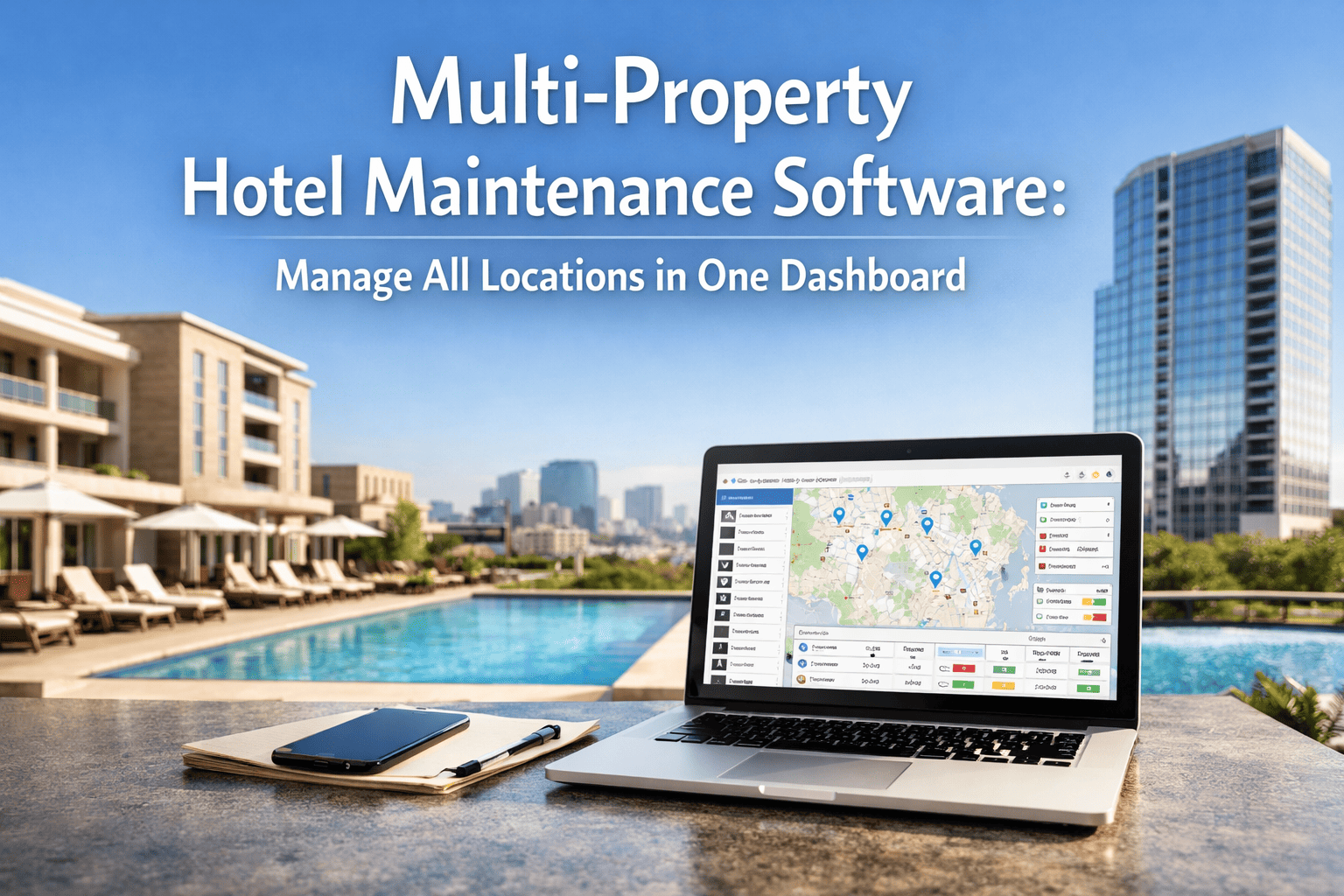
For a multi-property hotel chain, the difference between a 92% Guest Satisfaction Index and an 84% one rarely comes down to décor — it comes down to whether preventive maintenance actually fired at every property last Tuesday at 3 AM. A multi-property CMMS is the only system that can hold 20+ properties to the same brand PM template while still letting the local Director of Engineering handle an elevator outage without waiting on the flag office. Regional VPs of Engineering who centralize portfolio visibility typically cut emergency work orders 28–40% in the first year. This 2026 guide breaks down the portfolio architecture, brand-standard enforcement, and 90-day rollout playbook you need to get every flag, franchise, and managed asset on a single trusted system — Start Free Trial and stand up your portfolio workspace in under an hour.
Can your flag office trust the PM numbers coming from 22 properties right now?
Most regional VPs of engineering are flying blind on portfolio compliance — stitched-together spreadsheets, three different CMMS vendors, and a guest-complaint dashboard that lags reality by 11 days. A single multi-property CMMS collapses that lag to real time and turns brand PM standards into enforceable, auditable templates across every hotel in the portfolio.
One CMMS, three tiers, zero property-level blind spots
A multi-property hotel CMMS is not a single database with a property dropdown — it is a role-tiered architecture that gives the flag office, the Regional VP of Engineering, and the on-property Director of Maintenance exactly the visibility each role needs, no more and no less.
Flag Office / Corporate
Portfolio-wide KPI dashboard: PM compliance %, mean-time-to-repair, guest-impacting downtime events, and capex request pipelines across every managed and franchised property. Read-only on property-level work orders, full write on brand PM templates.
Regional VP of Engineering
Cross-property benchmarking across 8–25 hotels in a region. Drill into any property's backlog, compare MTTR between sister properties, and push standardized vendor contracts and parts pricing across the region.
On-Property DOE / Maintenance
Full autonomy over daily work-order execution, technician scheduling, parts checkout, and guest-room readiness — while brand PM templates, asset hierarchies, and reporting roll up automatically. No duplicate data entry, no month-end spreadsheet export.
Turn a 240-page brand-standards manual into 14 enforceable PM templates
A brand standard that lives in a PDF is a suggestion. A brand standard that lives as a CMMS PM template — with a trigger frequency, a required checklist, and a compliance report — is a guarantee. Here is what centralized template enforcement looks like in practice for a 20-property portfolio.
| Brand PM Template | Trigger | Owner Tier | Compliance KPI | Portfolio Target |
|---|---|---|---|---|
| Guest Room Preventive Maintenance (FF&E) | Quarterly, per room | On-property | % rooms completed on-cycle | ≥ 96% |
| Guestroom Deep Clean & PM Combo | Annual | On-property | Rooms flagged deficient | ≤ 4% |
| Pool / Spa Chemistry & Equipment | Daily + weekly | On-property | Out-of-range incidents | 0 / month |
| Life Safety / Fire System Inspection | Monthly + annual | Regional VP | Inspection pass rate | 100% |
| HVAC Rooftop Unit Filter & Coil | Quarterly | On-property | On-time completion | ≥ 94% |
| Elevator Monthly Inspection | Monthly | Regional VP | Cert. on file / overdue | 0 overdue |
| Kitchen Equipment / Hood Cleaning | Quarterly + semi-annual | On-property | Health-code violations | 0 critical |
When these templates are pushed from the flag office to every property in the portfolio, a new franchise acquisition can be brought onto brand-standard PM in 14 days instead of 90 — and the Regional VP sees compliance numbers the day the first PM fires, not the day after the first quarterly audit.
The portfolio KPI dashboard your flag office will actually trust
Most multi-property reporting is a Friday email with an attached spreadsheet — already 48 hours stale by the time the Regional VP opens it. A CMMS portfolio dashboard collapses that latency to zero and surfaces the five KPIs that actually predict guest complaints and capex surprises.
Percentage of brand-mandated PMs completed on or before due date, rolled up across every property in the portfolio.
Mean time to repair guest-impacting work orders, benchmarked property vs. property so outliers surface in red within an hour.
Open work orders older than 14 days as a share of total open — anything above 3% triggers a regional escalation flag.
Maintenance spend per square foot, normalized across properties, exposing the 2–3 hotels burning 40% more than the portfolio median.
Number of overdue life-safety or fire-system inspections across the portfolio. Target is always zero; any nonzero value pages the Regional VP.
Correlation-weighted count of maintenance-attributed guest complaints per 100 stays — the leading indicator for your next TripAdvisor dip.
Get 20+ properties on one CMMS without breaking property-level autonomy
A multi-property CMMS rollout fails when the flag office tries to migrate everything at once — or when it delegates migration to each property and ends up with 22 different configurations. The playbook below is the middle path: a 90-day, three-wave rollout that has worked for portfolios of 12 to 60 properties.
Brand template build + pilot at 2 flagship properties
Stand up the portfolio hierarchy, import the asset register for two highest-volume properties, and build the 14 core brand PM templates. Run both properties in parallel (legacy system + CMMS) for 21 days. Goal: 95% template match, zero missing PM triggers.
Onboard 6–10 properties per Regional VP
Roll out to the next 6–10 properties in the region. Each property gets a 4-hour onboarding session, legacy work-order import, and mobile-app provisioning for technicians. Regional VP begins daily dashboard reviews. Target: 90% of PMs firing on-template by day 30.
Complete portfolio + retire legacy systems
Onboard the remaining properties, decommission legacy CMMS / spreadsheets, and run the first portfolio-wide compliance report. Lock brand PM templates to flag-office-write-only. By day 90, the flag office should see real-time PM compliance across 100% of properties.
A 22-property portfolio: from 81% PM compliance to 97% in one fiscal year
Consider a 22-property full-service portfolio (3 flags, ~4,800 keys total) spending roughly $3.1M annually on maintenance labor and parts. Before centralizing on a CMMS, PM compliance averaged 81% with a 14-day reporting lag. Within 12 months on a single system, the numbers looked very different.
Fragmented state
- 3 different CMMS vendors across 22 properties
- PM compliance: 81% (portfolio avg, 14-day lag)
- Emergency work orders: 1,840 / quarter
- Maintenance spend: $3.1M / year
- Guest MSI maintenance-attributed complaints: 16.4 / 100 stays
- Capex surprises (failed asset > $10K): 9 / year
Single CMMS portfolio
- 1 CMMS, 22 properties, real-time dashboard
- PM compliance: 97% (live, 0-day lag)
- Emergency work orders: 1,090 / quarter (–41%)
- Maintenance spend: $2.74M / year (–11.6%)
- Guest MSI maintenance complaints: 9.1 / 100 stays
- Capex surprises: 3 / year (–67%)
Against a CMMS subscription of approximately $54,000/year for 22 properties, the payback period lands under 11 weeks once full portfolio reporting goes live in Month 3.
See your entire hotel portfolio on one dashboard by Friday.
Stand up a multi-property CMMS workspace, import your brand PM templates, and invite your Regional VPs — all in a 45-minute onboarding call.
Multi-property hotel CMMS — what Regional VPs ask first
How long does it take to roll out a CMMS across 20+ hotel properties?
A disciplined three-wave rollout gets 20+ properties live in 90 days: 2 pilot hotels in Month 1, 6–10 regional properties in Month 2, and the remaining portfolio in Month 3. The bottleneck is never the software — it is asset-register cleanliness and technician adoption. Properties with a clean asset hierarchy and a designated CMMS champion onboard 40% faster. Book a Demo and we will scope your rollout wave-by-wave.
Can a multi-property CMMS enforce brand PM standards without micromanaging the on-property team?
Yes — that is the entire design principle. The flag office controls brand PM templates (frequency, checklist, required parts) in a write-only layer, while the on-property Director of Engineering retains full autonomy over work-order execution, technician scheduling, and vendor dispatch. The brand standard is enforced by the template trigger; the local team decides how the work gets done.
What happens to property-level autonomy when we centralize on one CMMS?
Property-level autonomy actually increases. The on-property team gets a mobile CMMS app, auto-generated PM triggers, and a parts catalog with regional pricing — instead of a spreadsheet and a clipboard. The only thing they lose is the right to skip a brand-mandated PM without a documented reason, which is exactly the compliance gap the flag office needs to close.
How does a portfolio CMMS handle franchised properties versus managed properties?
The CMMS uses role-based access to give the flag office read-only visibility into franchised properties (PM compliance, life-safety status, capex pipeline) while granting full write access to managed properties. Franchisees keep their own CMMS admin but must push the brand PM template set to their instance. Compliance reports roll up automatically regardless of ownership structure.
What is the realistic payback period for a multi-property hotel CMMS?
For a 20+ property portfolio, payback typically lands between 8 and 14 weeks after full rollout. The savings come from three places: reduced emergency work orders (28–41%), avoided capex surprises from late-caught asset failures, and RevPAR recovery from improved guest satisfaction scores. A 22-property portfolio spending $3.1M/year on maintenance can expect $550K–$700K in Year-1 portfolio impact. You can Start Free Trial and model your own numbers in the portfolio dashboard.
Get every property on one trusted CMMS this quarter.
Import your brand PM templates, invite your Regional VPs, and watch real-time compliance numbers replace Friday spreadsheets — starting today.
Free 14-day trial · No credit card