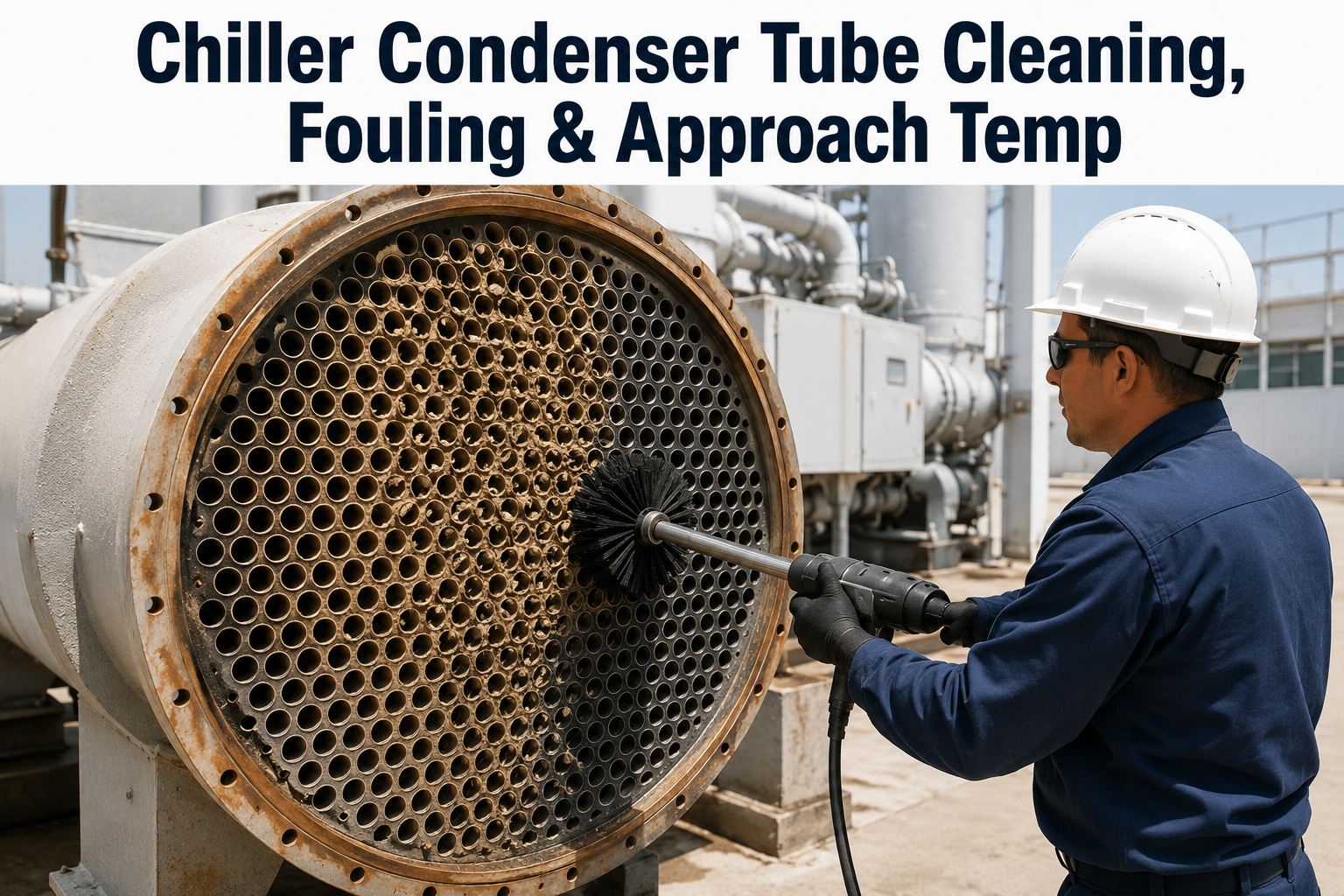
Condenser tube fouling is the single most predictable — and most preventable — efficiency killer in water-cooled chiller plants, typically robbing 6–12% of full-load kW within months of a clean baseline. The signal hides in plain sight inside your approach temperature trend: when condenser approach drifts past 3°F and heads toward 7°F, you are paying for fouling in real time, every operating hour. This guide breaks down how to detect, quantify, and remove that fouling through mechanical brushing, chemical cleaning, and CMMS-driven scheduling. If you want to act on what you read here today, you can Start Free Trial and turn approach trending into automated work orders.
Is your condenser approach quietly above 6°F — and your kW climbing with it?
Every 1°F of excess condenser approach typically adds 1.5–2% to chiller compressor energy. On a 500-ton machine at $0.12/kWh, that is roughly $4,200 per year lost to a fouled tube bundle you could have caught with a 5-minute trend review.
The physics behind the fouling tax
Condenser approach temperature = refrigerant condensing temperature minus leaving condenser water temperature. A clean tube bundle typically runs 1–3°F; fouling, scaling, or biological slime adds an insulating layer that forces the compressor to work harder against a higher head pressure.
A plant running eight 500-ton chillers with an unmanaged 5°F approach penalty is burning through an estimated $168,000 every year — money that disappears silently into the utility bill because nobody is trending the approach delta.
The 30-day approach-trending playbook
You cannot manage what you do not trend. The sequence below converts BAS logged data into a defensible cleaning trigger inside 30 days, without guessing or calendar-based guessing.
Baseline capture
Pull leaving condenser water temperature and refrigerant saturation temperature from the BAS at 15-minute intervals. Establish the clean-baseline approach after a verified tube cleaning. Target: 1–3°F steady-state at design flow.
Trend normalization
Normalize for load — compare approach only at 60–100% load where condenser flow and refrigerant readings are stable. Flag any 1°F uptick sustained over 48 hours. Log water-tower conductivity and makeup volume alongside.
Fouling trigger check
If the rolling 7-day average approach exceeds baseline + 2°F, open a CMMS inspection work order. If it crosses baseline + 4°F (typically 5–7°F absolute), trigger a full condenser tube cleaning — do not wait for the next quarterly calendar date.
Post-clean verification
After cleaning, re-baseline within 72 hours. Approach should drop back to within 1°F of the original clean value. If it does not, suspect waterside flow restriction, non-condensables, or incomplete brushing — escalate to eddy-current testing.
Mechanical brushing vs chemical cleaning vs combination
Not every fouling event needs the same response. Match the cleaning method to the deposit type and tube metallurgy — wrong choice means re-fouling within weeks or damage to the tube wall.
| Method | Best For | Downtime | Typical Cost (500-ton) | Approach Recovery | Risk |
|---|---|---|---|---|---|
| Mechanical brushing | Soft biological slime, mud, silt | 4–8 hours | $1,200–$2,500 | 2–4°F | Low — nylon/brass brushes |
| Chemical cleaning | Calcium carbonate scale, iron oxide | 6–12 hours | $2,800–$5,500 | 3–6°F | Medium — pH control critical |
| Combination (brush + chem) | Hard scale with biofilm layer | 10–16 hours | $4,000–$7,500 | 4–7°F | Medium — needs neutralization pass |
| High-pressure water jet | Severe hardened deposits | 8–14 hours | $3,500–$6,000 | 3–5°F | Medium-High — tube erosion risk |
Condenser approach = saturated refrigerant condensing temperature minus leaving condenser water temperature. Both readings must come from calibrated sensors at steady-state load.
Multiply excess approach (°F above clean baseline) by the 1.75% average kW penalty per degree, then by annual chiller kWh and your blended electric rate. This is the money fouling is quietly removing from your budget.
A 500-ton hospital chiller losing $6,800 a year to a 4°F approach drift
Consider a 500-ton water-cooled chiller in a 24/7 hospital, running ~4,800 equivalent full-load hours per year at $0.13/kWh. The maintenance team logs a clean-baseline approach of 2°F in March. By August, the 7-day rolling average has crept to 6°F — a 4°F drift.
500 tons × 0.6 kW/ton × 4,800 hours = 2.16M kWh at clean efficiency.
4°F excess approach × ~1.75% per °F = 7% additional compressor energy.
7% of 2.16M kWh — pure waste attributable to tube fouling.
151,200 kWh × $0.13/kWh — recovered with a $2,000 mechanical brush-out.
A $2,000 mechanical cleaning recovers $6,656 in avoided energy — payback in roughly 3.6 months, with the rest of the year as net savings.
Turn approach data into automatic cleaning work orders
The reason most plants clean on a fixed calendar — not condition — is that trending and triggering is manual. A CMMS closes that loop: the BAS exports the approach trend, the CMMS evaluates it against your threshold, and a work order opens before the energy loss compounds.
Set the approach threshold per chiller
Configure each chiller's clean baseline and the +2°F inspection / +4°F cleaning triggers in the CMMS asset record. Tag chillers by tonnage, metallurgy, and water-treatment program so alerts route to the correct technician.
Automate BAS → CMMS data flow
Push daily 7-day rolling average approach into the CMMS via API or scheduled CSV. No manual spreadsheets — the trigger fires when the threshold is crossed, not when someone remembers to check.
Generate the cleaning work order
The work order auto-populates chiller ID, last-clean date, current approach, deposit type suspected (scale vs biofilm), required method, parts (brushes, gaskets), and estimated downtime — then routes to the on-call tech.
Verify and re-baseline
After cleaning, the tech logs the post-clean approach reading directly in the CMMS. If it returns to within 1°F of baseline, the asset resets. If not, the system escalates to eddy-current NDT testing automatically.
"We stopped calendar-cleaning our seven condensers and switched to approach-triggered work orders. First year we cut cleaning spend 31% and recovered an estimated $38K in energy — the CMMS caught fouling three chillers earlier than we ever had."
See how OxMaint turns approach trends into automatic cleaning work orders
Connect your BAS data, set your fouling thresholds, and let the CMMS trigger cleanings before the energy loss compounds.
Condenser tube cleaning & approach temperature — answered
What is a normal condenser approach temperature on a clean chiller?
A clean, well-maintained water-cooled condenser typically runs an approach of 1–3°F at design load and flow. Anything above 3°F sustained warrants investigation; above 5–7°F almost always indicates fouling, scaling, or inadequate water flow that needs corrective cleaning. The exact baseline varies by compressor type and refrigerant, so always benchmark your own machine immediately after a verified cleaning rather than relying on a generic number.
How often should condenser tubes be cleaned?
There is no universal calendar interval — it depends on water quality, cooling-tower treatment, and load profile. Plants on well-controlled water-treatment programs often need annual cleaning; those with poor makeup water or heavy biological loading may need it quarterly. The defensible answer is condition-based: clean when the approach trend exceeds your threshold. You can Start Free Trial and set that trigger automatically inside the CMMS.
Can I clean condenser tubes without taking the chiller offline?
No. Mechanical brushing and chemical cleaning both require isolating and draining the waterside of the condenser, which means the chiller must be off. Plan for 4–8 hours of downtime for brushing and 6–12 hours for chemical descaling. The best practice is to trigger the cleaning from your approach trend so it happens before peak-load season, not during it.
Does chemical cleaning damage condenser tubes?
Improperly controlled chemical cleaning can etch tube walls, especially in copper-nickel or stainless bundles. The risk is managed by using the correct acid formulation for the deposit type, maintaining pH within the manufacturer's specified range, monitoring circulation time, and performing a thorough neutralization and flush pass afterward. Always confirm compatibility with the tube metallurgy and follow the chiller OEM's cleaning guidelines — Book a Demo to see how OxMaint tracks metallurgy per asset and routes the right procedure.
How much energy does a fouled condenser actually waste?
Industry data puts the penalty at roughly 1.5–2% additional compressor kW for every 1°F of excess condenser approach. A moderate 4°F drift on a 500-ton chiller running 4,800 full-load hours at $0.13/kWh wastes about 151,000 kWh — around $6,600 per year. Severe fouling on larger or higher-runtime machines can push losses well into five figures annually, which is why approach trending is one of the highest-ROI maintenance practices in a central plant.
Turn condenser approach into your highest-ROI maintenance signal
OxMaint gives you approach trending, fouling triggers, and automated cleaning work orders in one platform — connect your BAS and recover wasted kW within the first cooling season.
Free 14-day trial · No credit card