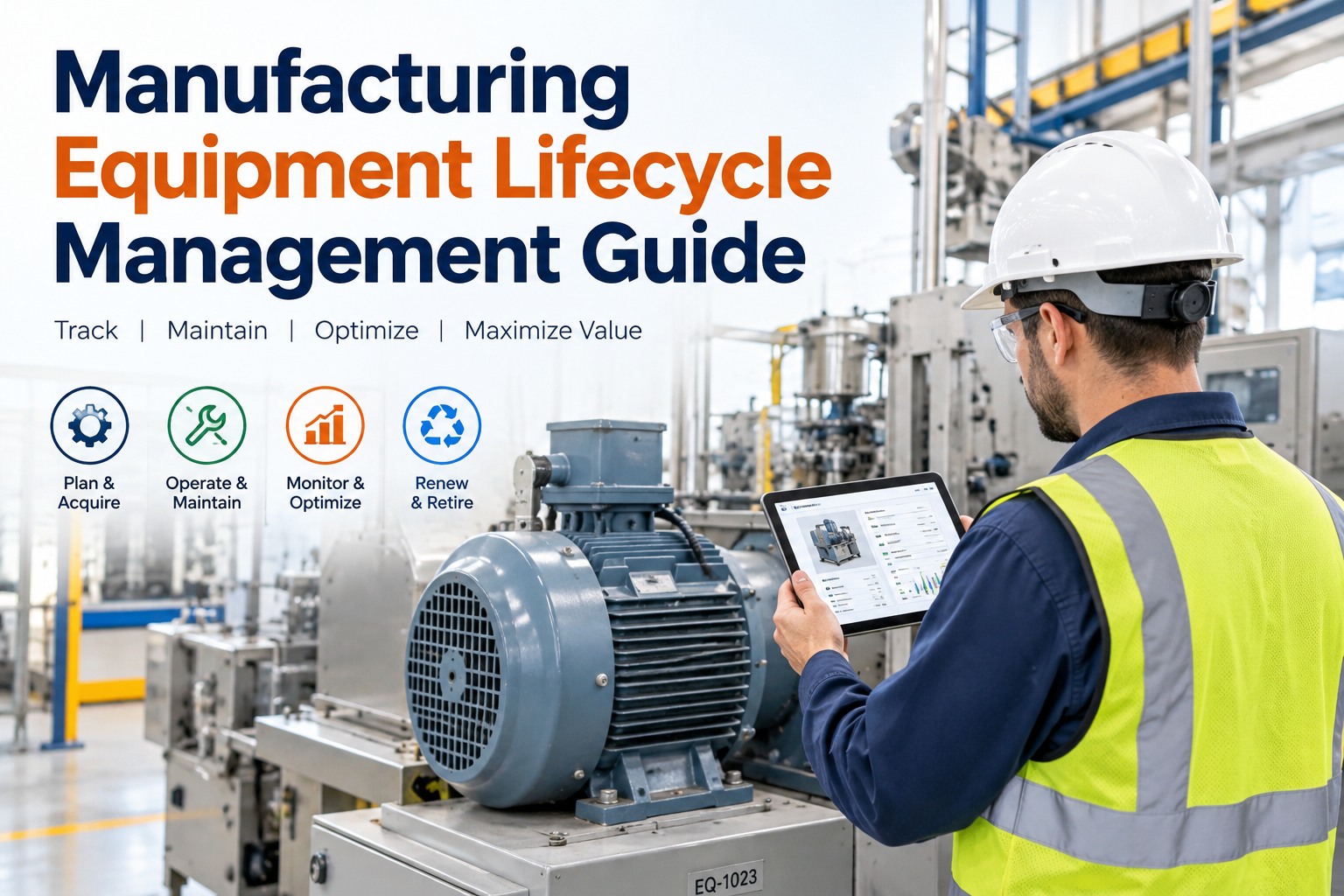
Every manufacturing machine you own is quietly moving through a predictable cost curve — and most plants have no idea where their critical assets actually sit on that curve until an emergency repair or a failed budget meeting forces the question. Unplanned equipment downtime alone costs industrial manufacturers nearly $50 billion annually, and a significant share of that loss comes not from bad luck but from treating asset lifecycle stages as disconnected events managed by different departments on different spreadsheets. The purchase price of a machine is typically just 10 to 25 percent of its total lifetime cost — energy, maintenance, spare parts, and downtime impact make up the rest, and those costs accelerate sharply in the final third of an asset's useful life. Start tracking your equipment lifecycle in Oxmaint free and connect procurement, maintenance history, depreciation, and end-of-life signals into one platform where every capital decision is backed by actual asset data — not accounting assumptions. Organizations that implement structured asset lifecycle management programs extend useful equipment life by 20 to 40 percent, reduce total maintenance costs by 25 to 35 percent, and replace reactive capital spending with planned, defensible budgets.
Asset Lifecycle Management for Manufacturing Equipment
From installation to decommissioning — how to track depreciation, optimize maintenance spend, and make repair vs. replace decisions with data instead of guesswork.
The Six Stages of Equipment Lifecycle — And Where Value Leaks Out
Every manufacturing asset moves through six predictable stages. The problem at most plants is not that these stages exist — it is that they are managed by different departments on different systems, with no data connecting one stage to the next. That fragmentation is where capital value silently drains away.
Planning & Procurement
Assess business need, evaluate total cost of ownership across vendors, and set baseline specifications. Most procurement decisions are made on upfront cost alone — the stage where the most expensive lifecycle mistakes are locked in.
Installation & Commissioning
Register every asset attribute at the moment of installation — serial number, install date, warranty terms, service intervals, spare parts list — into a centralized CMMS. Plants that skip this step spend years chasing data that should have been captured at week one.
Operation & Utilization
Track runtime hours, load levels, production output, and energy consumption per asset. Operators should understand proper use to prevent premature wear. Usage, load, and environment shape asset life far more than age alone — a pump running 24/7 in a corrosive environment degrades much faster than the same pump in a controlled warehouse.
Maintenance & Condition Monitoring
Execute scheduled preventive maintenance and condition-based interventions. Every work order, part consumed, and failure record logged to the asset's CMMS profile builds the maintenance cost history that makes the eventual repair vs. replace decision precise rather than political. Oxmaint logs every work order to the asset record automatically — sign up free to start building this history today.
Performance Decline & End-of-Life Signal
When cumulative maintenance spend reaches 40 to 60 percent of replacement cost, replacement planning should begin — not when the asset finally fails. Running an asset 18 months too long can cost more in emergency repairs, quality losses, and energy waste than the replacement machine itself. AI-driven condition monitoring surfaces these signals before they become crises.
Decommissioning & Disposal
Weigh depreciation against the rising cost of maintenance. Document regulatory compliance activities and create audit trails. Capture lessons from the asset's full lifecycle to improve the next procurement decision — closing the loop that most plants never close.
Why Straight-Line Depreciation Destroys Capital Planning Accuracy
Most capital planning is driven by the accounting department using straight-line depreciation. If a CNC machine is rated for 10 years, finance assumes its value drops by 10 percent annually until it hits zero. But your assets do not operate on paper. A machine "fully depreciated" on the books can be the most expensive piece of equipment in your building — and a machine with two years left on its depreciation schedule can be perfectly reliable and worth extending.
A regional bottling plant kept a 15-year-old palletizer running because finance said it was "fully depreciated." Maintenance data told a different story: $42,000 in specialized sensors and emergency shipping over 14 months, plus energy draw 18 percent above the manufacturer's original spec. When the maintenance manager presented this data to the CFO, a new palletizer was approved within 48 hours. The "free" machine was the most expensive asset in the building. Book a demo to see how Oxmaint builds this cost comparison automatically for every asset in your CMMS.
Stop guessing when to repair — start knowing when to replace
Oxmaint tracks cumulative maintenance spend, failure frequency, and energy trends per asset — and surfaces the data your team needs to make capital planning decisions that finance will approve on the first presentation.
The Repair vs. Replace Decision Framework — How to Answer It With Data
The repair vs. replace question is the most consequential maintenance decision in manufacturing — and the one most often made on gut instinct, political pressure, or accounting assumptions. A data-driven framework makes the answer defensible and financially precise.
| Signal | Data Source | Repair Indicator | Replace Indicator | How Oxmaint Tracks It |
|---|---|---|---|---|
| Cumulative maintenance cost | CMMS work order history | Below 40% of replacement cost | 40–60%+ of replacement cost | Auto-calculated per asset from closed WOs |
| Failure frequency trend | Work order failure records | Isolated failures, long MTBF | Accelerating failures, short MTBF | MTBF trend chart per asset |
| Energy consumption | IoT power monitoring | Within 5% of baseline | 10%+ above original spec | Energy trend vs. commissioning baseline |
| Parts availability | Inventory and supplier data | Parts readily available, standard lead time | OEM discontinued, custom fabrication required | Parts status flagged in asset record |
| Downtime impact | Production logs | Non-critical path, redundancy available | Critical path asset, no redundancy | Asset criticality rating in CMMS |
| Remaining warranty | Asset commissioning record | Active warranty covers repair cost | Warranty expired, full cost to owner | Warranty expiry alert in asset profile |
Swipe table left to see all columns on mobile
The Four Types of Data Every Asset Lifecycle Program Requires
Without reliable data in all four categories, lifecycle decisions become guesswork. Most plants have two of these four — and the gaps are where capital leaks out and replacement timing goes wrong.
Turning Lifecycle Data Into a Capital Plan Finance Will Approve
The most common reason capital replacement requests get rejected is not the budget — it is the data. A request that says "this machine is old and breaking down" gets deferred. A request that shows cumulative maintenance spend at 58 percent of replacement cost, MTBF declining from 340 hours to 90 hours over 18 months, and a projected 12-month repair cost exceeding the replacement price gets approved. Lifecycle data converts a gut-feel conversation into a financially defensible capital case.
Build a complete asset register with acquisition cost and install date
Every capital planning conversation starts with a clean asset record. Without acquisition cost and installation date, no meaningful depreciation or replacement timing analysis is possible.
Link every work order and part to the individual asset record
Cumulative maintenance cost is the single most important number in any repair vs. replace decision. It is only available if work orders are linked to assets — not just logged as general maintenance labor.
Set replacement cost benchmarks per asset class
Each asset in the register should have a current replacement cost estimate — updated annually. This is the denominator in the maintenance spend ratio that triggers replacement planning.
Generate a rolling 3-year capital replacement forecast
When maintenance spend ratio, failure frequency, energy trend, and remaining warranty data are combined per asset, a 3-year capital forecast becomes possible. Finance can plan budget before the emergency arrives — not after it. Oxmaint generates this forecast automatically from your existing work order data — sign up free to see what your current asset portfolio looks like.
Frequently Asked Questions About Asset Lifecycle Management
A CMMS is the operational backbone that records work orders, schedules maintenance, and tracks parts consumed per asset — it is the primary source of maintenance cost data. Asset lifecycle management is the broader strategy that uses CMMS data alongside financial data, operational data, and condition monitoring to make decisions about procurement, replacement timing, and capital planning. The CMMS makes ALM possible; ALM determines what decisions to make with CMMS data. Oxmaint combines both in one platform — start free to connect your asset register, work orders, and lifecycle analytics.
The general industry benchmark is that replacement planning should begin when cumulative maintenance spend reaches 40 to 60 percent of the current replacement cost of the asset. This is not a hard trigger for immediate replacement — it is the signal to begin the capital planning process, get replacement cost quotes, and prepare a budget case before the asset reaches the point of failure. Book a demo to see how Oxmaint surfaces this threshold automatically for every asset in your register.
Accounting depreciation (typically straight-line) reflects time, not condition. A machine that is fully depreciated on paper can be the most expensive asset in a plant to operate, while a machine with three years left on its depreciation schedule can be in excellent condition and worth extending well beyond its rated life. Actual asset condition is determined by runtime hours, load levels, failure frequency, energy consumption trends, and cumulative maintenance cost — none of which appear in a depreciation schedule. Effective lifecycle management tracks both so that capital decisions reflect real condition, not accounting theory.
You need four categories of data: asset registry data (ID, location, install date, criticality, specifications), financial data (acquisition cost, depreciation schedule, replacement cost estimate), operational data (runtime hours, energy consumption, utilization), and maintenance data (work order history, failure records, parts consumed). Most plants already have asset registry data — the gap is usually maintenance cost history linked to individual assets and current replacement cost benchmarks. Starting with just those two data gaps closed produces a meaningful improvement in capital planning accuracy within 60 to 90 days. Oxmaint helps you build all four data categories from a single platform — sign up free to start.
Connect every stage of your equipment lifecycle in one platform
Oxmaint tracks assets from commissioning to decommissioning — linking work order history, maintenance costs, condition trends, and replacement signals so your capital planning decisions are always backed by real data.