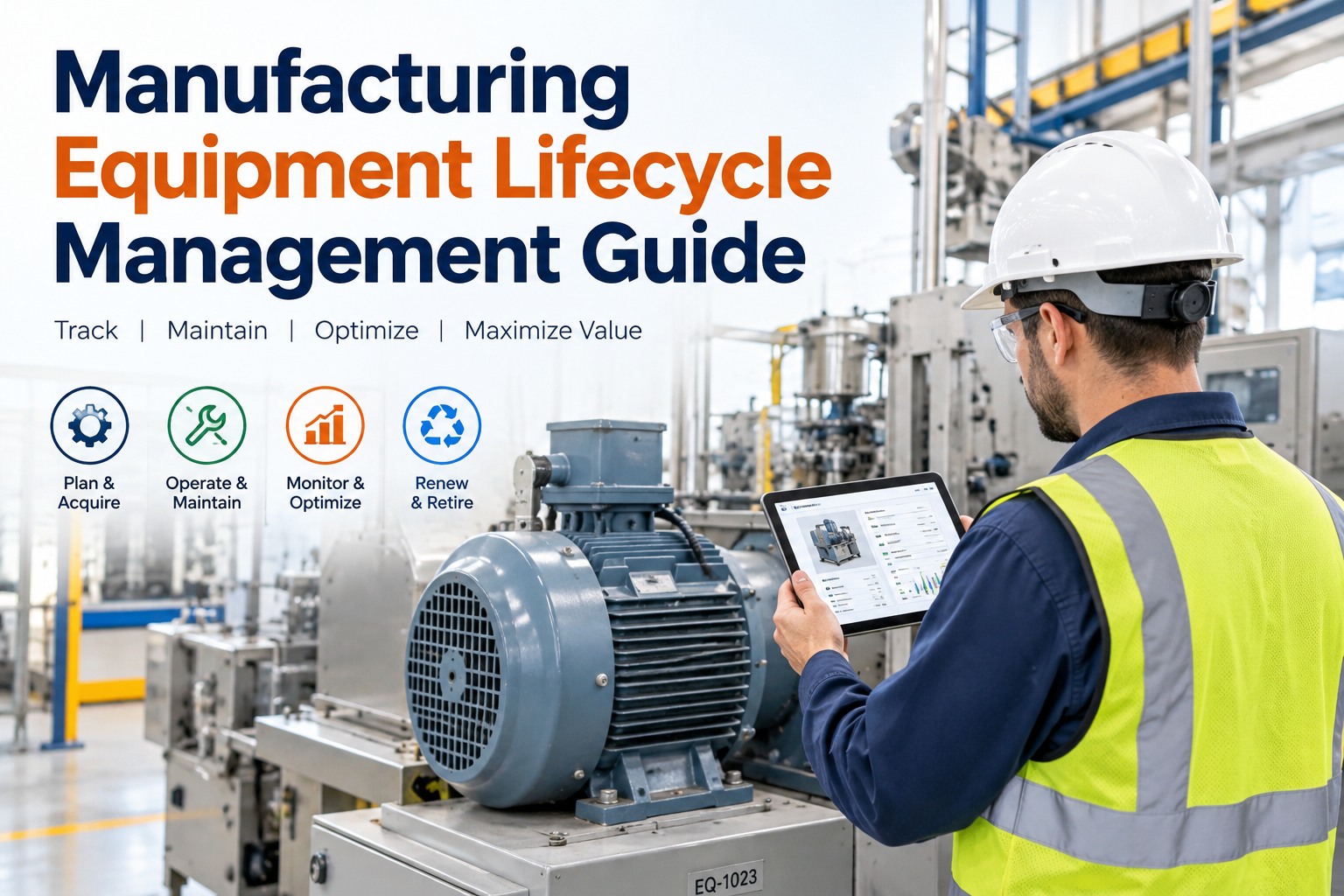
Manufacturing facilities average 800 hours of unplanned downtime per year — and aging equipment accounts for 29% of every unplanned stoppage, according to industry data collected from over 1,000 maintenance professionals. Oxmaint's CMMS tracks your equipment from day-one installation through end-of-life decommissioning, giving maintenance and finance teams the shared data foundation for capital planning, depreciation tracking, and repair-vs-replace decisions — start your free trial today. With the global asset lifecycle management market growing from $5.33 billion in 2025 to $8.90 billion by 2035, and over 60% of manufacturers already integrating AI-driven lifecycle tools, the question for plant managers is no longer whether to manage asset lifecycles systematically — it is how far behind you already are.
CMMS · Capital Planning · Equipment Strategy
Asset Lifecycle Management for Manufacturing Equipment
From installation commissioning to decommissioning disposal — the complete framework for managing every piece of manufacturing equipment through every stage of its working life.
$25K
Average cost per hour of unplanned downtime in manufacturing
29%
Of unplanned downtime caused by aging equipment — the leading single cause
40%
Maintenance cost reduction achievable with predictive lifecycle management
20%
Asset utilization improvement reported by companies implementing ALM programs
The Lifecycle Framework
Five Stages Every Manufacturing Asset Passes Through
Asset lifecycle management is not a single decision — it is a continuous process that spans the entire working life of each piece of equipment. Each stage has distinct data requirements, maintenance actions, and financial implications that your CMMS must track to support informed decisions.
1
Acquisition
Purchase cost, vendor, warranty terms, installation parameters, and baseline performance data recorded. This baseline is the reference point every future performance comparison depends on.
Track: Purchase price · Warranty expiry · Serial number · Baseline readings
2
Operation
Active production use with scheduled preventive maintenance, performance monitoring, and parts tracking. OEE, MTBF, and energy consumption measured continuously against baseline.
Track: PM compliance · OEE · Downtime events · Parts consumed
3
Maintenance
Cumulative repair cost tracking against asset value. Work order history reveals failure patterns, chronic fault components, and the total cost trajectory that drives replacement planning decisions.
Track: Cumulative repair cost · Failure patterns · Downtime frequency · MTTR
4
Degradation
Performance declining below targets, repair frequency accelerating, energy consumption rising. This is where repair-vs-replace analysis becomes critical and capital planning decisions must be made before costs escalate further.
Track: Performance ratio · Repair cost trend · Energy drift · Scrap rate impact
5
Decommission
Planned removal, salvage value recovery, disposal documentation, and capital budget release for replacement procurement. A managed end-of-life avoids emergency replacement costs and production disruption.
Track: Salvage value · Disposal records · Replacement capital request · Handover docs
Total Cost of Ownership
The True Cost Curve of Manufacturing Equipment Over Its Lifetime
Purchase price is the visible tip of the equipment cost iceberg. Total cost of ownership (TCO) across a typical asset's lifecycle reveals where capital is actually being consumed — and when replacement becomes the lower-cost option.
Initial Purchase Price
18%
Installation and Commissioning
7%
Planned Preventive Maintenance
22%
Unplanned Repairs and Downtime
28%
Energy and Utility Consumption
16%
Spare Parts Inventory Carrying
6%
Decommissioning and Disposal
3%
Typical TCO distribution for heavy manufacturing equipment over a 10–15 year lifecycle. Unplanned repair and downtime cost consistently exceeds purchase price within 5–7 years on reactive maintenance programs.
What This Means for Capital Planning
The purchase price decision controls only 18% of lifetime equipment cost. Operational and maintenance decisions control the other 82%.
Unplanned repairs become the largest single cost category as equipment ages — overtaking purchase price by year 7 on average for reactive maintenance programs.
Energy consumption increases 15–25% as equipment degrades past 80% of design life — a cost invisible without systematic performance trending.
Plants tracking TCO per asset make replacement decisions 18–24 months earlier than reactive plants — at planned cost rather than emergency cost.
Track TCO for Every Asset from Day One
Oxmaint captures purchase price, installation cost, cumulative repair spend, and downtime cost per asset automatically — giving your capital planning team the lifetime cost data that makes replacement decisions defensible, not debatable.
Repair vs. Replace Decision Framework
When to Repair and When to Replace — Making the Call With Data
The repair-vs-replace decision is the highest-stakes judgment in asset lifecycle management. Made too early, it wastes capital on unnecessary replacement. Made too late, it locks production into chronic unreliability. These are the five data signals that determine which answer is correct for each asset.
Replace Signal
Annual Repair Cost Exceeds 50% of Replacement Value
When cumulative annual maintenance spend on an asset crosses half its current replacement cost, continued investment in repairs delivers diminishing returns. The 50% threshold is the industry standard trigger for formal replacement evaluation — though the actual decision must weigh downtime frequency and production impact alongside cost.
Replace Signal
Downtime Frequency Accelerating Despite Repairs
When MTBF (mean time between failures) is shrinking quarter-over-quarter despite completed repairs, the asset is in systemic decline. Individual repair fixes symptoms while the underlying mechanical or electrical condition continues to deteriorate. Trending MTBF in your CMMS reveals this pattern before it produces a catastrophic failure.
Repair Signal
Isolated Single-Component Failure on Otherwise Healthy Asset
When a known, isolatable component fails on an asset with strong performance history and low cumulative repair cost, targeted repair is the correct decision. The asset's overall condition is still healthy — replacing it wastes the remaining useful life of every other component in the machine.
Repair Signal
Replacement Lead Time Exceeds Acceptable Production Risk
When a replacement unit cannot be sourced and commissioned within the production program's acceptable downtime window, repair extends operational continuity while replacement procurement proceeds in parallel. This is not a permanent decision — it is a bridge strategy that requires active parallel capital planning.
Evaluate Further
Asset Is Past 75% of Design Life with Rising Energy Consumption
An asset operating past 75% of its designed service life with documented energy consumption increases requires a formal TCO analysis comparing continued operation cost versus replacement ROI. Neither automatic repair nor automatic replacement is correct — the data must drive the conclusion specific to that asset's operating context and production criticality.
Depreciation and Capital Planning
Asset Depreciation Tracking and Capital Budget Planning
Depreciation tracking connects your maintenance decisions to your financial reporting. Without it, the finance team works from accounting schedules that bear no relationship to actual asset condition — and capital replacement budgets get built on assumptions rather than data.
Straight-Line Depreciation
Equal annual depreciation over the asset's useful life. Simple to calculate, standard for financial reporting, but does not reflect the accelerating maintenance cost curve as assets age. Best used alongside condition-based remaining useful life estimates.
Formula: (Cost — Salvage Value) / Useful Life Years
Condition-Based Remaining Useful Life
Remaining useful life calculated from actual performance data — failure frequency, repair cost trend, energy consumption drift — rather than calendar assumptions. This is the depreciation model that connects to real asset condition and produces defensible capital replacement requests.
Data sources: CMMS work orders · PM records · Performance trending
Capital Replacement Planning Horizon
Identifying assets approaching end-of-life 18–36 months ahead of required replacement allows planned procurement rather than emergency sourcing. Lead times for heavy manufacturing equipment run 3–18 months — capital planning that starts after failure has already failed.
Output: Rolling 3-year capital replacement forecast per asset class
Typical Manufacturing Equipment Design Life
CNC Machining Centers
12–18 yrs
Year 10
Industrial Robots
10–15 yrs
Year 8
Hydraulic Presses
20–30 yrs
Year 15
Air Compressors
10–15 yrs
Year 8
Conveyor Systems
15–20 yrs
Year 12
Drive Motors (VFD)
15–20 yrs
Year 12
Power Transformers
25–40 yrs
Year 20
HVAC / Cooling Systems
15–20 yrs
Year 12
Oxmaint for Lifecycle Management
What a CMMS Does at Each Stage of the Asset Lifecycle
Asset lifecycle management without a CMMS is a collection of spreadsheets, paper records, and memory — none of which scale beyond a handful of assets or survive personnel turnover. Oxmaint provides the continuous, asset-linked data trail that makes every lifecycle decision defensible.
Acquisition
Asset Commissioning Records
Purchase price, vendor, warranty terms, installation date, serial number, and baseline performance readings recorded at commissioning. Every future analysis references this baseline — without it, you cannot measure degradation or calculate remaining useful life accurately.
Operation
PM Scheduling and Compliance
Preventive maintenance schedules, work orders, and completion records maintain the asset condition history. OEE, MTBF, and downtime metrics calculated from actual work order data rather than estimates — enabling performance trending over the full operating life.
Maintenance
Cumulative Repair Cost Tracking
Every repair work order linked to the asset record builds the cumulative repair cost total automatically. When annual repair spend approaches the replacement threshold, Oxmaint surfaces the data your capital planning team needs — not a year after the threshold was crossed.
Start tracking repair costs per asset — free trial available.
Degradation
Failure Pattern and RUL Analysis
Failure frequency trending, component repeat failures, and performance ratio calculations from the work order history reveal the degradation pattern. This is the data that supports a repair-vs-replace analysis with evidence rather than opinion — making the capital request credible to finance leadership.
End of Life
Decommissioning and Replacement Workflow
Planned decommissioning work orders, salvage value documentation, disposal records, and replacement asset commissioning managed in sequence. The new asset inherits the asset class's PM template from day one — starting the next lifecycle with the institutional knowledge from the previous one intact.
Book a demo to see Oxmaint's asset lifecycle workflow end-to-end.
Common Questions
What Operations and Maintenance Leaders Ask About Asset Lifecycle Management
What is the 50% rule for repair vs. replace decisions?
The 50% rule states that when annual repair and maintenance costs for an asset exceed 50% of its current replacement value, replacement evaluation becomes the default recommendation. It is a widely used screening threshold — not an absolute rule — because production criticality, replacement lead times, and remaining performance capacity also factor into the final decision.
Track cumulative repair cost ratios per asset in Oxmaint — start free today.
How far in advance should we plan equipment replacement?
For heavy manufacturing equipment, start capital planning 18–36 months before the projected replacement date. Lead times for custom-built machinery run 3–18 months, and budget approval cycles typically require 6–12 months of advance notice. Plants that start replacement planning after a failure have already lost the ability to make it a cost-controlled event.
Book a demo to see how Oxmaint supports capital replacement forecasting.
What data does a CMMS need to support lifecycle management?
At minimum: purchase price and installation date, every PM and repair work order with labor and parts cost, downtime event records, and performance readings at regular intervals. This data exists in most facilities but is scattered across paper records, spreadsheets, and ERP systems. A CMMS consolidates it into asset-linked records that support trending analysis and capital planning.
Oxmaint centralizes all lifecycle data per asset — free trial, no setup required.
How does depreciation tracking connect to maintenance decisions?
Accounting depreciation schedules treat all assets identically regardless of actual condition. Condition-based remaining useful life — calculated from CMMS work order history — tells you which assets are aging faster than their depreciation schedule assumes and which still have years of value beyond their book value. This gap is where smart capital allocation decisions are made.
Talk to our team about connecting Oxmaint asset data to your capital planning process.
What is the difference between asset lifecycle management and preventive maintenance?
Preventive maintenance is one activity within asset lifecycle management — the operational maintenance phase. ALM is the broader framework that covers acquisition documentation, performance baseline tracking, cumulative cost analysis, depreciation, repair-vs-replace decision support, and end-of-life planning. PM keeps assets running; ALM determines for how long, at what cost, and when to stop.
Start managing the full asset lifecycle in Oxmaint — free trial available.
Every Asset Has a Lifecycle. The Question Is Whether You Are Managing It or Reacting to It.
Purchase price is 18% of lifetime equipment cost. The other 82% is determined by how well you track, maintain, and plan each asset from commissioning to decommissioning. Oxmaint gives your maintenance and finance teams the shared data foundation that makes that 82% controllable.