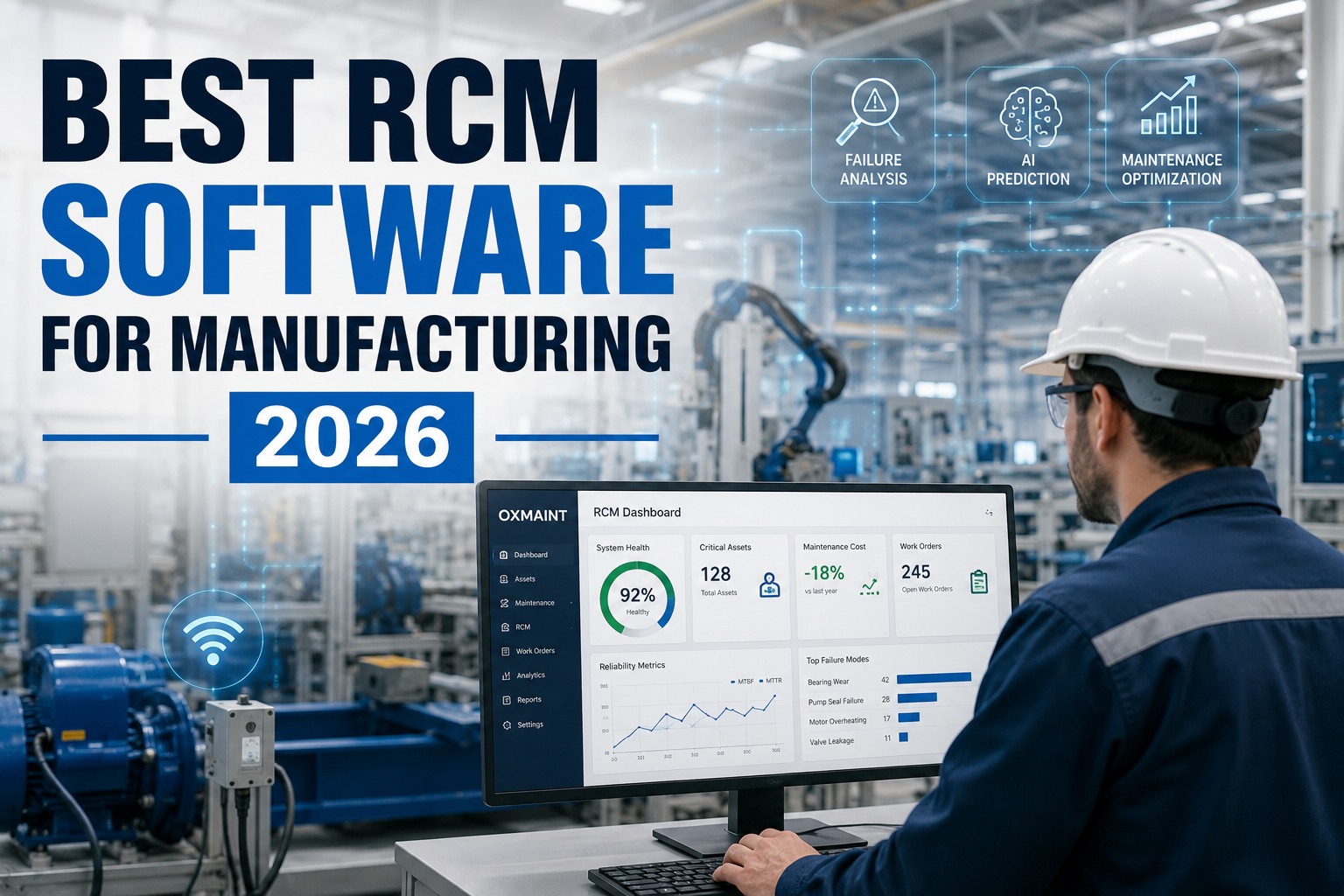
Reliability-Centered Maintenance is the most rigorous framework ever built for answering a single manufacturing question: for each failure mode in each operating context, what is the most effective thing to do — and is doing something more effective than doing nothing? The SAE JA1011 standard, the seven-question logic, the consequence hierarchy, the P-F interval — none of that is administrative overhead. It is the analytical spine that separates maintenance strategies that improve reliability from strategies that merely consume budget. Manufacturing plants applying RCM correctly report OEE gains of 15–25% and eliminate 30–50% of legacy PM tasks that were adding cost without adding reliability. The question in 2026 isn't whether to run RCM — it's which platform actually operationalizes it on the plant floor without becoming another shelf-ware analytics tool nobody opens after month three. This guide compares the best RCM software for manufacturing and shows why cloud-native AI-first platforms are displacing the legacy enterprise stack. Book a free demo to see the RCM workflow against your asset register.
$50K
Average per-hour cost of manufacturing production downtime
15–25%
OEE improvement typical from RCM program implementation
30–50%
Share of legacy PM tasks that can be safely eliminated or optimized
up to 40%
Unplanned downtime reduction reported after full RCMII deployment
What RCM Software Actually Has to Do
Most tools marketed as "RCM software" are one of two things — a document management system for FMEA worksheets, or a CMMS that mentions "reliability" in the feature list. Neither operationalizes RCM. A real RCM platform for manufacturing has to execute the SAE JA1011 seven-question logic against every failure mode, feed the resulting task selection into scheduled work orders, ingest condition-monitoring data to trigger predictive interventions, and keep the analysis alive as a continuously refined program — not a one-time consulting deliverable that dies in a shared drive.
FN1
Asset Criticality & Pareto Analysis
Live criticality scoring surfaces the 20% of systems driving 80% of downtime. RCM effort concentrates on assets where it moves the needle.
FN2
Structured FMEA Worksheets
Failure Mode & Effects Analysis captured per component — mode, cause, effect, severity, occurrence, detection, RPN — linked to the asset record.
FN3
JA1011 Seven-Question Decision Logic
Every failure mode routed through the consequence hierarchy — hidden / safety / environmental / operational / non-operational — with task selection driven by outcome.
FN4
P-F Interval & Task Scheduling
Potential failure to functional failure interval determines predictive-task frequency. Scheduling engine turns intervals into real work orders on the calendar.
FN5
Condition Monitoring & IoT Ingest
Vibration, thermal, current, pressure — sensor data streams into the platform, triggers predictive WOs when thresholds cross, feeds the P-F clock.
FN6
Living Program & Feedback Loop
Actual MTBF / MTTR compared against FMEA predictions monthly. Task intervals auto-recommend adjustment. Program refines itself with operational data.
FN7
Mobile Execution on the Floor
Predictive and preventive tasks delivered to technician's phone with pass/fail criteria, photo evidence, readings captured against the asset.
FN8
SAP / Maximo Overlay
Runs alongside enterprise EAM rather than replacing it — RCM lives in a purpose-built layer that syncs asset records and pushes optimized tasks back.
The 2026 RCM Software Landscape · How the Field Actually Stacks Up
The RCM software market in 2026 splits cleanly into three tiers, each with different economics, deployment timelines, and operational fit. Understanding the tier matters more than any individual vendor comparison — because the wrong tier is the wrong tool no matter how good the sales demo looks.
IBM Maximo · SAP PM · Oracle EAM
Best for: multi-site enterprises with existing EAM stack and dedicated reliability team
Cost: $10K+/user annually, plus implementation
Timeline: 6–18 months to production
Tradeoff: deep functionality, but heavy to change; mobile experience often bolted-on
RCM++ · Windchill FMEA · dedicated FMEA tools
Best for: reliability engineering teams doing formal FMEA studies as project deliverables
Cost: per-seat licensing, moderate
Timeline: weeks to install, months to embed in workflow
Tradeoff: strong analysis, weak execution — findings often don't reach the plant floor
OxMaint · modern reliability CMMS with RCM native
Best for: single-site to multi-site manufacturers wanting RCM as an operational reality, not a project
Cost: cloud subscription with free forever plan tier
Timeline: live in days · scaled in weeks
Tradeoff: less enterprise ceremony, more operational velocity
The Scoring Matrix · How to Compare RCM Platforms in an RFP
Ops leadership scoping RCM software should score every candidate against the same set of capabilities. The matrix below is the working framework — same seven dimensions, same weight, same tests. Anything less than "yes native" on the first three dimensions is a compromise you'll pay for in month six.
Capability
Legacy EAM
FMEA Point Tool
OxMaint · Cloud-Native RCM
Native FMEA worksheet in-platform
Add-on module
Yes (standalone)
Yes · linked to asset & WO
FMEA findings auto-generate WOs
Manual mapping
Export only
Direct WO generation
JA1011 seven-question logic
Config required
Yes
Built-in decision tree
Live criticality & Pareto rollup
Reporting module
Static analysis
Live dashboard
IoT / condition monitoring ingest
Via middleware
Not native
Native REST + MQTT
Mobile execution on plant floor
Add-on app
Not available
Mobile-first · offline sync
SAP / Maximo overlay compatibility
N/A (is the EAM)
Limited
Purpose-built overlay layer
Deployment timeline
6–18 months
Weeks to months
Days to weeks
Free plan tier available
No
No
Free forever plan
Score OxMaint Against the Matrix on Your Asset Data
30-minute working session — bring your top-20 critical assets and existing PM cadence, we'll walk the RCM decision logic through them and show what optimized task selection actually looks like against your equipment.
The RCM Decision Flow · From Asset Register to Optimized Work Order
The best RCM software is judged by how completely it closes the loop from asset criticality to a scheduled work order that actually fires on the plant floor. The five-stage flow below is what OxMaint runs as one integrated workflow rather than five disconnected steps.
01
Criticality Analysis
Pareto scan of asset register surfaces the 20% driving 80% of downtime. RCM effort scoped to where it moves the needle — not applied blindly to every machine.
02
FMEA per Critical Asset
Failure modes, causes, effects captured with severity / occurrence / detection scoring. RPN calculated. Findings linked back to specific asset records — not stored in a separate document.
03
JA1011 Decision Logic
Each failure mode routed through the seven-question tree: hidden or evident, safety consequence, operational consequence, technically feasible predictive task, feasible preventive task, feasible failure-finding, run-to-failure default.
04
Task & Interval Selection
Selected task type — predictive, preventive, condition-based, failure-finding, run-to-failure — with P-F interval defining frequency. Schedule engine converts intervals into calendar-based auto-generated work orders.
05
Living Program Feedback
Actual MTBF / MTTR / failure frequency tracked and compared to FMEA predictions monthly. Task intervals auto-recommend adjustment. Program refines itself with operational data — not annual re-analysis.
Reliability KPIs That RCM Software Must Track
An RCM platform without live KPI tracking is a static analysis exercise, not an operating system. The five KPIs below are the minimum any manufacturing reliability program has to report on continuously — because RCM's whole promise is measurable improvement in each of them.
MTBF
Mean Time Between Failures
Average operational hours between breakdowns per asset. RCM's central success metric — trending up is the operational signal that the program is working.
MTTR
Mean Time To Repair
Average time from failure to restored service. Measures the speed of the response — RCM lowers both failure frequency and repair time through spares readiness.
OEE
Overall Equipment Effectiveness
Availability × Performance × Quality. World-class ≥85%; industry average ~60%. RCM lifts OEE by 15–25% in typical deployments.
PM Comp
Preventive Task Compliance
Percentage of scheduled RCM tasks completed on time. Below 90% means the program is defined but not executed — visibility fixes the gap fast.
P/R
Planned-to-Reactive Ratio
Hours of planned maintenance ÷ hours of reactive maintenance. Best-in-class ≥80:20. Every percentage-point shift toward planned is money saved.
$/Hr
Cost per Operating Hour
Total maintenance cost ÷ asset operating hours. The financial signal — RCM's target is falling cost per hour alongside rising availability.
Expert Perspective · What Separates Real RCM From Shelf-Ware Analysis
Every manufacturing plant we've helped deploy RCM successfully shares one habit — they refused to let the FMEA analysis end up in a document. In the plants where RCM fails, the pattern is identical: consultants ran a 6-month analysis, delivered a 200-page report with beautiful worksheets, and left. Six months later, none of it had translated to a single new work order. The maintenance team was still doing the same calendar-based PMs, and the plant floor never saw the analysis. The plants where RCM works skip the deliverable-based model entirely. They put the FMEA worksheet inside the CMMS as a live object linked to the asset. Every failure mode is a database row. Every selected task is an auto-generated recurring work order. Every KPI reading updates the FMEA prediction accuracy score. The analysis becomes the operating system, not a shelf-ware artifact. That's what "cloud-native AI-first" actually means for RCM — it's not about the algorithms, it's about the operational architecture that keeps analysis and execution as the same thing.
Analysis Lives Inside the CMMS
FMEA worksheets as database records, not documents. Every failure mode linked to the asset it describes. Findings drive real work orders.
Predictions vs Actual Every Month
The MTBF the FMEA predicted vs the MTBF actually observed. The gap is the learning signal — task intervals adjust automatically.
Kill the Deliverable Mindset
RCM is not a project with an end date. It's an operating rhythm the CMMS runs continuously — no consultants required to keep it alive.
Why OxMaint Is the Cloud-Native RCM Answer for Manufacturing
OxMaint packages the full RCM operating model into a single cloud-native CMMS — no separate FMEA tool, no external reliability analytics platform, no consulting-heavy deployment. Assets, failure modes, decision logic, tasks, work orders, condition data, and KPIs live as facets of one data model. That's what makes RCM operational instead of aspirational.
FMEA
Structured Analysis In-Platform
Failure mode records linked to assets · severity/occurrence/detection scoring · RPN auto-calculated · versioned as the analysis evolves
Logic
JA1011 Decision Tree Native
Seven-question flow encoded — hidden/evident, safety, operational, technical feasibility — surfaces the optimal task type per failure mode
Schedule
Task & Interval Auto-Generation
P-F interval sets frequency · schedule engine auto-fires recurring predictive and preventive work orders per asset
Sensor
IoT & Condition Data Ingest
Vibration, thermal, current, pressure ingested via REST or MQTT · threshold-crossing auto-fires condition-based work orders
Mobile
Plant-Floor Execution
Every task delivered to phone with pass/fail criteria, photo capture, offline sync · QR asset tags · works everywhere technicians do
Overlay
SAP / Maximo Compatible
Runs alongside enterprise EAM · asset records sync bidirectionally · optimized RCM tasks push back into the system of record
Analytics
Live Reliability KPIs
MTBF, MTTR, OEE, PM compliance, planned-to-reactive ratio, cost per operating hour — live dashboards, no monthly report cycle
AI
Predictive Anomaly Detection
Machine-learning models watch sensor streams for early failure signatures · surface anomalies before threshold-based rules would catch them
Turn Your RCM Analysis Into a Living Program
Stop letting FMEA analysis die in a shared drive. See how OxMaint runs the whole RCM stack — FMEA, JA1011 logic, task selection, IoT ingest, mobile execution, live KPIs — on a single cloud-native CMMS. Free forever plan available to trial the full workflow.
Frequently Asked Questions
What's the difference between RCM software and a regular CMMS?
A regular CMMS manages work orders, spares, and PM schedules — but treats the maintenance strategy as an input. RCM software builds the strategy itself: it structures FMEA analysis, applies the SAE JA1011 seven-question decision logic to each failure mode, calculates the P-F interval, selects the optimal task type (predictive, preventive, condition-based, failure-finding, or run-to-failure), and then auto-generates the resulting work orders. The best 2026 platforms combine both — RCM analysis and CMMS execution as one data model — so the analysis stays alive rather than becoming a shelf-ware document.
Is OxMaint really cloud-native AI-first, or is that marketing?
OxMaint is architected as cloud-native from the ground up — multi-tenant SaaS, mobile-first client, native REST and MQTT interfaces for IoT, and machine-learning models that watch sensor streams for early failure signatures rather than relying solely on threshold rules. The distinction from bolt-on modules matters operationally: cloud-native means live in days rather than months, mobile that works offline in plant environments, and AI that operates on live data rather than nightly batches.
Sign up free to try the platform.
How does OxMaint work as an overlay to SAP PM or IBM Maximo?
Many manufacturing enterprises already run SAP PM or IBM Maximo as their system of record and can't rip them out. OxMaint deploys as an overlay layer — asset records sync bidirectionally, RCM analysis runs in OxMaint, and the optimized preventive and predictive tasks push back into the EAM as work orders. Reliability engineers get purpose-built RCM tooling and mobile execution while the corporate EAM remains authoritative. This is the pattern most large manufacturers now use in 2026 to modernize reliability without a multi-year EAM replacement project.
What ROI should we expect from an RCM deployment on OxMaint?
Manufacturing plants applying RCM correctly typically report 15–25% OEE improvement, up to 40% unplanned downtime reduction after full RCMII deployment, elimination of 30–50% of legacy PM tasks that were adding cost without adding reliability, and 15–20% annual maintenance cost reduction. Actual ROI depends on baseline maturity, asset criticality mix, and how thoroughly the FMEA findings translate to live scheduled work — which is exactly where OxMaint's integrated model outperforms consulting-led analyses that die in a shared drive.
Book a free demo to model ROI against your assets.
Which failure-mode analysis method does OxMaint support — FMEA, FMECA, RCM-R?
OxMaint supports the FMEA / FMECA methodology as its primary failure-mode analysis engine, with severity / occurrence / detection scoring, RPN calculation, and criticality classification per component. The SAE JA1011 decision logic then routes each failure mode to the appropriate maintenance strategy. This structure aligns with both RCMII and RCM-R methodologies — the analytical structure is the same, only the labelling differs across schools. For plants operating under specific reliability standards, the field labels and scoring scales are configurable.
How long does it take to deploy OxMaint's RCM software at a manufacturing plant?
A single-plant pilot with the top 20 critical assets typically goes live in days — asset import, FMEA structure, initial task scheduling — because there's no on-premise install, no infrastructure procurement, no license-server setup. Full plant deployment across all critical assets usually takes 2–6 weeks depending on how much of the asset register needs digitizing and how much existing PM history is being migrated. Multi-site enterprise deployment with SAP or Maximo overlay integration typically completes in 8–12 weeks. Compare that with 6–18 months for a traditional EAM-native RCM implementation.
Sign up free to start with your first critical assets.
.png)


.png)
.png)

