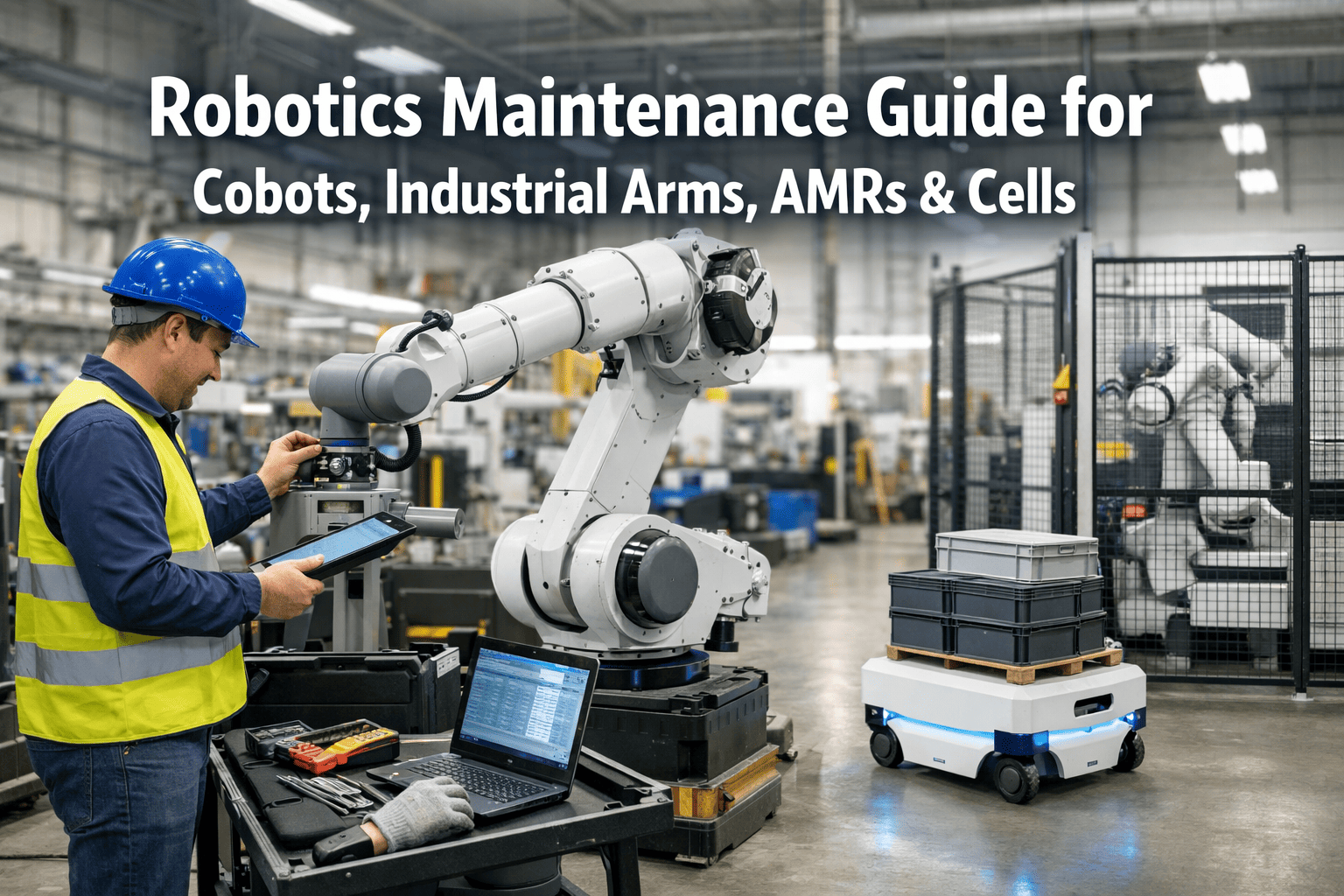
Cobots & Industrial Robotics Maintenance: Boosting Uptime and Efficiency
By Johnson on March 17, 2026
Collaborative robots and industrial robotic arms are now the fastest-growing asset category on the modern factory floor — and also the most under-maintained. A cobot that goes down on a high-volume assembly line does not just stop one task; it stalls the entire cell, disrupts human-robot workflows, and can trigger cascading downtime across interconnected stations. Yet most maintenance teams manage robot fleets the same way they managed machines in 1995 — with paper logs, calendar-based service intervals, and reactive repair after something breaks. In 2026, leading manufacturers are applying predictive maintenance, runtime-based service tracking, and live health monitoring to every robot and cobot in their fleet — reducing unplanned downtime by up to 65% and extending arm service life by 40%. This guide covers every dimension of robotics maintenance: failure modes, service intervals, fleet tracking, OEE impact, and how OxMaint automates the entire maintenance workflow for robotic assets of any brand or type. Sign up free on OxMaint and bring your entire robot fleet under structured maintenance management today.
Cobots & Industrial Robotics Maintenance:
Maximising Uptime Across Your Entire Fleet
Your robot fleet is only as reliable as your maintenance programme. Here is how forward-thinking plants track, service, and predict failures across every arm, cobot, and AMR — before they stop the line.
Why Robot Maintenance Is the Blind Spot in Most Maintenance Programmes
When manufacturers invest $35K–$250K in a robot or cobot, they focus intensely on installation, programming, and safety. What gets skipped is the long-term maintenance plan — and the cost of that omission compounds with every operating hour.
No Runtime Tracking
Most plants service robots on a calendar schedule — every 6 months regardless of actual cycles run. A robot doing 3 shifts needs service 3× more often than one doing 1 shift. Calendar intervals create dangerous over- and under-maintenance.
Institutional Knowledge Gap
Robot maintenance expertise is concentrated in 1–2 people per plant. When they leave, the tacit knowledge of each arm's quirks, fault history, and custom settings leaves with them. Without a structured CMMS, that knowledge is gone permanently.
Mixed Fleet Complexity
A typical plant runs robots from 3–5 different OEMs, each with proprietary software, different fault codes, and separate service manuals. Without a unified maintenance layer, each robot becomes a separate silo — invisible to the broader maintenance team.
Cascading Cell Failures
Robots in modern factories are not isolated — they operate in interconnected cells where one arm's failure stops upstream and downstream stations. A $500 worn gear on one robot can trigger $50,000 in cell downtime across an entire shift.
Robot Types
Cobots vs Industrial Robots vs AMRs: Different Assets, Different Maintenance Needs
Top failure modesJoint wear · Grease degradation · Force sensor drift · Cable fatigue
Avg. MTBF35,000 hours (unmanaged: 12,000)
Track joint cycles individually — not total power-on hours. Different joints wear at different rates.
Industrial Robot Arms
$50K–$250K
FANUC · ABB · KUKA · Yaskawa · Kawasaki
Payload6–2,300 kg
Service intervalEvery 3,840–7,680 operating hours
Top failure modesGearbox wear · Servo motor faults · Teach pendant errors · Encoder drift
Avg. MTBF80,000+ hours (properly maintained)
Gearbox grease changes are the single highest-ROI maintenance task — cheap to do, catastrophic to miss.
AMRs & AGVs
$20K–$120K
MiR · Locus Robotics · Omron · Boston Dynamics · Clearpath
Payload100–1,500 kg
Service intervalEvery 500–1,000 operating hours
Top failure modesBattery degradation · Drive wheel wear · LiDAR fouling · Charger port wear
Avg. MTBF15,000 hours (battery-dependent)
Battery health is the primary uptime driver. Track charge cycles and capacity fade per unit — not fleet averages.
Failure Analysis
The 8 Most Common Robot Failure Modes — and How to Prevent Each One
01
Joint & Gearbox Wear
Accounts for 38% of all unplanned robot downtime. Reducers and gearboxes degrade with cumulative load cycles — not calendar time. Vibration analysis and cycle counting are the only reliable early warning signals.
Grease change every 20K cycles + vibration monitoring
02
Cable & Connector Fatigue
Repetitive motion cycles stress cable dress assemblies at flex points. Signal cables on high-cycle applications fail every 12–18 months without protective routing and periodic inspection. Intermittent faults are the hardest to trace.
Inspect cable dress every 50K cycles · Replace at first sign of chafing
03
Servo Motor & Drive Faults
Servo drives develop thermal issues, capacitor degradation, and encoder feedback errors over time. Drive faults are the second leading cause of unplanned robot stops and the most expensive to fix outside a planned maintenance window.
Thermal monitoring + annual drive diagnostic scan
04
End-of-Arm Tooling (EOAT) Wear
Grippers, welding torches, and vacuum cups wear faster than the robot arm itself. EOAT failures cause quality defects before they cause downtime — making them invisible until scrap rates spike at the end of a shift.
Insufficient or degraded lubrication in joints, wrists, and gearboxes causes accelerated metal wear. The challenge is that lubrication failure is invisible until it produces noise, heat, or elevated current draw — typically well past the optimal intervention point.
Runtime-triggered lube schedule + temperature monitoring on joint housings
06
Controller & Software Issues
Firmware version mismatches, corrupted parameters from e-stops, and teach pendant failures cause up to 15% of all robot stoppages. Unlike mechanical failures, these produce no early physical warning — they simply stop the robot mid-cycle.
Scheduled backup of controller parameters + firmware update protocol
07
Battery & UPS Degradation (AMRs)
AMR and mobile robot batteries lose capacity progressively — reducing per-charge range until the robot cannot complete a full mission. Battery fade is gradual and invisible without per-unit capacity tracking across charge cycles.
Track capacity per unit · Replace at 80% original capacity threshold
08
Collision & Overload Damage
Collisions — even minor ones that trigger a safety stop — can cause micro-damage to joint housings, wrist assemblies, and EOAT mounts that compound over repeated events. Without logging every collision event, damage accumulates invisibly until a major failure.
Log every collision event in CMMS · Inspect after any overload trip
Service Intervals
Robot Maintenance Intervals by Task and Asset Type
These intervals are starting points based on OEM recommendations and industry practice. Actual intervals should be adjusted based on your specific duty cycle, environment, and payload utilisation.
Maintenance TaskCobotsIndustrial ArmsAMRsPriority
Joint / Gearbox Grease Change
20,000–35,000 cycles
3,840–7,680 hrs
N/A
Critical
Cable Dress Inspection
50,000 cycles
Every 6 months
500 hours
High
EOAT / Gripper Inspection
10,000–25,000 cycles
10,000 cycles
Weekly visual
High
Controller Backup
Monthly
Monthly
Monthly
Medium
Brake Test & Safety Check
Quarterly
Every 6 months
Quarterly
Critical
Battery Capacity Test
N/A
N/A
Every 250 charge cycles
High
Drive Wheel / Track Wear
N/A
N/A
Every 1,000 hours
Medium
Full OEM Service Inspection
Annually
Annually
Annually
High
OxMaint Platform
How OxMaint Manages Your Entire Robot Fleet in One Place
OxMaint treats every robot and cobot as a first-class asset — with cycle-based PM schedules, live health monitoring, fault history, and auto-generated work orders that ensure nothing is missed across your entire fleet regardless of brand or type.
Cycle-Based PM Scheduling
Set maintenance triggers on actual joint cycles — not calendar dates. OxMaint auto-generates PM work orders when each joint, axis, or EOAT reaches its service threshold, regardless of shifts worked or downtime periods.
Live Robot Health Monitoring
Connect robot controllers via OPC-UA or REST API to stream torque, temperature, current draw, and fault codes to OxMaint dashboards in real time — no third-party middleware required.
Fleet-Wide Fault & History Log
Every fault code, maintenance action, collision event, and controller backup is logged against the specific robot asset — building a complete service history that survives staff changes and informs future decisions.
Robot OEE & Uptime Dashboard
Track planned vs actual uptime, MTBF, MTTR, and availability per robot — and compare performance across the fleet to identify outliers before they become failures.
Technician Mobile App
Technicians receive work orders on mobile with step-by-step service checklists, torque specs, parts lists, and photo documentation fields — building the institutional knowledge that prevents knowledge-loss gaps.
Multi-Brand Fleet Support
Manage FANUC, ABB, KUKA, Universal Robots, YASKAWA, Mitsubishi, and any other brand in a single platform — with brand-specific PM templates and OEM service interval libraries pre-loaded.
Proven Results
What Structured Robot Maintenance Delivers in 12 Months
65%
Reduction in Unplanned Robot Downtime
40%
Longer Average Robot Service Life
55%
Lower Robot Maintenance Spend
3×
ROI on Maintenance Investment
28%
Higher First-Time Fix Rate on Robots
70%
Reduction in Emergency Robot Repairs
"
We had 14 cobots across three assembly lines and zero structured maintenance records. Every service was reactive and every failure was a surprise. After deploying OxMaint with cycle-based PM triggers on each arm, we went nine months without a single unplanned robot stop. Our maintenance cost per cobot dropped by 48% and we pushed back a planned replacement by two full years.
Head of Automation Engineering
Electronics Assembly Plant · 2,100 employees · South Korea
Every Robot in Your Fleet Deserves a Maintenance Plan. Build One Today.
OxMaint turns your robot fleet from a reactive liability into a managed asset — with cycle-based PM schedules, live health monitoring, fleet-wide fault history, and automated work orders for every arm, cobot, and AMR you operate. Brand-agnostic, deploys in days.
Cycle-based PM for every robot joint FANUC · ABB · UR · KUKA · YASKAWA + more Live uptime & MTBF per robot Free to start · no credit card needed
How is cobot maintenance different from traditional industrial robot maintenance?
Cobots operate in close proximity to humans, which means their safety-critical systems — force/torque sensors, brake mechanisms, joint stops — require more frequent verification than traditional industrial arms behind safety fencing. Cobots also typically run lower payloads at slower speeds, meaning joint wear patterns differ from high-speed industrial arms. The key difference in maintenance approach: cobots require both mechanical service (joint grease, cable inspection) and regular safety function verification, while industrial robots primarily need mechanical and electrical maintenance. OxMaint has pre-built service checklists for both types — start free today.
How do I calculate the right service interval for my robot fleet?
OEM-specified intervals assume a defined duty cycle (typically 50–80% payload, standard operating temperature, single-shift operation). For each deviation from this baseline, adjust intervals accordingly: 3-shift operation at high payload reduces grease change intervals by 40–60% vs the OEM calendar recommendation. The most accurate approach is tracking actual joint cycles (available from the robot controller) and setting PM triggers at the OEM cycle-based threshold — rather than calendar time. OxMaint automates this by pulling cycle data from the controller and triggering work orders at the right threshold per joint. Book a demo to see cycle-based PM configuration.
Can OxMaint manage robots from multiple different manufacturers?
Yes. OxMaint is brand-agnostic — it manages assets, not machines from a specific vendor. Every robot, regardless of manufacturer, is entered as an asset with its own service history, PM schedule, cycle counter integration, and fault log. OxMaint includes pre-built PM templates for major robot brands including FANUC, ABB, KUKA, Universal Robots, YASKAWA, Kawasaki, and Mitsubishi. Integration with robot controllers for live data is supported via OPC-UA, REST API, or manual cycle logging through the mobile app.
What happens to robot maintenance records when a technician leaves?
With OxMaint, nothing is lost. Every maintenance action, fault event, parts replacement, calibration result, and controller backup is logged against the specific robot asset — not stored in someone's memory or personal notebook. When a technician leaves, their full history of work on each asset remains in the system, accessible to their replacement from day one. This is one of the highest-value capabilities for plants that have experienced knowledge-loss from staff turnover on automation-heavy lines.