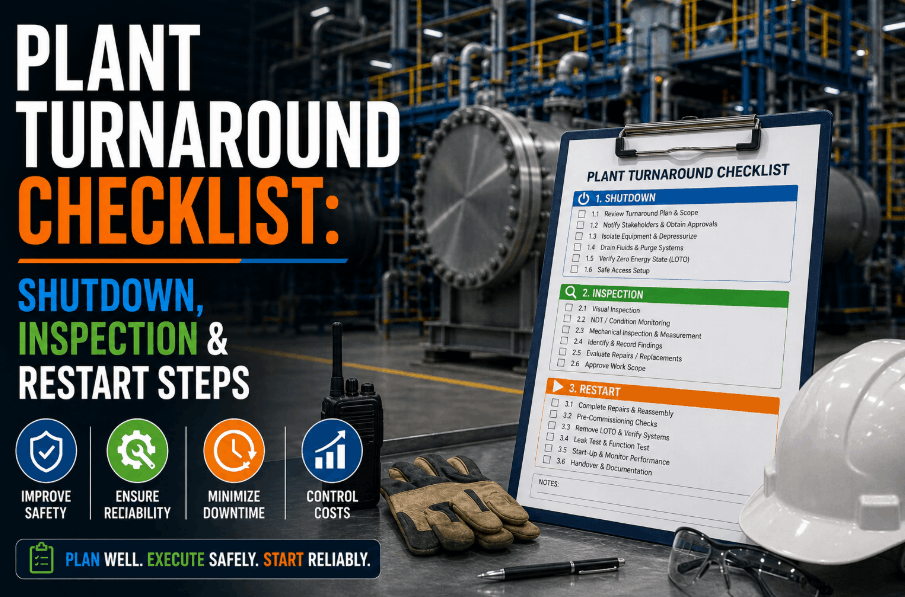
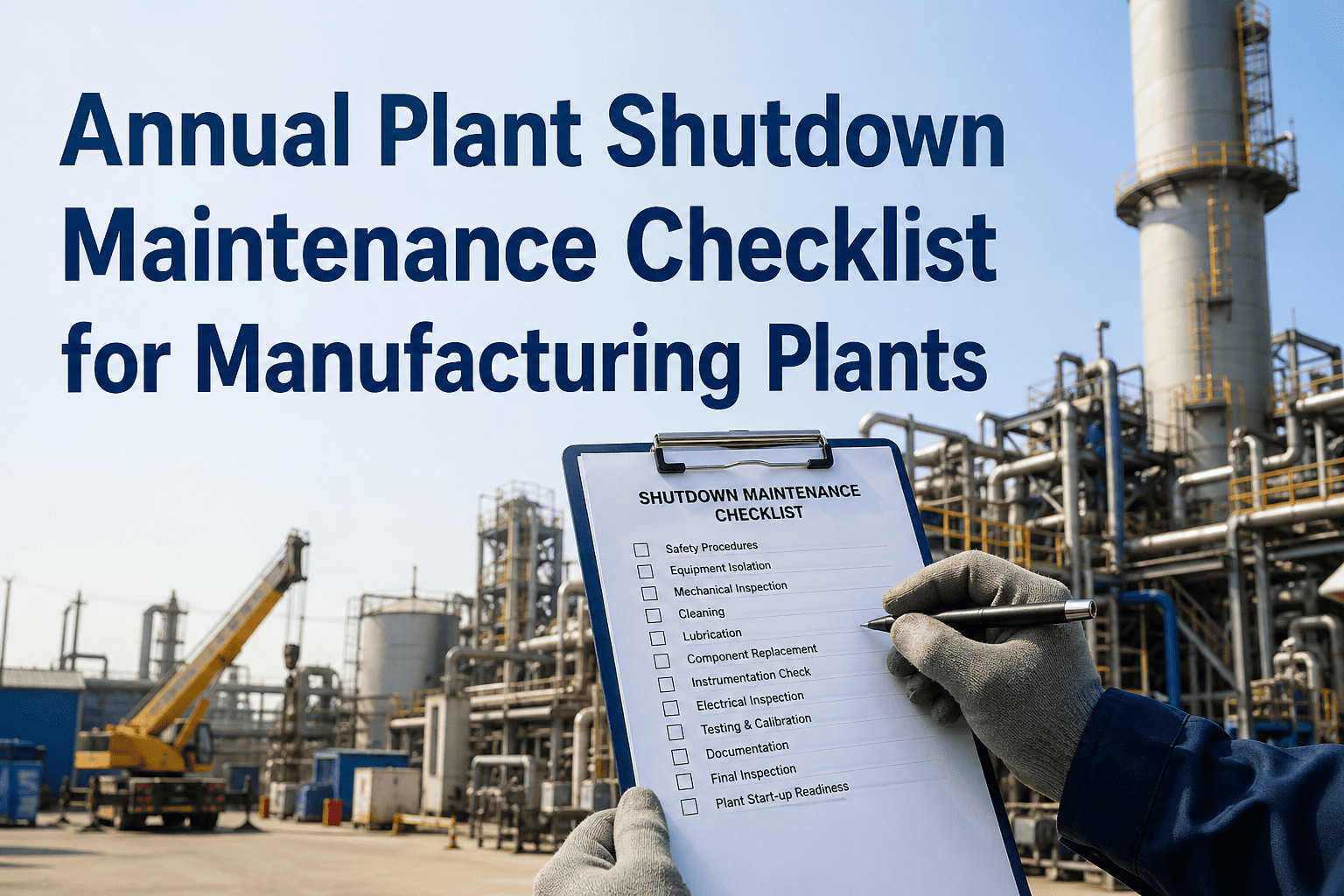
Every year, manufacturing plants across industries — from petrochemicals to food processing — face the same high-stakes challenge: executing a planned plant shutdown or turnaround without blowing the budget, missing the restart window, or triggering a safety incident. Industry data shows that over 80% of turnarounds exceed their budget by more than 10%, and nearly half result in schedule delays that translate directly into lost production revenue. The difference between plants that consistently deliver on-time, on-budget turnarounds and those that don't comes down to one thing — structured planning supported by the right tools. If your team is still coordinating shutdowns through spreadsheets and phone calls, OxMaint's shutdown planning platform gives you the digital infrastructure to change that — book a free demo and see how plants cut turnaround duration by up to 30%.
What Is a Plant Shutdown vs. a Turnaround?
The terms are often used interchangeably, but they describe events with different scopes and planning requirements. A shutdown is a temporary stoppage targeting a portion of a facility — typically lasting days to a few weeks — allowing other areas to continue operating. A turnaround is a complete cessation of operations for comprehensive inspection, repairs, equipment overhaul, and capital upgrades that cannot happen while the plant runs. Turnarounds require 18 to 24 months of advance planning, involve hundreds of contractors, and can consume an entire year's maintenance budget in a matter of weeks. An outage can refer to either planned or unplanned stoppages — and unplanned outages are consistently three to five times more expensive than planned ones.
The 6 Phases of Shutdown & Turnaround Management
Best-in-class plants don't treat shutdowns as single events — they manage them as six distinct phases, each with its own deliverables, accountable roles, and completion criteria. Skipping or rushing any phase is the primary reason turnarounds spiral into costly overruns.
Scope Definition & Initiation
Define SMART shutdown objectives tied to production targets. Appoint a dedicated Turnaround Manager. Identify every work item, challenge scope, and freeze it. Late scope additions are the single biggest cost driver.
12–18 months beforePlanning & Work Package Development
Build detailed job plans for every work item, especially those on the critical path. Management review of all plans before scheduling — a second set of eyes at this stage prevents the most expensive execution surprises.
8–12 months beforeScheduling & Resource Leveling
Integrate schedules across all departments and contractors. Identify the critical path, establish contingency plans, and level resources to eliminate idle labor and bottlenecks during execution.
4–6 months beforeProcurement & Materials Kitting
Order bearings, seals, gaskets, belts, and specialty parts early to avoid vendor backlog. Kit materials by work package so every crew has a complete, verified kit before Day 1 — incomplete kits cause idle labor from the first hour.
3–4 months beforeExecution & Real-Time Monitoring
Execute against the schedule with real-time tracking of work order progress, safety compliance, and critical path status. Any deviation needs same-day corrective action — delays compound exponentially in shutdown windows.
Active shutdown windowReview, Debrief & Lessons Learned
Debrief the full cross-functional team. Document KPI performance, schedule variances, cost analysis, and safety outcomes. This lessons-learned archive becomes the starting point for the next turnaround planning cycle.
Post-shutdownPlan Your Next Shutdown Digitally — Not on Spreadsheets
OxMaint centralizes every phase of shutdown planning — scope management, work orders, contractor coordination, and real-time execution tracking — in one platform built for manufacturing teams.
The True Cost of a Poorly Planned Turnaround
Most plant managers know shutdowns are expensive — but few have a clear view of where the money actually goes. The breakdown below shows the typical cost distribution in unplanned versus structured turnarounds, and where the biggest savings opportunities live.
Shutdown Planning Checklist — Phase by Phase
This checklist captures the critical tasks that separate well-executed turnarounds from chaotic ones. Every item should have a named owner and a documented completion date before the shutdown window opens.
Organization & Scope (12–18 months out)
Planning & Scheduling (4–8 months out)
Procurement & Pre-Shutdown (2–3 months out)
Execution & Closeout
Contractor Coordination: The Execution Risk Most Teams Underestimate
For most manufacturing turnarounds, external contractors represent 40–70% of total execution labor. Poor contractor coordination is consistently cited as a top-three cause of schedule overrun — not because contractors are incapable, but because the information and access they need arrives late, incomplete, or not at all.
Consolidate Contractor Count
More contractors means more coordination overhead, not more speed. Identify which work can be bundled with fewer vendors with broader scopes. Consolidating contractors reduces interface risk and accountability gaps during execution.
Pre-qualify Well in Advance
Verify certifications, safety records, and equipment capability 6–8 months before execution — not 6 weeks. Late contractor qualification forces compromises that show up as quality issues or safety incidents during the shutdown window.
Assign Interface Managers
Each contractor interface needs a named internal coordinator who owns access, tooling logistics, and day-to-day communication. Without dedicated interface management, contractors spend billable hours waiting for access that should have been pre-cleared.
Evaluate at Completion
Contractor performance data — safety record, schedule adherence, quality of work — should be documented post-shutdown and used to inform vendor selection for the next event. Organizations that skip this step repeat the same contractor failures cycle after cycle.
T-Minus Planning Timeline: How Top Plants Structure the Countdown
18 Months Out — Scope Freeze & Team Assembly
Appoint Turnaround Manager, assemble cross-functional team, define objectives, complete scope challenge, freeze scope with formal change control. Any scope added after this milestone increases cost by an average of 40%.
12 Months Out — Work Package Development
Detailed job plans written for every work item. Management review of all plans on the critical path. Begin long-range resource planning. Develop 3–5 year shutdown schedule if not already in place.
6 Months Out — Integrated Scheduling & Contractor Selection
Finalize integrated schedule across all departments. Select and pre-qualify all contractors. Identify the critical path. Begin specialty parts procurement for long-lead items. Conduct preliminary safety reviews.
3 Months Out — Procurement Completion & Kitting
All materials ordered and delivery dates confirmed. Begin kitting by work package. Rental equipment confirmed. Finalize LOTO procedures. Conduct contractor orientation and safety briefings.
Execution Window — Real-Time Tracking
Execute against the frozen schedule with daily critical path reviews. Track every work order in real time. Same-day escalation of any deviation. Safety compliance verification at every work package sign-off.
Planned vs. Reactive: Why the Gap Is Wider Than You Think
Key Metrics That Define Turnaround Performance
If you can't measure it, you can't manage it — and you definitely can't improve it for the next event. These are the KPIs that best-in-class turnaround teams track from scope definition through post-shutdown review.
| Metric | Industry Average | Top Performer Benchmark | Impact of Gap |
|---|---|---|---|
| Scope freeze compliance | 60–70% frozen on time | 95%+ frozen on time | 22–35% cost overrun risk |
| Schedule adherence | 50–55% on schedule | 85–90% on schedule | $50K–$500K/day overrun |
| First-time quality rate | 72–78% | 92%+ | 5–10% rework cost |
| Materials availability Day 1 | 65–70% | 95%+ | 15–20% idle labor cost |
| Safety incident rate (vs. normal ops) | 3–5x higher | Equal or lower | Regulatory + liability exposure |
5 Common Shutdown Planning Mistakes — and How to Fix Them
Scope Creep After Freeze
Most costlyAdding work items after scope freeze without a formal change control process. Late additions skip planning, skip procurement, and arrive on-site without job packages — creating chaos in an already compressed window.
Fix: Enforce formal change control with cost impact review for every post-freeze additionNo Critical Path Visibility
Schedule killerTreating all work as equal priority. Without a documented critical path, every delay feels equally bad — so nothing gets the escalation it needs until the schedule has already slipped beyond recovery.
Fix: Build the critical path into the integrated schedule and review it daily during executionLate Materials & Incomplete Kits
Labor wasterKitting materials right before — or during — the shutdown window. Incomplete kits cause crews to stand down on Day 1 while parts are tracked down, converting planned labor hours into idle time billed at full rate.
Fix: Complete and verify all kits at least 2 weeks before shutdown window opensSiloed Department Scheduling
Coordination failureEach department plans its own shutdown schedule without cross-functional integration. The result is resource conflicts, shared-access bottlenecks, and contractors waiting on each other in the same area.
Fix: One integrated schedule, one scheduling coordinator, one source of truthNo Post-Shutdown Debrief
Repeat failureTreating the restart as the finish line. Without a structured debrief and lessons-learned archive, every turnaround starts from scratch — repeating the same coordination failures, the same vendor problems, the same schedule mistakes.
Fix: Conduct a formal debrief within 30 days. Archive it as the first input to the next turnaround planSafety as an Afterthought
Highest riskEmbedding safety compliance into execution — not planning. With 50% of manufacturing accidents occurring during maintenance outages, safety protocols need to be written into every job plan, not added as a pre-work briefing on Day 1.
Fix: LOTO procedures, permit requirements, and safety sign-offs in every job package from scope definitionFrequently Asked Questions
Major turnarounds require 18 to 24 months of advance planning to achieve on-time, on-budget execution. Minor shutdowns targeting specific systems can be planned in 3 to 6 months, but scope definition and procurement should still begin well ahead of the window. Plants that start planning less than 6 months before a major turnaround almost universally experience contractor availability problems, material shortages, and incomplete job packages on Day 1. Book a consultation with OxMaint's turnaround specialists to map a planning timeline specific to your facility's scope and shutdown frequency.
Scope freeze is the formal point at which no new work items are added to the turnaround without a documented change control review that includes cost and schedule impact. Research consistently shows that work added after scope freeze costs 30 to 40% more to execute than the same work included in the original plan — because it arrives without job packages, without pre-ordered materials, and without scheduled resources. Enforcing scope freeze with a change control process is the single highest-leverage action a turnaround manager can take to protect the budget. Use OxMaint's digital work order system to track scope items and flag post-freeze additions automatically.
Top performers spend 30% less time in execution than the industry average — and the difference is almost entirely attributable to planning quality, not team size. The key practices: integrated cross-department scheduling that eliminates contractor idle time, materials kitted and verified before Day 1, daily critical path reviews that trigger same-day corrective action, and pre-qualified contractors who arrive briefed and ready to work. Digital work order platforms like OxMaint give teams real-time visibility into execution progress, enabling the fast decisions that prevent small delays from becoming multi-day overruns.
A CMMS (Computerized Maintenance Management System) is the operational backbone of a structured turnaround — centralizing work order management, asset history, contractor assignments, compliance documentation, and real-time execution tracking in one platform. Teams using digital work order management consistently report shorter turnaround durations, fewer schedule overruns, and better safety records compared to spreadsheet-based approaches. With OxMaint, every job plan, work order, material kit, and contractor assignment is tracked in real time — giving your turnaround manager full visibility from scope freeze through post-shutdown debrief.
Ready to Make Your Next Turnaround Your Best One?
OxMaint gives manufacturing teams the planning tools, work order management, and real-time execution visibility to finish shutdowns on time, under budget, and without safety incidents. Start free today — no credit card required.