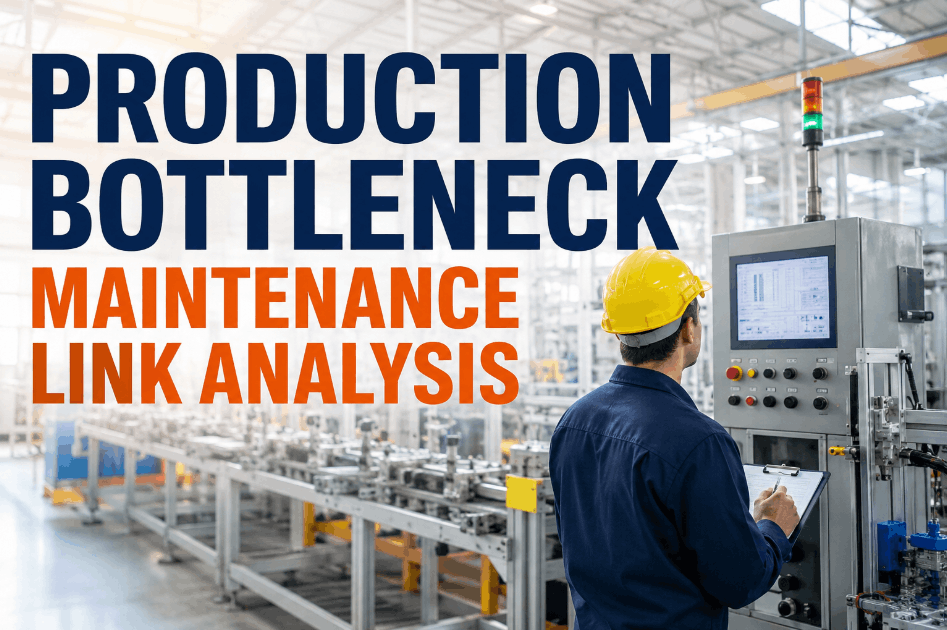
Every manufacturing line has one station, one machine, or one process step that determines the maximum output of the entire facility — and until you find it with data, you are optimizing the wrong things. AI-powered production bottleneck identification using real-time throughput modeling, queue depth analysis, and constraint detection transforms guesswork into precision — showing exactly where capacity is being lost, by how much, and what the throughput impact of fixing it will be. This guide covers the analytical methods, data requirements, and implementation approach for manufacturers serious about continuous throughput improvement.
23%
average throughput gain when the true bottleneck is correctly identified and resolved
67%
of manufacturers target the wrong constraint when relying on operator intuition alone
$1.5M+
annual revenue recovered per production line when primary bottleneck is eliminated
3–5 days
to identify primary bottleneck with AI analytics vs weeks of manual time study
Why Bottleneck Identification Is Harder Than It Looks
The intuitive answer — "find the slowest machine" — fails in real manufacturing for three reasons: bottlenecks migrate under different product mixes, demand levels, and shift conditions; secondary constraints mask the true primary constraint; and the visible queue buildup often forms two or three stations downstream from the actual limiting operation. AI analytics resolves all three problems simultaneously.
01
Bottlenecks Are Dynamic
The constraint at 70% utilization shifts when product mix changes or a machine runs slow. A static time study taken on Tuesday may not reflect Thursday's reality. AI models continuously track which station is limiting flow in real time — not which one was limiting last week.
02
Secondary Constraints Hide Primary Ones
When Station 4 is the true bottleneck, Stations 5 and 6 starve and appear idle. Operators observe idle time at 5 and 6 and incorrectly conclude those are the problems to fix — investing in the wrong solution while the real constraint goes untouched.
03
Queue Location Misleads Analysis
Work-in-progress queues build in front of bottlenecks — but in lines with variable buffer zones, the visible pile-up may appear one to three stations upstream of the actual constraint. Queue location is a lagging symptom, not the diagnosis.
04
Utilization Data Alone Is Insufficient
High utilization is a necessary but not sufficient condition for a bottleneck. A machine running at 95% utilization on a non-critical path has zero impact on throughput. AI correlates utilization with downstream starvation and upstream queue data to confirm the true constraint.
The AI Bottleneck Detection Framework
Effective AI-driven bottleneck detection combines four analytical layers — each answering a different question about where and why production flow is constrained.
Layer 1
Real-Time Throughput Mapping
Which stations are producing below their design rate — right now?
Collect cycle time, part count, and availability data from every workstation. Calculate actual throughput rate vs. designed rate per station per shift. The ratio — actual/design — gives a live constraint score for each operation. Stations with scores below 0.85 are candidates for primary or secondary constraint status.
Cycle time per unit
Parts-per-hour actual vs design
Availability %
Layer 2
Queue and Starvation Pattern Analysis
Where is WIP accumulating — and where is starvation occurring?
Map the ratio of queue depth to downstream idle time across the line. The true bottleneck sits where the longest consistent queue ends. AI tracks queue depth trends over multiple shifts to distinguish the primary constraint (always queued) from secondary constraints (queued only under certain conditions).
WIP queue depth per buffer
Downstream idle time %
Queue persistence across shifts
Layer 3
Constraint Sensitivity Modeling
If this station improves by 10%, what happens to line throughput?
Build a digital model of the line that quantifies how much each station's performance improvement translates into overall throughput gain. Non-bottleneck stations have near-zero sensitivity — improving them costs money without moving output. The bottleneck station shows the highest throughput sensitivity multiplier.
Throughput sensitivity per station
Improvement ROI ranking
Constraint migration prediction
Layer 4
Dynamic Bottleneck Tracking
When the constraint migrates, how fast do you detect and respond?
After the primary bottleneck is resolved, the constraint migrates to the next-weakest station — often within hours. AI continuously re-evaluates constraint scores across the line and alerts the production team when the bottleneck location shifts, so improvement efforts remain focused on the actual current constraint.
Live constraint ranking
Migration alert triggers
Shift-over-shift constraint history
Stop Guessing Where Your Line Is Losing Throughput
Oxmaint's AI analytics connects to your production data — MES, SCADA, or manual entry — and surfaces your live constraint ranking, throughput sensitivity scores, and bottleneck migration alerts in one dashboard your team can act on today.
Bottleneck Types: Classifying What You Find
| Bottleneck Type |
Root Cause |
Key Data Signal |
Typical Fix |
Throughput Impact |
| Capacity Constraint |
Station design rate below line pace |
Persistent queue + high utilization |
Add capacity, parallelize, or re-engineer process step |
High — 15–30% gain |
| Availability Constraint |
Unplanned downtime exceeds buffer time |
MTTR > buffer zone time |
Predictive maintenance, faster changeover, spare parts staging |
High — 10–25% gain |
| Quality Constraint |
High rework or scrap rate consuming capacity |
First pass yield below 95% |
SPC, process parameter control, upstream defect prevention |
Medium — 8–18% gain |
| Changeover Constraint |
Frequent product changeovers consuming productive time |
Setup time > 15% of available time |
SMED methodology, pre-staging, standardized tooling |
Medium — 10–20% gain |
| Material Flow Constraint |
Upstream supply delays starving the bottleneck |
Bottleneck idle % due to no-material |
Buffer stock optimization, kanban, supplier scheduling |
Variable — 5–15% gain |
Before vs After: AI Bottleneck Analysis in Practice
Without AI Analytics
Production manager walks the floor and identifies the noisiest, busiest-looking machine as the problem
Engineering runs a time study over 2–3 days — capturing a snapshot that may not reflect typical production conditions
Capital is invested in expanding capacity at a non-constraint — throughput does not improve
After one constraint is fixed, the team does not know the bottleneck has migrated and returns to general observation
No sensitivity data — impossible to prioritize which improvement delivers the highest throughput ROI
With AI Analytics
Live constraint score for every station — ranked by throughput sensitivity, updated every shift
Queue depth and starvation data confirms which station is the true primary constraint vs. secondary
Sensitivity model shows exactly how much each station's improvement translates to line output before investment is committed
Automatic bottleneck migration alerts keep the team focused on the current real constraint after each improvement cycle
Historical constraint patterns reveal recurring issues — predictive scheduling prevents future bottleneck events
Frequently Asked Questions
Know Exactly Where Your Line Is Losing Output — Starting This Week
Oxmaint gives production and maintenance teams a shared view of constraint scores, throughput sensitivity rankings, and bottleneck migration alerts — so every improvement dollar goes to the station that actually moves the needle on output.