Remote Monitoring Solutions for Manufacturing Plant Maintenance
By oxmaint on March 6, 2026
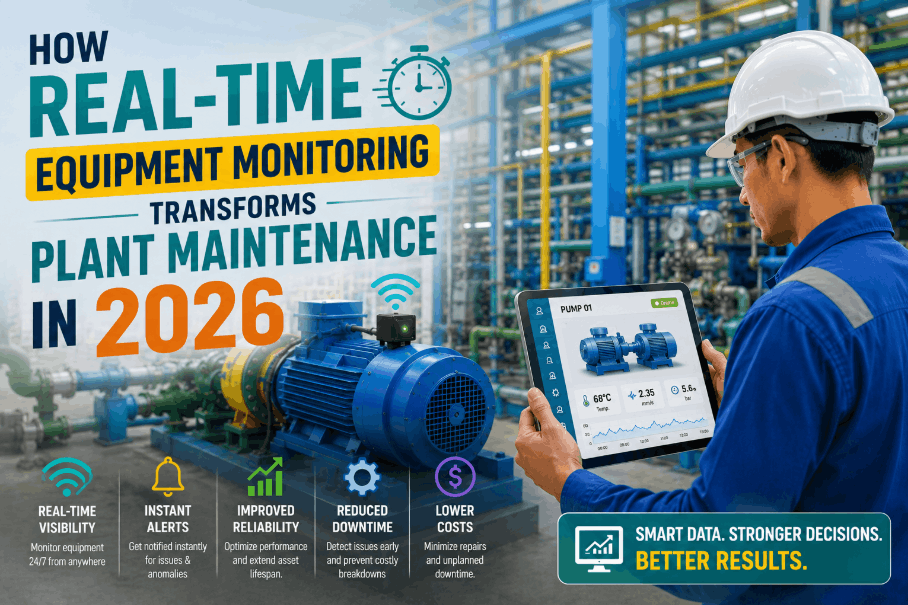
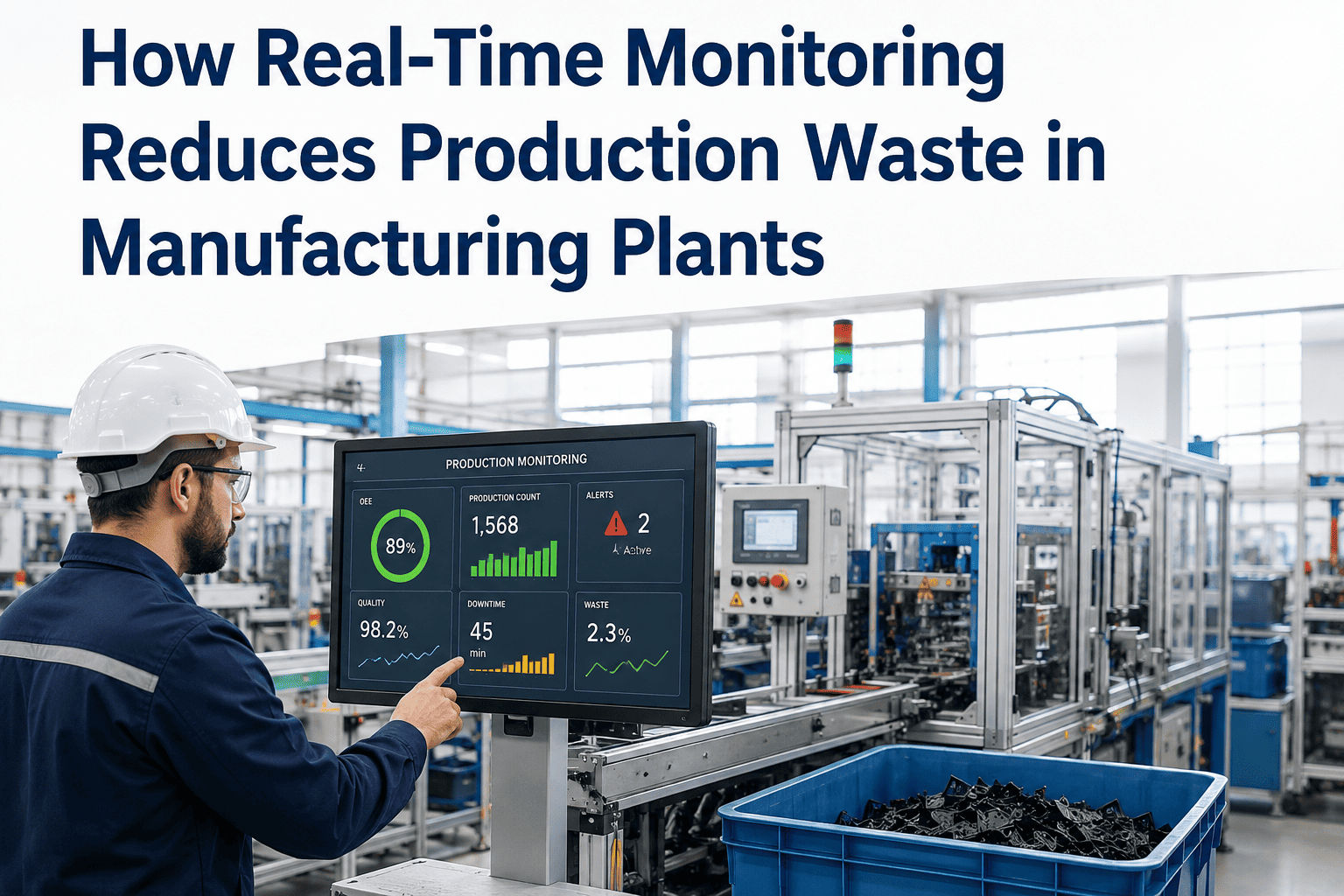
Every manufacturing plant has that one machine everyone worries about—the aging compressor that vibrates a little more each week, the motor that runs hotter than it should, the conveyor that jams during third shift when no one is watching. Remote monitoring takes the guesswork out of plant maintenance by placing IoT sensors directly on your critical assets, feeding real-time health data into a centralized dashboard, and alerting your team the moment something starts to go wrong. The result is fewer breakdowns, lower repair costs, and a maintenance team that fixes problems before production ever stops. Schedule a free consultation to see how remote monitoring integrates with your current maintenance workflows.
How IoT Sensors Detect Equipment Failures Before They Happen
The shift from reactive to predictive maintenance starts with data—and IoT sensors are the source. Mounted directly on motors, pumps, compressors, gearboxes, and conveyors, these industrial-grade devices measure the physical signals that precede every mechanical failure. A bearing does not fail without warning; it generates increasing vibration, heat, and noise for weeks or months before it seizes. Remote monitoring captures those signals continuously and automatically.
What IoT Sensors Measure on Your Equipment
Vibration
Detects imbalance, misalignment, bearing degradation, and structural looseness. RMS velocity and acceleration data establish baselines and flag deviations weeks before failure.
Temperature
Monitors surface heat on motors, bearings, electrical panels, and process lines. Rapid temperature rise signals overload, insulation breakdown, or lubrication failure.
Current & Power
Tracks electrical consumption patterns to identify motor stress, phase imbalance, and efficiency degradation. Power signature analysis reveals mechanical load changes invisible to other sensors.
Pressure & Flow
Monitors hydraulic and pneumatic systems for leaks, blockages, pump cavitation, and valve degradation. Pressure trend analysis predicts seal failures and pipe corrosion.
Acoustic Emission
Captures high-frequency sound waves from micro-cracks, friction, and electrical discharge. Ultrasonic analysis detects lubrication issues and early-stage bearing defects that vibration sensors miss.
$260,000
average cost per hour of unplanned downtime in manufacturing
Remote monitoring with IoT sensors catches the early warning signs that manual inspections miss — reducing unplanned downtime by up to 50% and maintenance costs by 40%. Sign up for Oxmaint to start tracking your equipment health in real time and receive automated alerts before breakdowns happen.
Real-Time Asset Monitoring: What Your Plant Floor Data Reveals
Collecting sensor data is only the first step. The real value emerges when that data flows into an analytics platform that correlates equipment behavior with production schedules, environmental conditions, and maintenance history. Here is what a connected monitoring system reveals that walk-around inspections never could.
01
Hidden Efficiency Losses
A motor running at 92% efficiency instead of 96% does not trigger alarms—but it costs thousands in wasted energy annually. Continuous power monitoring spots these silent losses across your entire fleet of rotating equipment and quantifies exactly how much each one costs.
02
Failure Progression Timelines
AI models trained on vibration and temperature trends can predict remaining useful life for bearings, seals, and other wear components. Instead of replacing parts on a fixed calendar, your team replaces them at the optimal moment—not too early (wasting life), not too late (risking failure).
03
Shift-to-Shift Performance Gaps
The same machine operated by different shifts often shows dramatically different performance signatures. Remote monitoring data reveals whether equipment stress varies by operator, shift schedule, or production recipe—insights that drive targeted training and process standardization.
04
Cross-Plant Benchmarking
For multi-facility operations, identical equipment at different plants rarely performs identically. Remote monitoring lets you compare OEE, MTBF, and energy consumption across sites, identify why Plant A's compressor lasts 18 months longer than Plant B's, and replicate best practices everywhere.
Your equipment is generating health data right now — but without a connected platform, those insights stay invisible. Sign up for Oxmaint to start capturing real-time asset data, set automated alert thresholds, and receive maintenance reports from day one — all from a single dashboard.
Predictive vs. Preventive: Why Sensor Data Changes the Maintenance Equation
Preventive maintenance follows a calendar. Predictive maintenance follows the equipment. The difference in outcomes is significant—and remote monitoring is what makes the shift possible.
Calendar-Based Preventive
Services equipment on fixed intervals regardless of condition
Replaces healthy components prematurely, wasting part life
Still allows unexpected failures between scheduled PMs
Requires shutting down production for routine inspections
43%
of downtime caused by delayed or improper maintenance planning
Sensor-Driven Predictive
Services equipment based on actual measured condition
Maximizes component life by replacing at optimal degradation point
Provides weeks of advance warning before critical failures
Schedules repairs during planned windows, not emergency stops
50%
reduction in unplanned downtime with predictive maintenance
Setting Up Remote Monitoring: From First Sensor to Full Visibility
Implementing a remote monitoring system does not require replacing your equipment or overhauling your plant infrastructure. Modern IoT sensors are designed to retrofit onto existing machines—even legacy equipment built decades ago—without modifying controllers or voiding warranties.
1Audit & Prioritize
Identify your top 10-15 failure-prone or high-value assets. Map their failure modes and determine which sensor types (vibration, thermal, current) provide the earliest detection for each failure pattern. Start where the cost of downtime is highest.
Week 1-2
2Install & Connect
Mount wireless sensors on selected assets—most installations take under an hour per machine. Deploy edge gateways to aggregate data and establish connectivity to your cloud platform via industrial WiFi, cellular, or LoRaWAN mesh networks.
Week 3-4
3Baseline & Configure
Let the system learn normal operating patterns for 2-4 weeks. Configure alert thresholds, escalation rules, and notification channels. Integrate monitoring data with your CMMS to enable automatic work order creation when anomalies are detected.
Week 5-8
4Scale & Predict
Expand monitoring to additional assets based on pilot results. Activate AI-driven predictive models as historical data accumulates. Roll out dashboards to operators, technicians, and plant managers. Extend coverage across multiple facilities from a single platform.
Week 9+
Want to see exactly how remote monitoring works at a plant like yours? Book a demo and our team will walk you through live asset dashboards, show how sensor alerts trigger automatic work orders, and build a deployment plan tailored to your most critical equipment.
Which Manufacturing Equipment Benefits Most from Continuous Monitoring
Not every asset needs the same monitoring intensity. Prioritization should be based on failure consequence, replacement cost, and how quickly degradation progresses. Here is how different equipment categories rank for remote monitoring value.
Equipment Monitoring Priority Matrix
Asset Type
Priority
Best Sensors
Failure Lead Time
Downtime Cost Impact
Production-Critical Motors
Critical
Vibration + thermal + current
2-12 weeks detectable
Line shutdown; $10K-$100K/hr
Air Compressors
Critical
Vibration + pressure + temperature
1-8 weeks detectable
Plant-wide impact; $50K+/hr
Pumps & Hydraulics
Critical
Pressure + flow + vibration
1-6 weeks detectable
Process stoppage; $5K-$50K/hr
Conveyors & Material Handling
High
Vibration + speed + current
2-4 weeks detectable
Throughput loss; $5K-$25K/hr
HVAC & Chillers
High
Temperature + pressure + current
1-4 weeks detectable
Environment risk; varies widely
Backup Generators
Moderate
Vibration + fuel level + temperature
2-8 weeks detectable
Emergency readiness; indirect
Start your pilot with the highest-priority assets to maximize early ROI. Expand coverage progressively based on demonstrated savings.
Calculating the ROI of Remote Monitoring in Your Plant
The financial case for remote monitoring is built on multiple value streams—reduced downtime, lower repair costs, extended asset life, and more efficient use of maintenance labor. Manufacturing plants that connect sensor data to a CMMS like Oxmaint consistently report measurable improvements within months.
Proven Manufacturing Results
Based on industry data across manufacturing deployments
50%
Reduction in unplanned downtime with predictive maintenance enabled by continuous monitoring
40%
Lower overall maintenance costs through condition-based repairs instead of calendar-based schedules
30%
Of equipment problems resolved remotely without dispatching a technician to the site
20%
Additional downtime reduction achieved by integrating monitoring with a CMMS platform
Stop Reacting. Start Predicting.
Oxmaint connects remote sensor data with intelligent maintenance workflows—auto-generating work orders, tracking asset degradation trends, and giving your team a single platform to manage every piece of equipment across every facility. Move from spreadsheets and clipboards to a maintenance operation that knows what is about to break and what to do about it.
Connecting Remote Monitoring to Your Maintenance Management System
Sensors generate data. A CMMS turns that data into action. The integration between remote monitoring and your maintenance platform is where the real operational transformation happens—automatically converting equipment alerts into prioritized work orders, updating asset health records, and giving managers a single source of truth across all facilities.
Sensor Alert Triggered
Vibration, temperature, or pressure exceeds adaptive threshold
Work Order Created
CMMS auto-generates prioritized task with fault details, asset history, and recommended repair steps
Technician Dispatched
Right technician assigned with correct parts and tools based on skill matching and availability
Asset Record Updated
Repair logged, health baseline recalibrated, and predictive model refined with new data
Every minute between detecting a problem and starting a repair is downtime waiting to happen. Sign up for Oxmaint to connect your monitoring sensors directly to automated work orders — so your technicians get dispatched with the right parts and instructions before a failure ever stops production.
Industry-Specific Monitoring Strategies for Different Plant Types
Every manufacturing sector has unique equipment profiles, failure patterns, and compliance requirements. The monitoring strategy should reflect these differences rather than applying a one-size-fits-all sensor package.
Automotive & Assembly
Stamping presses, welding robots, paint booths
Cycle-time deviation monitoring catches tooling wear and robot calibration drift before scrap rates climb. Typical ROI payback within 3-6 months.
Food & Beverage
Mixers, fillers, refrigeration, CIP systems
Temperature compliance monitoring protects product safety while motor health tracking prevents costly mid-batch failures. Critical for FSMA and HACCP compliance.
Pharmaceuticals
Reactors, centrifuges, HVAC, cleanrooms
Environmental control monitoring ensures GMP compliance while vibration analysis on centrifuges prevents batch loss. Audit-ready data logs come standard.
Heavy Manufacturing
CNC machines, furnaces, cranes, compressors
Oil analysis integration alongside vibration monitoring catches gearbox and hydraulic degradation in high-load equipment. Payback often within 2-5 months.
Chemicals & Processing
Pumps, heat exchangers, valves, compressors
Corrosion and leak detection monitoring is critical for safety and environmental compliance. Pressure trending predicts seal failures months in advance.
Packaging & Consumer Goods
Filling lines, labelers, palletizers, wrappers
Speed consistency and reject-rate correlation monitoring identifies mechanical degradation that impacts throughput before it causes line stoppages.
We used to discover problems when a machine stopped. Now we discover them when a sensor trend shifts. Our maintenance team went from firefighting to planning—and our unplanned downtime dropped by more than 40% in the first year.
Every motor, pump, and compressor in your plant generates signals about its health—signals that go unheard until something breaks. Oxmaint gives your maintenance team the platform to capture those signals, act on them automatically, and transform reactive repairs into a proactive reliability operation across every facility you manage.
How many sensors do we need to start a remote monitoring pilot?
A typical pilot begins with 15 to 30 sensors placed on your 5-10 most critical or failure-prone assets. This is enough to demonstrate measurable value within 30-60 days and build the business case for broader deployment. Most plants scale to full coverage over 6-12 months, adding sensors based on the ROI proven during the pilot phase. Schedule a free assessment to identify the ideal starting assets for your facility.
Can we monitor legacy equipment that has no digital controls?
Yes. Modern IoT sensors attach externally using magnetic mounts, clamps, and wrap-around current sensors—without modifying the machine, touching its controller, or voiding any warranty. Equipment built decades ago can be brought into a remote monitoring network within hours. Serial-to-digital converters can also translate older RS-232 and RS-485 outputs into modern data formats.
What is the difference between remote monitoring and a CMMS platform?
Remote monitoring captures real-time equipment health data through sensors and edge analytics. A CMMS manages the maintenance response—work orders, schedules, parts inventory, and technician assignments. The maximum impact comes from connecting both systems so that a monitoring alert automatically triggers a prioritized work order in your CMMS. Sign up for Oxmaint to experience this seamless sensor-to-work-order integration.
How quickly will we see a reduction in unplanned downtime?
Most manufacturing plants report measurable downtime reduction within the first 30-60 days. Initial wins come from catching obvious anomalies—overheating motors, excessive vibration spikes, and pressure leaks—that were previously missed between manual inspections. As AI baselines mature over 3-6 months, detection becomes increasingly precise, with many facilities achieving 35-50% downtime reduction within the first year.
Is our operational data secure with cloud-based monitoring?
Enterprise-grade security protects every layer of the monitoring architecture. Data is encrypted in transit and at rest, role-based access controls manage visibility, and edge processing keeps sensitive operational data on-premises when required. Cloud infrastructure operates on SOC 2 compliant platforms with continuous security audits. Book a demo to walk through the full security architecture and compliance certifications.


.png)