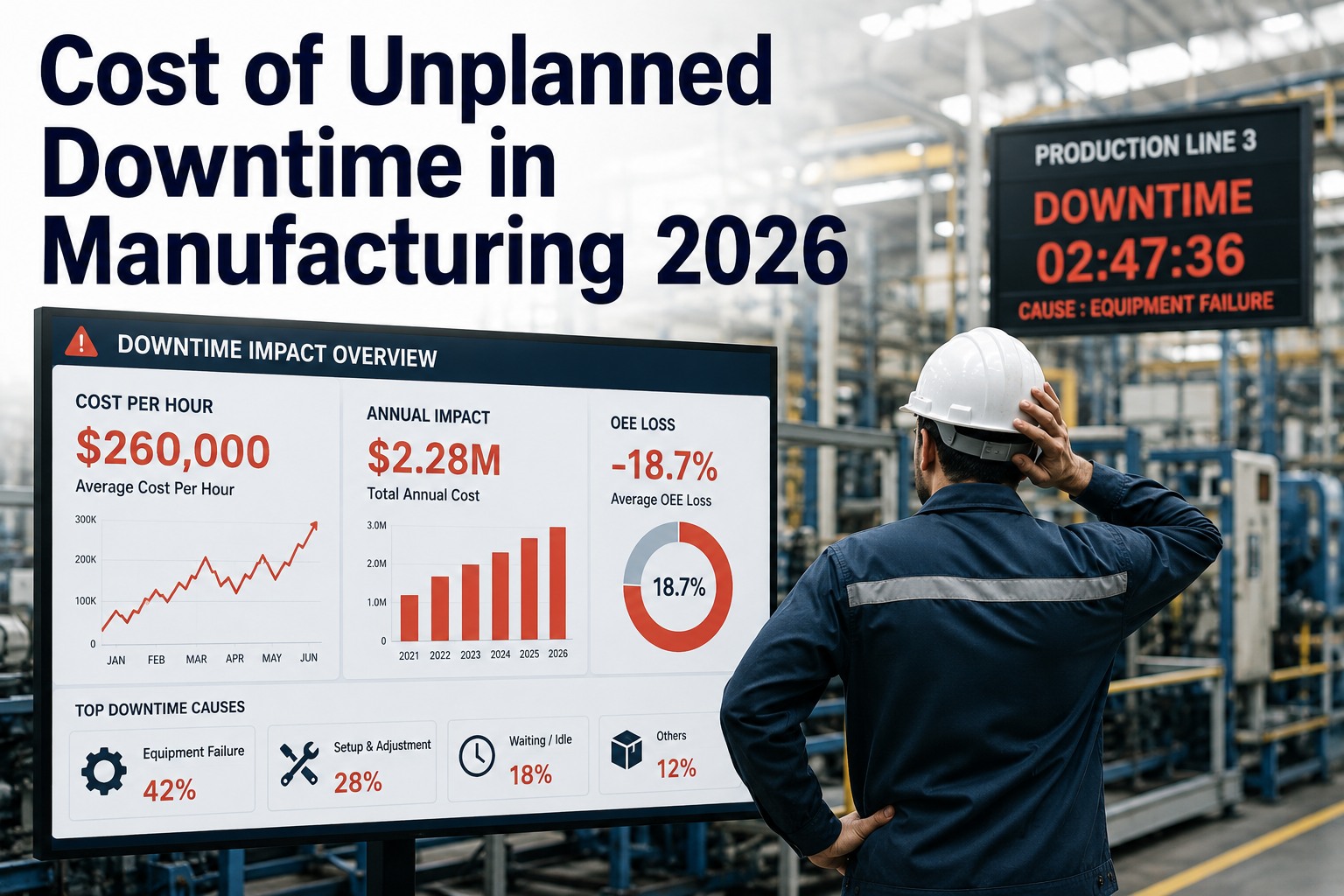
Every hour your production line sits idle without a plan, you're not just losing output — you're bleeding labor costs, contract penalties, customer trust, and maintenance premiums that compound long after the machine restarts. Unplanned downtime in manufacturing averages $260,000 per hour across industries, yet most plants still rely on reactive repair cycles that guarantee the next breakdown is already in progress. This guide breaks down exactly what downtime costs your operation, where it comes from, and the proven strategies that forward-thinking maintenance teams use to stop it before it starts.
$260K
Average cost per hour of unplanned downtime
800 hrs
Average annual downtime per plant (mid-size manufacturing)
70%
Of unplanned downtime is preventable with the right strategy
3–5×
Higher repair cost for emergency vs planned maintenance
What Unplanned Downtime Actually Costs — Beyond the Obvious
Most manufacturers only count the direct production loss when a line stops. The real cost is 2–4× higher once you factor in the hidden expense layers that accumulate around every unplanned event.
What You See
Lost Production Output
Idle Labor During Stoppage
The Hidden Cost Layer — Often 2–4× the Visible Loss
Emergency Repair Premium
Overtime labor, expedited parts, contractor call-out rates — all 3–5× standard cost
Customer Penalties & Missed SLAs
Late delivery penalties, order cancellations, and long-term contract risks from missed commitments
Quality Scrap After Restart
Post-downtime startup rejects and off-spec product before the process stabilizes — often 1–3 hours of scrap
Secondary Equipment Stress
Upstream/downstream equipment pushed harder to compensate, accelerating wear and triggering cascading failures
Energy & Utilities Waste
Restart cycles, idle heating/cooling systems, and re-pressurization consume disproportionate energy per unit produced
Workforce Morale & Turnover
Chronic reactive firefighting burns out maintenance technicians — top performers leave reactive environments first
Downtime Cost Per Hour by Industry
Downtime cost varies dramatically by industry based on production value, labor intensity, and downstream impact. Use these benchmarks to understand your exposure — and justify your maintenance investment budget.
Calculate Your Own Downtime Cost
Root Causes of Unplanned Downtime in Manufacturing
42%
Equipment Failure & Aging Assets
Worn bearings, degraded seals, electrical faults, and fatigue cracks are the leading cause. Most failures give 2–6 weeks of detectable warning signals before catastrophic breakdown.
22%
Human Error & Process Deviations
Incorrect setup parameters, missed lubrication, wrong tooling, and non-standard operator procedures that cause premature equipment stress or immediate failure events.
18%
Inadequate Preventive Maintenance
Fixed-interval PM schedules that miss actual asset condition — performing maintenance too late on degraded components, or too early and creating unnecessary maintenance-induced failures.
11%
Supply Chain & Parts Delays
Equipment sits repaired-but-idle waiting for critical spare parts that weren't stocked. Poor inventory planning turns a 2-hour fix into a 2-day outage.
7%
Utility & Infrastructure Failures
Power quality issues, compressed air drops, cooling water interruptions, and network failures that halt equipment without the equipment itself failing.
Know Exactly What Downtime Is Costing Your Plant — In Real Time
Oxmaint tracks every unplanned stoppage, logs root causes, calculates actual cost impact, and automatically generates work orders — so your team spends time fixing problems, not documenting them.
Proven Strategies to Reduce Unplanned Downtime
#1 Highest Impact
Shift From Reactive to Predictive Maintenance
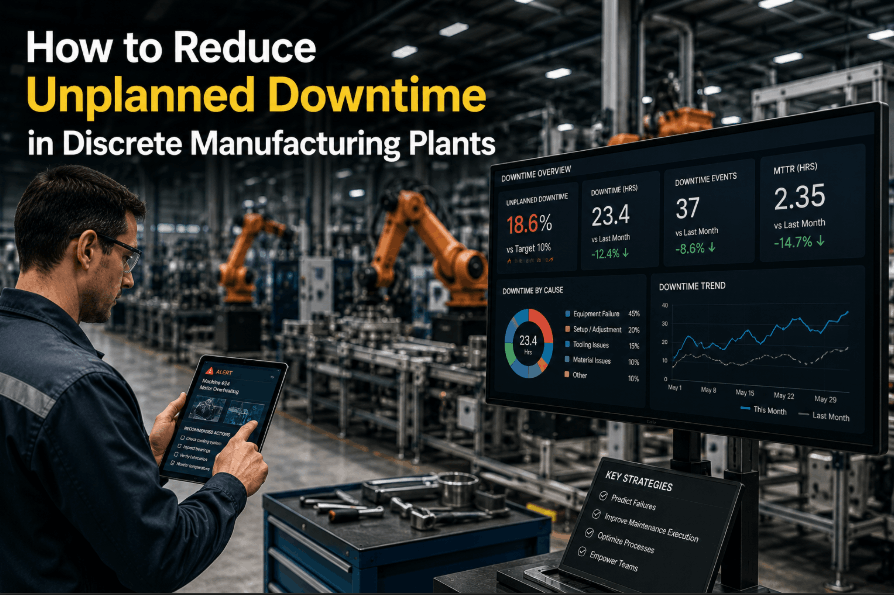
Predictive maintenance uses continuous condition monitoring — vibration analysis, thermal imaging, oil analysis, and AI anomaly detection — to catch developing failures weeks before they cause downtime. Unlike calendar-based PM that often misses real degradation, predictive maintenance acts on actual equipment condition data. Plants that implement predictive maintenance programs reduce unplanned downtime by 30–50% within the first year and lower overall maintenance costs by 25–30%.
30–50%
Downtime reduction
25–30%
Maintenance cost savings
2–6 wks
Advance warning window
#2
Implement a CMMS for Work Order Discipline
Untracked maintenance creates invisible repeat failures. A Computerized Maintenance Management System (CMMS) logs every failure event, repair action, and parts used — building the asset history needed to identify chronic failures and justify capital decisions. Plants with structured CMMS programs see 20–35% fewer repeat failures within 18 months.
#3
Build a Critical Spare Parts Strategy
Identify the top 20 components most likely to cause production-critical failures and ensure they are stocked on-site. Emergency parts procurement adds days to repair time and 3–10× cost to standard part price. A data-driven spare parts strategy, built from failure history, cuts mean time to repair (MTTR) by 40–60%.
#4
Establish Operator-Led Daily Inspections
Trained operators performing structured daily checks catch early signs of wear — unusual sounds, vibration, leaks, temperature changes — that maintenance teams miss between scheduled PM visits. Integrating digital inspection checklists with mobile reporting closes the loop between observation and action without paperwork delays.
#5
Use Failure Mode Analysis to Eliminate Root Causes
For any asset that has failed more than twice, a structured FMEA (Failure Mode and Effects Analysis) analysis identifies the root cause and corrective action. Without root cause elimination, the same failures recur on a predictable cycle — each one carrying the full emergency cost premium of the first event.
Reactive vs Predictive Maintenance: The Real Cost Difference
| Factor |
Reactive Maintenance |
Predictive Maintenance |
| Average Downtime Per Event |
4–12 hours |
Planned window, 1–2 hrs |
| Parts Cost |
Emergency pricing (3–10× markup) |
Standard planned order |
| Labor Cost |
Overtime + contractor call-out |
Scheduled shift hours |
| Secondary Damage |
High — cascading equipment stress |
Minimal — caught early |
| Technician Preparation |
Unknown fault, blind diagnosis |
Known failure mode, right parts |
| Production Impact |
Unplanned, full line stop |
Scheduled in low-demand window |
| Total Cost Per Event |
$30K–$2M+ depending on industry |
Typically 70–90% lower |
Downtime Reduction Roadmap: From Reactive to Predictive in 90 Days
Days 1–14
Audit Downtime History and Rank Asset Risk
Pull your last 12 months of maintenance records. Calculate total downtime hours and cost per asset. Rank your 10–15 highest-risk assets by failure frequency, repair cost, and production impact. These are your priority targets — the assets where downtime prevention delivers the fastest, largest ROI.
Days 15–30
Deploy Condition Monitoring on Priority Assets
Install vibration sensors, thermal monitoring, or current analysis on your top-risk machines. Connect sensor outputs to a centralized monitoring platform. Begin logging real-time equipment condition data that will form the baseline for AI anomaly detection. Most plants can instrument 10 assets in under two weeks.
Days 31–60
Connect CMMS for Work Order Automation
Integrate your condition monitoring alerts directly into your CMMS so every anomaly detection automatically generates a work order with asset ID, fault type, and recommended action. Eliminate the gap between "alert seen" and "technician dispatched" by removing manual handoffs from the workflow.
Days 61–90+
Track KPIs and Expand to Full Asset Fleet
Measure MTBF, MTTR, planned vs unplanned maintenance ratio, and downtime cost per asset week-over-week. Validate ROI from pilot assets and use the data to build the business case for plant-wide rollout. Expand predictive monitoring to your full asset list using the architecture and workflows proven in the pilot phase.
Your Maintenance Team Deserves Tools That Work as Hard as They Do
Oxmaint connects condition monitoring alerts, work order management, spare parts inventory, and downtime analytics in one platform — purpose-built for manufacturing maintenance teams who are done fighting fires.
Key KPIs to Measure Downtime Reduction Progress
MTBF
Mean Time Between Failures
Target: Increase by 30–60% in 12 months
The primary indicator that your downtime prevention is working. Rising MTBF confirms failures are being caught and corrected before they become stoppages.
MTTR
Mean Time to Repair
Target: Reduce by 40–60%
When predictive maintenance identifies the fault type before failure, technicians arrive prepared — right parts, right procedure, right diagnosis. MTTR drops dramatically.
PM Ratio
Planned vs Unplanned Work Orders
Target: 85%+ planned work orders
A direct measure of your maintenance culture. Plants below 70% planned ratio are in reactive mode. Reaching 85%+ means you're predicting and preventing — not firefighting.
Downtime %
Unplanned Downtime as % of Production Time
World-class target: below 2%
The headline KPI for leadership reporting. Most manufacturers run at 5–15% unplanned downtime. World-class plants hold below 2% — the gap represents millions in recoverable production value.
Frequently Asked Questions About Unplanned Downtime
How do I calculate the true cost of downtime for my plant?
Add your hourly production revenue loss to idle labor costs, emergency maintenance spend (parts and overtime labor), and any scrap or customer penalty costs resulting from the event. Most plants discover their true downtime cost is 2–4× what they assumed when only counting production loss.
Oxmaint's downtime tracking module logs every cost component automatically so you get accurate, auditable numbers without manual calculation.
What is a realistic timeline to see measurable downtime reduction results?
Most manufacturing plants see measurable MTBF improvement within 60–90 days of deploying structured condition monitoring on their highest-risk assets. Full plant-wide impact — 30–50% unplanned downtime reduction — typically takes 9–18 months as models mature and maintenance culture shifts.
Book a consultation to get a realistic timeline projection based on your current maintenance maturity level.
Is predictive maintenance only for large plants with big budgets?
No — modern predictive maintenance platforms have made the technology accessible to mid-size and even small manufacturers. Cloud-connected sensor hardware now starts under $500 per asset, and SaaS-based maintenance management platforms eliminate the need for expensive on-premise software.
Oxmaint is built for manufacturing teams of all sizes, with pricing that scales to your asset count — not your enterprise contract budget.
How does poor spare parts inventory management contribute to downtime duration?
When critical spares aren't stocked, a technically simple repair that takes 2 hours becomes a 2–5 day outage waiting for emergency parts delivery. Studies show that parts availability issues account for 20–30% of total downtime duration across manufacturing facilities.
Oxmaint's integrated parts inventory connects directly to work orders so technicians know part availability before they open a job — eliminating surprise delays.
What's the difference between unplanned downtime and planned downtime in KPI reporting?
Planned downtime includes scheduled maintenance windows, changeovers, and inspections that are pre-arranged to minimize production impact. Unplanned downtime is any stoppage that occurs outside of a planned window — breakdowns, unexpected failures, or emergency repairs. Only unplanned downtime reflects maintenance effectiveness; planned downtime reflects scheduling decisions.
Accurate CMMS categorization of both types is essential to get KPIs that actually tell you something useful.
Every Hour of Downtime You Prevent Is Money That Goes to Your Bottom Line
Oxmaint gives manufacturing maintenance teams the tools to track downtime causes in real time, predict equipment failures before they happen, and build the planned maintenance discipline that separates high-performing plants from reactive ones.



.png)