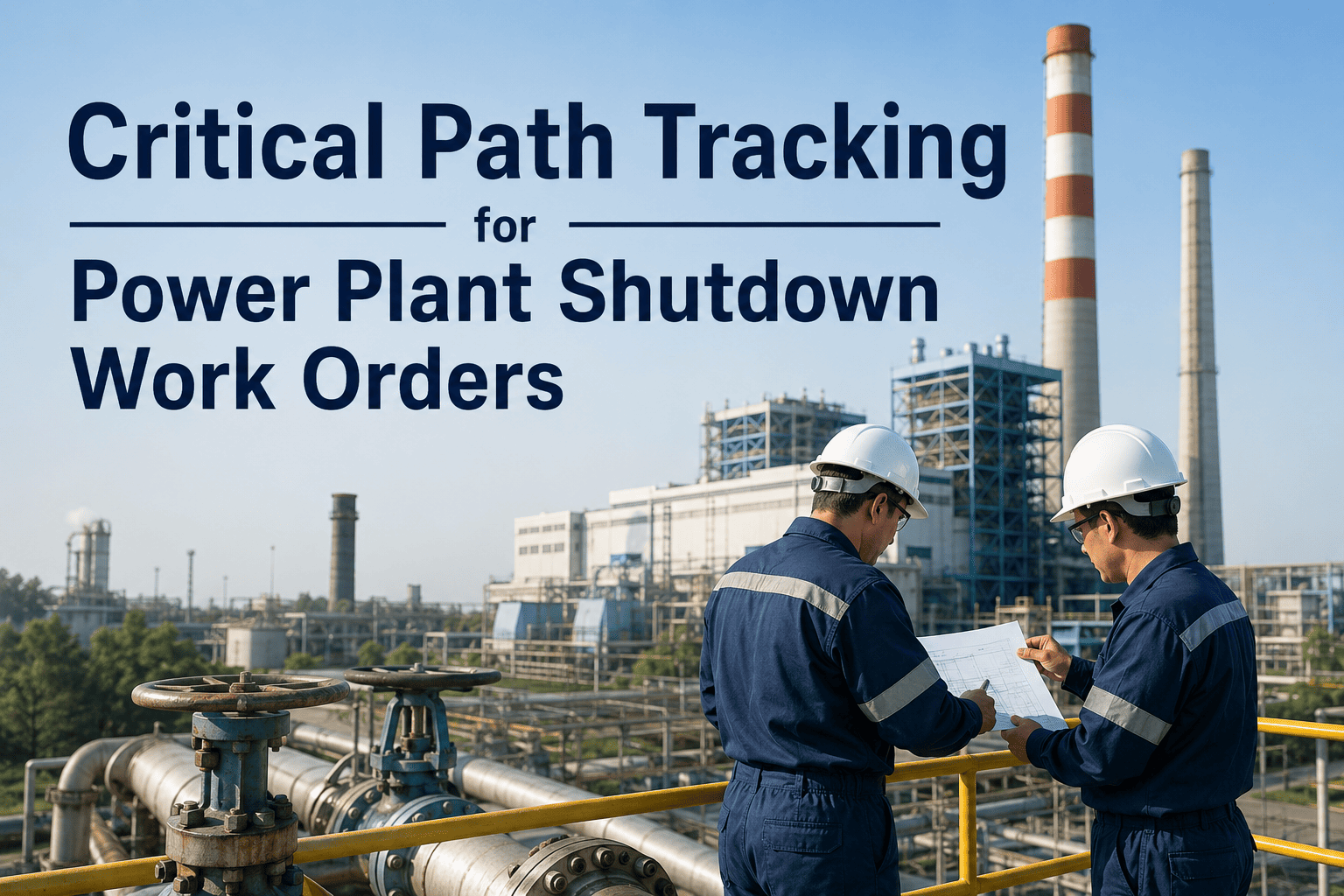
Every day a unit sits in outage is a day it earns nothing and costs plenty so the shutdown schedule is the single most expensive document a plant writes all year. And most schedules don't slip because the work is hard; they slip because a permit wasn't ready, a part was still in transit, or an inspector couldn't get to a hold point. The end date lives on one chain of tasks, and only the things that touch that chain actually move it. OXMAINT AI is the AI-powered maintenance management software that links task duration, dependencies, labor, permits, materials and inspections to the critical path they sit on.
Power Plant · Shutdown & Turnaround · Critical Path · Resources · Return to Service · 2026
Power Plant Shutdown Schedule Optimization
A turnaround schedule is a web of tasks, and one chain through it decides the return-to-service date. The OXMAINT AI maintenance management software ties every task to its duration, dependencies and the resources it needs — labor, permits, materials and inspections — so you optimize the chain that matters instead of the work that doesn't.
1Scope
→
2Sequence
→
3Resource
→
4Return
1 chain
the critical path — the longest sequence that sets the return-to-service date
4 resources
labor, permits, materials and inspections — any one can break the path
0 float
slack on a critical task — a day lost there is a day added to the outage
Scope freeze
the line after which new work needs sign-off — the single biggest overrun guard
Why Shutdown Schedules Slip
Overruns rarely come from the work itself — they come from the things around it that weren't ready when the task was. Name the usual culprits and most are avoidable; book a demo to surface these risks before the outage in OXMAINT AI.
Scope creep
Work added after the freeze without a hard look at the path — the top reason a turnaround runs long.
Permits not ready
A confined-space or hot-work permit held up stalls a critical task while the crew stands idle.
Materials in transit
A long-lead part that lands mid-outage turns a planned repair into a wait the whole path pays for.
Labor clashes
Two critical jobs needing the same crew at once — unlevelled resources quietly extend the chain.
Inspection hold points
A hold point with no inspector booked freezes everything downstream until someone can sign it off.
Discovery work
What you find once it's open is real — but only a path-aware plan can absorb it without blowing the date.
The Critical Path, in Plain Terms
A schedule has hundreds of tasks but only one longest chain of dependent ones — and that chain, not the task list, sets the return date. Shorten anything off the chain and you save nothing; the whole optimization lives here. Start free and see your critical path light up in OXMAINT AI.
ON THE PATH
Dependent tasks with zero float. A day lost to any one of them adds a day to the whole outage — these get the attention, the best crews and the first permits.
HAS FLOAT
Tasks with slack that can move within a window without touching the end date. Useful as a labor reserve — pull crews from here to protect the path.
THE RULE
Only work that touches the critical path changes the return date. Optimize the chain first; everything else is scheduled around it, not ahead of it.
Four Resources That Break the Path
A task's duration is only half the story — it can't start until its resources are present. Each of these four can stall a critical task, so each belongs on the schedule, not in a side list. The OXMAINT AI maintenance management software ties all four to the task; book a demo to link resources to the path in OXMAINT AI.
LABOR
The right crew, when the task is ready
Critical tasks need their trade and headcount reserved and levelled, so two path jobs never fight for one crew — and float-task crews can backfill when the path needs them.
PERMITS
Cleared before the crew arrives
Confined-space, hot-work and isolation permits sequenced to be ready at task start — not raised when the crew is already standing at the job waiting.
MATERIALS
Staged, not still shipping
Long-lead parts ordered against the schedule date and confirmed on site before the path reaches them, so no critical task waits on a delivery truck.
INSPECTIONS
Hold points booked in advance
Every inspection and witness point on the path has an inspector scheduled to it, so a sign-off never becomes the thing the whole chain is waiting on.
A Gantt Chart Doesn't Know Your Permit Is Late.
A schedule built on durations alone assumes every resource shows up on time — and they don't. The OXMAINT AI maintenance management software ties labor, permits, materials and inspections to each task, so a resource at risk flags as a threat to the return date before the crew is idle.
The Levers That Shorten the Outage
Optimizing a shutdown isn't working people harder — it's five disciplined moves that take time off the chain or protect it from slipping. Pull them in the right order; start free and apply these to your own schedule in OXMAINT AI.
01
Freeze the scope early
Lock the work list before the schedule is built. New additions after the freeze pass a path check first — the single biggest overrun guard.
02
Level the resources
Smooth crew and equipment demand so no critical task waits on a resource busy elsewhere. Peaks on the path are where days leak.
03
Run work in parallel
Sequence independent jobs side by side instead of in series, so the chain is as short as the dependencies truly allow.
04
Order long-lead ahead
Place long-lead materials against the schedule date well before the outage, so a part never becomes the critical constraint.
05
Plan the hold points
Book inspections and witness points into the schedule so a sign-off is ready when the path arrives, not chased after it.
From Planning to Return to Service
A good outage is won months before it starts and closed out cleanly at the end. These are the phases the OXMAINT AI maintenance management software keeps on track; book a demo to run this timeline on your next outage in OXMAINT AI.
01
Scope & freeze
Build the work list from condition, PM due and known defects, then freeze it so the schedule has a fixed target.
→
02
Schedule & resource
Sequence the work, find the critical path, and tie labor, permits, materials and inspections to every task on it.
→
03
Execute & control
Work the plan, track progress against the path daily, and fold discovery work in only through a path check.
→
04
Test & return
Clear the return-to-service checklist — permits closed, tests passed, sign-offs done — and bring the unit back on time.
The Return-to-Service Gate
The outage isn't over when the last wrench turns — it's over when the unit is proven safe to run. A clear RTS gate stops a rushed restart from becoming a forced outage days later; start free and keep the RTS checklist on the schedule in OXMAINT AI.
Permits closed
Every isolation lifted and every work permit formally closed, with nothing left energised by accident.
Tests passed
Functional, pressure and protection tests complete and signed, so the unit is proven, not assumed.
Inspections signed
All hold-point and final inspections cleared, with the records attached to the work they close.
Punch list ranked
Open items triaged into run-now versus next-window, so nothing safety-critical rides along unseen.
How OXMAINT AI Optimizes the Shutdown
A schedule holds only when scope, path and resources live on one record and move together. Here's what the OXMAINT AI maintenance management software brings to the outage; book a demo to build your outage on it in OXMAINT AI.
Scope freeze control
A locked work list where any post-freeze addition is flagged and checked against the path before it's accepted.
Critical path view
Dependencies mapped so the longest chain is visible, and a slip on it is seen the day it happens, not at the review.
Resource leveling
Labor and equipment demand smoothed across the plan, so no critical task waits on a resource busy elsewhere.
Permit & hold-point links
Permits and inspection hold points tied to their tasks, so a missing one surfaces as a path risk, not a surprise.
Long-lead material tracking
Parts ordered against the schedule date and flagged if they slip, so a delivery never becomes the critical constraint.
Return-to-service checklist
Permits, tests, inspections and punch list on one gate, so the unit comes back proven and the outage closes clean.
“
We used to plan the outage in a scheduling tool and manage permits, parts and inspections in three other places — so the schedule always looked green right up until a crew hit a job with no permit. Tying those resources to the actual tasks changed that. Now a late permit or a part still shipping shows as a threat to the return date weeks out. Last outage came back on its original date for the first time in years.
Outage Manager · Thermal Generating Station
Frequently Asked Questions
What is the critical path in a shutdown schedule?
It's the longest chain of dependent tasks through the outage — the one that sets the return-to-service date. Only work on this chain changes the end date, so it gets the resources and attention first.
Start free and see yours mapped.
Why do shutdowns overrun even with a detailed schedule?
Because most schedules track task durations but not the resources behind them. A permit held up, a part in transit or an unbooked inspector stalls a critical task even when the plan looks on track — which is why resources belong on the schedule.
What is a scope freeze and why does it matter?
It's the point where the work list is locked before the schedule is built. After it, new work must pass a path check before being added — which is the single most effective guard against overrun.
Book a demo to see freeze control.
How do you handle discovery work found once equipment is open?
Discovery work is real and unavoidable, but it's folded in through a path check — if it doesn't touch the critical chain it's absorbed in float, and if it does, the impact on the return date is seen and decided, not hidden.
What is return to service and why gate it?
Return to service is the formal confirmation the unit is safe to run — permits closed, tests passed, inspections signed, punch list triaged. Gating it stops a rushed restart from becoming a forced outage days later.
Optimize the Chain That Sets the Date.
Build the outage on its real critical path with the OXMAINT AI maintenance management software — scope frozen, the longest chain mapped, and labor, permits, materials and inspections tied to every task on it, through to a clean return to service. Bring the unit back on the date you promised.